Quick Answer: On Japanese trains the core rule is simple: keep quiet and keep to yourself. Set your phone to silent (“manner mode”) and don’t take calls, keep any conversation low, use headphones, and avoid eating on commuter trains. Take your backpack off and hold it, give up priority seats, let passengers exit before you board, and line up on the platform markings. Do these and you’ll blend in effortlessly.
- The Scene Most Travelers Run Into First
- Quick Facts
- The Big Picture: Why Trains Are So Quiet
- The Phone Rule (and What It Actually Says in 2026)
- Priority Seats (Yusen-seki / 優先席)
- Eating and Drinking
- Queueing and Boarding
- Loud Conversations
- Bags and Backpacks
- Women-Only Cars
- Photography and Video
- Sleeping on the Train
- Drunk Behavior on Last Trains
- Strollers and Wheelchairs
- Common Mistakes Tourists Make
- A Note for Visitors Who Want to Go Deeper
- FAQ
- Related Reading
- Sources
The Scene Most Travelers Run Into First
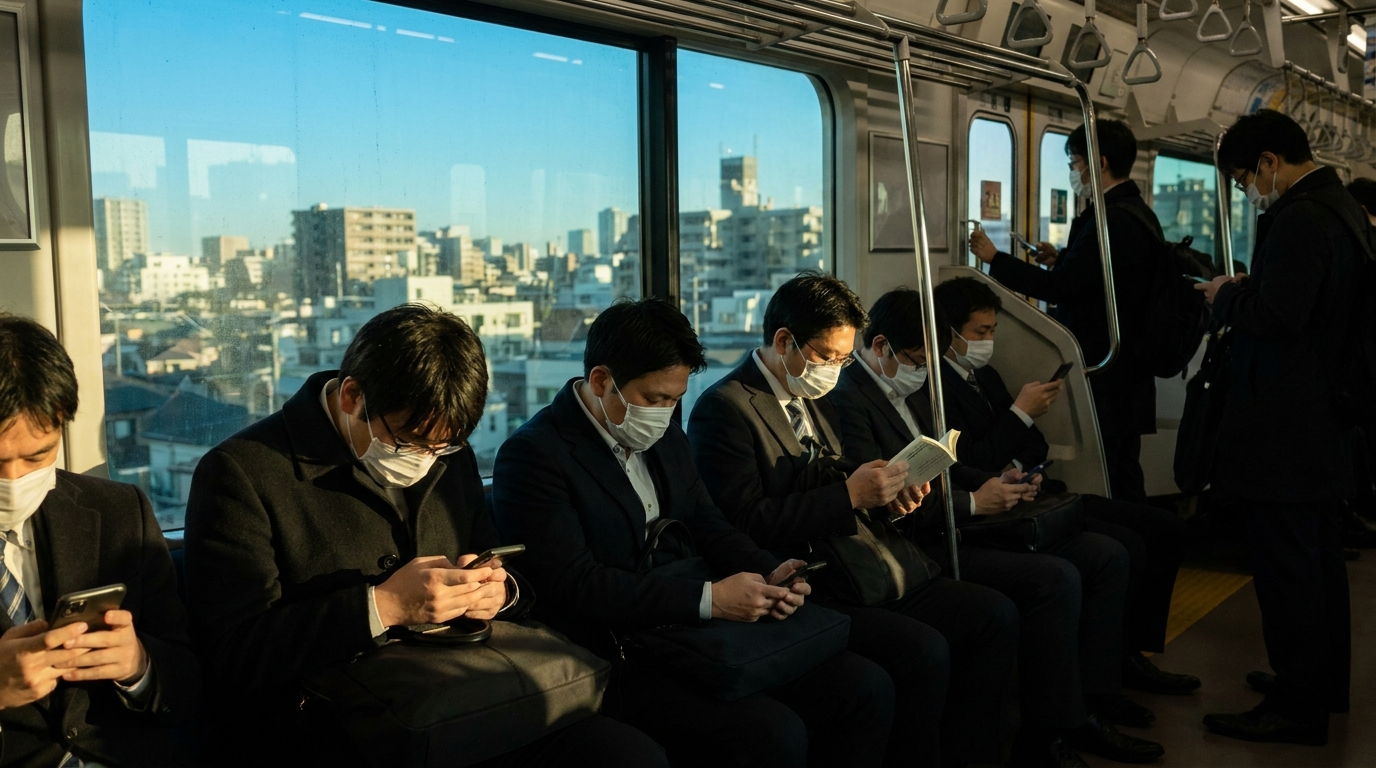
It’s 8:15 on a Tuesday morning. The inbound Yamanote Line is shoulder-to-shoulder, packed with commuters in dark suits and school uniforms. The carriage is loud only in the way a stadium is loud at halftime — full of people, almost no voices. Then a phone rings two seats over. A traveler picks up and starts a normal-volume conversation about a hotel reservation.
The reaction in the carriage is not anger. It is closer to a kind of quiet, collective wince. Heads tilt very slightly down toward phones. A high-school student fidgets. An older man’s eyes flicker up for half a second, then back to his book. Nobody says anything.
That moment is the heart of why this guide exists. Tokyo’s train manners aren’t a set of legal rules a visitor can break and get fined for. They’re a layer of soft expectations that almost every Japanese passenger picks up by their teenage years, and that almost no guidebook explains in enough detail. This article is about the why behind the silence — and the small handful of habits that, once you know them, make a Tokyo train feel less like a test and more like one of the easier parts of the trip.
Quick Facts
– Phone calls on trains are not legally banned but are a strong social no — texts, LINE messages, and silent video are fine.
– The “switch off near priority seats” rule was relaxed in October 2015 across JR East and most Kanto private railways after a government report concluded interference risk to pacemakers was extremely low.
– Eating and drinking is broadly tolerated on long-distance trains (Shinkansen, limited express) and broadly avoided on short urban trains.
– Queue at the floor markings, let people exit before you board, and avoid 駆け込み乗車 (last-second dashes through closing doors).
– Women-only cars run on several major Tokyo lines on weekday mornings, with cutoffs ranging from around 9:00 to 9:40 depending on the line — and the Yamanote Line does not have one.
– Backpacks in front or down by your knees, not on your back, when the car gets full.
– Photos and video are allowed in moderation but JR East launched a 2025 campaign specifically against dangerous platform photography.
– Last trains on Friday nights are the one carriage where the quiet rule visibly breaks down.
The Big Picture: Why Trains Are So Quiet
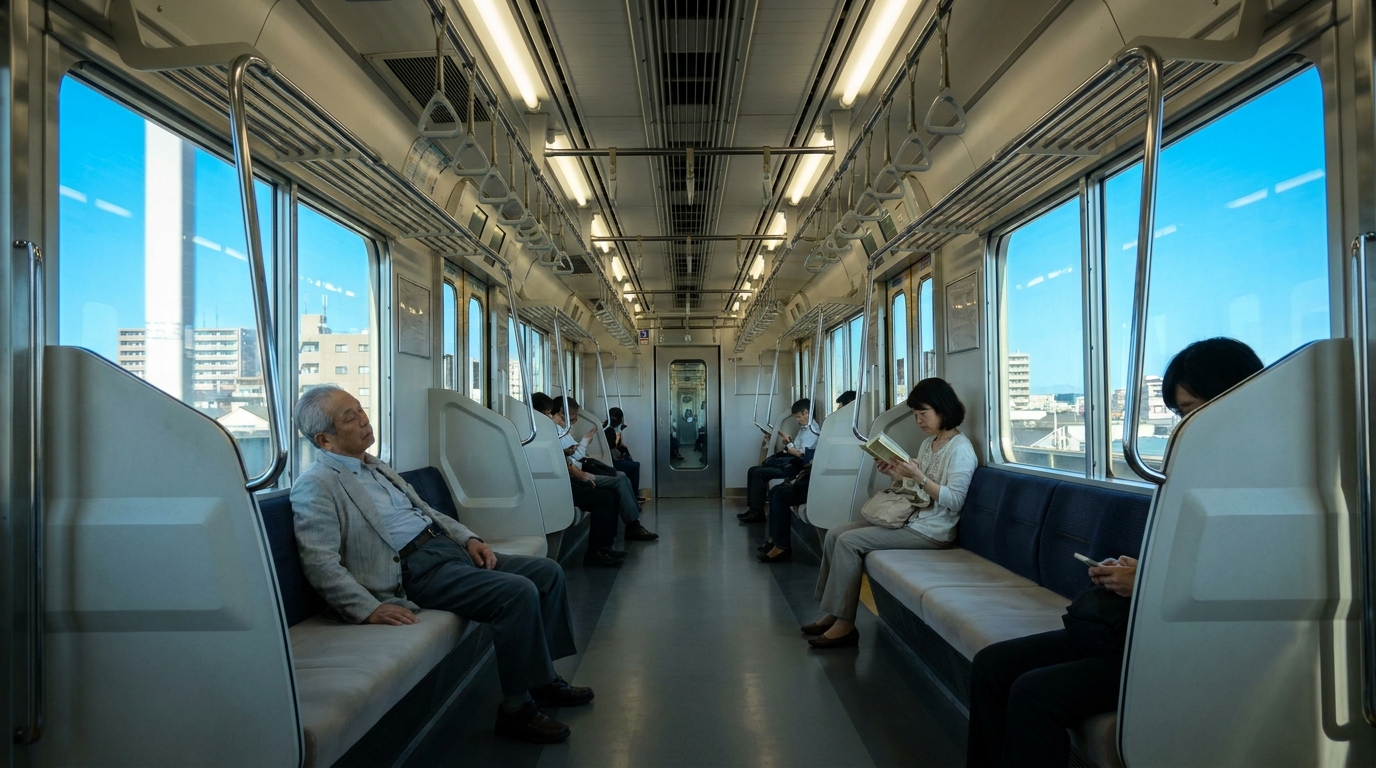
Travelers often describe Tokyo trains with the same word: eerie. A car can hold 150 people and sound like a library. Understanding why this is the default — rather than a strict rule that gets enforced — makes the rest of the guide much easier.
Three overlapping reasons
1. The idea of “meiwaku” — not creating a burden for others.
The single most useful Japanese word for understanding public-space behavior is meiwaku (迷惑), which roughly translates as “bother” or “trouble caused to others.” It isn’t a moral judgement so much as a social one. The standard you’ll see Japanese passengers holding themselves to is not “am I doing something wrong” but “am I making this slightly harder for the person next to me.” On a packed commuter train, voices, ringtones, smells, and luggage all become meiwaku in a way they wouldn’t in a less crowded space.
2. Crowded trains as borrowed personal space.
Japan’s commuter networks regularly carry more people per square meter than almost any other rail system in the world. When physical distance is impossible, the social compromise is sound distance. Keeping your voice down, your music inaudible, and your phone silent is treated as the polite version of giving the people pressed against you a small piece of psychological room.
3. The trains as shared workspaces and quiet time.
For millions of Tokyo workers, the morning and evening commute is the closest thing to a quiet moment in the day. Some read. Some sleep. Some catch up on email. Almost nobody actively socializes. The carriage isn’t designed as a quiet space, but it has become one by accumulated habit, and that habit is now defended quite firmly — politely, but firmly.
For a visiting traveler, none of this is something you have to fully internalize. You just need to know the default volume of the car you’re stepping into and adjust by a notch or two. That’s most of it.
The Phone Rule (and What It Actually Says in 2026)
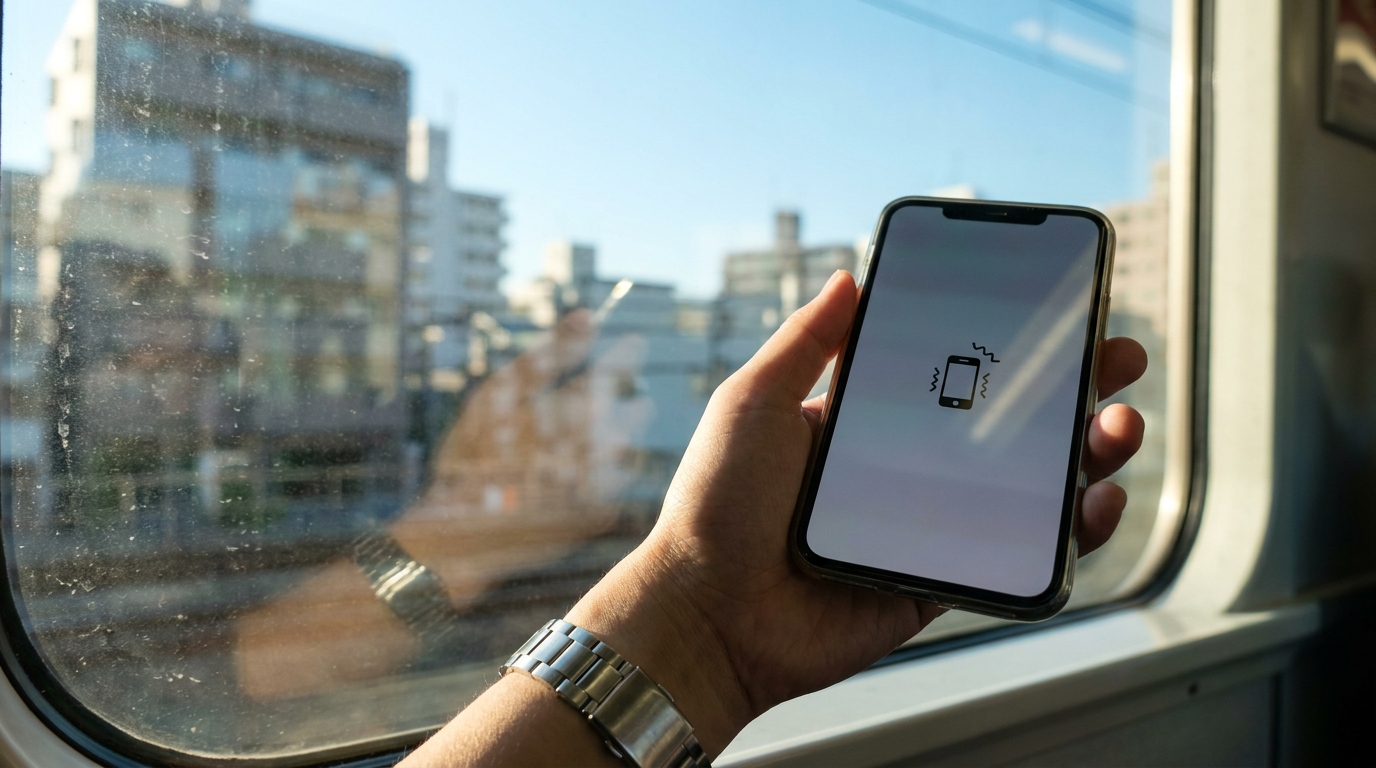
Phones are the area where travelers most often feel they’ve broken a rule without knowing it. The current state in Tokyo is more relaxed than older guidebooks suggest, but the social rule about talking on the phone has barely moved.
What is and isn’t expected
| Action | On a Tokyo train? |
|---|---|
| Ringer audible | Avoided — manner mode (silent / vibrate) is the default |
| Voice call | Strong social no — almost nobody does this, even in non-crowded cars |
| Texting / LINE / messaging apps | Fine, including in the priority-seat area |
| Browsing, reading, watching with headphones | Fine at low volume |
| Watching video without headphones | Avoided |
| Brief whisper if the call is urgent | Tolerated if you keep it under 30 seconds and step toward a door |
The technical-looking rule on every Japanese train is “please switch your phone to manner mode and refrain from talking on the phone.” That phrasing is so common it almost functions as background music on station announcements. The rule has soft enforcement — nobody will tap you on the shoulder — but the room temperature drop when somebody takes a call is unmistakable.
The 2015 priority-seat change you can stop worrying about
For about two decades, signs near priority seats asked passengers to switch their phones completely off. The reasoning was concern that mobile signals might interfere with implanted pacemakers. In October 2015, JR East and most major private railways in the Kanto and Tohoku regions relaxed this rule, after a Ministry of Internal Affairs and Communications report concluded the interference risk was extremely low. The Kansai-area railways made a similar change in July 2014, the year before.
The current guidance near priority seats is much narrower:
- Manner mode (silent) — yes, expected.
- Switch the phone off completely — no longer required at normal crowding levels, though some operators still ask passengers to power off entirely when the train is so packed that movement is impossible.
- No phone calls — unchanged.
If you’re a traveler who heard “you always have to turn your phone off near priority seats in Japan,” that is now an outdated piece of advice for everyday rides. Silent mode and not talking is the live version of the rule for the trains you’ll actually ride.
Sources for the curious
- Japan Times: Railway companies in eastern Japan set to relax rules for cellphones near priority seats (Sep 2015)
- Japan Today: Kansai scraps ‘power off’ mobile phone ban on trains
Priority Seats (Yusen-seki / 優先席)
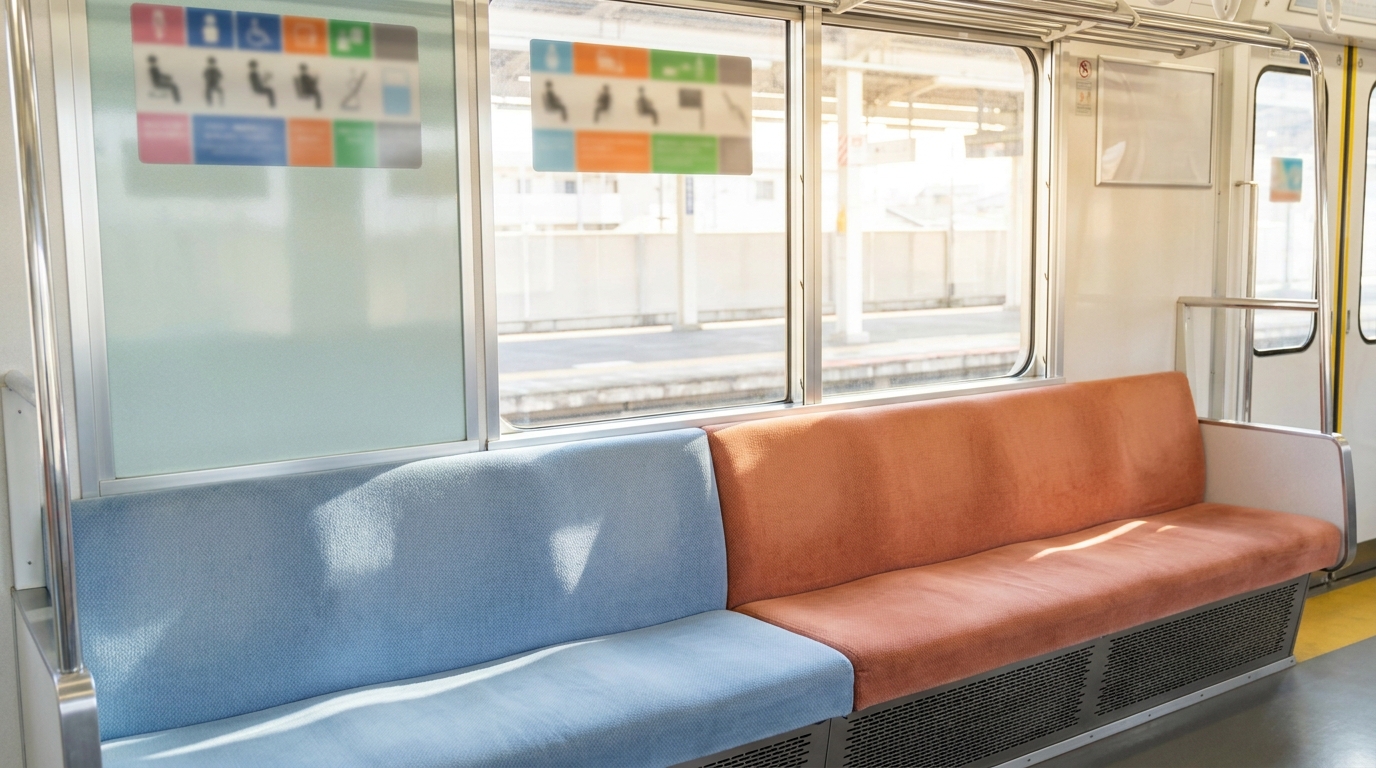
Most Tokyo trains have a small block of seats near each end of the carriage marked in a different color — usually a pale blue or orange — and labeled “優先席 / Priority Seat.” They’re sometimes called “silver seats” in older English signage.
Who they are for
- Elderly passengers
- Pregnant women (often wearing a pink “maternity badge”)
- Passengers with infants or small children in arms
- Passengers with disabilities, injuries, or visible difficulty standing
- Passengers carrying very heavy items in some interpretations
What’s expected of everyone else
- It’s fine for any passenger to sit in a priority seat when no one in those categories is nearby.
- It’s customary to stand and offer the seat the moment someone in those categories boards.
- The offer is usually made wordlessly — a small gesture toward the seat is enough.
What’s no longer required
As covered above, the old rule asking passengers near priority seats to power their phones off completely was relaxed in late 2015. The expectation now is silent mode and no calls — the same as anywhere else on the train.
A small note on offering a seat
Sometimes a passenger will decline a seat that’s been offered to them, especially if they’re getting off at the next stop. The polite move is to gesture once, accept the decline graciously if it comes, and not press the point.
Eating and Drinking
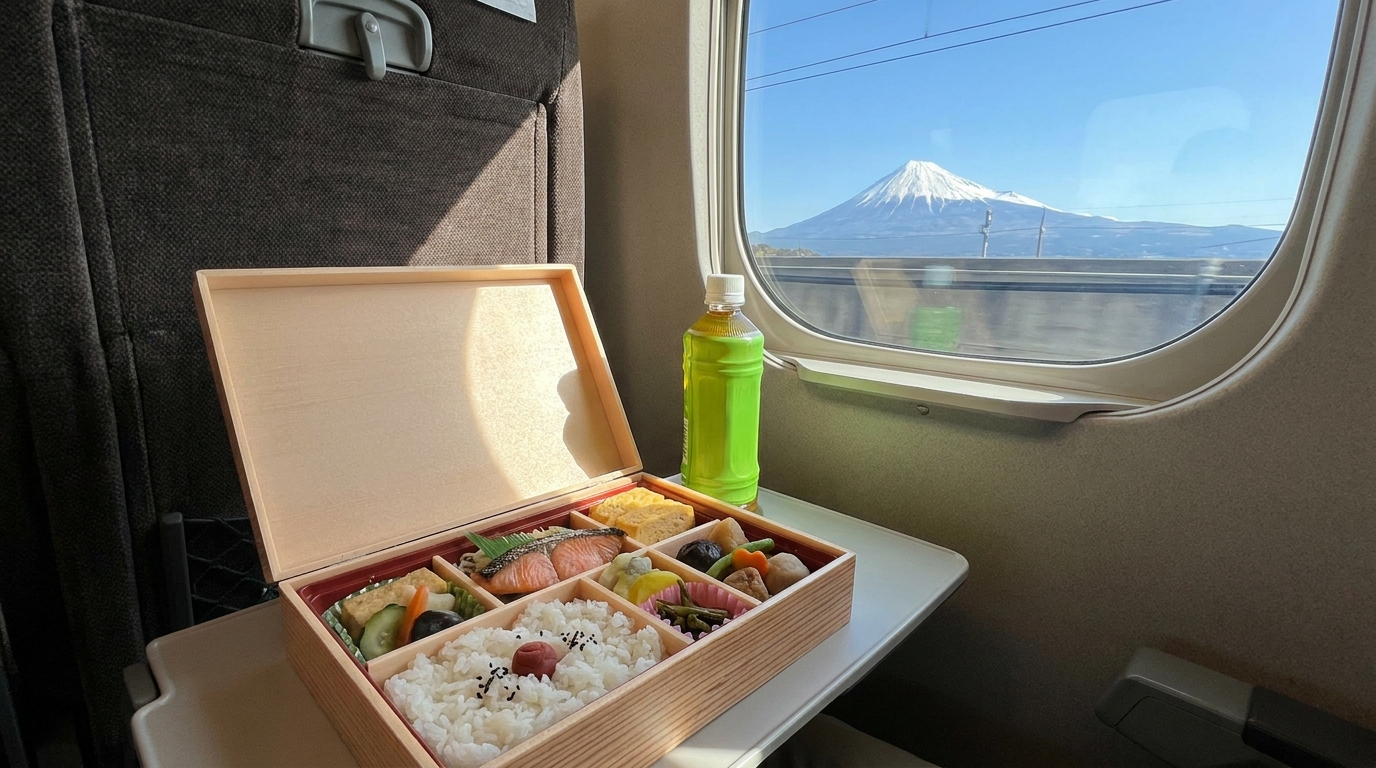
This is one of the rules that’s often described as stricter than it really is.
A working split
| Train type | Eating and drinking? |
|---|---|
| Shinkansen (bullet train) | Yes, very common — bento, drinks, snacks all standard |
| Limited express / reserved long-distance | Yes, similar to Shinkansen |
| Romance Car, Keisei Skyliner, Narita Express | Yes |
| Local urban trains (Yamanote, Chuo, Tokyo Metro lines) | Generally avoided |
| Crowded urban trains | No |
Why the split exists
The unwritten standard is roughly: if the train is built for a journey long enough that food becomes reasonable, eating is reasonable. If the train is for a 15-minute commute, eating tends to read as either smelly (for other passengers) or messy (for the seat fabric). A traveler with a coffee from the konbini on a non-crowded local train won’t draw attention. A traveler unwrapping a hot katsu sandwich on a packed Yamanote Line at 8:30 AM will.
Practical examples
- Onigiri or a small sandwich on a non-crowded local train: tolerated.
- A bottle of water or coffee on any train, sipped quietly: fine.
- Bento on a Shinkansen: actively expected — that’s what station ekiben are for.
- Anything strong-smelling on any urban train: avoid.
- Alcohol on a long-distance train: fine. On a packed Yamanote at 8 AM: very avoidable.
For most travelers, the safe rule is: drinks always, food only on long-distance trains.
Queueing and Boarding
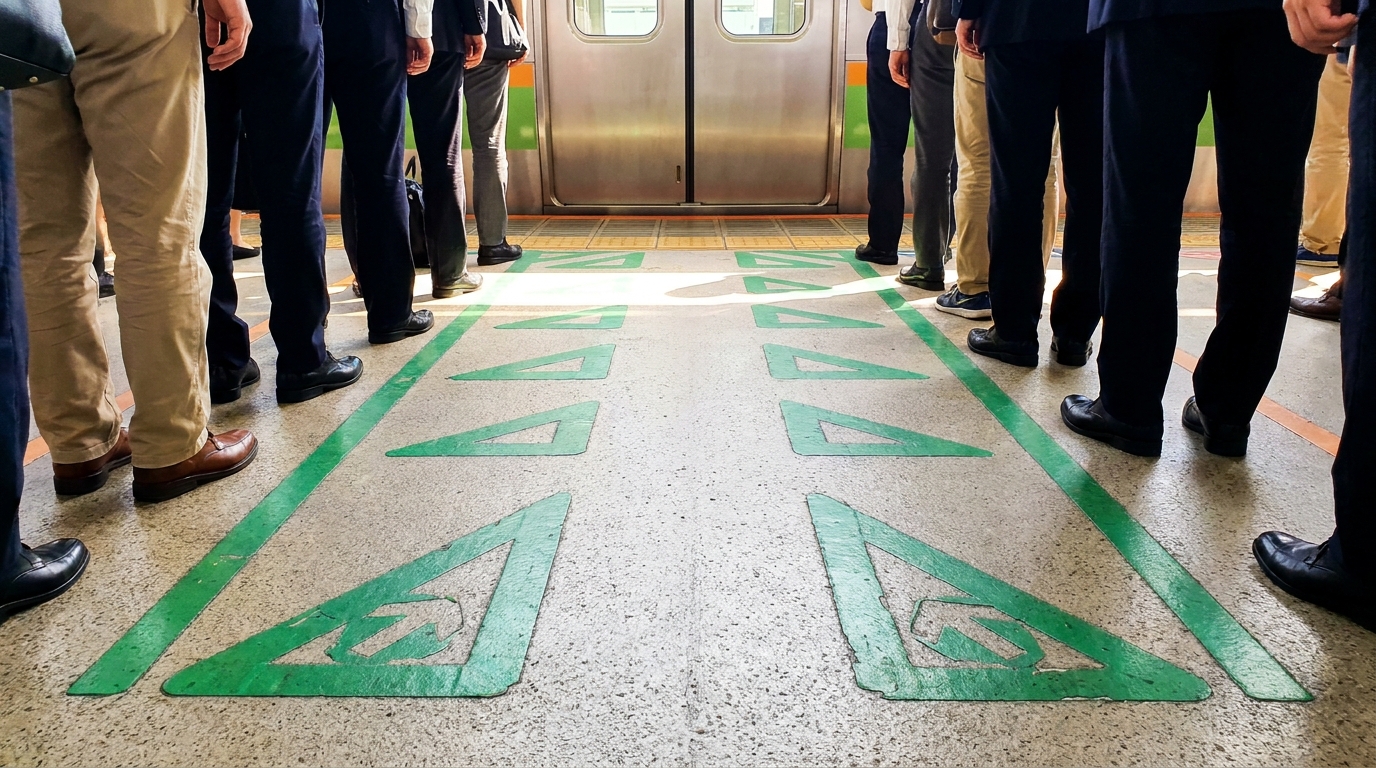
One of the most visible features of a Tokyo platform is the painted lines on the floor showing exactly where the train doors will stop.
How it works
- Look down before the train arrives. Most platforms have arrows or footprints painted on the ground in two parallel lines beside each door position.
- Stand in those lines. The lines fork around the door because of the next rule.
- Let everyone exit before you board. The line splits exactly so departing passengers have a clear corridor through the middle.
- After everyone has stepped off, the two queues fold inward and board.
What to avoid
- Standing directly in front of the door. It blocks the people getting off and is the single most-noticed tourist mistake.
- 駆け込み乗車 (kakekomi-josha) — last-second dashes through closing doors. Every Tokyo train plays an announcement against this. It causes door re-opens and small delays, and on a network where punctuality is measured in tens of seconds it creates real problems for the train behind you. A coordinated April 2026 anti-kakekomi-josha campaign by JR East and 26 other Tokyo-area private rail operators has filled major stations with bilingual posters reinforcing this — if you see them, that’s the live version of the rule.
- Holding the door for a friend. The doors close automatically and don’t have the elevator-style “hold” sensor. Stretching an arm through them is dangerous and visibly frustrates other passengers.
If you miss a train, the next one in central Tokyo is usually two to four minutes away. Almost nothing is worth a sprint into closing doors.
Sources
Loud Conversations
Quiet conversation is fine. The point at which a conversation starts to feel out of place is more about volume than language.
What tends to read as too loud
- Group of four or more talking at conversation-volume — even at a “normal” café volume, the carriage will register it.
- Excited tourist conversations with arms gestures and laughter — fine on the platform, attention-grabbing on the train.
- Voices raised over headphone music that’s still audible from the next seat.
- Late-night drunk groups (the one consistent exception, covered below).
What tends to be fine
- Couple chatting at low volume.
- Children talking — Japanese passengers are generally patient with small children on trains.
- A short “this is our stop” exchange at a normal-quiet voice.
- Listening to media with proper headphones at a volume nobody else can hear.
The actionable version: drop your voice by one notch from where it would naturally land, and you’re inside the local norm.
Bags and Backpacks
Backpacks are one of the few areas where Tokyo trains have a specific posted preference, and it shows up on actual posters in the stations.
The expected positions, in order of crowd level
- Empty / not crowded: Backpack on the back is fine.
- Moderately full: Backpack on the front of your body, by the chest, or down by your knees.
- Packed (rush hour): Backpack up on the overhead rack, or held low between your feet.
Why this is a real rule
Two things drive the off-the-back convention:
1. Doors and delays. Backpacks have been getting caught in closing doors for so long that Odakyu Railway has been running posters about it since fiscal 2005. A snagged pack delays the door close, which delays the train, which cascades down the line.
2. Space efficiency. A backpack on the back occupies the space of a second person. On a packed car, that’s the difference between everyone fitting and one person being left on the platform.
The phrase you’ll hear on station announcements is roughly “please carry backpacks where they don’t bother other passengers.” This is one of the few etiquette rules that Tokyo Metro and the Tokyo Metropolitan Bureau of Transportation have made overt — including a memorable poster a few years back showing Vermeer’s Girl with a Pearl Earring with a chest-front backpack.
A 2025–2026 update on the chest-front advice
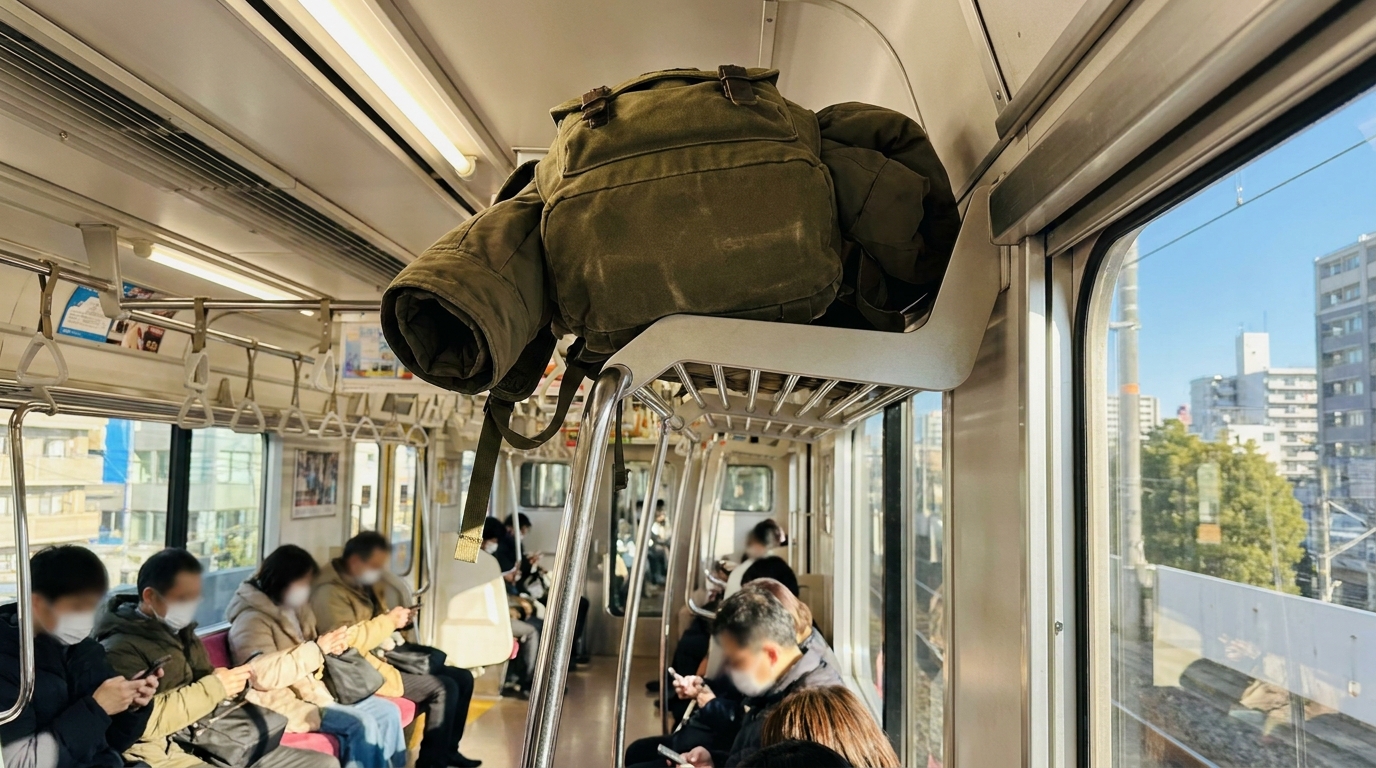
For about a decade, the standard guidance was “wear your backpack on your chest in crowded cars.” Several major railways, working through the Japan Private Railway Association, have since stepped back from that line — because a chest-front pack still occupies a full person’s worth of standing space. The current preferred message is to take the pack off entirely and either place it on the overhead luggage rack, hold it low between your feet, or hang it down by your knees. The chest-front position is still tolerated and you’ll see it routinely, but it is no longer the official “right answer.” The simplest version of the new rule for a traveler: get the pack off your back, then put it wherever it’s least in the way of other people.
Suitcases
- Use the overhead rack if your suitcase fits.
- Otherwise stand it upright between your feet, never lying down across an aisle.
- On the Tokaido, Sanyo, Kyushu, and Nishi-Kyushu Shinkansen (the lines running south or west from Tokyo), a suitcase that exceeds 160 cm in total dimensions requires an advance reservation for the dedicated oversized-luggage space when you book your seat. JR East’s Tohoku, Joetsu, and Hokuriku Shinkansen heading north or northwest from Tokyo do not currently require this reservation. Bags above 250 cm in total dimensions aren’t accepted on any Shinkansen at all.
Sources
- Japan Today: What are you supposed to do with your backpack on a crowded train in Japan?
- Unseen Japan: Are you holding your backpack on Japanese trains wrong?
Women-Only Cars
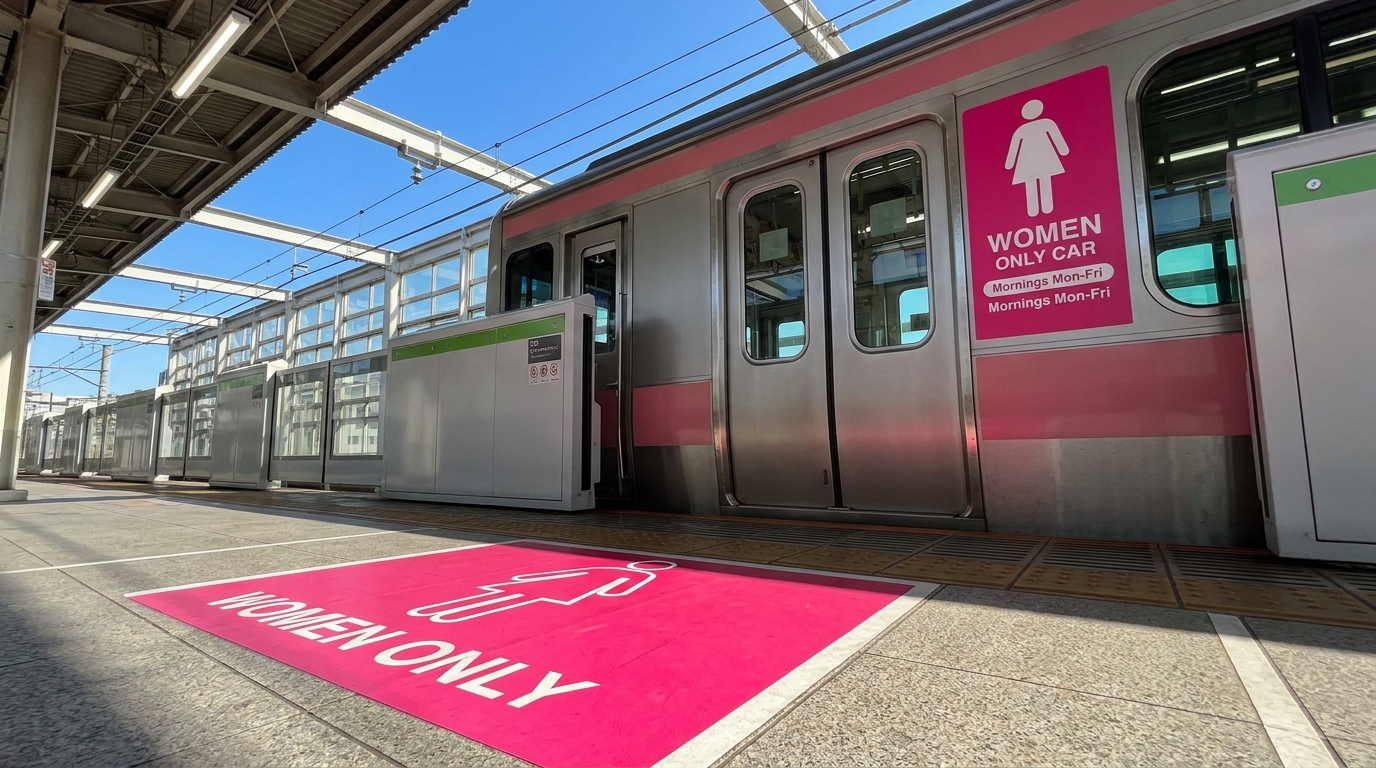
Most major Tokyo lines (with one notable exception) operate a women-only car — usually one carriage at a fixed position on the train, typically the front or rear — during specific hours.
How they work
- Marked with pink signage on the platform floor, on the carriage door, and inside the car.
- Apply only at specific times, mostly weekday mornings.
- Children (boys included, usually up to elementary-school age) and male caregivers of disabled passengers are typically allowed.
- Outside of operating hours, the same carriage is regular mixed seating.
Approximate operating windows on major Tokyo lines
| Line | Roughly when women-only applies |
|---|---|
| JR Saikyo | Weekday mornings until about 9:40 |
| JR Chuo Rapid | Weekday mornings until about 9:30 |
| Tokyo Metro Chiyoda | Weekday mornings, until about 9:30 |
| Tokyo Metro Hibiya | Weekday mornings, until about 9:00 |
| Toei Shinjuku | Weekday mornings, until about 9:00–9:30 (varies by direction) |
| JR Yamanote | None — Yamanote does not run a women-only car |
| Tokyo Metro Marunouchi | None — Marunouchi does not run a women-only car |
| Toei Mita | None — Mita does not run a women-only car |
The two lines that some older guides list — Marunouchi and Toei Mita — do not actually operate women-only cars in 2026, despite the wider Tokyo Metro and Toei networks doing so. Operating windows on the lines that do run women-only cars shift slightly by line and have been adjusted over the years, so the exact minute of cutoff is best confirmed on the platform itself, where the pink floor markings show whether the carriage is in women-only mode at that moment.
What to do if you accidentally board
If you’re a male passenger and you board a women-only car during its operating hours, you’ll usually realize within about 30 seconds — the carriage will be visibly all-female and somebody nearby may glance at the pink sign. The polite move is to step off at the next stop and walk to the next carriage. Nobody will say anything; the silent shift in attention is the prompt.
The original reason these cars exist is the longstanding problem of chikan (groping on crowded trains). Tokyo police continue to run anti-chikan campaigns including a smartphone app, “Digi Police,” with a panic-alarm function, and discrete badge programs distributed by support groups.
Sources
Photography and Video
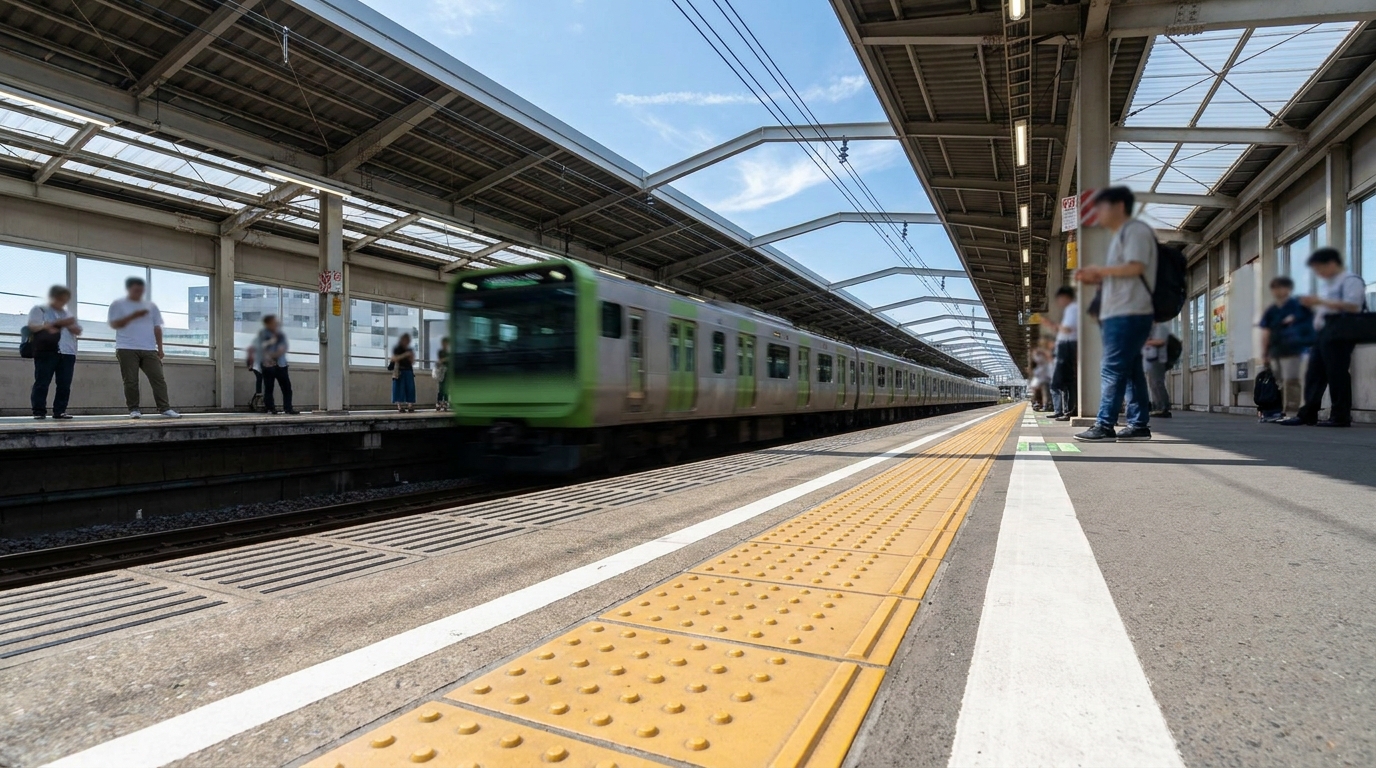
Tokyo’s stations and trains are visually beautiful and entirely photographable — within some real limits that JR East has actively pushed back into focus over the past year.
What’s broadly fine
- Quick phone snaps on the platform that don’t focus on individual people.
- A few seconds of carriage footage that doesn’t include identifiable faces.
- Photos of station signage, art, and architecture.
- Videos of trains arriving and departing, taken from a normal standing position behind the platform line.
What JR East specifically warned about in late 2025
In December 2025, JR East launched an awareness campaign aimed at a particular type of train-photography behavior on station platforms. The four behaviors they singled out:
- Shooting with tripods or stepladders on the platform.
- Leaning out from the platform edge to get a better shot.
- Standing on the yellow tactile paving (the bumpy strips designed to guide visually impaired passengers).
- Long boom-style equipment (selfie sticks, GoPro poles) that extends past the platform line.
These aren’t just rude — JR East specifically called out the risk of contact with moving trains and electric shock from the overhead lines. Posters with this message have been going up in major stations since December 2025 and are still in rotation in 2026.
What to avoid filming inside the train
- Close-ups of other passengers, especially women — both for general courtesy and because Japanese law treats covert filming of strangers seriously.
- Any photo or video where the framing would let somebody identify a stranger on their commute.
- Children in school uniforms (this is treated very firmly by both passengers and staff).
Sources
- PetaPixel: Japanese Railway pleads with photographers (Dec 2025)
- TRAICY: JR East issues warning against dangerous recording on station platforms
Sleeping on the Train
Sleeping on Tokyo trains is one of the most common visible behaviors and is, depending on how you count, either the most-violated quiet rule or not really a rule at all.
Why so many people sleep
The combination of long commutes, long working days, and a cultural acceptance of brief public napping (called inemuri) means seated passengers nodding off is part of the visual texture of every line. It isn’t considered impolite. If anything, the social reading is that the person is working hard enough to be tired, which is a positive frame in this context.
What to do if someone falls asleep on your shoulder
The standard moves, in order of intensity:
1. Do nothing if you can stand it — it’s not personal and the person doesn’t intend it.
2. Shift your shoulder slightly so they wake themselves up.
3. If they’re getting off at your stop and still asleep, a gentle “sumimasen” (excuse me) and a small movement is enough.
Nobody will fault you for any of these. Aggressive shrugging or pushing them off does read as rude.
Missing your stop
Setting a phone alarm is the standard. Conductors are not in a position to wake individual passengers at intermediate stations — that’s a frequently repeated bit of internet folklore that doesn’t match how the service actually runs. At terminal stations, staff will walk through and check the cars to clear the train, which catches most heavy sleepers. For everything before the terminal, an alarm on your phone (or a vibrating smartwatch if you don’t want to disturb others) is the only reliable option.
Drunk Behavior on Last Trains
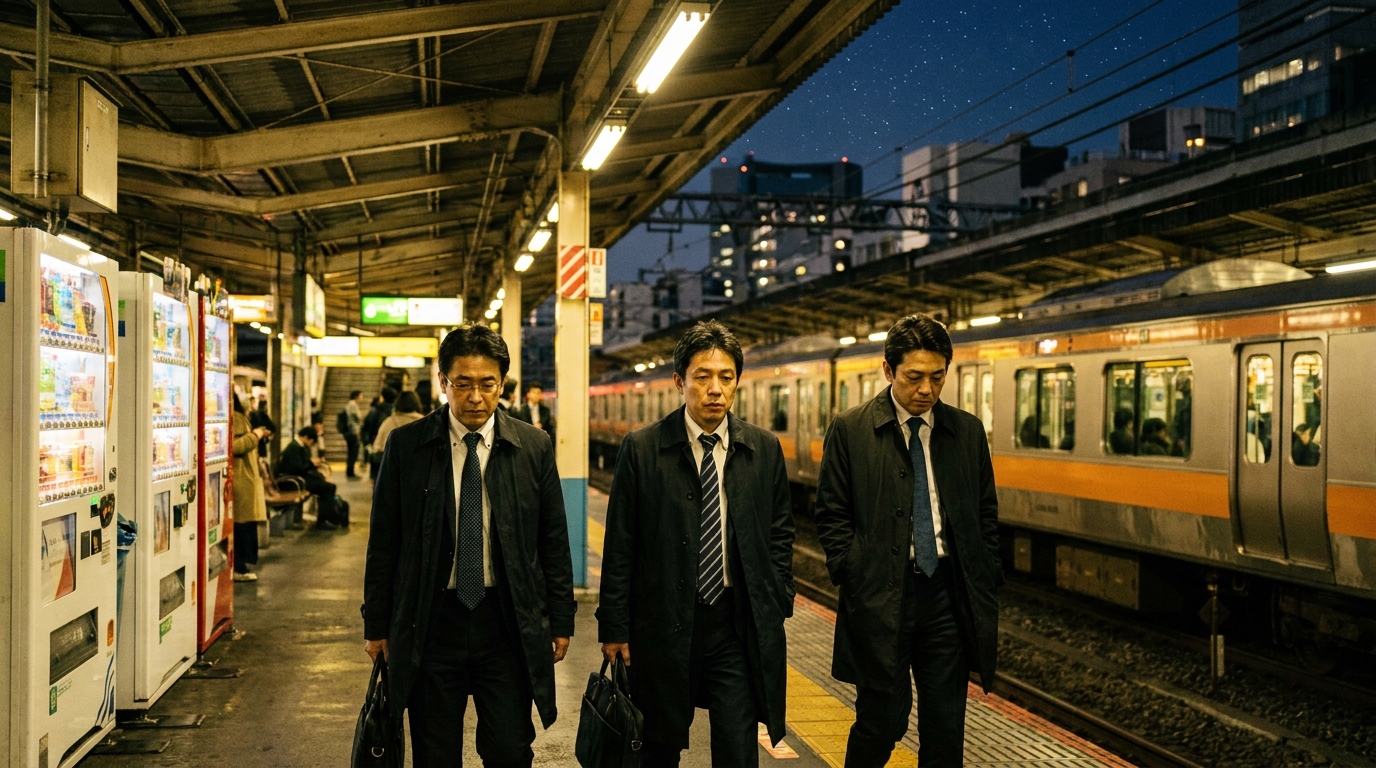
Friday and Saturday last trains are the predictable exception to almost every other rule in this guide.
The Yamanote, the Chuo, and the major Tokyo Metro lines from about 11 PM onward on a weekend night carry a meaningfully different kind of carriage. Voices are louder. Conversations happen across the carriage. Sleep is heavier. Smell is more present. This is the salaryman (and increasingly salarywoman) commute home after the second nomikai (drinking party) of the night, and the social tolerance for it is much higher than at any other time.
What this means for a traveler
- The “trains are quiet” rule is genuinely true 98% of the time. Don’t over-correct your expectations based on a single Friday-night ride.
- You may witness sleeping that looks unusually deep, conversations that feel out of place, and an occasional confused passenger asking which station they’re at.
- Confrontation is very rare. Most passengers, sober or not, give each other space.
- If you’ve been drinking yourself, the standard caveats apply: aim for a window seat, don’t fall asleep with valuables on your lap, and know your stop.
It helps to think of last trains as a separate set of expectations rather than a failure of the regular ones.
Strollers and Wheelchairs
Tokyo’s train system has invested significantly in accessibility over the past decade, and the carriages themselves now reflect that.
- Most carriages have a dedicated wide space near one of the doors marked for wheelchairs, strollers, and large luggage.
- Station staff at major stations will help wheelchair passengers board and disembark with a portable ramp, usually if you ask at the gate before boarding.
- Strollers are no longer expected to be folded on the train — a national campaign in the mid-2010s explicitly normalized open strollers and asked other passengers to make room.
If you’re traveling with a stroller or a wheelchair, the wide space near the marked door is the right target. Other passengers will generally make room for you to position there, and Japanese parents using the same space tend to be quite patient with first-time travelers asking how it works.
Common Mistakes Tourists Make
These show up roughly in this order on most Tokyo lines.
1. Standing directly in front of the door instead of beside it. Block the people exiting, and the awkwardness is immediate.
2. Talking on the phone. The single most-noticed misstep. Even one short call shifts the whole carriage.
3. Backpacks staying on backs in a crowded car. Front or down, especially during rush.
4. Trying to board through the closing doors. Triggers an audible station announcement and a small delay.
5. Loud group conversation, especially in English. Volume is the issue, not language.
6. Photographing other passengers. Architecture and signage yes, individual commuters no.
7. Eating something hot or strong-smelling on a short urban line. Save it for the Shinkansen.
None of these are catastrophic, and none of them will get you in trouble. They’re just the things that put a traveler in the visible-tourist category in a system where most of the etiquette is invisible.
A Note for Visitors Who Want to Go Deeper
If the cultural-background side of all this is interesting to you, the Tokyo Metropolitan Government and Tokyo Metro have run themed manner-poster campaigns since the 1970s. Each year picks a slightly different angle — “do it elsewhere,” “good manners, good Tokyo,” and similar. The posters often appear in subway stations and are themselves a small piece of the city’s visual culture. You don’t need to study them, but if you find yourself standing on a platform with a few minutes to spare, they’re worth a look.
FAQ
Is talking on the phone really banned on Tokyo trains?
Not by law, but by very strong social convention. Phones should be on silent (manner mode), and voice calls are avoided across all lines and all times of day. Texts, messages, and silent video are fine. If a call is genuinely urgent, keep it to under 30 seconds and step toward a door.
Can I eat or drink on the train in Tokyo?
Drinks are fine on any train as long as they’re not spilling. Food is broadly accepted on long-distance trains (Shinkansen, limited express, Romance Car) and broadly avoided on local urban trains, especially in rush hour. Strong-smelling food on a short urban line is the main thing to avoid.
Why are Japanese trains so quiet?
A combination of three things: the cultural concept of meiwaku (not creating bother for others), the unusual density of Tokyo commuter trains making sound the only space people can give each other, and the role of the morning and evening commute as a quiet personal moment for millions of workers. None of these are formal rules — they’re an accumulated habit.
What happens if I sit in a priority seat?
Nothing, as long as nobody who needs the seat is nearby. The expectation is that you stand up the moment an elderly passenger, pregnant woman, parent with a small child, or visibly disabled passenger boards. The offer is usually wordless — a small gesture toward the seat.
Do I really have to switch off my phone near priority seats?
Not for normal rides. JR East and most major private railways across Kanto and Tohoku relaxed that rule in October 2015 after a Ministry of Internal Affairs and Communications report concluded the interference risk to pacemakers was extremely low; the Kansai-area railways had already done the same in July 2014. The everyday expectation is silent (manner mode) and no calls — the same as everywhere else on the train. Some operators still ask passengers to power off entirely when the train is so packed that movement is impossible, so a fully off phone in extreme rush-hour crush is a polite default.
Is it OK to take photos inside the train?
Photos and short video are broadly tolerated as long as the framing doesn’t focus on individual passengers. Avoid close-ups of strangers, school children in uniform, and anything that would identify someone on their commute. JR East also launched a December 2025 campaign against tripods, stepladders, leaning out, and selfie-stick filming on station platforms, citing safety risks from passing trains.
What are women-only cars and when do they apply?
A designated carriage on several major Tokyo lines (JR Saikyo, JR Chuo Rapid, Tokyo Metro Chiyoda, Tokyo Metro Hibiya, Toei Shinjuku) reserved for women — plus small children and male caregivers of disabled passengers — during weekday morning rush hours. Cutoff times range from around 9:00 to 9:40 depending on the line. They’re marked with pink signage on the platform and on the door. The Yamanote Line, the Tokyo Metro Marunouchi Line, and the Toei Mita Line do not have one. Outside the operating hours, the same carriage is regular mixed seating.
What’s the deal with backpacks on Japanese trains?
On crowded trains, backpacks are expected to come off your back and go onto the overhead luggage rack, between your feet, or held low by your knees. Two reasons: a backpack on your back takes up the space of another person, and trailing straps can get caught in closing doors and delay the train. Odakyu Railway has been running posters about this since fiscal 2005. The older “wear it on your chest” version of the advice has quietly been stepped back from by several major railways since around 2025, because a chest-front pack still occupies a full person’s worth of standing space. The simplest version: take the pack off your back, then put it wherever it’s least in the way of other people.
What is 駆け込み乗車 and why is it a problem?
Kakekomi-josha — running into a train through closing doors at the last second. It triggers a door re-open, delays the train by a few seconds, and on a network as tight as Tokyo’s that propagates down the line. It’s also genuinely dangerous: hands and bag straps get caught regularly. Every Tokyo line plays an automated announcement against it. The next train in central Tokyo is rarely more than a few minutes away.
Are last trains different?
Yes — Friday and Saturday last trains are visibly louder, sleepier, and a bit messier than any other train of the week. This is the late-night commute home after drinking parties. The social tolerance for noise and inebriation is much higher in this window. Treat it as a separate set of expectations rather than a failure of the daytime ones.
Related Reading
- Trash in Japan: Why It’s Sorted So Carefully — and How Short-Stay Guests Can Help
- Japanese Konbini Guide: 12 Services You Can Actually Use
- Riding the Shinkansen as a First-Time Traveler
- Japan’s Vending Machines: A Cultural and Practical Guide
- JR Pass in 2026: Is It Still Worth It?
Sources
- Japan Times — Railway companies in eastern Japan set to relax rules for cellphones near priority seats (2015-09-21)
- Japan Today — Kansai scraps ‘power off’ mobile phone ban on trains; Kanto won’t budge
- SoraNews24 — Kansai scraps power-off mobile phone ban on trains (2014-09-03)
- SoraNews24 — Tokyo trains to ease cellphone restrictions near priority seats
- JR Central — Procedures for Carrying Oversized Baggage (English)
- Tokyo Metro — Women-Only Cars (official)
- Japan Private Railway Association — Manner campaigns
- PetaPixel — Japanese Railway Pleads With Photographers (Dec 2025)
- TRAICY — JR East issues warning against dangerous recording on station platforms
- Japan-guide.com — Train manners in Japan
- Japan Today — What are you supposed to do with your backpack on a crowded train in Japan?
- Unseen Japan — Are You Holding Your Backpack on Japanese Trains Wrong?
- Japan Experience — Women only cars on trains
- Wikipedia — Women-only passenger car (Japan)
- Wikipedia — Priority seat
- Coto Academy — Japanese train announcement phrases
- JR East official multi-language portal
- Tokyo Metro official site (English)
- Japan Times — Japan still struggling with problem of groping (2025-08-29)

Comments