Japanese Toilets Explained: What to Expect at Hotels, Airbnbs, and Public Restrooms (2026)

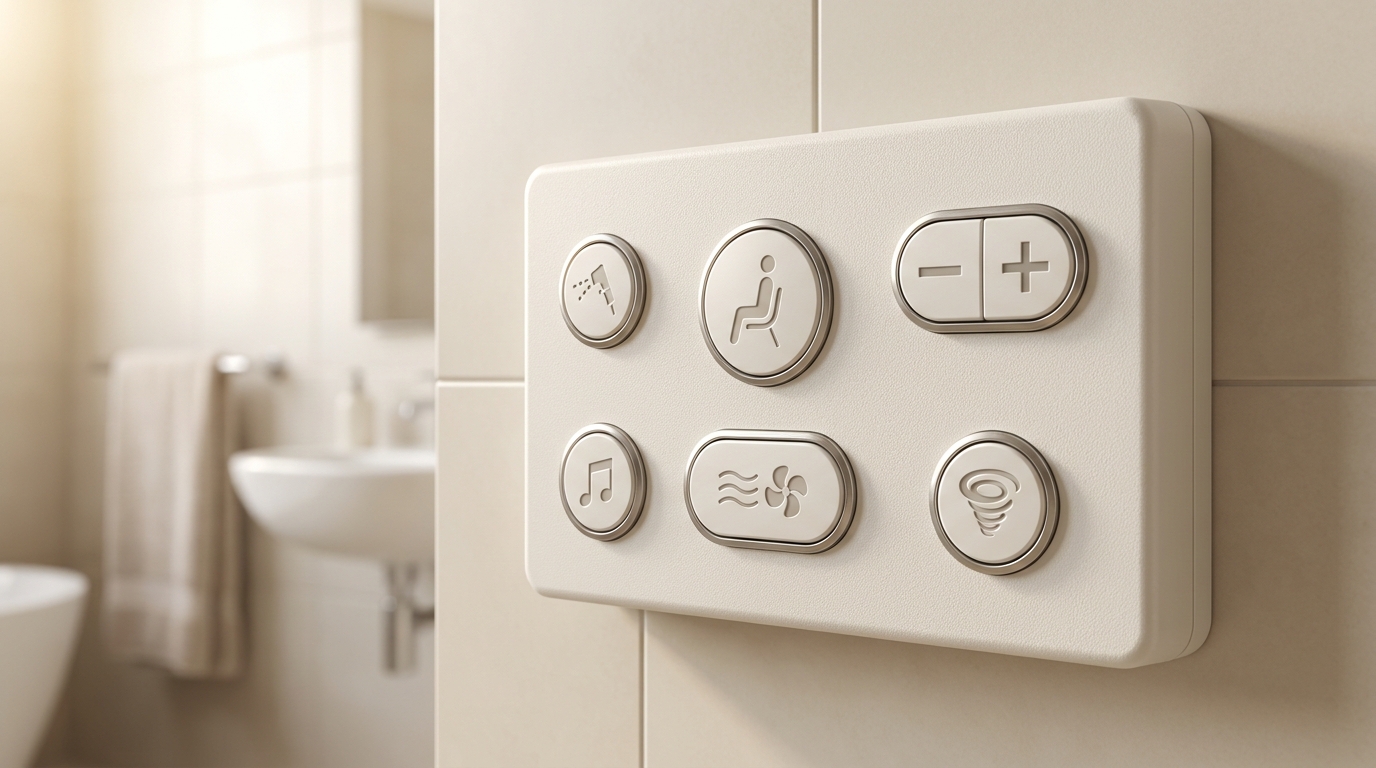
Close-up of a modern Japanese washlet toilet remote control panel mounted on a clean bathroom wall, buttons marked with universal pictograms only Travel Tips

  1. Quick Answer
  2. Why This Guide Exists
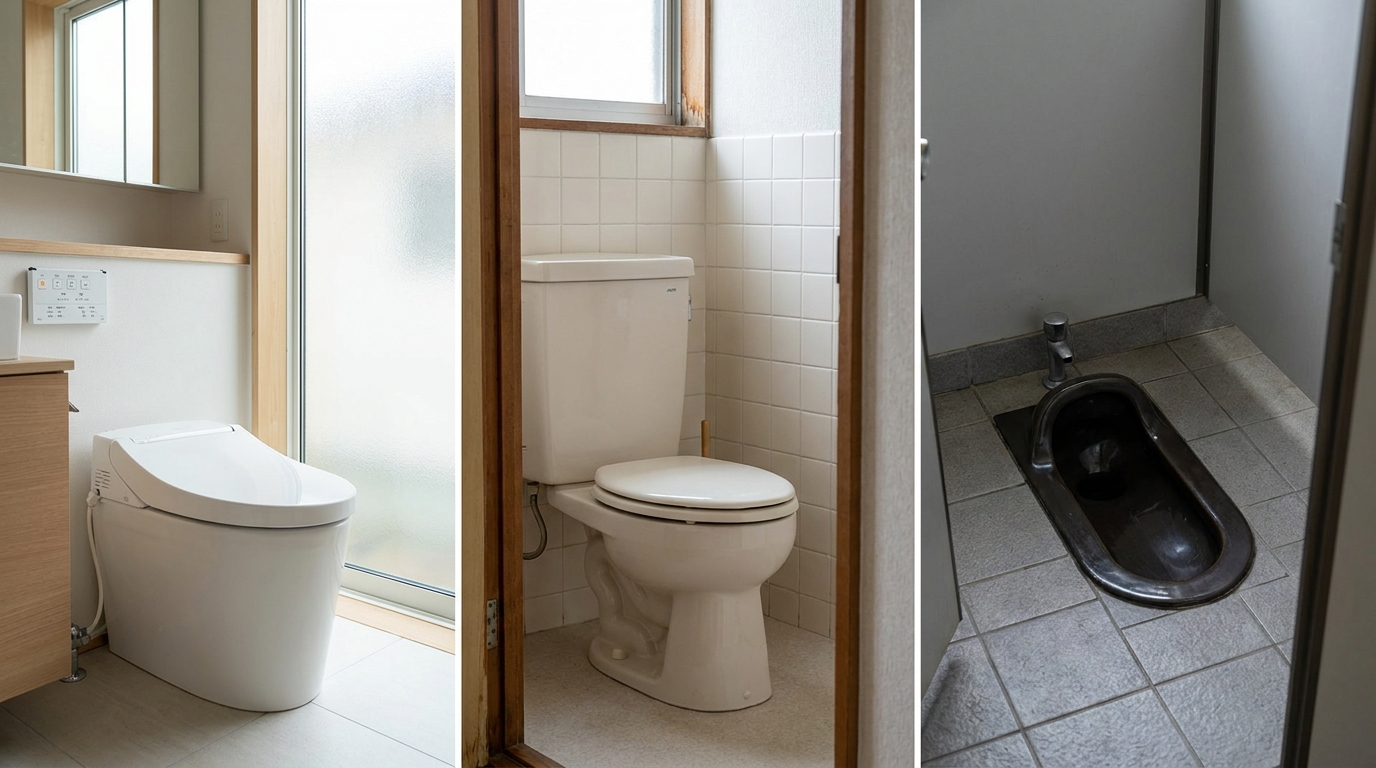
  3. The Three Types You’ll Actually Encounter
    1. 1. Western-style with washlet
    2. 2. Western-style standard (no electronics)
    3. 3. Squat toilet (washiki / 和式)
  4. Where Washlets Are — and Aren’t
    1. Newer hotels and major business chains
    2. Newer Airbnbs and minpaku in central Tokyo, Osaka, Kyoto
    3. Older Airbnbs, smaller minpaku, traditional houses, countryside stays
    4. Public restrooms
    5. Convenience stores (with a 2026 caveat for tourist districts)
  5. Paper In, Everything Else In the Bin
    1. Toilet paper goes into the bowl
    2. Everything else goes into the bin
  6. First-Time Washlet Survival Guide
    1. A simple first-time sequence
    2. A note on flushing
  7. Decoding the Panel: Every Button Translated
  8. When the Flush Button is Hidden: 5 Places to Check
  9. The Squat Toilet (Washiki): What to Do When You Walk Into One
    1. Why some Japanese travelers actually prefer them
    2. What to do if you can’t or don’t want to use one
  10. Etiquette You Can Actually Mess Up
    1. The Otohime / Sound button
    2. Slipper switching
    3. The two-direction flush handle
    4. Barrier-free stalls — reserve them for those who need them
  11. Public Toilet Strategy: Where to Go When You’re Out
    1. Department stores
    2. Major train stations
    3. Convenience stores
    4. Roadside stations and highway service areas
    5. Public parks
    6. Late-night options (post-midnight)
  12. Smart Tips for Specific Situations
    1. Traveling with kids
    2. During menstruation
    3. Upset stomach
    4. Wheelchair users and mobility issues
    5. Pregnancy
    6. Late at night
  13. Common Tourist Mistakes (and the Real Consequences)
    1. 1. Pressing the red emergency button by accident
    2. 2. Forgetting to switch back from toilet slippers
    3. 3. Putting toilet paper in the bin
    4. 4. Wearing outdoor shoes into a private toilet area
    5. 5. Flushing wipes or “flushable” tissues
    6. 6. Sitting on the seat with the lid still down
  14. When Things Go Wrong: Quick Fixes
  15. Frequently Asked Questions
  16. Final Note
  17. Related Reading

Quick Answer

You will run into three different toilet types in Japan: a Western-style seat with a washlet panel, a plain Western-style seat with no electronics, and a traditional squat toilet (washiki, 和式). Washlets are common in newer hotels, large train stations, and many newer Airbnbs, but they are not universal — older minpaku, public parks, and some older buildings still have plain seats or squat toilets. The two rules you absolutely need: toilet paper goes into the bowl, everything else goes into the small bin in the stall. Three minutes of reading this guide should be enough to use any toilet in Japan without panic.

Close-up of a modern Japanese washlet toilet remote control panel mounted on a clean bathroom wall, buttons marked with universal pictograms only

Why This Guide Exists

Most travel articles describe Japanese toilets as if every restroom in the country is an electronic spa with heated seats, music, and self-opening lids. That is true for some toilets, and not true for others. Three things catch travelers off guard the first day:

  • Not every toilet is a washlet. Older minpaku, smaller stations, and older park toilets often have a plain Western-style seat or even a squat toilet.
  • The buttons are in Japanese. Even when you find a washlet, the panel is covered in kanji and pictograms that are not always intuitive.
  • The flush is sometimes hidden. It might be a lever on the tank, a button on the wall, a sensor pad, or a foot pedal — and you can spend a full minute looking for it.

This guide is built around those three friction points, plus the etiquette mistakes that local hosts and cleaning staff actually deal with the most. By the end you should know what kind of toilet you are walking into, how to use it, where to find a clean public one, and what to do when something goes wrong.


The Three Types You’ll Actually Encounter

You will see all three types during a normal trip — sometimes within the same day. Knowing which is which makes the experience easier.

1. Western-style with washlet

A normal seat with a side panel or wall remote covered in buttons. Icons cover a rear spray, a front (bidet) spray, water pressure, water position, dryer, deodorizer, and a sound function. Many newer models heat the seat and lift the lid automatically when you walk in. This is what travelers usually picture when they hear “Japanese toilet.”

2. Western-style standard (no electronics)

A regular flush toilet with a normal seat, a flush lever or two-button flush (small/large), and nothing else. Common in older buildings, smaller minpaku, public restrooms in older parks, and some shrines and temples. There’s nothing exotic about it — it works exactly like a Western toilet at home.

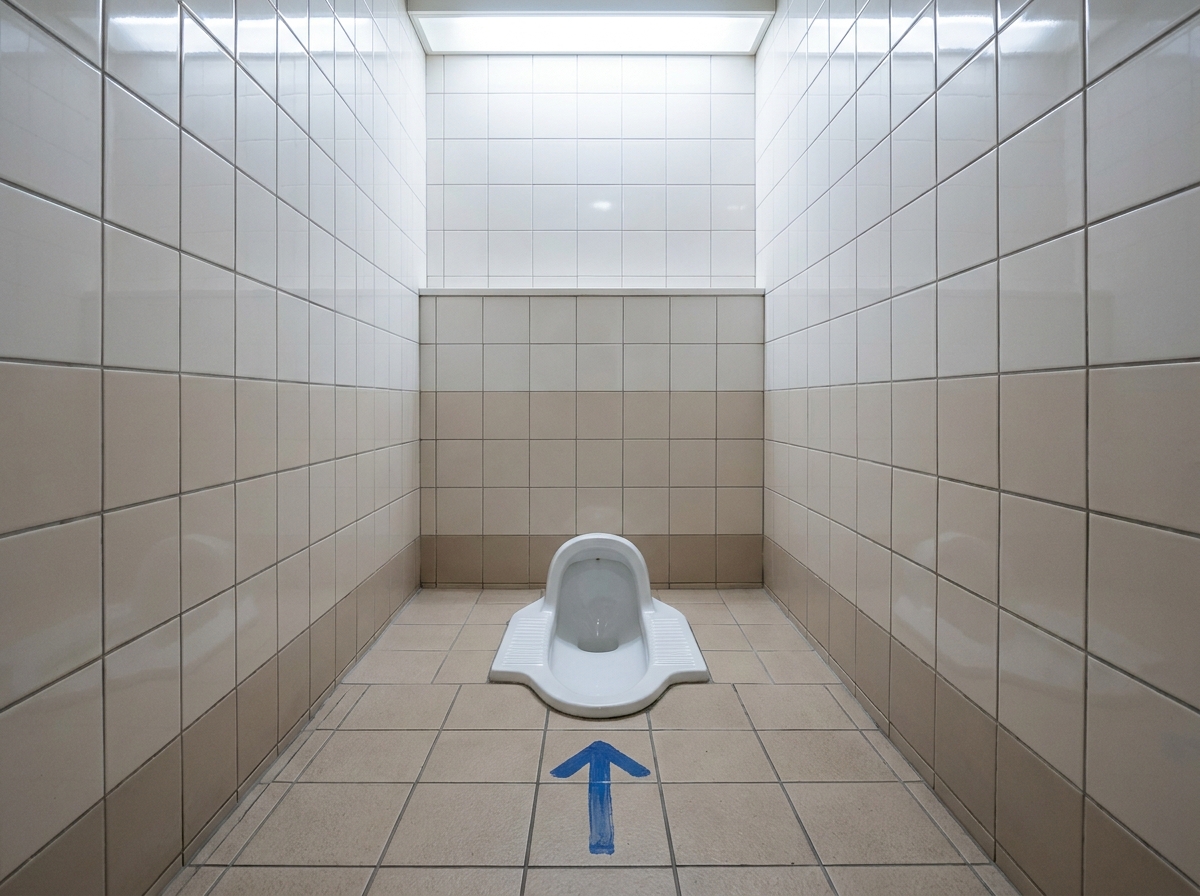
3. Squat toilet (washiki / 和式)

A porcelain trough set flat into the floor, with a hood at one end. You squat over it, facing the hood. Far less common than even ten years ago, but you will still see them in older train stations, public parks, some highway rest areas, and a number of older buildings. Many facilities now mark which stalls are which on the door.

Photographic comparison of three Japanese toilet types side by side: a modern Western washlet toilet, a plain Western flush toilet, and a traditional ceramic squat toilet

Where Washlets Are — and Aren’t

Why this matters for guests: managing your expectations is the single biggest win. If you arrive expecting a washlet at every toilet, you will be disappointed several times. If you arrive expecting any of the three types, you will be pleasantly surprised more often than not.

Washlets are widespread, but they are not universal. The gap between “what you read online” and “what you’ll actually see” is what causes confusion.

Newer hotels and major business chains

Hotels built or renovated in the last two decades — APA, Toyoko Inn, Daiwa Roynet, Richmond, Mitsui Garden, the Hilton/Hyatt/Marriott end of the market — tend to have washlets across all rooms. Major business chains in particular install warm-water washlets as a default.

Newer Airbnbs and minpaku in central Tokyo, Osaka, Kyoto

Apartments converted to short-term rentals in recent years usually include washlets, especially in popular tourist wards. Hosts know that international guests look for them, and most modern Japanese homes have them as a default.

Older Airbnbs, smaller minpaku, traditional houses, countryside stays

Here the gap shows up. A wooden townhouse in a Kyoto backstreet, a 1980s apartment in a quiet residential area, a family-run guesthouse in a small town — these may still have a plain Western-style toilet with no washlet, or in rare cases a squat toilet. Nothing is wrong with the property; it predates the washlet upgrade. If a washlet is essential to your trip, check the listing photos and amenity list before booking, and message the host if it isn’t clear.

Public restrooms

This is where expectations need the most resetting. Public toilets in older train stations, smaller suburban stations, public parks, riverside walks, and older commercial buildings often do not have washlets. Many have plain Western-style seats; some still have squat stalls. Newer commercial complexes, department stores, large terminal stations, and most highway service areas tend to have washlets.

Convenience stores (with a 2026 caveat for tourist districts)

A konbini toilet in suburban or residential areas is still one of the more reliable options for a clean Western-style seat, and many do have a basic washlet. The bigger value of a konbini toilet is that it is usually clean, well-lit, and accessible during a long walking day.

In central tourist districts — Shibuya, Shinjuku, Asakusa, Kyoto’s Kawaramachi, Osaka’s Kuromon Market — the picture has changed sharply. A 2026 survey in central Kyoto found that nearly 70% of convenience stores had suspended public toilet use, and a January 2026 field investigation in peak tourist hotspots like Higashiyama and Gion put the figure at 80–90%, with stores using physical barricades or “トイレ貸出中止” (toilet use suspended) signs. The cause is a combination of overtourism, plumbing damage from inappropriate flushing, and cleaning load on staff. In these areas, plan for the alternatives below — department stores, large stations — first, and treat konbini as a last resort.

Split image comparing a modern Japanese hotel bathroom with washlet on the left and an older public park restroom with a plain Western toilet on the right

Paper In, Everything Else In the Bin

Why this matters for guests: this is the rule that hosts and cleaners care about most. Getting it wrong causes clogs, complaints, and in older buildings real plumbing damage.

Two simple rules cover almost every situation in Japan.

Toilet paper goes into the bowl

Japanese toilet paper is designed to dissolve in water. In modern accommodations, public restrooms, train stations, department stores, and konbini, you flush used toilet paper down with the waste. The small bin you see inside the stall is not for toilet paper.

A small number of older buildings, mountain rest areas, and a few traditional properties may post a sign asking you to put paper in the bin instead, usually because the plumbing is older or runs through a septic system. If you see a clear sign in English or with a pictogram, follow it. Otherwise, paper goes into the bowl.

Everything else goes into the bin

The small lidded bin in the stall is for:

  • Sanitary products (pads, tampons, applicators)
  • Facial tissues (these do not break down like toilet paper and can clog older pipes)
  • Wet wipes, including ones labeled “flushable” (these clog even modern Japanese toilets — the low-flow, water-saving designs do not generate enough flow to break them down)
  • Diapers (in stalls that don’t have a dedicated diaper bin)
  • Any non-paper item

Wet wipes and tissues cause the most cleaning-staff complaints in short-term rentals because they look like toilet paper but behave very differently in the pipes. If the stall has a small bin with a lid, that is what it is for. If the stall has no bin at all, hold on to the item and dispose of it elsewhere — never in the bowl.

These two rules — paper into the bowl, everything else into the bin — cover almost every situation you will encounter. They are also the rules that prevent the kind of plumbing problem that ends a stay early.


First-Time Washlet Survival Guide

Why this matters for guests: most washlet panic happens in the first 30 seconds. A simple sequence covers it.

The buttons on a washlet panel look intimidating, but the layout is consistent across major brands (TOTO, INAX/LIXIL, Panasonic). You actually only need four or five of them.

A simple first-time sequence

  1. Find the Stop button before doing anything else. It is almost always red or orange and visually isolated from the others. This cancels any spray instantly.
  2. Sit down fully on the seat. Many washlets only spray when a sensor detects you are seated. Hovering over the seat will not trigger the spray.
  3. Start at the lowest pressure. If the panel has a pressure (水勢) control with + / − or step indicators, set it to the lowest before pressing rear or bidet. You can always increase it.
  4. Press the rear (おしり) or front (ビデ) button. The rear spray icon usually shows a stylized splash hitting a seat. The bidet icon shows a wider, more diffuse spray.
  5. Press Stop, then dry and flush. Use a small amount of toilet paper, or use the dryer (乾燥) if you prefer no paper. Then flush with the lever or button.

A note on flushing

The flush is not always on the washlet panel. If you don’t see one, check the side of the tank, the wall behind you, the front of the tank, and any sensor pad on the wall. The next section covers this in detail.

Five-step infographic showing the basic sequence for using a Japanese washlet toilet for the first time

Decoding the Panel: Every Button Translated

Why this matters for guests: screenshot this table once, and you have an offline reference for any washlet you walk into for the rest of the trip.

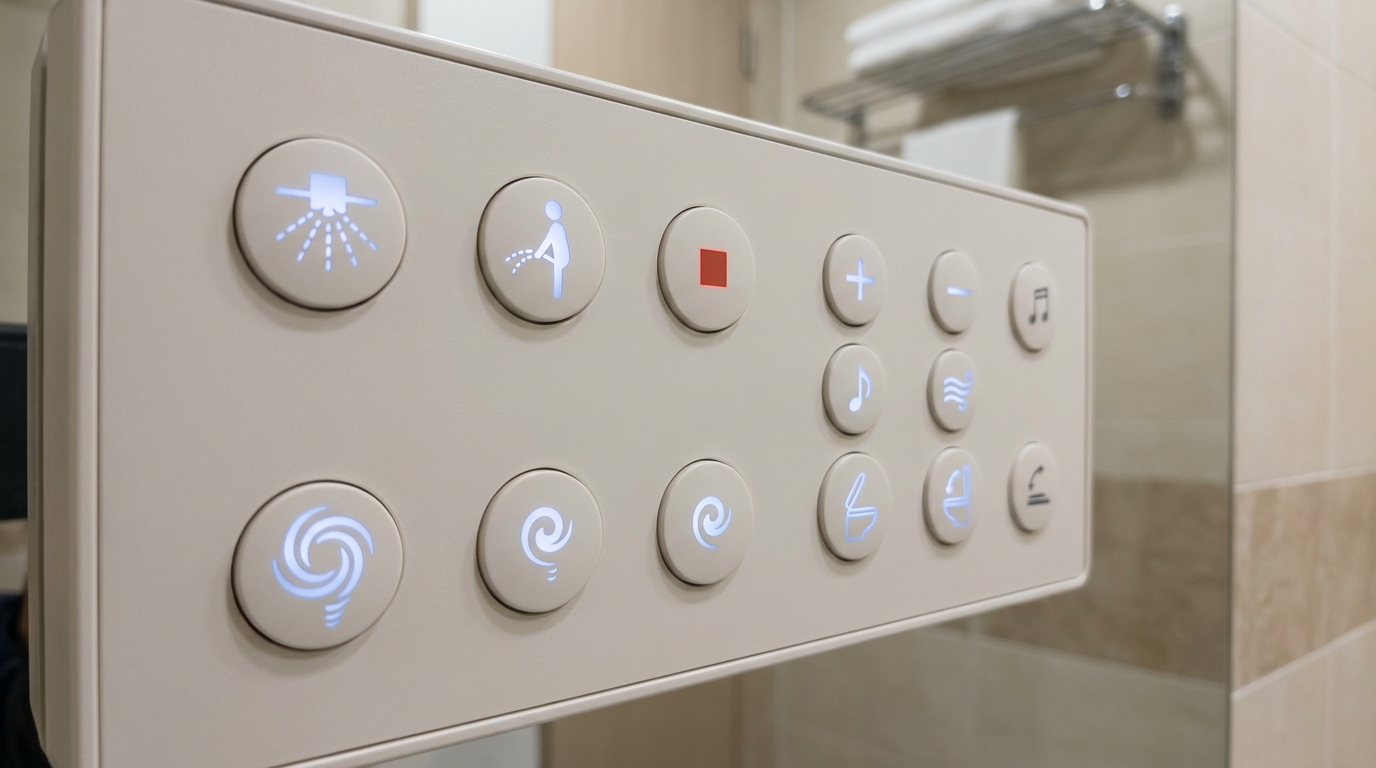
Almost every washlet panel uses some combination of these labels. The exact wording varies between brands, but the icons are consistent.

Japanese Reading English What it does
止 / 停止 Tomeru / Teishi Stop / Cancel Cancels any active spray. Press first if anything goes wrong.
おしり Oshiri Rear Rear spray. The main washlet function.
ビデ Bide Front / Bidet Front cleansing for women.
水勢 強 Suisei Kyou Pressure + Increases water pressure.
水勢 弱 Suisei Jaku Pressure − Decreases water pressure. Start here.
位置 Ichi Position Moves spray nozzle slightly forward or back.
マッサージ Massaaji Massage / Pulsating Variation on rear spray. Optional.
乾燥 Kansou Dryer Warm-air dry after spray. Slow but useful.
脱臭 Dasshuu Deodorizer Runs automatically on most newer models.
音姫 / 音 / 擬音 / サウンドデコレーター Otohime / Oto / Giwon / Sound Decorator Sound / Privacy Plays a flushing sound. “Otohime” is TOTO’s brand name; LIXIL uses Sound Decorator, Panasonic uses 擬音装置. See etiquette section.
流す 大 Nagasu Dai Flush Large For solid waste.
流す 小 Nagasu Shou Flush Small For liquid only. Saves water.
Futa Lid Auto-open / close on newer models.
便座 Benza Seat Heated seat function.
温度 Ondo Temperature Adjusts water or seat temperature.
節電 Setsuden Power Save Eco mode. Reduces seat heating.
自動 Jidou Auto Toggles automatic features.
非常 Hijou Emergency Do not press by accident. Calls staff in public stalls.

The single most useful button is Stop (止). The single most important button to not press is Emergency (非常), which is usually red and large in public barrier-free stalls. If you do press it by accident, see the Common Mistakes section below.

Overhead photograph of a Japanese washlet toilet remote control panel with multiple buttons each marked with simple universal pictograms

When the Flush Button is Hidden: 5 Places to Check

Why this matters for guests: more travelers panic about not finding a flush than about anything else on the panel.

If you cannot find a flush, check these locations in order:

  1. Side of the tank. A traditional handle or lever, often with 大 / 小 markings. Turn it toward the marked direction.
  2. Wall behind you or beside you. A button (sometimes two — large/small) mounted on the wall. Most common in newer hotels and stations.
  3. Front of the tank. A push-button or lever on top.
  4. Sensor pad on the wall. A round or square panel with a hand icon. Wave your hand in front of it; the toilet flushes after a short delay.
  5. Foot pedal. Found on some older squat toilets. Step on it; the flush activates.

If none of these work and you cannot find a way to flush, leave the stall, find another, and let the host or station staff know on the way out. Modern toilets very rarely fail; if a toilet appears completely non-functional, it is more often a problem with the building than with you.


The Squat Toilet (Washiki): What to Do When You Walk Into One

Why this matters for guests: you can travel a full week and never use one — but if you walk into one without warning, the wrong stance is uncomfortable and embarrassing.

You face the hood (the raised, dome-shaped end). You do not face the door. You squat with your weight on the balls of your feet, knees bent. Your trousers should be lowered to about your knees, not your ankles, so they do not touch the floor. The flush is a handle or button on the wall behind you — or in some older stalls, a foot pedal.

Why some Japanese travelers actually prefer them

Squat toilets do not require contact with any surface, which some people consider more hygienic in a public setting. They are also less likely to be vandalized and easier to clean, which is part of why they survive in older public facilities.

What to do if you can’t or don’t want to use one

In facilities with multiple stalls, the door usually has a small label or pictogram showing whether the stall is Western-style (洋式) or squat (和式). If all stalls are squat and you would rather find a Western-style toilet, the nearest convenience store, department store, or larger train station is usually a short walk away. The next section has a strategy for finding one quickly.

Photograph of a traditional Japanese squat toilet (washiki) inside a clean public restroom stall with a directional arrow indicating the correct facing direction toward the hood

Etiquette You Can Actually Mess Up

These are the small things that cause confusion, embarrassment, or actual cleaning problems. The paper rule is covered above; these are the rest.

The Otohime / Sound button

Many women’s restrooms have a small box or wall button with a musical-note icon. Pressing it plays a recorded flushing or water sound to mask any noise. The purpose is privacy — it lets you avoid flushing the toilet repeatedly to cover sounds. The original device, “Otohime” (音姫), was launched by TOTO in 1988 as a water-saving response to the problem of women double- or triple-flushing for sound privacy, which was wasting significant amounts of water (especially highlighted during the 1978 Fukuoka drought). “Otohime” is TOTO’s registered trademark; LIXIL/INAX labels their version “Sound Decorator” (サウンドデコレーター), and Panasonic uses 擬音装置 (sound-generator). Whatever the brand, it is a courtesy feature, not a requirement.

Slipper switching

In ryokan, traditional homes, some older minpaku, and a small number of restaurants, the bathroom has its own pair of slippers waiting just inside the door. The rule is simple: switch from your indoor slippers (or socks) into the toilet slippers when you enter, and switch back when you leave. Forgetting to switch back and walking through the rest of the house in toilet slippers is one of the more visible “tourist mistakes” — locals are usually polite about it, but it stands out. If your accommodation does not have toilet slippers at all, you don’t need to bring your own.

The two-direction flush handle

Many tank-mounted flush handles can be turned in two directions. One direction is 大 (dai, large) for solid waste, the other is 小 (shou, small) for liquid only. This is a water-saving feature that is now standard in most Japanese homes and accommodations.

Barrier-free stalls — reserve them for those who need them

These larger, wheelchair-accessible stalls were officially renamed from “multi-purpose toilets” (多目的トイレ) to “barrier-free toilets” (バリアフリートイレ) in March 2021 by the Ministry of Land, Infrastructure, Transport and Tourism. The change was made because able-bodied users were occupying these stalls to change clothes, escape crowds, or rest, while wheelchair users and parents with infants were left waiting. Older signs may still read 多目的トイレ or 誰でもトイレ (anyone’s toilet); newer signs read バリアフリートイレ.

They are equipped with grab bars, baby-changing platforms, an emergency call button, and a small fold-down child seat. They are intended for wheelchair users, parents with infants, people with ostomies, and people with internal health needs. If you do not need one, use a regular stall — it leaves the barrier-free stall available for someone who does.

A pair of designated toilet slippers placed at the entrance of a Japanese ryokan toilet room, with regular indoor slippers visible nearby on the wooden hallway floor

Public Toilet Strategy: Where to Go When You’re Out

Why this matters for guests: knowing where to go saves real time and avoids the worst stalls.

Department stores

Department stores like Isetan, Takashimaya, Mitsukoshi, Lumine, and Marui have well-maintained restrooms on multiple floors. They are typically the cleanest public option in any neighborhood, with washlets, baby-changing stations, and accessible stalls. No purchase required.

Major train stations

Major terminals — Tokyo, Shinjuku, Shibuya, Shinagawa, Ueno, Kyoto, Shin-Osaka, Hakata — have multiple restroom blocks, almost all with washlets. Station size matters: smaller suburban stations may have older facilities, sometimes only a single Western-style stall and a squat stall, sometimes only squat.

Convenience stores

In suburban and residential areas, most 7-Eleven, Lawson, and FamilyMart locations have a customer toilet that is clean, well-lit, and reliable enough to plan around. Treat the toilet as a courtesy — a small purchase (a drink or a snack) is the expected etiquette.

In central tourist districts in 2026, the situation has changed sharply. Konbini in Shibuya, Shinjuku, Asakusa, Kyoto’s Kawaramachi, and Osaka’s tourist hubs have widely locked or suspended public toilet use — a 2026 survey in central Kyoto found nearly 70% of stores had stopped lending toilets to non-customers, with a January 2026 field investigation in peak tourist hotspots like Higashiyama and Gion putting the figure at 80–90%. The cause is overtourism, plumbing damage from inappropriate flushing, and cleaning load on staff. In these areas, do not plan around konbini. Where the toilet is still available, expect to buy something first and ask staff (トイレ借りてもいいですか — toire karitemo ii desu ka?); some now require a key or a numeric code from the register.

Roadside stations and highway service areas

If you are on a long-distance bus or rental-car trip, michi-no-eki (roadside stations) and SA/PA on expressways have extensive, modern restrooms — usually washlets, baby rooms, and accessible stalls.

Public parks

Park toilets vary widely. Larger urban parks (Yoyogi, Ueno, Osaka Castle Park) have multiple buildings with mixed facilities. Smaller neighborhood parks may have only a single building with basic, sometimes older, fixtures. If you have a choice, take the department-store or station option over a small park toilet.

Late-night options (post-midnight)

For most of the past decade, 24-hour family restaurants were a default late-night fallback. That has changed. Skylark Holdings (Gusto, Jonathan’s, Bamiyan) ended 24-hour operations across all locations in 2020, and most family-restaurant chains now close between 23:30 and 02:00. A handful of locations in major nightlife districts (Shinjuku, Shibuya) still extend hours to around 5:00 AM, but they are not a reliable plan.

The 2026 late-night options that actually work:

  • 24-hour karaoke parlors (Big Echo, Karaoke Kan, Joysound) — clean toilets, no time-of-night issue, small drink order to enter.
  • Don Quijote — many central Tokyo and Osaka locations are 24 hours and have customer toilets.
  • 24-hour internet cafes / manga cafes (Kaikatsu Club, Bagus, Comic Buster) — entrance fee applies, but toilets are reliable.
  • 24-hour gyms — only useful if you are a member.
  • Hospital emergency entrances — only for actual emergencies, not casual use.

Plan around these rather than around family restaurants if you expect to be out past midnight.

Flat icon set illustrating five Japanese public toilet location types: department store, train station, convenience store with caution badge, roadside station, and public park

Smart Tips for Specific Situations

Why this matters for guests: not every traveler needs the same toilet — these are the situations that come up most often.

Traveling with kids

Department stores and large train stations have dedicated baby rooms (ベビールーム) with changing platforms, feeding chairs, and bottle-warming stations. Look for signs reading ベビールーム or a baby icon. Barrier-free stalls (バリアフリートイレ) in most modern public buildings also have a small fold-down child seat where a parent can place a toddler while using the toilet, plus a changing platform.

During menstruation

Sanitary pads and tampons are sold at every konbini and drugstore (Matsumoto Kiyoshi, Welcia, Tsuruha, Cocokara). Every women’s stall and most barrier-free stalls have a small lidded bin (sanitary box / サニタリーボックス) for disposal. The bidet (front) function on a washlet can be useful for cleansing.

Upset stomach

Konbini are open 24 hours and have a customer toilet, even if it isn’t always advertised. If a 7-Eleven, Lawson, or FamilyMart is the closest option and you need it urgently, walk in, ask “toilet, please” to the staff at the counter, and they will usually point you to it without requiring a purchase first. Buy something on the way out as a courtesy.

Wheelchair users and mobility issues

Major terminal stations are step-free and have barrier-free stalls. Department stores have elevators on every floor. Older shrines, older parks, and smaller stations may not have step-free access. If accessibility is a daily need, plan around larger stations and department stores rather than small neighborhood facilities.

Pregnancy

Avoid squat stalls if there is any choice. Barrier-free stalls (バリアフリートイレ) in stations and department stores have grab bars, more space, and a Western-style seat. Department-store priority cards (handed out at customer service) sometimes give you access to a separate priority stall.

Late at night

Most public train station restrooms close with the last train (around 12:30–01:15 AM) because they sit inside the ticket gates. Konbini in suburban areas remain 24 hours, but konbini in central tourist districts may have locked their toilets (see the Public Toilet Strategy section). 24-hour family restaurants are largely a thing of the past — Skylark Holdings ended them in 2020 and most chains now close by 02:00. The reliable late-night options are 24-hour karaoke parlors, 24-hour Don Quijote stores, and 24-hour internet/manga cafes.


Common Tourist Mistakes (and the Real Consequences)

Why this matters for guests: knowing what could go wrong stops you from making it worse.

1. Pressing the red emergency button by accident

In barrier-free stalls, the emergency call button (非常) is large, red, and easy to confuse with the flush. If you press it, staff will arrive within a minute or two. The fix is simple: open the door, say “sorry, by mistake” in any language, and walk out. Staff are used to it. There is no fine, no embarrassment that lasts beyond the minute.

2. Forgetting to switch back from toilet slippers

You walk into the toilet in your house slippers, switch into the toilet slippers, do your business, and walk out — still wearing the toilet slippers — into the rest of the house. Hosts and locals notice. The fix: turn around, switch back. Most hosts find it more amusing than rude.

3. Putting toilet paper in the bin

Covered above, but it is the single most common host complaint. Paper goes into the bowl in modern facilities.

4. Wearing outdoor shoes into a private toilet area

In ryokan and traditional homes, the entrance to the toilet has its own slippers. Walking in with outdoor shoes (or even indoor slippers from the rest of the house) is the wrong move. Look for slippers at the entrance; if they are there, switch.

5. Flushing wipes or “flushable” tissues

Even labeled-flushable wipes can clog Japanese plumbing — and not only in older buildings. Most modern Japanese toilets are low-flow water-saving models (節水型トイレ), and the reduced water volume per flush is not enough to break down dense wet wipes quickly. Tissues do not disintegrate like toilet paper either. Both go into the bin.

6. Sitting on the seat with the lid still down

On washlets with auto-lift lids, this happens when the sensor doesn’t trigger fast enough. If the lid is down, lift it manually first. The seat itself is the warm, contoured ring; the lid is the flatter cover above it.


When Things Go Wrong: Quick Fixes

Why this matters for guests: minor toilet problems are normal during a trip — the right response is short and not dramatic.

Problem First action
Toilet won’t flush Check the 5 places listed above (tank lever, wall button, front of tank, sensor, foot pedal).
Washlet doesn’t respond It needs power. Check the cord, the breaker, and whether the building has lost power. Notify the host.
Toilet appears clogged Do not flush again. Notify the host or front desk; do not try to fix it yourself in someone else’s property.
Door lock stuck Do not force it. Knock for help, call out, or call the host or front desk. Most door locks have a manual override.
Pressed emergency button by accident Wait for staff. Apologize. Walk out. No further action needed.
Lid auto-closed before you sat down Lift it manually. The sensor sometimes mistimes.
Seat is too cold (winter) Look for a power button on the panel — the seat heater may have been turned off.

The general rule: do not try to repair plumbing or electronics in a property that is not yours. Notify the host quickly, in a polite and short message, and follow their instructions. Most hosts have a plumber on call and can resolve issues within hours.


Frequently Asked Questions

Q1. Do all toilets in Japan have washlets?

No. Washlets are common in newer hotels, larger train stations, department stores, and many newer Airbnbs, but they are not universal. Older minpaku, public park toilets, smaller suburban stations, and some older buildings may have a plain Western-style seat or a traditional squat toilet.

Q2. Where does the toilet paper go?

Into the bowl, in almost all modern facilities. Japanese toilet paper is designed to dissolve in water. A small number of older buildings post a sign asking you to put paper in the bin instead — follow the sign if you see one.

Q3. What goes in the small bin in the stall?

Sanitary products, facial tissues, wet wipes (including “flushable” ones), and diapers. Anything that is not toilet paper.

Q4. What is the Otohime button?

It plays a recorded flushing sound to mask any noise during use, for privacy. Originally launched by TOTO in 1988 to stop women from double-flushing and wasting water. “Otohime” (音姫) is a TOTO brand name; LIXIL labels theirs “Sound Decorator,” Panasonic uses 擬音装置. It is a courtesy feature, not a requirement.

Q5. How do I flush if I can’t find a button?

Check the side of the tank, the wall behind you, the front of the tank, and any sensor pad on the wall. Some older squat toilets have a foot pedal.

Q6. Are squat toilets still common?

Far less common than they used to be, but you will still encounter them in older train stations, public parks, mountain rest areas, and some older buildings.

Q7. Are public toilets in Japan free?

Yes, in almost all cases. Train stations, department stores, parks, konbini, and most other public facilities have free toilets. NEXCO highway service areas (SA/PA) — including the famously luxurious “Omotenashi Toilets” — are also free; despite their high quality there is no fee. A small number of premium fee-based public toilets exist in major urban hubs, but the standard everywhere is free.

Q8. What if my Airbnb doesn’t have a washlet?

Older properties sometimes have a plain Western-style toilet without a washlet. It works the same as a Western toilet at home. If a washlet is important to your trip, check the listing photos and amenity list before booking.

Q9. I pressed the red emergency button by accident — what now?

Wait for staff to arrive (1–2 minutes), apologize briefly, and walk out. There is no fine, and staff handle it routinely.

Q10. Can I use a konbini toilet without buying anything?

In suburban and residential areas, usually yes — a small courtesy purchase on the way out is the expected etiquette. In central tourist districts in 2026 (Shibuya, Asakusa, Kyoto’s Kawaramachi, Osaka’s tourist hubs), expect the toilet to be locked or off-limits to non-customers. A 2026 Kyoto survey found nearly 70% of konbini in the central tourist area had suspended public toilet lending, with peak tourist hotspots like Higashiyama and Gion reaching 80–90% in January 2026 field reports. Where the toilet is still available in those areas, plan to buy something first and ask staff.

Q11. Where do I change a baby’s diaper in Tokyo?

Department stores, large train stations, and most modern public buildings have barrier-free stalls (バリアフリートイレ) with a fold-down changing platform. Bigger department stores also have separate baby rooms (ベビールーム) with feeding chairs and bottle-warming stations.

Q12. Are there 24-hour public toilets in Japan?

Most station toilets close with the last train (around 12:30–01:15 AM) because they sit inside the ticket gates. Suburban konbini are 24 hours, but konbini in central tourist districts may have locked their toilets. 24-hour family restaurants are no longer reliable — Skylark Holdings (Gusto, Jonathan’s) ended 24-hour operations in 2020 and most chains now close by 02:00. The genuinely 24-hour options in 2026 are karaoke parlors, 24-hour Don Quijote stores in central Tokyo and Osaka, and 24-hour internet/manga cafes.

Interior view of a Japanese barrier-free accessible toilet stall with grab bars, baby changing platform, fold-down child seat, and a prominent red emergency call button

Final Note

The biggest mental adjustment for first-time visitors is letting go of the idea that every Japanese toilet is the same advanced machine. The reality is that you will use all three types during a normal trip, sometimes within the same day, and most of them are simple to operate once you know what to look for.

The features that surprise travelers — heated seats, sprays, sound buttons, automatic lids — are conveniences. The features that actually matter for a comfortable trip are the same as anywhere else: knowing where the flush is, knowing whether to put paper in the bowl, knowing which stalls are Western-style. If your accommodation has a washlet, take a minute on the first day to find the Stop button and the flush. If it does not, you have a normal toilet, and that is also fine.

One small thing to pack: a tissue pack. They are handed out free as advertising outside many train stations and shopping districts, and they are useful as a backup for the rare older park toilet that has run out of paper.

Clean tidy small Japanese toilet room with a modern Western washlet toilet, light wood flooring, and a small unopened pocket tissue pack on the window ledge

Related Reading

  • Japanese Konbini Guide: What You Can Actually Do at a Convenience Store in Japan (2026)
  • Trash in Japan: Why Japan Sorts So Carefully — and How Short-Stay Guests Can Help
  • When to Take Off Your Shoes in Japan: A Practical Guide for Short-Term Guests (2026)
  • How to Check In to Your Japanese Accommodation: Airbnb, Hotel & Minpaku Guide (2026)

Comments

Copied title and URL