By Yukihiro Hirano / Last updated: 2026-04-19
A quick note on tone. This guide is written primarily for travelers staying in Airbnb or licensed minpaku (private vacation rentals) in Japan — the setting where the pre-arrival noise messages from hosts most often arrive. Hotels and ryokan have their own staff managing the building, so the expectations there are handled on the operator’s side. Nothing in here is a legal “rule” that will get you in trouble. These are courtesy suggestions, grounded in how Japanese buildings are actually constructed and what Japanese law actually requires of your host. Most guests generate no complaints at all and never notice anything unusual. This guide just gives you the context.
Before you even arrive, your host sends a message — sometimes two or three — about keeping quiet at night and being careful with your suitcase wheels. It can feel like an overreaction, but it isn’t. In Japan, repeated noise complaints from neighbors can lead to administrative guidance from the local government, and in rare persistent cases, a property’s registration can be suspended. Hosts aren’t being fussy. They’re protecting the business you booked, and they’re asking for help with a few acoustic facts that most travelers simply aren’t told.
This guide covers three things: why Japan treats residential noise the way it does, what actually shows up in real minpaku complaints (according to industry operators), and how to think about your own stay without second-guessing every step.
Quick Answer: In Japan, apartments and minpaku often have thin walls and neighbors who value quiet, so hosts ask guests to keep noise low — particularly loud talking, music, and footsteps at night and early morning. Keep voices down in hallways, entrances, and stairwells, avoid parties, and roll luggage quietly. Noise complaints are taken seriously and can put a host’s license at risk, which is why the reminders arrive before you even check in.
1. Why Japan Takes Noise So Seriously
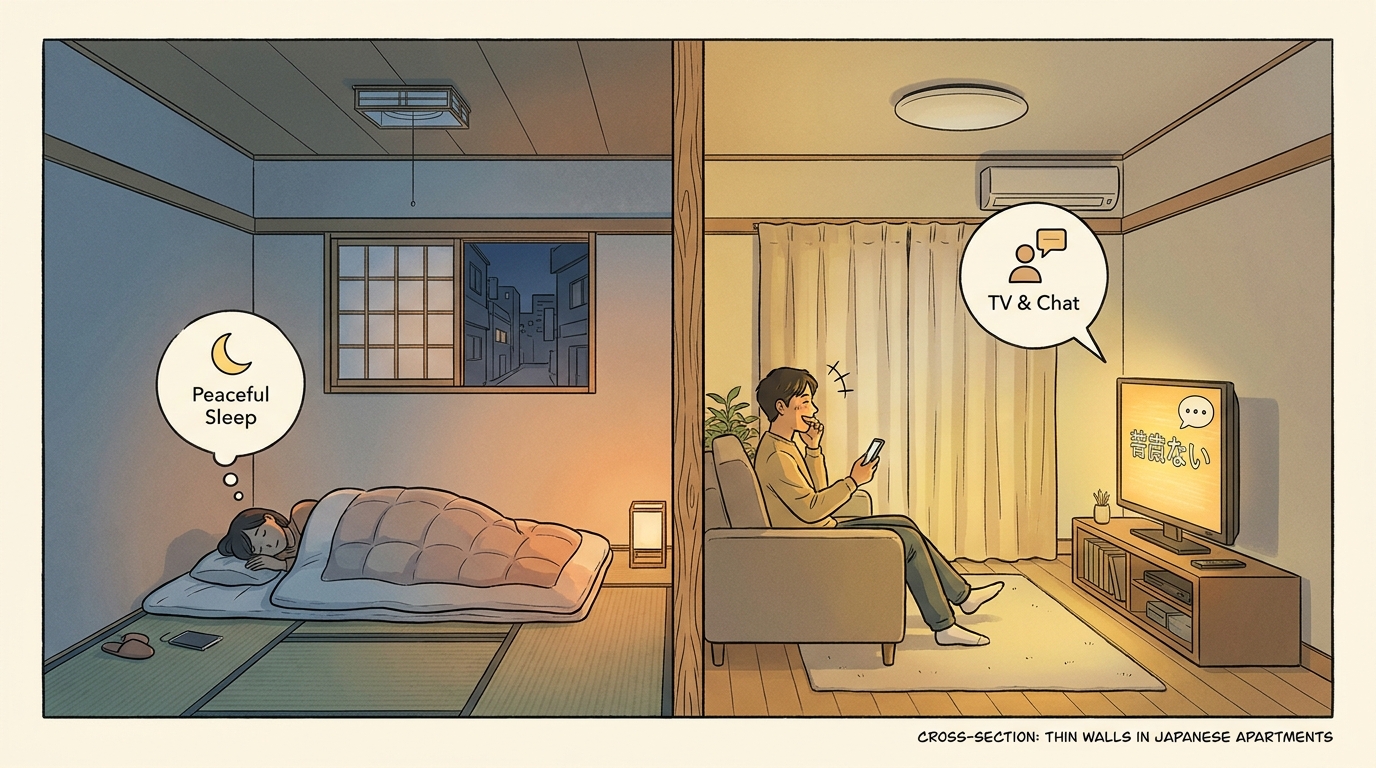
The short answer: Japan’s housing stock, its legal framework, and its social norms all push toward a low tolerance for sound from neighbors.
Thin walls are the rule, not the exception
Most Japanese apartment buildings — especially the three-to-six-story buildings that dominate residential Tokyo, Osaka, and Kyoto — are built with light-gauge steel framing (LGS) or wood framing with drywall interior partitions. Wall thickness in LGS and wooden apartments is typically around 10cm, compared to 15–20cm in concrete “mansion” buildings. Japan is also the only G7 country without mandatory insulation standards for residential construction. A conversation at normal volume in one apartment can be audible in the next, especially late at night when ambient street noise drops. Older timber-frame houses converted into minpaku have even less soundproofing.
Concrete “mansion” buildings (seven stories or taller) perform better, but impact sounds — a suitcase wheel bumping across tile, a chair dragged across a floor — still travel through concrete surprisingly well. When your host says the neighbors will hear you, they’re describing the actual acoustic properties of the building, not stereotyping you.
The minpaku law has a complaints clause
Japan’s Private Lodging Business Act (住宅宿泊事業法), usually called the minpaku law, came into force in June 2018. Article 9 requires hosts to explicitly brief guests on noise prevention, and Article 10 requires hosts to respond promptly to neighbor complaints. A pattern of complaints can trigger administrative guidance from city hall, and in persistent cases, the operator’s registration can be suspended. The Japan Tourism Agency announced in January 2026 that it is drafting clearer enforcement criteria for repeated nuisance violations.
This is why hosts are tense about it: the cost of repeated noisy nights isn’t just an awkward conversation — it’s a paper trail that can shut the business down. The warnings you’re getting trace back to real regulatory risk, not a cultural tic.
Different building types, different risk
- Wooden apartment buildings (アパート): highest risk. Thin-walled, older rental stock where most complaints originate.
- Apartment mansions (マンション): high risk. Concrete helps with airborne sound, but impact noise still travels vertically.
- Detached houses (一戸建て): moderate risk. Your own walls are fine, but neighbors on either side are often just a few meters away.
- Hotels and ryokan: low risk. Licensed commercial buildings managed by staff.
If the property name ends in 荘 (-so) or uses katakana アパート, you are almost certainly in the highest-risk category.
2. Quiet Hours
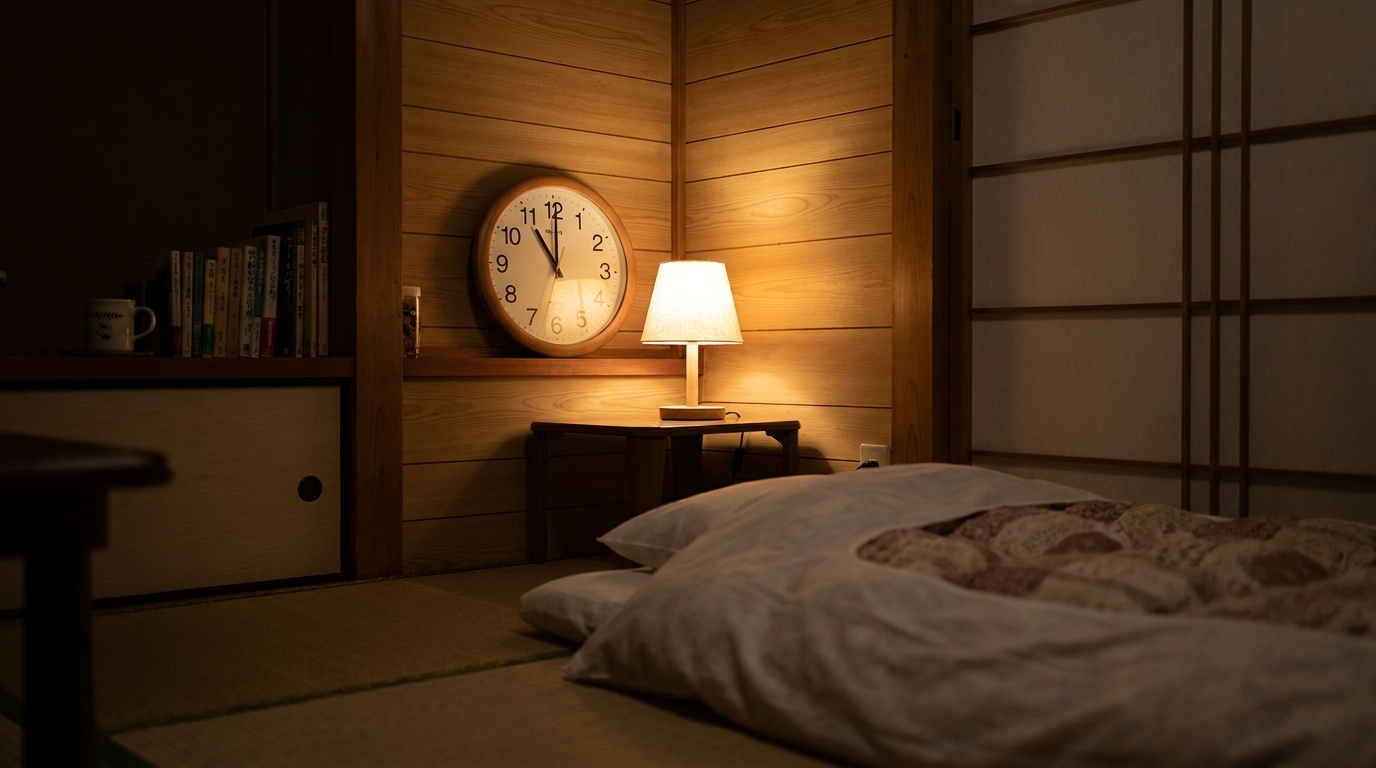
Japan has no single nationwide “quiet hours” law for residential noise. Behavior is governed by a layered system of local ordinances (迷惑防止条例), building-specific rules, and unwritten neighborhood norms. A useful generalization: the evening slot from around 22:00 onward is when neighbors become most sensitive.
The 22:00–08:00 window
Across most Japanese cities, local ordinances restrict loud commercial activity — construction, outdoor loudspeakers, amplified music — between 22:00 and 08:00. These target commercial noise, but they set the cultural baseline neighbors apply to residents too. By 22:00, most people are home, many are winding down, and some are already asleep (early starts are common — plenty of commuters are up before 06:00). Sound that passes unnoticed at 18:00 can feel jarring at 22:30.
If you’re in central Shinjuku or Namba, the street outside may still be lively at midnight. Inside the building, the same norms apply as in a quiet suburb — the street noise doesn’t change the neighbor’s expectations.
After 23:00
The window from about 23:00 to 01:00 is when most formal complaints get filed — the point at which a neighbor who has been tolerating noise finally gives up on sleep. The first step is usually contact to the host, not the police. If noise is actively disturbing sleep and the host isn’t responding, some neighbors do dial 110 (the emergency line); the non-emergency consultation line #9110 is more often used for ongoing disputes. Police intervention is rare for short-stay guests who respond to the host’s message quickly.
3. What Actually Generates Complaints
Most travelers assume noise complaints are about loud music or parties. Industry operators running minpaku report something different: the bulk of complaints are mundane. In rough order of frequency:
Suitcase wheels on hard floors
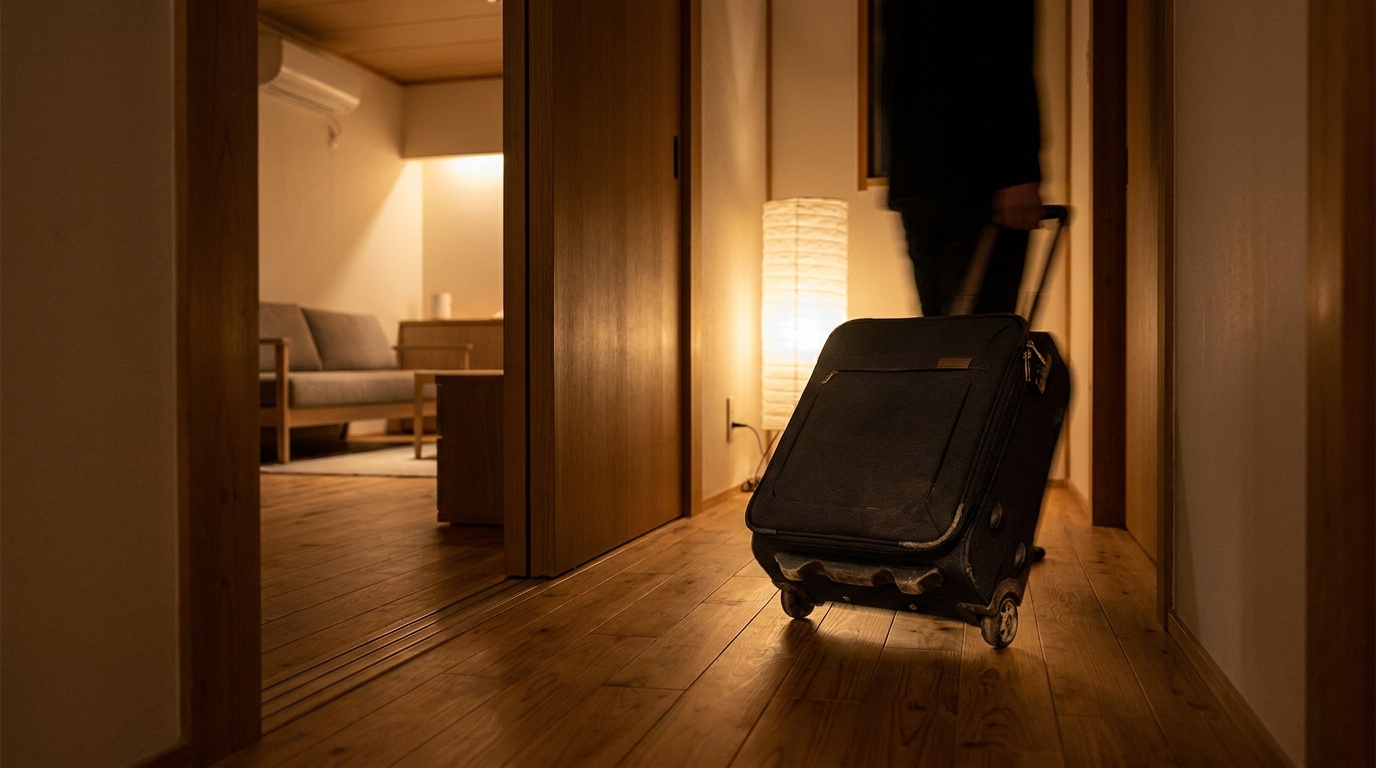
By a wide margin, the single biggest source of tourist-generated noise complaints. Industry operators report that roughly 30% of minpaku complaints involve noise, with suitcase wheels routinely cited alongside late-night voices as the top triggers. Hard-shell cases rolled across a tiled entryway or wooden corridor produce a low-frequency rumble that transmits directly through the building’s structure — a neighbor two floors down can hear you arrive.
Carrying the case through the building — rather than rolling it — is the most commonly recommended habit.
Voices in the entryway (玄関)
The genkan is acoustically the worst spot in the apartment for conversation: tiled, echoing, and pressed against a thin front door that opens onto the shared corridor. A normal-volume chat here is clearly audible on the same floor. This is the single item most often raised in host house-rules briefings.
Conversations held further inside the unit carry much less.
Late-night group conversations
Voices from a group of guests winding down together after 23:00 are the second most cited complaint alongside suitcase wheels, according to the same operator reports. There’s nothing unusual about the behavior — it’s simply that the walls amplify it more than visitors expect.
4. Rooms Where Sound Carries More
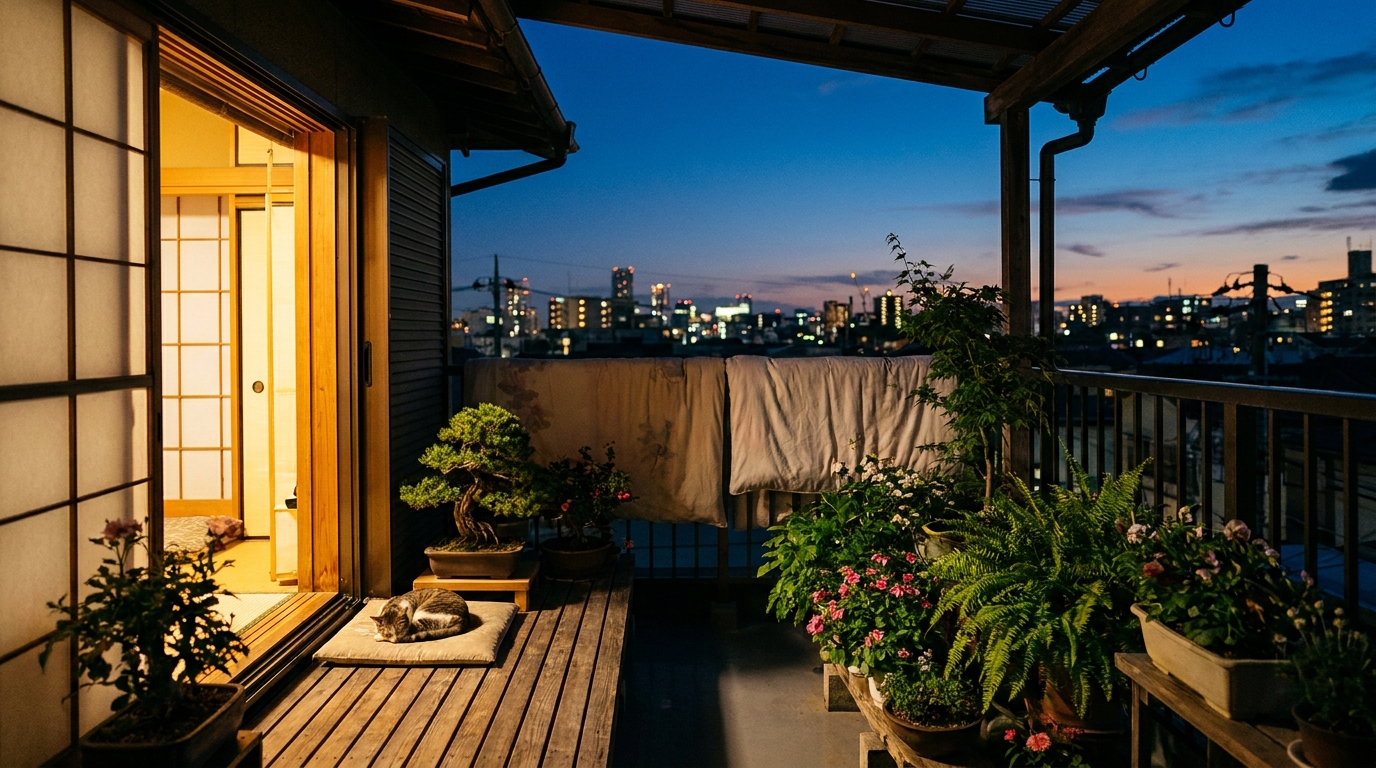
A quick orientation to which rooms carry sound further than you might expect, so you can calibrate. No specific prohibitions here — Japanese residents use these rooms in all the normal ways you would.
- Genkan (entryway): Tiled and echoing; conversation held here reaches the corridor.
- Bedroom adjacent to a neighbor’s wall: A CPAP machine or loud alarm positioned against a shared wall will be more audible than one placed on the interior side.
- Balcony: Sound along the back face of the building travels between units, especially after dark. Some buildings’ house rules prohibit smoking on balconies; check your listing.
- Shared corridors and elevators: Voices in the corridor feed into every door on the floor. Most conversations move comfortably inside the unit.
For everything else — shower, laundry, TV, kitchen — the building is designed for normal residential use at normal hours, and you can use them normally. Where the thin walls matter is mainly volume after dark, not time-of-day bans.
5. What Happens If a Complaint Is Filed
Most of the time, nothing visible to you. Most Japanese neighbors are conflict-averse and will tolerate one moderately noisy evening silently. But because the complaint pipeline is invisible from your side, it’s worth knowing how it actually moves.
Step 1: The neighbor contacts the host
The minpaku’s registration notice (legally required, usually posted at the entrance) lists a 24-hour contact number. The neighbor calls it. This is where the majority of complaints stop. The host messages you asking for the noise to be reduced. If you respond and the noise stops, that’s usually the end of it.
Step 2: The police (rare)
If noise continues and the host hasn’t resolved it, a neighbor may call the police. An officer arrives, asks for the volume to be lowered. This is not a criminal matter for guests in almost all cases — it’s a polite request — but it creates a record, and it always notifies the host.
Step 3: City hall (行政指導)
If the property accumulates multiple complaints over time, the city’s minpaku oversight office may issue administrative guidance (行政指導) to the host. Repeated guidance can lead to suspension of the property’s registration. This has happened — the Japan Tourism Agency recorded one such suspension between 2018 and early 2025 — but it is rare.
What you might personally lose
- A middle-of-the-night message from the host.
- A security deposit deduction where the platform allows it.
- A negative review that Japanese hosts can see when you book again.
- In the most serious cases, an early termination of the stay.
None of this is likely for the average guest. But the asymmetry is real: being a quiet guest costs nothing, and being a repeatedly noisy one can cost the rest of the trip.
6. Frequently Asked Questions
Can I take a phone call in my Airbnb in Japan?
Yes. A normal-volume call in an interior room is fine during the day. After 22:00, a quieter voice and a spot away from the entryway and shared walls will carry less.
Can I shower at night?
Yes — Japanese households shower at all hours, including late. The water itself is not the issue.
Can I run the washing machine late at night?
There is no law against it, and travelers coming back from a late day out do run laundry at night. If you have the option to run it during the day instead, it’s appreciated by downstairs neighbors, since the spin cycle vibrates through thin floors. But this is a matter of preference, not a rule.
Is a noise complaint really that serious for a Japanese Airbnb?
More serious than most travelers assume, but not for the reasons you’d expect. Under the 2018 Private Lodging Business Act, Article 9 requires licensed hosts to brief guests on noise prevention, and Article 10 requires them to respond promptly to complaints. Repeated complaints against a property can lead to administrative guidance and, in extreme cases, suspension of the host’s registration — that’s why hosts take even polite neighbor messages seriously.
What about traveling with young children?
Children’s crying and natural play sounds are generally understood as unavoidable, and Japanese neighbors rarely complain about infants. A polite heads-up to your host before arrival (“traveling with small children”) is appreciated and often addresses any concerns in advance.
Related Guides
- How to Open a Key Box at Your Japanese Airbnb
- Japanese Futon Guide: How to Set Up, Sleep On, and Fold Your Bedding
- JR Pass Guide 2026: Is It Still Worth It?
- How to Check In to Your Japanese Accommodation: Airbnb, Hotel & Minpaku Guide

Comments