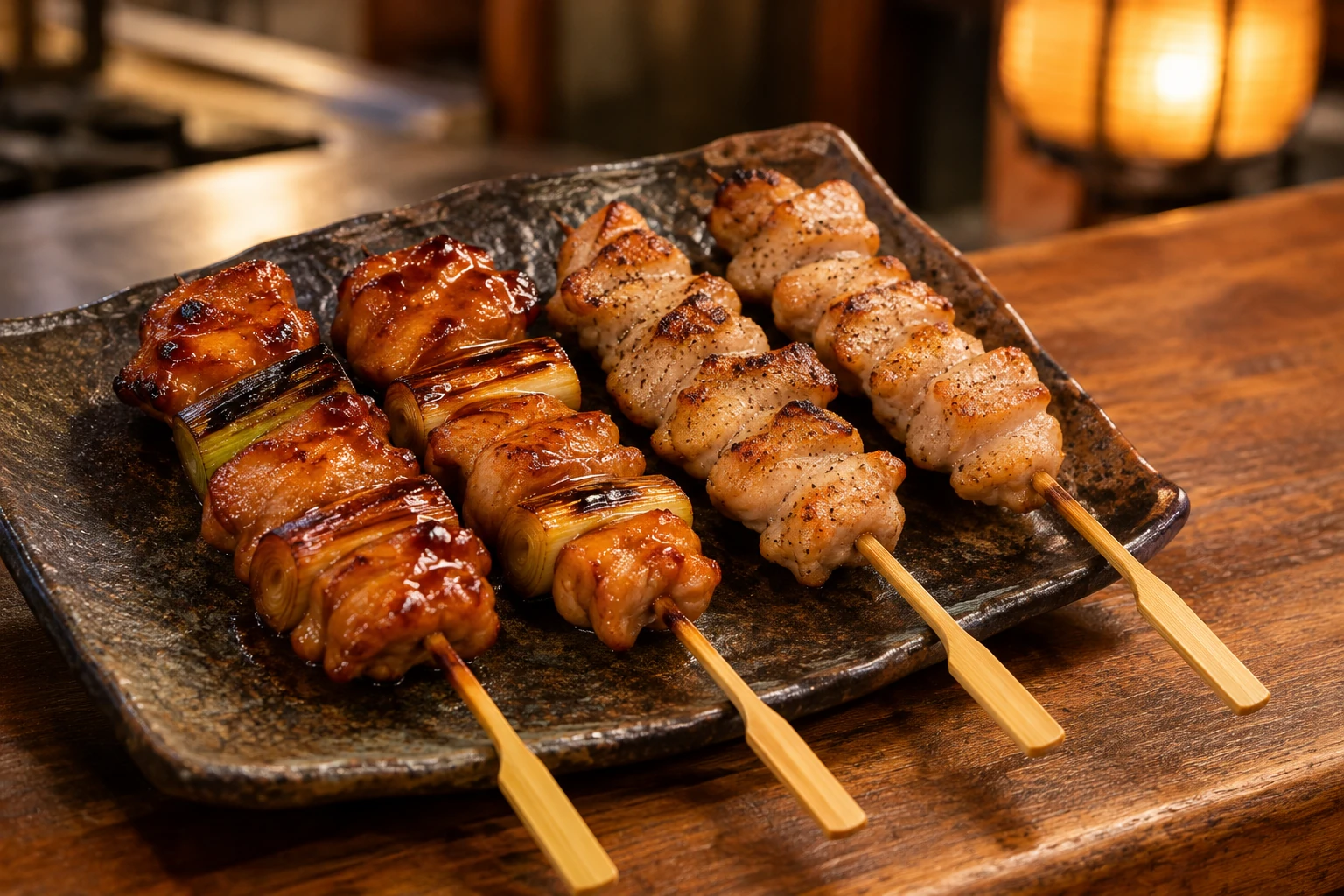
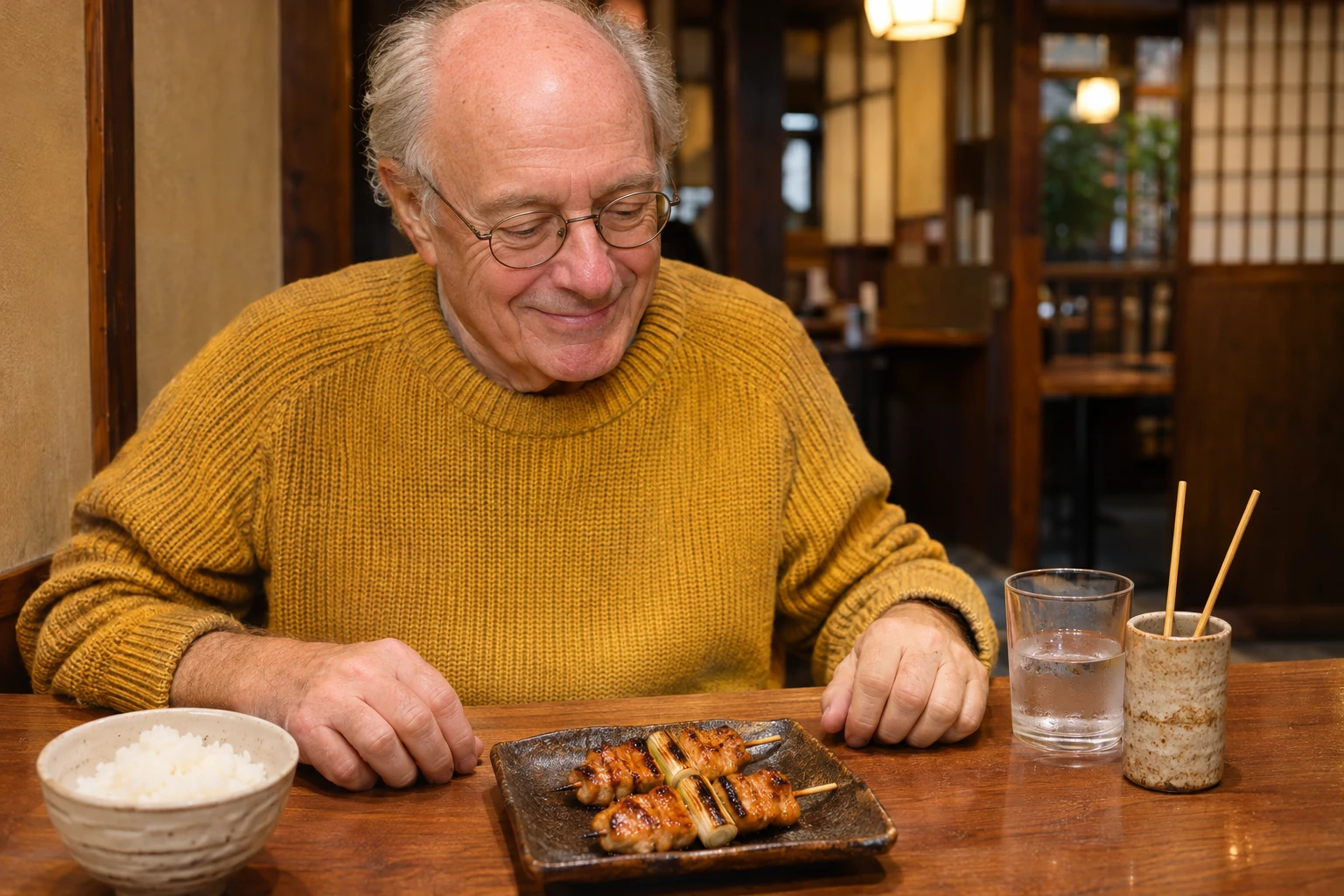
Featured image: AI-generated yakitori illustration; not a photograph of a named restaurant or its dishes.
For a first yakitori order, choose a chicken cut, pick salt or sauce, and check how many skewers one order contains. Momo is thigh, negima adds pieces of scallion, and tsukune is a chicken meatball. Start with a small order, then add more if you want it.
The price beside a picture may buy one stick or a plate containing two. At Torikizoku, the current official menu lists ¥410 including tax per item, with yakitori served as two skewers per order. Check the menu in front of you before multiplying a price by the number of diners.
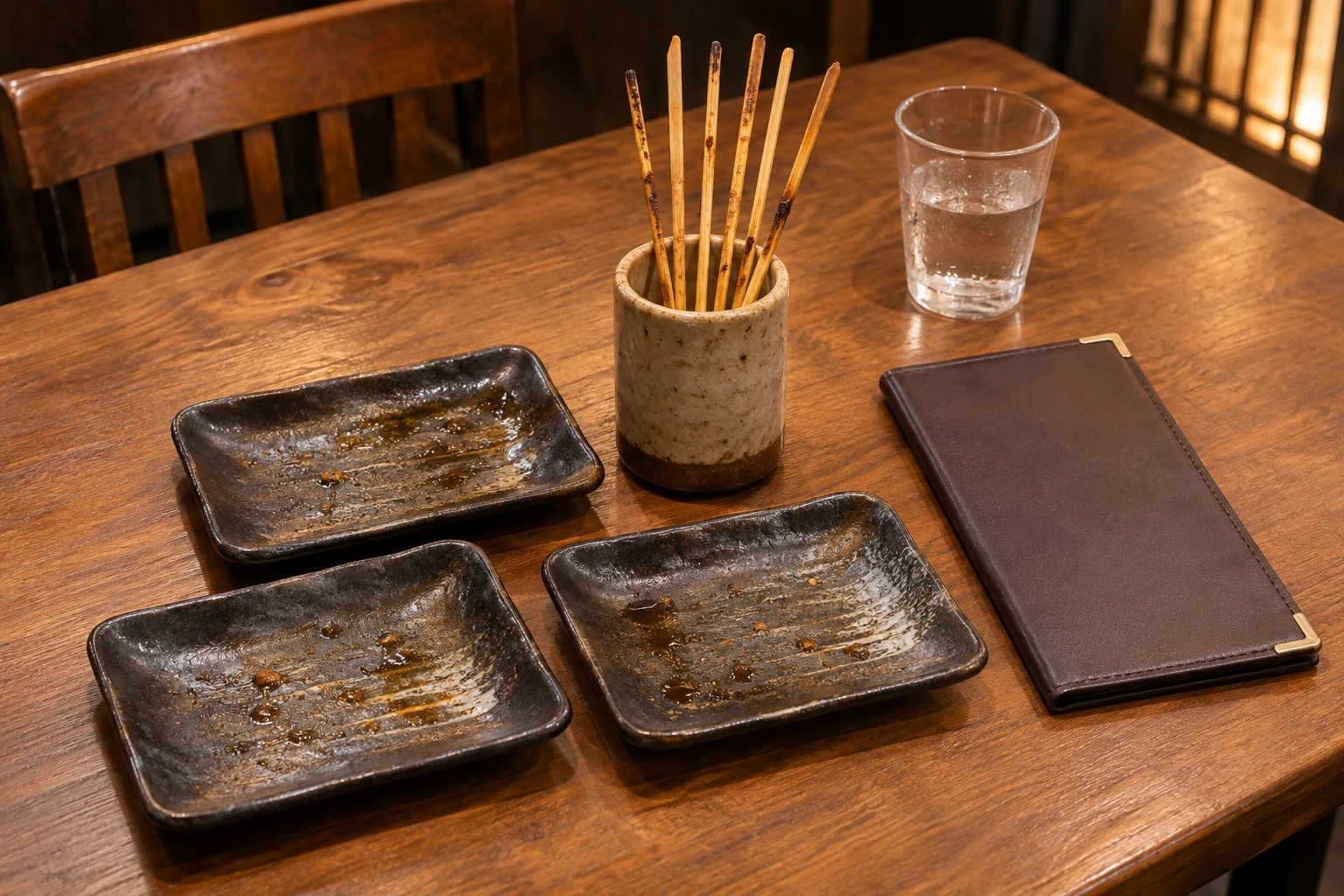
Official information checked November 3, 2026. This is a researched ordering guide. Prices below are dated Torikizoku examples, not a Japan-wide price range or a checked meal receipt. All images are AI-generated concepts and show no named restaurant, exact product or live ordering screen.
- Choose chicken skewers before choosing a restaurant
- Recognize a few cuts and their textures
- Pick shio or tare
- Read the unit: one stick or one plate?
- Calculate a bill from the current menu
- Order a small first round
- Keep the sticks and table manageable
- Check the branch before making it your dinner plan
- Check ingredients and ask for fully cooked chicken
- Frequently asked questions
- What should I order for my first yakitori?
- Does yakitori only mean chicken breast?
- Is shio spicy?
- Does one order mean one skewer?
- Is Torikizoku still ¥390?
- Can I buy a single Torikizoku skewer for ¥205?
- Does every yakitori restaurant have no table charge?
- Is salt-seasoned yakitori suitable for my dietary restriction?
- Do these pictures show Torikizoku food?
- Official sources
Choose chicken skewers before choosing a restaurant
Yakitori (焼き鳥) means grilled chicken skewers. Menus can include muscle meat, skin and organs, so “chicken” alone tells you little about the texture. A skewer menu may also include vegetables or other meats. Read the item name rather than assuming everything in the section is the same ingredient.
For an uncomplicated introduction, our suggestion is to find a menu with pictures, written prices and individual orders. If you are considering a set course, check its contents, total price and extra-order rules before booking. A photo of several skewers does not establish that you can buy each one separately.
If you wanted beef grilled at your table, see our yakiniku guide. Here, the task is choosing cooked chicken skewers from the menu.
Recognize a few cuts and their textures
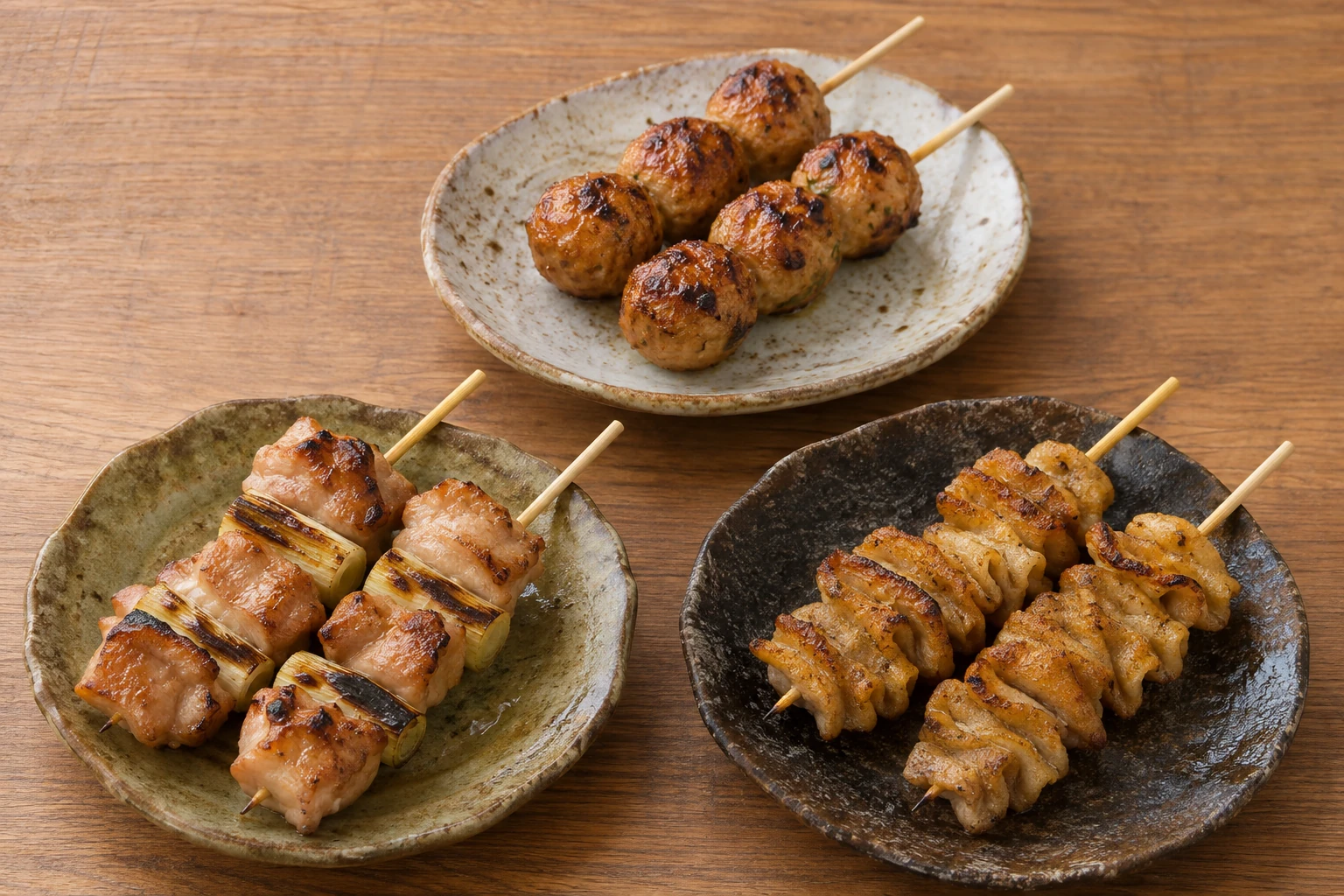
You can begin with two names and learn the rest later. The table is a recognition aid; recipes and English translations vary. Torikizoku’s Japanese skewer menu and English menu let you compare the names with photographs.
| Menu word | Cut or preparation | Useful first-choice clue |
|---|---|---|
| もも / momo | Chicken thigh | Start here if you want ordinary pieces of meat. |
| ねぎま / negima | Chicken and scallion on the same stick | Choose it if you want vegetables between the meat. |
| むね / mune | Chicken breast | A leaner meat option; check the topping. |
| つくね / tsukune | Minced-chicken meatball | Check mixed ingredients, sauces and extras. |
| かわ / kawa | Chicken skin | A fatty, chewy or crisp texture depending on preparation. |
| 砂肝・砂ずり / sunagimo, sunazuri | Gizzard | A firm bite; choose deliberately if organs are unfamiliar. |
| ハツ / hatsu | Heart | A springy texture, distinct from breast or thigh. |
| レバー・きも / rebā, kimo | Liver | A richer, softer option. |
Our suggested starting combination is thigh or negima plus tsukune, if their ingredients suit you. Try one preparation before ordering several plates of an unfamiliar cut. Ask what is in an assortment if you want to avoid organs.
Pick shio or tare
Shio / 塩 means salt seasoning; tare / たれ is sauce. For a simple comparison, choose the same cut in both versions. The sauce gives a glazed surface, while the salt version makes it easier to compare the meat without that glaze. This is a suggested tasting exercise, not a rule about which is better.
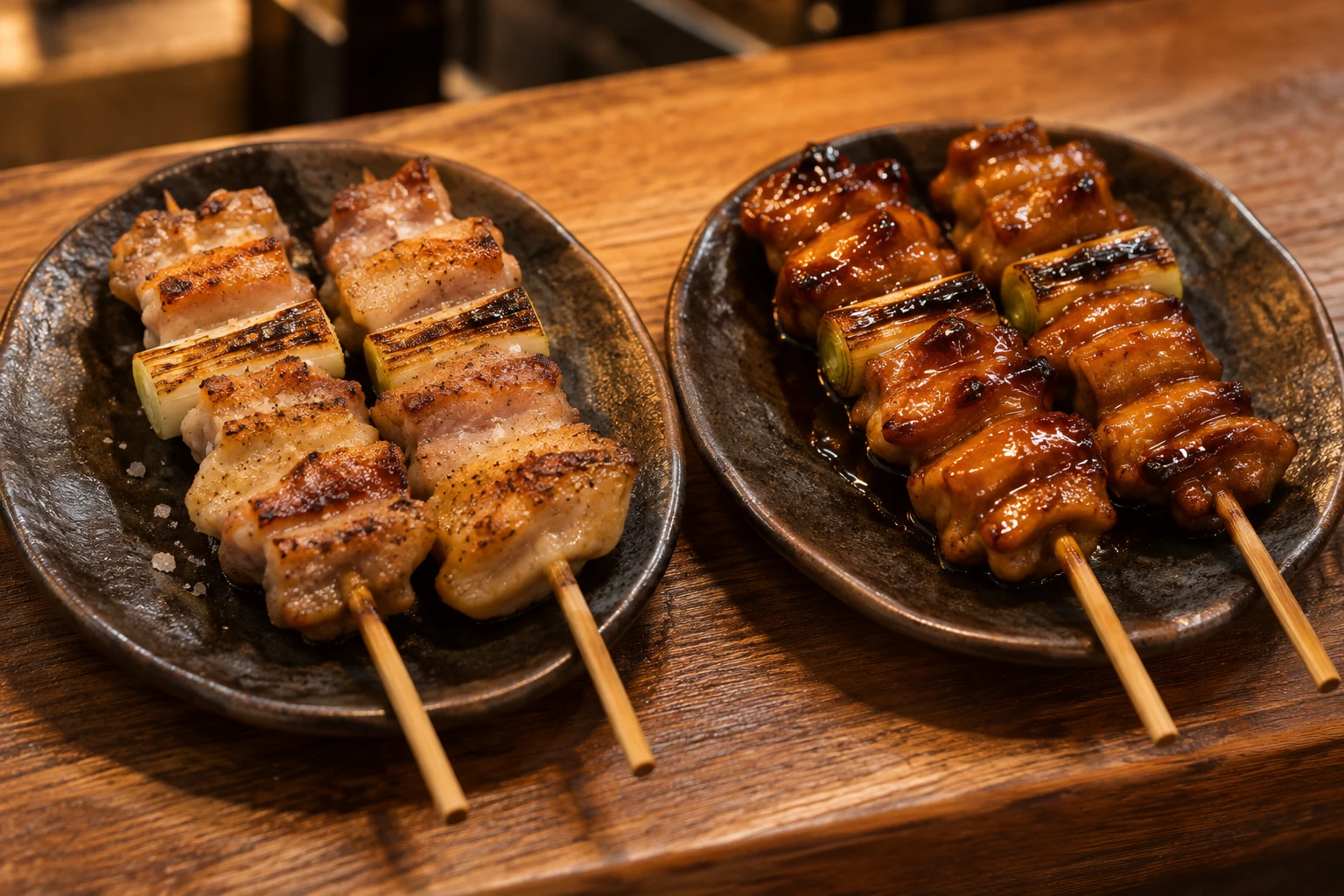
Torikizoku also lists a spice version of its Kizokuyaki chicken-and-scallion skewers. Match the seasoning to the exact item: a choice offered for thigh may not appear for another cut. Ask before requesting a combination absent from the menu.
Salt seasoning does not establish that a dish meets an allergy or dietary requirement. Check marinades, toppings and preparation as well as the finishing seasoning.
Read the unit: one stick or one plate?
Find the quantity beside the price. 1本 means one skewer; 2本 means two. 1皿 means one plate, so you still need to check what the plate contains. Point to the item and ask 一皿に何本ですか? / Hitosara ni nanbon desu ka? (“How many skewers are on one plate?”).
Our practical check is to say both the number of orders and the expected number of sticks. Two people who each select one two-skewer order will receive four skewers in total. Someone who presses “2” while intending two individual sticks may buy twice the food they expected.
Torikizoku’s official ordering guide states two yakitori skewers per order. Treat that as a chain-specific example. Use another restaurant’s own quantity and price, even if its dish photograph looks similar.
For a short spoken order, show the menu and say これを一皿ください。 / Kore o hitosara kudasai. (“One plate of this, please.”). To check the whole bill, ask 全部でいくらですか? / Zenbu de ikura desu ka? (“How much is everything?”). These phrases identify a quantity or price; tell staff about any food restriction separately, before the dish is prepared.
A sharing example for two people
Suppose you both want to taste negima and tsukune, and the menu sells each as two skewers per plate. Our suggested first order is one plate of each: four skewers altogether, with one of each kind for each diner if you choose to share. Confirm the portions first. Ordering two plates of each would bring eight skewers.
Decide together which items are shared before placing another round. If one person wants liver and the other does not, keep that choice separate rather than assuming an assortment suits both. Note the names or use the tablet’s order list when available. This is a planning example; the restaurant’s order minimum, serving format and sharing conditions still apply.
Calculate a bill from the current menu
The checked Torikizoku menu shows ¥410 per food or drink item, tax included. Build your estimate by counting order units. These examples use that listed price and ordinary individual orders:
| Example order | Calculation | Total |
|---|---|---|
| Two yakitori orders: four skewers | 2 × ¥410 | ¥820 |
| Those four skewers plus one drink item | 3 × ¥410 | ¥1,230 |
| Three yakitori orders: six skewers, plus one drink and one rice item | 5 × ¥410 | ¥2,050 |
These are arithmetic examples, not set offers or recommendations for a fixed appetite. At ¥410 for two skewers, the calculated equivalent is ¥205 per stick, but the menu sells the order. Do not assume you can purchase half an order at that price.
Torikizoku’s own description says it has no appetizer, seat or late-night service charge. Other restaurants need their own check. Ask about extra charges before sitting if your budget is tight; our izakaya guide explains otoshi and bills.
Order a small first round
Wait for staff to seat you, then identify how the restaurant takes orders. Pointing at a paper menu is useful when speaking; on a tablet, check the item and quantity before sending the order. Keep track of what you have already submitted.
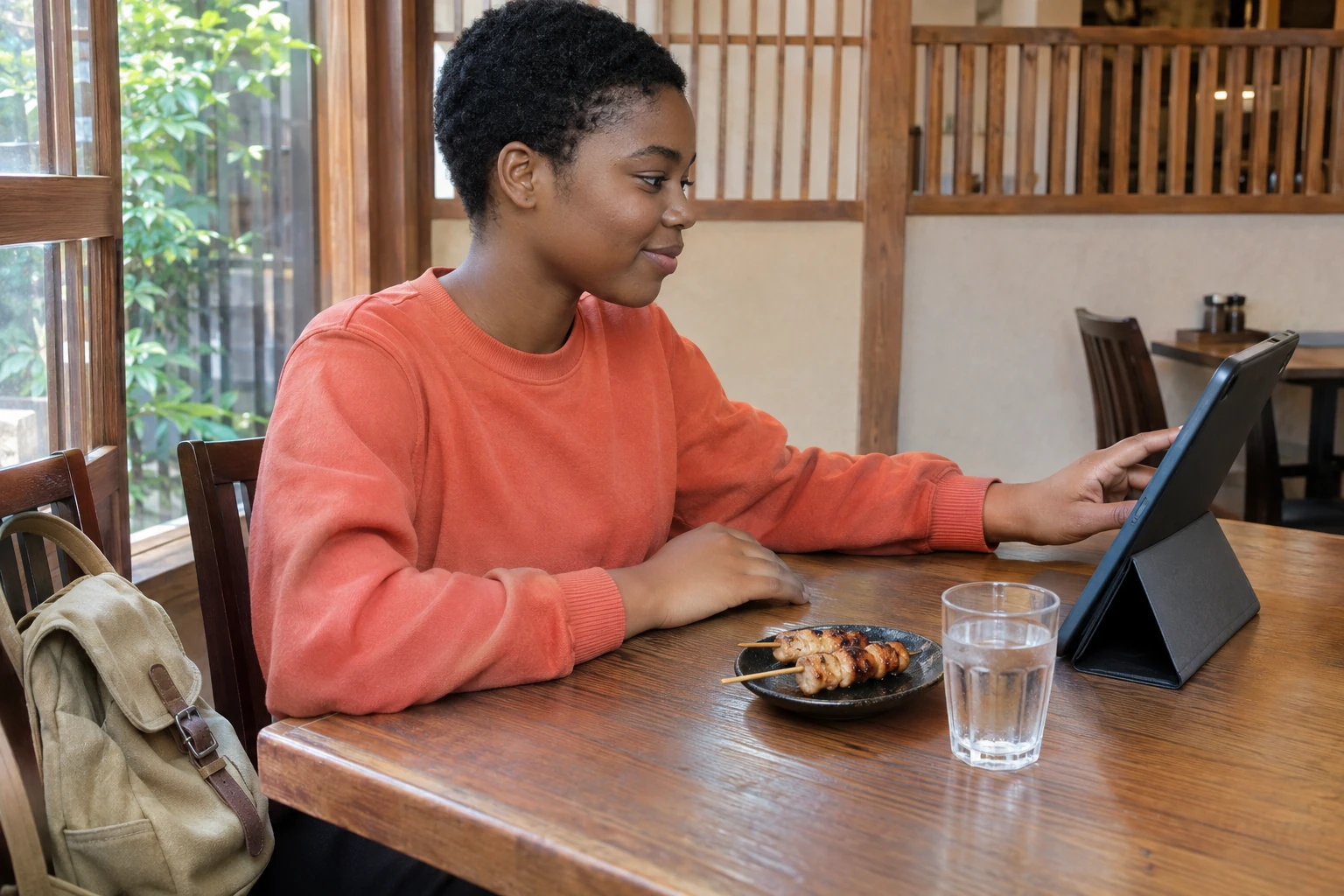
Our suggestion is to order a small round, see the portions, then decide whether to add more. If an item is slow to arrive, check with staff before submitting it again. A second order can create a second charge.
At Torikizoku, the ordering guide explains the tablet’s language switch and counter payment with the table’s bill binder. Choose a language you can read, and ask staff for help if the screen is unclear. Follow the branch’s actual instructions if equipment or service differs.
Keep the sticks and table manageable
Eat at a comfortable pace and keep the plate beneath the food. Ask for help if you want the pieces removed from a skewer; avoid wrestling with a stuck piece over someone else’s plate. Put the pointed sticks where they cannot roll onto a seat or into a bag.
Torikizoku asks diners to put used sticks in its skewer stand. At another restaurant, use the holder provided or ask staff. Keep your bag out of the aisle and leave room for new plates. You can add a rice dish if you want one; check its price and preparation time before ordering near departure.
Check the branch before making it your dinner plan
Use the official store finder to check the branch you intend to visit. Torikizoku’s FAQ says card acceptance and closing days vary by store. Carry a payment backup and confirm the current hours rather than relying on another branch’s listing.
The same FAQ says guests under 20 cannot enter unless accompanied by a guardian or someone aged 20 or over. No alcohol is served to guests under 20. Check this before choosing the chain for a student trip, including a solo visit.
For reservations, the English FAQ states a two-hour limit from the reserved time. Keep the confirmation email: its link handles changes or cancellation for online bookings. If the branch is full or its conditions do not suit your party, choose another nearby meal; our Tokyo restaurant Plan B can help you prepare an alternative.
Check ingredients and ask for fully cooked chicken
A plain-looking skewer is not an ingredient list. Torikizoku’s allergen information, updated November 1, 2026, warns that dishes share a kitchen and ingredients can mix during preparation. Check the current file for your exact item and discuss the requirement with staff before ordering. Use our food-allergy guide for broader planning.
Choose fully cooked chicken, including liver. Japan’s agriculture ministry warns about illness from raw or undercooked chicken; appearance or freshness cannot establish safety. If cooking seems uncertain, stop eating that item and ask staff to check it. Do not judge safety from an illustration in this guide.
Before leaving, compare the bill with the orders you submitted and query an unfamiliar line. Save the receipt if you need to resolve a question. Your first visit can stay simple: choose food you recognize, confirm the quantity and keep the whole order within your budget.
Frequently asked questions
What should I order for my first yakitori?
Our suggestion is momo or negima, then tsukune if its ingredients suit you. Check the order size before adding more.
Does yakitori only mean chicken breast?
No. Menus include thigh, skin and organs too. Read the cut name.
Is shio spicy?
Shio means salt. Check any extra seasoning; a separately labelled spice version is another choice.
Does one order mean one skewer?
Check the menu. Torikizoku states two yakitori skewers per order.
Is Torikizoku still ¥390?
The official pages checked on November 3 list ¥410 including tax per item. Recheck before your visit.
Can I buy a single Torikizoku skewer for ¥205?
¥205 is the calculated per-stick equivalent. The checked ordering guide specifies a two-skewer order.
Does every yakitori restaurant have no table charge?
Check each restaurant. Torikizoku’s no-charge statement is about its own service.
Is salt-seasoned yakitori suitable for my dietary restriction?
The seasoning name does not establish suitability. Verify ingredients and shared preparation for your exact dish.
Do these pictures show Torikizoku food?
No. They are AI-generated illustrations of generic ordering and dining scenes.
Official sources
Checked November 3, 2026. Recheck current menus and branch conditions before visiting.
- Torikizoku: English menu and prices; Japanese cut names; linked English menu PDF.
- Torikizoku: ordering; charges; Japanese FAQ; English FAQ; allergen information.
- MAFF: cook meat thoroughly.
Comments