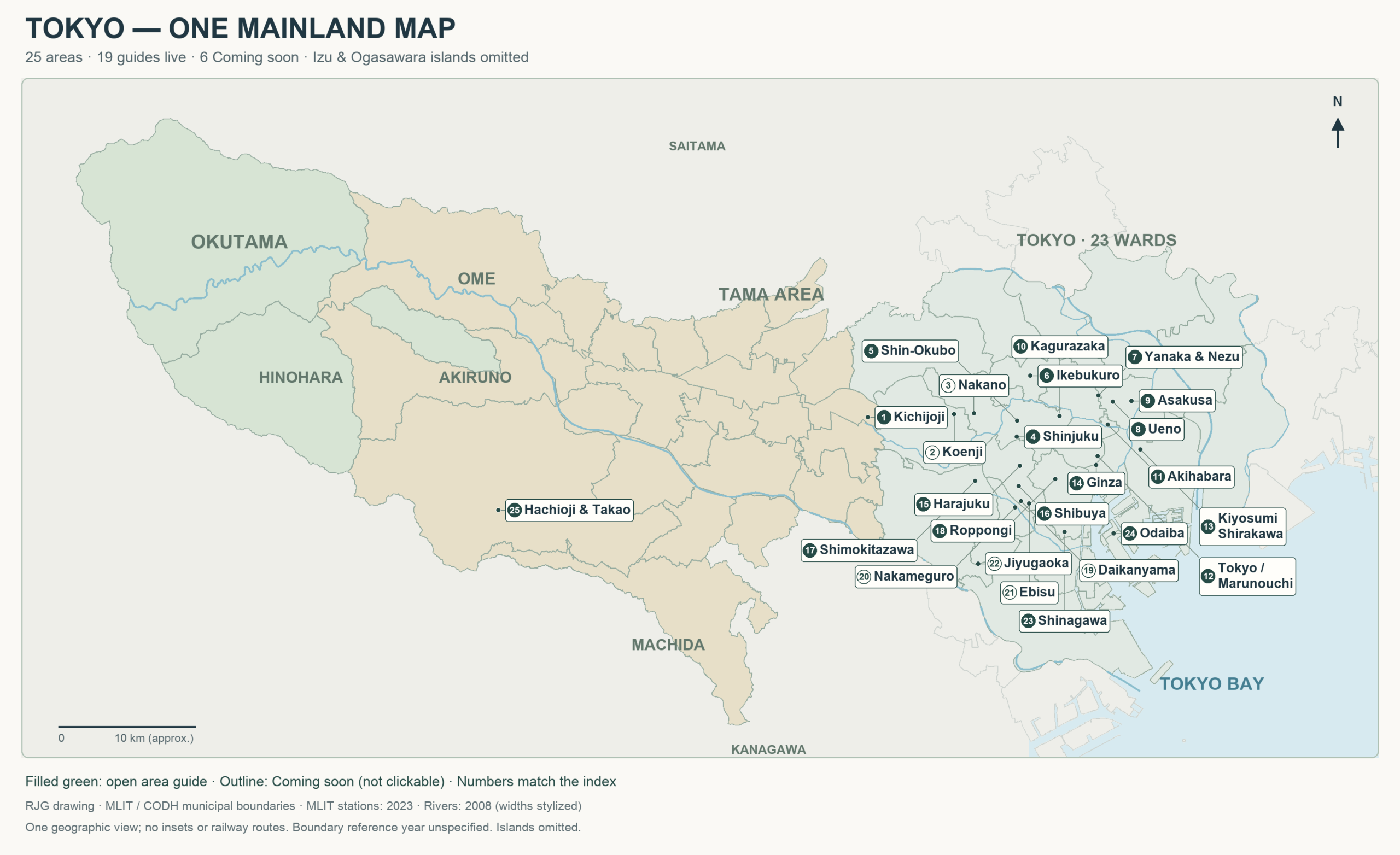
Tokyo becomes easier when you stop treating it as one city center. It is a network of major stations and distinct neighborhoods. Shinjuku, Shibuya, Tokyo Station, Ueno and Shinagawa are transport anchors; Asakusa, Ginza, Roppongi, Harajuku and Odaiba are destinations with very different atmospheres and access patterns.
The single map below covers all mainland Tokyo, from Okutama to the eastern wards, with 25 RJG visitor areas and guide candidates. Izu and Ogasawara islands are omitted. It is a geographic orientation map with representative station anchors; railway routes are not shown. Use it to choose a base and group nearby days, then check a route app for the exact train on the day you travel.
Quick answer: East Tokyo is best for traditional streets, temples, museums and Akihabara. West Tokyo is best for large entertainment hubs, fashion and nightlife. Central Tokyo is convenient for the Imperial Palace, Ginza and intercity trains. The south and bay side are useful for Haneda access, business hotels, waterfront attractions and Odaiba.
Time note: The times in this guide are approximate examples from Tokyo Station. They can change with the route, transfer, wait, platform and station entrance. A five-minute train ride can become a 20-minute hotel-to-destination move inside a large station.
One map of mainland Tokyo, from Okutama to the eastern wards; Izu and Ogasawara islands are omitted. Click a filled green name or number to open its individual area guide. Outlined names are Coming soon and are not links. Enlarge and scroll this same map. Keyboard: Tab to a guide link, Enter to open it. Open the full-size map.
 01 · Kichijoji — Open area guide04 · Shinjuku — Open area guide05 · Shin-Okubo — Open area guide06 · Ikebukuro — Open area guide07 · Yanaka & Nezu — Open area guide08 · Ueno — Open area guide09 · Asakusa — Open area guide10 · Kagurazaka — Open area guide11 · Akihabara — Open area guide12 · Tokyo / Marunouchi — Open area guide13 · Kiyosumi Shirakawa — Open area guide14 · Ginza — Open area guide15 · Harajuku — Open area guide16 · Shibuya — Open area guide17 · Shimokitazawa — Open area guide18 · Roppongi — Open area guide23 · Shinagawa — Open area guide24 · Odaiba / Tokyo Bay — Open area guide25 · Hachioji & Takao — Open area guide
25 areas: 19 individual guides live and 6 Coming soon. Only published individual guides are linked. If a label is difficult to tap, use the area index below. Representative station anchors; no railway or walking routes are drawn.
Map drawn by RJG from Historical Administrative Area Dataset Beta (CODH), doi:10.20676/00000447, based on MLIT administrative area data (CC BY 4.0); MLIT railway station data (2023); and MLIT river data (2008). Geometry is simplified for visitor orientation. The boundary reference year is not specified by the downloaded latest interface. River widths are stylized. This is not a railway route or navigation map.
- Tokyo geography in 60 seconds
- Tokyo areas at a glance
- East Tokyo: Asakusa, Ueno and Akihabara
- Central Tokyo: Tokyo Station, Marunouchi and Ginza
- West Tokyo: Shinjuku, Shin-Okubo, Shibuya and Ikebukuro
- South Tokyo: art districts, rail hubs and the bay
- Odaiba: bay walks, indoor stops and a fountain finale
- Western Tokyo: Hachioji & Takao
- Yanaka & Nezu: shrine, sculpture and small streets
- Harajuku: shrine forest, street style and local food
- Shimokitazawa: vintage lanes, small theaters and curry
- Kagurazaka: stone lanes, shrines and a downhill walk
- Kiyosumi Shirakawa: garden, Edo history, coffee and art
- More Tokyo neighborhoods: guides coming soon
- Where should you stay in Tokyo?
- Full RJG area guides
- Frequently asked questions
- Official sources checked
Tokyo geography in 60 seconds
The Imperial Palace is a useful visual anchor near the middle of central Tokyo. Tokyo Station and Marunouchi sit to its east. Ginza is just south-east of Tokyo Station. Akihabara and Ueno continue north, while Asakusa lies farther east near the Sumida River.
On the west side, Shinjuku, Harajuku and Shibuya form a strong sightseeing corridor. Shin-Okubo is immediately north of Shinjuku. Ikebukuro is farther north and works as another large rail and entertainment hub.
Roppongi is south-west of the Imperial Palace area but inside the Yamanote loop. Shinagawa is farther south on the rail corridor toward Haneda, Yokohama, Kyoto and Osaka. Odaiba sits away from the central rail loop on Tokyo Bay, reached by the Yurikamome or Rinkai Line rather than the Yamanote Line.
The Yamanote Line is a useful mental shortcut for first-time visitors because it connects Tokyo, Ueno, Akihabara, Ikebukuro, Shinjuku, Harajuku, Shibuya and Shinagawa. But it is not the boundary of Tokyo, and several useful areas are off the loop. Asakusa, Ginza, Roppongi and Odaiba need subway or non-JR connections.
Tokyo areas at a glance
| Area | Main station or access point | Approx. from Tokyo Station | Best known for | RJG guide |
|---|---|---|---|---|
| Asakusa | Asakusa | 20 min | Sensoji, Nakamise, traditional streets, river walks | Open guide |
| Ueno | Ueno | 8 min | museums, park, zoo, Ameyoko, airport access | Open guide |
| Akihabara | Akihabara | 4 min | anime, games, electronics, hobby shopping | Open guide |
| Tokyo / Marunouchi | Tokyo | — | Shinkansen, Imperial Palace side, architecture, business district | Open guide |
| Ginza | Ginza / Yurakucho | 3–10 min | department stores, cafes, kabuki, polished evening walks | Open guide |
| Roppongi | Roppongi | 25–30 min | art museums, skyline views, dining, nightlife | Open guide |
| Shinjuku | Shinjuku | 14 min | skyscrapers, shopping, nightlife, highway buses | Open guide |
| Shin-Okubo | Shin-Okubo | 30 min | Korea Town, international food, halal shops | Open guide |
| Shibuya | Shibuya | 23 min | crossing, fashion, shopping, youth culture | Open guide |
| Ikebukuro | Ikebukuro | 17–24 min | shopping, anime, Sunshine City, suburban rail links | Open guide |
| Shinagawa | Shinagawa | 13 min | Tokaido Shinkansen, Haneda access, business hotels | Open guide |
| Odaiba / Tokyo Bay | Tokyo Teleport / Daiba / Odaiba-kaihinkoen | 30 min | bay views, malls, museums, family attractions | Open guide |
| Kichijoji | Kichijoji | Check live route | Inokashira Park, shopping and food | Open guide |
| Koenji | Koenji | Check live route | Vintage shops and alternative music | Coming soon |
| Nakano | Nakano | Check live route | Anime, manga and Nakano Broadway | Coming soon |
| Yanaka & Nezu | Nezu / Nippori | Check live route | Shrine, sculpture and neighborhood food | Open guide |
| Kagurazaka | Kagurazaka / Iidabashi | Check live route | Backstreets, traditional dining and cafes | Open guide |
| Kiyosumi Shirakawa | Kiyosumi-shirakawa | Check live route | Coffee, gardens and contemporary art | Open guide |
| Harajuku | Harajuku / Meiji-jingumae | Check live route | Meiji Jingu, street style and neighborhood food | Open guide |
| Shimokitazawa | Shimokitazawa | Check live route | Vintage shops, live music and cafes | Open guide |
| Daikanyama | Daikanyama | Check live route | Boutiques, bookstores and brunch | Coming soon |
| Nakameguro | Nakameguro | Check live route | Meguro River walks, cafes and shops | Coming soon |
| Ebisu | Ebisu | Check live route | Dining, galleries and Yebisu beer heritage | Coming soon |
| Jiyugaoka | Jiyugaoka | Check live route | Lifestyle shops, cafes and sweets | Coming soon |
| Hachioji / Takao | Hachioji / Takaosanguchi | Check live route | Separate city and mountain visits | Open guide |
East Tokyo: Asakusa, Ueno and Akihabara
East Tokyo is the easiest cluster for combining traditional sightseeing, museums and pop culture. The three areas are close on the map but they are not interchangeable.
Asakusa: traditional Tokyo and the Sumida River
Asakusa is a strong choice for Sensoji Temple, Nakamise shopping street, rickshaws, traditional snacks and views toward Tokyo Skytree. It feels lower-rise and more historical than Shinjuku or Shibuya, especially early in the morning before the busiest visitor period.
Useful access points include Asakusa stations served by the Tokyo Metro Ginza Line, Toei Asakusa Line, Tobu Skytree Line and Tsukuba Express. These are separate station facilities, so check the operator and exit rather than following the word “Asakusa” by itself.
Allow roughly 20 minutes from Tokyo Station under a simple route, then add walking and transfer time. Asakusa pairs naturally with Ueno, Tokyo Skytree or a Sumida River trip. Use the Asakusa Quick Guide to put Sensoji, Nakamise and the river side in walking order.
Ueno: museums, park space and Ameyoko
Ueno is a practical north-east Tokyo hub. Ueno Park contains major museums, cultural institutions and the zoo, while Ameyoko provides a dense shopping and food street beneath and beside the railway tracks.
Ueno Station is served by JR local lines, several Shinkansen services and the Tokyo Metro Ginza and Hibiya lines. Keisei Ueno, a short walk away, is useful for some Narita Airport journeys. This combination makes Ueno a good base for travelers who want Asakusa and Akihabara nearby without staying inside their busiest streets.
The JR ride from Tokyo Station can be about eight minutes. The full hotel transfer will be longer, but Ueno is still one of the closest major visitor hubs to Tokyo Station.
Akihabara: anime, games and electronics
Akihabara sits south of Ueno and north of Tokyo Station. It grew from an electronics district into one of Tokyo’s strongest centers for anime, manga, games, figures, arcades and specialist hobby stores. The streets west of the JR station contain the most familiar “Electric Town” scenery; the east side is more businesslike.
Akihabara Station is served by the JR Yamanote, Keihin-Tohoku and Sobu lines, the Tokyo Metro Hibiya Line and the Tsukuba Express. The JR ride from Tokyo Station is about four minutes, which makes Akihabara easy to add to a central Tokyo day.
Many Akihabara shops open later in the morning, so the area works better from late morning into the evening than at sunrise. The Akihabara Quick Guide separates the Electric Town and station-side shopping zones and helps you choose exits.
Central Tokyo: Tokyo Station, Marunouchi and Ginza
Central Tokyo is the best cluster for travelers who prioritize intercity trains, the Imperial Palace area, refined shopping and efficient movement in several directions.
Tokyo Station and Marunouchi: the national rail anchor
Tokyo Station is the time reference point in this guide because it connects multiple Shinkansen lines, JR local lines and the Tokyo Metro Marunouchi Line. The red-brick Marunouchi building faces the Imperial Palace side; the Yaesu side faces east toward Nihombashi and Ginza.
The station is a destination as well as a transfer point, with food, souvenir and shopping areas inside and below the complex. It is also large enough to consume time. “Arrive at Tokyo Station” does not mean you are immediately outside on the correct side. Budget extra minutes to find the Marunouchi, Yaesu or Nihombashi exit.
Stay around Tokyo Station when early Shinkansen departures, business appointments or simple airport and regional connections matter more than late-night neighborhood atmosphere.
Ginza: polished shopping and an easy evening walk
Ginza is immediately south of the Tokyo Station area. It is known for department stores, flagship shops, galleries, cafes and Kabukiza Theatre. The district feels formal and polished, but you do not need a luxury-shopping budget to enjoy the architecture, basement food halls or pedestrian streets.
Ginza Station is served by the Tokyo Metro Ginza, Marunouchi and Hibiya lines. Yurakucho Station on the JR Yamanote Line is nearby, and Higashi-ginza serves the Hibiya and Toei Asakusa lines. The choice of station should follow your first stop rather than the area name by itself.
The subway ride from Tokyo Station can take about three minutes, and walking from the south side of Tokyo Station is also realistic. Use the Ginza Quick Guide for a compact route through shopping, cafes, kabuki and evening streets.
West Tokyo: Shinjuku, Shin-Okubo, Shibuya and Ikebukuro
West Tokyo contains city scenes often associated with the capital: giant stations, bright crossings, department stores, fashion streets, skyline views and late-night entertainment. It is convenient but can feel overwhelming when a daily itinerary repeatedly crosses the city from east to west.
Shinjuku: transport giant by day, neon hub by night
Shinjuku combines several different districts around one enormous station. The west side has skyscrapers and the Tokyo Metropolitan Government Building. The east side leads toward major shopping streets and Kabukicho. The south side connects to newer commercial buildings and the Shinjuku Expressway Bus Terminal.
Shinjuku Station is served by JR, Tokyo Metro, Toei, Odakyu, Keio and other connected services. Station names such as Seibu-Shinjuku, Shinjuku-sanchome and Shinjuku-nishiguchi may be useful for a specific destination but are not the same platforms.
The fastest JR route from Tokyo Station is about 14 minutes. Inside-station navigation can take almost as long. Stay in Shinjuku for strong suburban and highway-bus connections, many hotel choices and late dining. Open the Shinjuku Quick Guide before choosing an exit.
Shin-Okubo: Korea Town beside Shinjuku
Shin-Okubo is one stop north of Shinjuku on the JR Yamanote Line. It is best known for Korean restaurants, street food, cosmetics, K-pop stores and a wider international food community. Islam Yokocho near the station adds halal grocers and South Asian and Southeast Asian flavors to the area.
Shin-Okubo Station is on the Yamanote Line, while nearby Okubo Station is on the Chuo-Sobu local line. The streets between them are walkable, but the distinction matters when planning a transfer.
GO TOKYO gives about 30 minutes from Tokyo Station and about five minutes from Shinjuku. It is easier to combine Shin-Okubo with Shinjuku than with Ginza or Asakusa. The Shin-Okubo Quick Guide includes a food-first route and a quieter side-street alternative.
Shibuya: fashion, shopping and nearby walks
Shibuya and Harajuku are close enough to combine, but each deserves its own starting point. Shibuya centers on the Scramble Crossing, large-scale shopping, music, nightlife and an expanding skyline. Harajuku centers on Meiji Shrine, Takeshita Street, street fashion and the approach toward Omotesando.
Shibuya Station is served by JR, Tokyo Metro, Tokyu and Keio lines. Harajuku Station is on the JR Yamanote Line; Meiji-jingumae connects to the Tokyo Metro Chiyoda and Fukutoshin lines. Walking from Harajuku toward Shibuya through Cat Street can be more enjoyable than taking one short train ride.
From Tokyo Station, allow roughly 23 minutes to Shibuya or 26 minutes to Harajuku under simple routes. From Shinjuku, both are much closer. Use the Shibuya Quick Guide for a half-day route, then extend north toward Harajuku if your energy and daylight allow.
Ikebukuro: a northern entertainment and rail hub
Ikebukuro is north of Shinjuku on the Yamanote Line. It is a major shopping, entertainment and transfer center, with Sunshine City, anime retail—especially for female audiences—and large department stores around the station.
The station is served by JR, Tokyo Metro, Seibu and Tobu lines. It is especially useful for travelers whose plans extend into north-west Tokyo or Saitama. From Tokyo Station, GO TOKYO gives examples of about 17 minutes by Metro or 24 minutes by JR, while Shinjuku is about eight minutes away.
Choose Ikebukuro as a base when west-side access and hotel value matter more than being near the Imperial Palace or Asakusa. It is less efficient for repeated Odaiba or bay-side days.
Kichijoji: park, shopping and food
Kichijoji sits west of Shinjuku. Combine Inokashira Park with the station-side shopping streets and a food stop. Open the Kichijoji Quick Guide for a proposed half-day route and practical shop details.
South Tokyo: art districts, rail hubs and the bay
South Tokyo is not one straight sightseeing corridor. Roppongi is an inner-city art and nightlife district, Shinagawa is a rail and hotel hub, and Odaiba is a waterfront destination on separate lines.
Roppongi: museums, views and nightlife
Roppongi combines the Mori Art Museum and Tokyo City View around Roppongi Hills, the National Art Center, Tokyo and other museums with a large dining and nightlife scene. It is one of the best areas for moving from an afternoon exhibition into an evening view or dinner.
Roppongi Station is served by the Tokyo Metro Hibiya Line and Toei Oedo Line. Roppongi-itchome on the Namboku Line serves a different side of the district. There is no JR station, which is why Roppongi can look close on a map but require a transfer from Tokyo Station.
Allow roughly 25–30 minutes from Tokyo Station depending on the route. The Roppongi Quick Guide connects key museums and an evening loop without unnecessary backtracking.
Shinagawa: Shinkansen and Haneda-friendly base
Shinagawa is a major business and transport hub south of central Tokyo. It is served by JR lines, the Keikyu Line and the Tokaido Shinkansen. This makes it practical for Haneda Airport, Yokohama and westbound Shinkansen trips to Nagoya, Kyoto and Osaka.
The JR ride from Tokyo Station is about 13 minutes, and Shibuya is about 14 minutes away. The immediate station area has business hotels, dining and an aquarium, while the wider Shinagawa and Tennozu area includes waterfront art and older streets.
Shinagawa is a strong base when transport efficiency matters. It is less compelling if your entire itinerary centers on Asakusa, Ueno and north-east Tokyo.
Open the Shinagawa Quick Guide to choose Takanawa or Konan, store luggage first and follow one half-day route.
Odaiba: bay walks, indoor stops and a fountain finale
The Odaiba Quick Guide combines the waterfront, Hachitama, retro shopping, The Gundam Base Tokyo and Tokyo Aqua Symphony with six food choices. Check the current closure and entry notices: Miraikan is closed for refurbishment and the outdoor Unicorn statue display has ended.
Odaiba is a reclaimed-land waterfront district with bay views, shopping malls, museums and family entertainment. Its open spaces and seaside atmosphere feel different from the dense streets around Shinjuku, Ginza or Asakusa.
There is no single station for the entire Odaiba district. Tokyo Teleport is on the Rinkai Line; Daiba and Odaiba-kaihinkoen are on the Yurikamome. Choose the station after choosing the attraction. The Yurikamome route from Shimbashi also provides an elevated view over the bay and Rainbow Bridge approaches.
Allow around 30 minutes from Tokyo Station to an Odaiba access station, plus local walking. Do not use Odaiba as a quick gap-filler between central sights. It works better as a half-day or full-day cluster.
Western Tokyo: Hachioji & Takao
Choose a city afternoon around Hachioji Station, or a mountain half-day from Takaosanguchi. These are separate destinations. The Hachioji & Takao Quick Guide covers five sights, six food options and a cable-car route that turns back at Yakuo-in.
Yanaka & Nezu: shrine, sculpture and small streets
The Yanaka & Nezu Quick Guide connects Nezu Shrine, Ueno Sakuragi Atari, Yanaka Cemetery, Asakura Museum and Yanaka Ginza, with six food options and a suggested half-day route from Nezu to Nippori. Check the museum closure notice before planning your visit.
Harajuku: shrine forest, street style and local food
The Harajuku Quick Guide connects Meiji Jingu, Takeshita Street, HARAKADO and Cat Street, with optional Yoyogi Park, six food choices and a suggested five-hour walk. Choose one lunch and one sweet stop; check the linked shop notices before leaving.
Shimokitazawa: vintage lanes, small theaters and curry
The Shimokitazawa Quick Guide connects Ichibangai, reload, Mikan Shimokita, Honda Theater and BONUS TRACK with six food choices and a suggested half-day walk. Choose one lunch and one break; performances need their own ticket and time.
Kagurazaka: stone lanes, shrines and a downhill walk
The Kagurazaka Quick Guide connects Akagi Shrine, Zenkoku-ji and the stone-paved lanes with a lunch and an Iidabashi finish. Choose from six food options, check the exact branch and monthly closure notices, and keep eating outside shrine grounds unless using the cafe.
Kiyosumi Shirakawa: garden, Edo history, coffee and art
The Kiyosumi Shirakawa Quick Guide offers a garden-to-river half-day, Fukagawa Edo Museum and six food options. Choose the westward river finish or an eastward MOT and Kiba Park alternative; museum closures and cafe service hours differ.
More Tokyo neighborhoods: guides coming soon
These individual RJG area guides are not yet published. Coming soon entries are not links, and there is no announced release date.
Koenji — Coming soon
Vintage shops and alternative music
Nakano — Coming soon
Anime, manga and Nakano Broadway
Daikanyama — Coming soon
Boutiques, bookstores and brunch
Nakameguro — Coming soon
Meguro River walks, cafes and shops
Ebisu — Coming soon
Dining, galleries and Yebisu beer heritage
Jiyugaoka — Coming soon
Lifestyle shops, cafes and sweets
Where should you stay in Tokyo?
Choose a base from your repeated journeys, not from a list of famous neighborhoods.
- First trip with mixed sightseeing: Shinjuku, Shibuya, Ueno and the Tokyo Station area can each work. Choose east or west based on where most of your saved places sit.
- Asakusa, temples and museums: Asakusa or Ueno reduces daily cross-city travel.
- Nightlife and late dining: Shinjuku, Shibuya or Roppongi keeps the final trip short. Check the exact distance from the station because late-night taxis across a large district can add cost.
- Early Shinkansen: Tokyo Station or Shinagawa. Use Tokyo for northbound and broad national connections; Shinagawa is especially useful for the Tokaido Shinkansen and Haneda side.
- Haneda Airport: Shinagawa is the simplest major base in this list. Shibuya and Shinjuku remain workable but need more time.
- Narita Airport: Ueno can be convenient through Keisei Ueno, while Tokyo, Shinjuku and Shibuya have other rail and bus options. Compare your exact terminal and hotel.
- Anime and games: Akihabara for the classic electronics-and-hobby district; Ikebukuro for another major retail cluster; Nakano can be added later but is included among the future guide candidates below.
- Family attractions and bay views: Odaiba works for the activity day, but central Tokyo or Shinagawa may be a more flexible hotel base.
The most common planning mistake is choosing a hotel because the ward name says “Tokyo” or because the nightly rate is low. Check walking time to the actual station, number of transfers to your top three areas and the final train after dinner.
Full RJG area guides
This page tells you where each district sits and how the city fits together. The Quick Guides tell you what to do after you arrive.
- Asakusa Quick Guide — Sensoji, Nakamise, river side and a practical walking order.
- Shibuya Quick Guide — Hachiko, the crossing, viewpoints and a half-day route.
- Shinjuku Quick Guide — west-side skyline, east-side neon and the exits between them.
- Akihabara Quick Guide — Electric Town, anime and game shopping zones.
- Shin-Okubo Quick Guide — Korean food, K-culture and a calmer Plan B.
- Ginza Quick Guide — shopping, cafes, kabuki and polished city walks.
- Roppongi Quick Guide — museums, views and an evening route.
- Tokyo Station & Marunouchi Quick Guide — choose the west-side exit, avoid luggage backtracking and keep an indoor Plan B.
- Ueno Quick Guide — museums, Ueno Park, Ameyoko and practical station choices.
- Shinagawa Quick Guide — Takanawa or Konan exit choice, luggage-first planning and two practical half-day routes.
- Ikebukuro Quick Guide — station-side shopping and entertainment.
- Kichijoji Quick Guide — Inokashira Park, shopping and food.
- Hachioji & Takao Quick Guide — separate city and mountain visits, five sights, six food stops and a cable-car half-day.
- Yanaka & Nezu Quick Guide — shrine paths, sculpture, six food options and a Nezu-to-Nippori half-day walk.
Kichijoji and Ikebukuro have full Quick Guides. All 19 published guides are also collected in the Tokyo Area Guides directory. Areas marked Coming soon above are future guide candidates.
If your next move is outside Tokyo, continue with Japan Travel Times From Tokyo: Train vs Plane. It compares the scheduled segment with a more realistic hotel-to-hotel planning block.
Frequently asked questions
What is the best area of Tokyo for a first-time visitor?
There is no single best area. Shinjuku is strong for west Tokyo, buses and nightlife; Ueno is strong for Asakusa, museums and north-east Tokyo; Tokyo Station is strong for Shinkansen and central access; Shibuya is strong for fashion and nightlife. Choose the area that reduces your repeated trips.
Is Shibuya close to Shinjuku?
Yes. The JR Yamanote Line connects them in roughly seven minutes on a simple ride. Harajuku sits between them. Add time for the walk inside each station and from the exit to your destination.
Is Asakusa near Shinjuku or Shibuya?
No. Asakusa is in east Tokyo, while Shinjuku and Shibuya are on the west side. A cross-city trip is easy by train but can take roughly 35–50 minutes door to door after transfers and walking.
Is Tokyo Station in the center of Tokyo?
It is a central transport anchor beside Marunouchi and east of the Imperial Palace, but Tokyo has several major centers. Shinjuku, Shibuya, Ikebukuro and Ueno are also major hubs with their own surrounding districts.
Can I walk between Tokyo Station and Ginza?
Yes. The south side of Tokyo Station and northern Ginza are close enough for many travelers to walk. The useful distance depends on the exact exit and shop. Subway or JR to Yurakucho may be easier with luggage or in bad weather.
Is Odaiba on the Yamanote Line?
No. Use the Rinkai Line for Tokyo Teleport or the Yurikamome for stations such as Daiba and Odaiba-kaihinkoen. Choose the station based on the attraction you want to visit.
Should I stay near Tokyo Station or Shinjuku?
Stay near Tokyo Station for Shinkansen, Marunouchi, Ginza and east-side access. Stay near Shinjuku for west Tokyo, nightlife, suburban rail and highway buses. Either can reach the other quickly, but the station-to-hotel walk and daily direction matter.
How many Tokyo areas should I plan in one day?
Plan one primary cluster and one nearby secondary area. Asakusa–Ueno, Ueno–Akihabara, Tokyo Station–Ginza, Shinjuku–Shin-Okubo and Harajuku–Shibuya are efficient pairings. Crossing from Asakusa to Shibuya and then to Odaiba in one day wastes useful time.
Official sources checked
Candidate descriptions retain the GO TOKYO source checks of October 11, 2026. Individual guide publication status was checked against RJG’s current Pages and Posts inventory on October 20, 2026: 19 published Quick Guide Pages and 6 Coming soon areas. Seasonal event articles are not counted as individual area guides. Existing example journey times below retain their earlier source date; no new travel-time estimates have been added.
Area characterizations, example travel times and access details were checked against the Official Tokyo Travel Guide’s area directory and its individual pages for the 12 areas on July 22, 2026. Rail lines were cross-checked with Tokyo Metro’s route information and JR East’s official metropolitan maps.
This page is an orientation guide, not a live timetable. Routes, station construction, attraction access and travel times can change. Confirm the exact route shortly before departure.