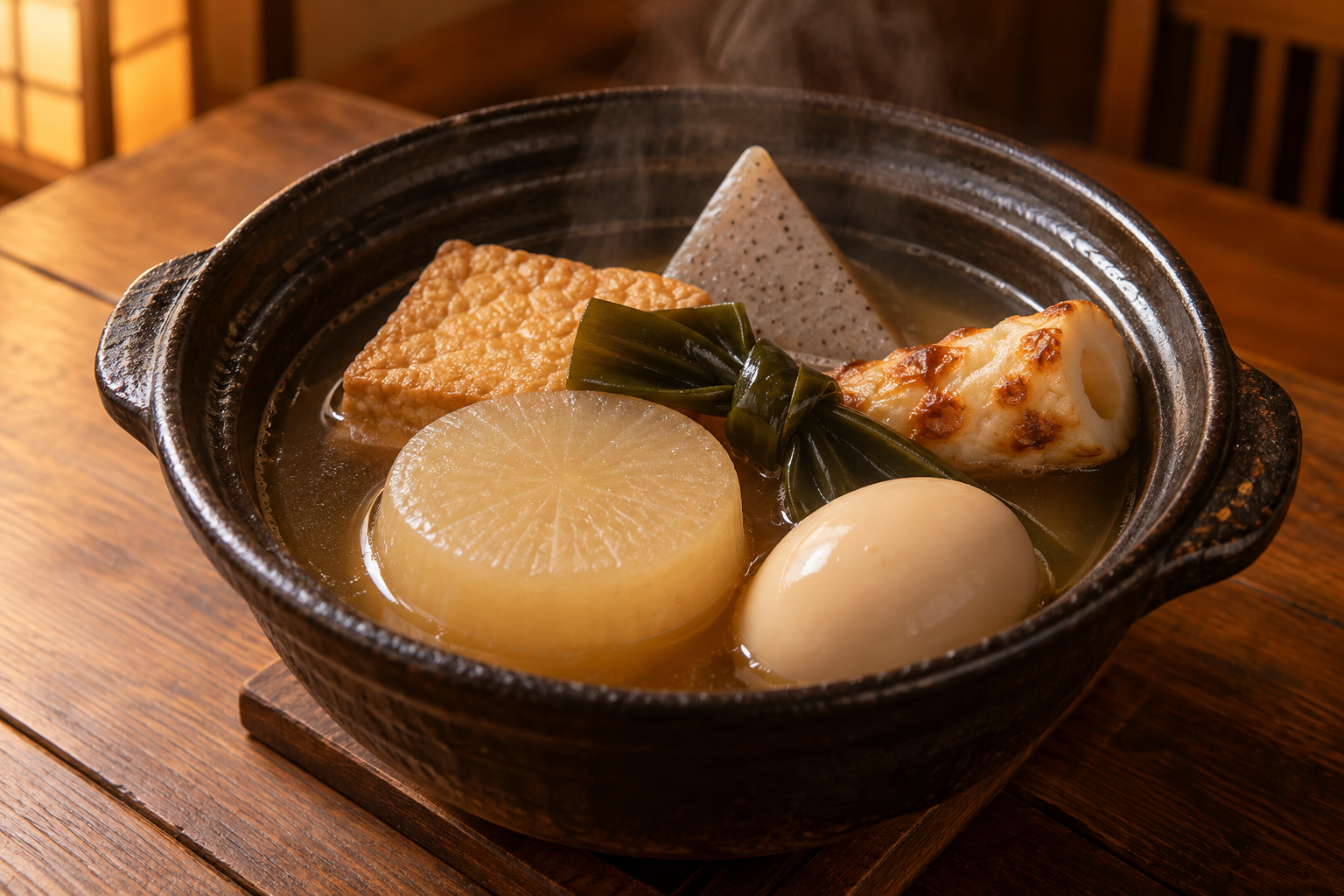
Featured image: AI-generated oden illustration; not a photograph of a real restaurant or convenience-store product.
Oden (おでん) is a dish of ingredients simmered in seasoned broth. For a small first order, try daikon radish, an egg and one fish cake, after checking any dietary needs. At a convenience-store pot, ask staff how to order before taking the utensils. A sealed pack may be a ready meal or ingredients for cooking; read its preparation instructions before paying.
Official information checked October 30, 2026. This is a researched ordering guide, not a tasting report. Prices below are dated examples; stock and recipes vary. All images are conceptual AI illustrations and do not identify a chain, branch or actual package.
- Choose a hot bowl, a ready meal or cooking ingredients
- Recognize the ingredients before choosing
- Order at the counter without guessing the service rules
- Budget by the piece: a ¥440 example
- Check the broth as well as the visible food
- Read the heating instructions on a packed meal
- At a restaurant, read the assortment and the bill
- Expect regional differences, including Shizuoka’s dark broth
- Frequently asked questions
- Official sources
Choose a hot bowl, a ready meal or cooking ingredients
Start by deciding where you will eat and what equipment you have. A traveler returning to a hotel with no kitchen needs a different product from someone cooking in an apartment. The word おでん on the front does not answer that question.
| What you find | What to check |
|---|---|
| A heated counter pot | Ask whether staff serve you, which pieces are available, and the price per item. |
| A sealed prepared meal | Check whether it is fully cooked, its storage conditions and the permitted heating method. |
| Separate ingredient packs | Check what cooking or assembly is needed and whether broth is included. |
| An oden restaurant | Read whether you are ordering individual pieces or an assortment; check the full bill. |
The current Lawson and 7-Eleven catalogues show store-cooked oden, but an online listing does not establish that your nearest branch has a pot operating now. Check at the counter. If the shop has none, decide whether a suitable pack or another meal will do, rather than walking from branch to branch while hungry.
Recognize the ingredients before choosing
Save a few names you want to try. Shapes help you point, while the written name helps distinguish similar-looking foods. This is an identification guide, not an allergen list: preparation and broth can change what the finished item contains.
| Menu word | What you are looking for |
|---|---|
| 大根 / daikon | A thick round of white radish, softened by simmering. |
| たまご・玉子 / tamago | A peeled boiled egg, often lightly coloured by the broth. |
| こんにゃく / konnyaku | Firm konjac jelly, often grey and cut into triangles or blocks. |
| 白滝 / shirataki | Thin konjac strands, sometimes tied into a small bundle. |
| 焼ちくわ / yaki-chikuwa | A tubular fish cake with a browned surface and a hollow centre. |
| ちくわぶ / chikuwabu | A pale wheat-flour ingredient, often with a ridged outer edge and a hole. |
| 厚揚げ / atsuage | A block of fried tofu; check the seasoning and shared broth. |
| はんぺん / hanpen | A light, soft fish cake; its pale colour does not make it tofu. |
Kibun’s product descriptions explain the fish-cake categories. For the easily confused wheat ingredient, Fukuya’s chikuwabu product page lists wheat flour and wheat as the allergen. Chikuwa and chikuwabu have similar names but are different foods. Check the actual product if avoiding either fish or wheat.
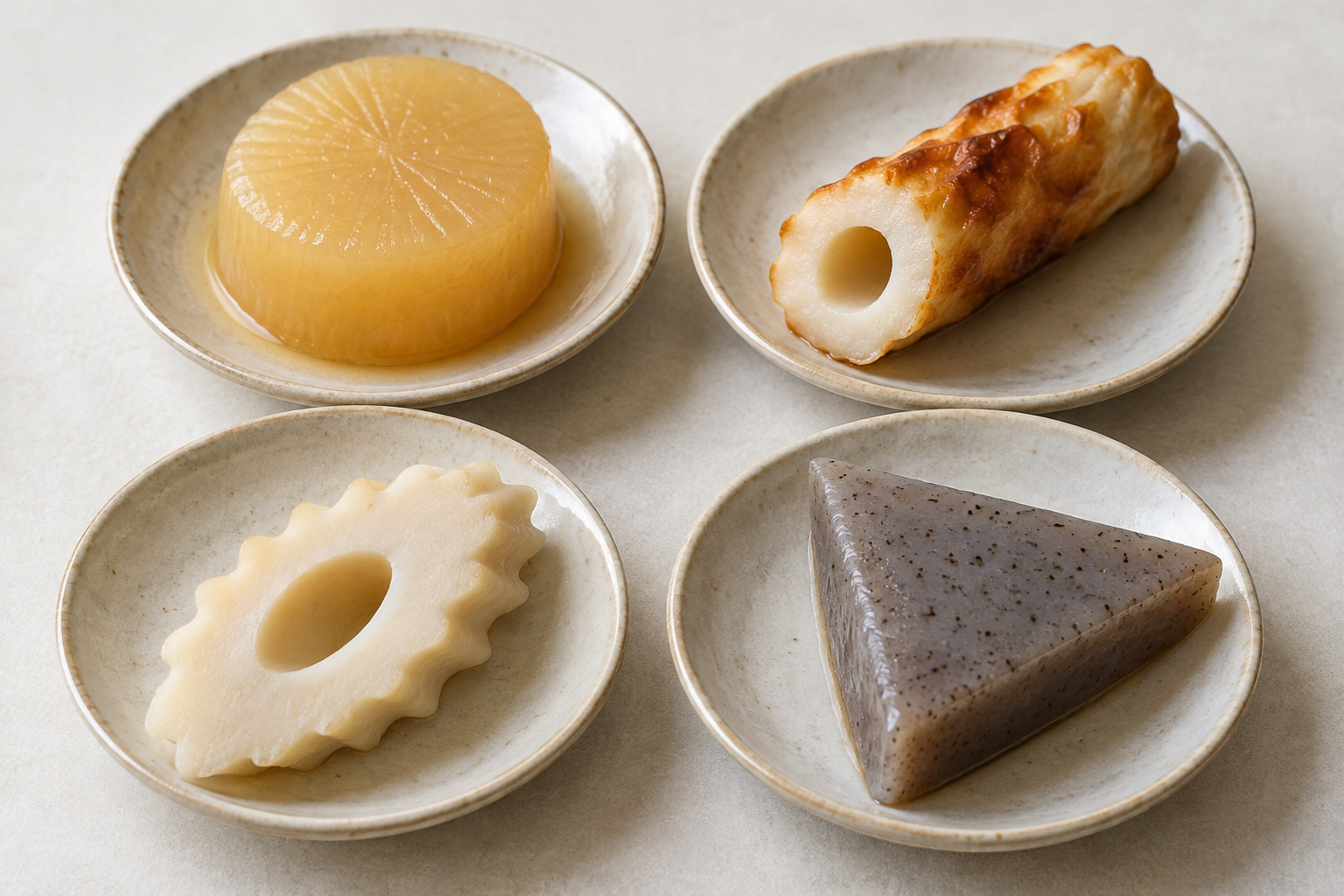
For a first tasting, our suggestion is one radish, one egg and one fish cake, if suitable for you. It lets you compare a vegetable, an egg and a processed fish product without ordering the whole pot. If you prefer a firmer bite, consider konnyaku; if the texture is unfamiliar, buy one piece before adding more. This is a suggested tasting order, not a claim that three pieces make a complete dinner.
Order at the counter without guessing the service rules
- Find the available items and prices. Point to the item card as well as the food if two pieces look alike. Ask about an unclear price before the order is served.
- Speak to staff first. Say that you would like oden and show your chosen names. Use customer utensils only if the shop indicates that you should. An open pot alone is not an invitation to reach in.
- Give the quantity. Point to each choice and say one or two. Wait for confirmation before adding another item; this makes mistakes easier to catch.
- Clarify takeaway or eating inside. Ask whether there is a permitted place to eat if that matters to your plan. Check any condiments you want and the total before payment.
- Keep the container level. Check that the lid is secure before leaving. Put it somewhere stable when you stop; a bowl of broth is awkward to carry with luggage.
These steps are our practical recommendation. Service arrangements depend on the shop. If you cannot tell which side of the counter the bowls belong on, pointing and asking is easier than putting food back after choosing the wrong procedure.

Short phrases are enough for a simple order. Show the Japanese text if speaking is difficult:
- おでんはありますか? Oden wa arimasu ka? / Do you have oden?
- 大根とたまごを一つずつください。 Daikon to tamago o hitotsu zutsu kudasai. / One daikon and one egg, please.
- これを一つください。 Kore o hitotsu kudasai. / One of this, please.
- 持ち帰りです。 Mochikaeri desu. / To take away.
If you have an ingredient restriction, resolve it before selecting the food. A pointing phrase identifies your order; it does not communicate an allergy or a request for a different broth.
Budget by the piece: a ¥440 example
Lawson’s published menu lists tsuyu-shimi daikon at ¥160, tsuyu-shimi tamago at ¥160 and gobō-maki at ¥120, including tax. One of each totals ¥440. Add the listed ¥135 kinu-atsuage and the four-item total becomes ¥575. These are calculations from published prices, not a set-menu offer or a checked branch receipt. Confirm the shop’s current price and stock.
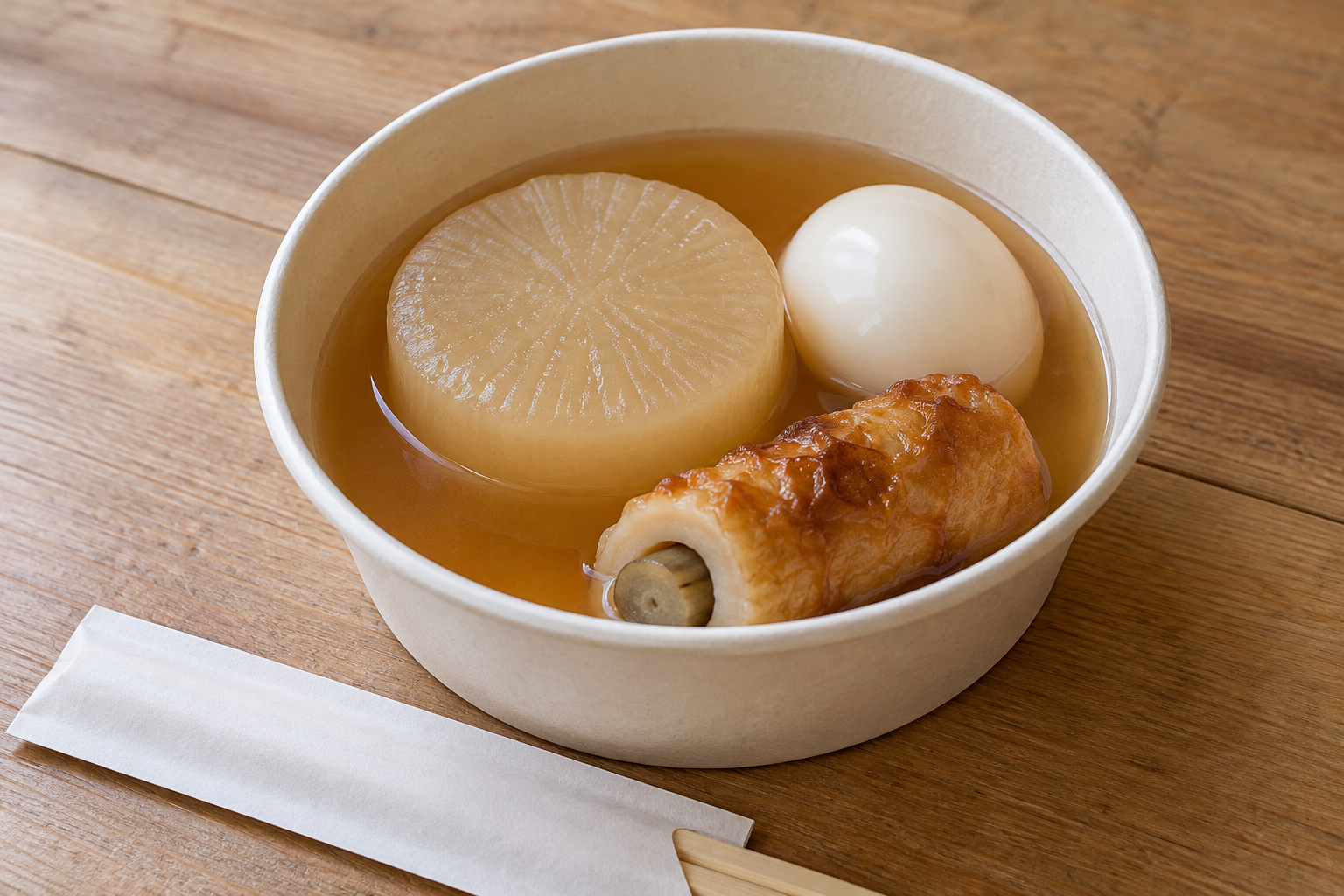
Lawson Store 100 is a different format. Its 2026 “100-yen oden” announcement concerns ingredient packs priced at ¥108 including the stated takeaway tax. The announcement says these products are not sold at ordinary Lawson or Natural Lawson. It does not mean that every hot oden piece in a Lawson costs ¥100. Read pack quantity, preparation and current shelf price before comparing.
For a larger appetite, compare the full order with a prepared meal or a teishoku set meal. Decide what you want to spend before adding several extra pieces. The cheapest-looking item name does not establish the cost of your whole dinner.
Check the broth as well as the visible food
A vegetable or tofu piece is not enough to establish that an oden order meets your dietary needs. The broth and other foods cooking in it matter. Fish cakes can also contain ingredients beyond fish.
Lawson’s published allergy guidance says its oden ingredients cook together in dedicated broth, and asks customers to check both the broth and other ingredients. Its published broth information lists wheat, soy and chicken. Removing a meat piece does not change that shared cooking process. Recipes may differ or change, so check current product information and ask staff about your exact restriction before buying.
If the shop cannot establish the information you need, choose food with a suitable, verifiable ingredient list instead. A sealed package is easier to inspect, but it is not automatically vegetarian, halal or suitable for an allergy. Our food-allergy guide covers broader restaurant and label checks.
Read the heating instructions on a packed meal
At the shelf, find the preparation instructions before choosing a pack. Check whether your accommodation has the required equipment and permits its use. Ask staff whether they can prepare that particular product; do not assume the shop microwave is suitable.
A useful counterexample is Kibun’s Oden Ichininmae prepared meal. Its instructions describe warming the sealed bag in boiling water or transferring the contents with broth to a saucepan. They explicitly prohibit microwaving this product because the egg may burst. Do not invent a microwave time or substitute instructions from another brand.
Kibun’s FAQ says its prepared oden is already cooked and may be eaten without warming. That answer is about the identified product category; it does not establish that every ingredient pack is ready to eat. Check your own package’s storage, opening and preparation directions. Follow the label when it differs from an online catalogue.

At a restaurant, read the assortment and the bill
Ask whether the menu lists individual pieces or a moriawase (盛り合わせ), an assortment. If you are sharing, state the number of diners and clarify how many pieces come in the order. This avoids receiving several complete assortments when you intended a shared starter.
Check drinks, any seating charge and other conditions before sitting down if the total matters. Our izakaya guide explains otoshi and bills. Convenience-store item prices are not a restaurant price list. This guide does not verify a particular restaurant’s stock, booking availability or charges.
Expect regional differences, including Shizuoka’s dark broth
Oden will not look identical everywhere. The Ministry of Agriculture’s Shizuoka oden page describes skewered ingredients including black hanpen and beef tendon in dark broth, served with green laver and powdered fish seasoning. That regional description explains why a bowl can look different from the lighter-broth examples above; it does not establish a universal recipe.
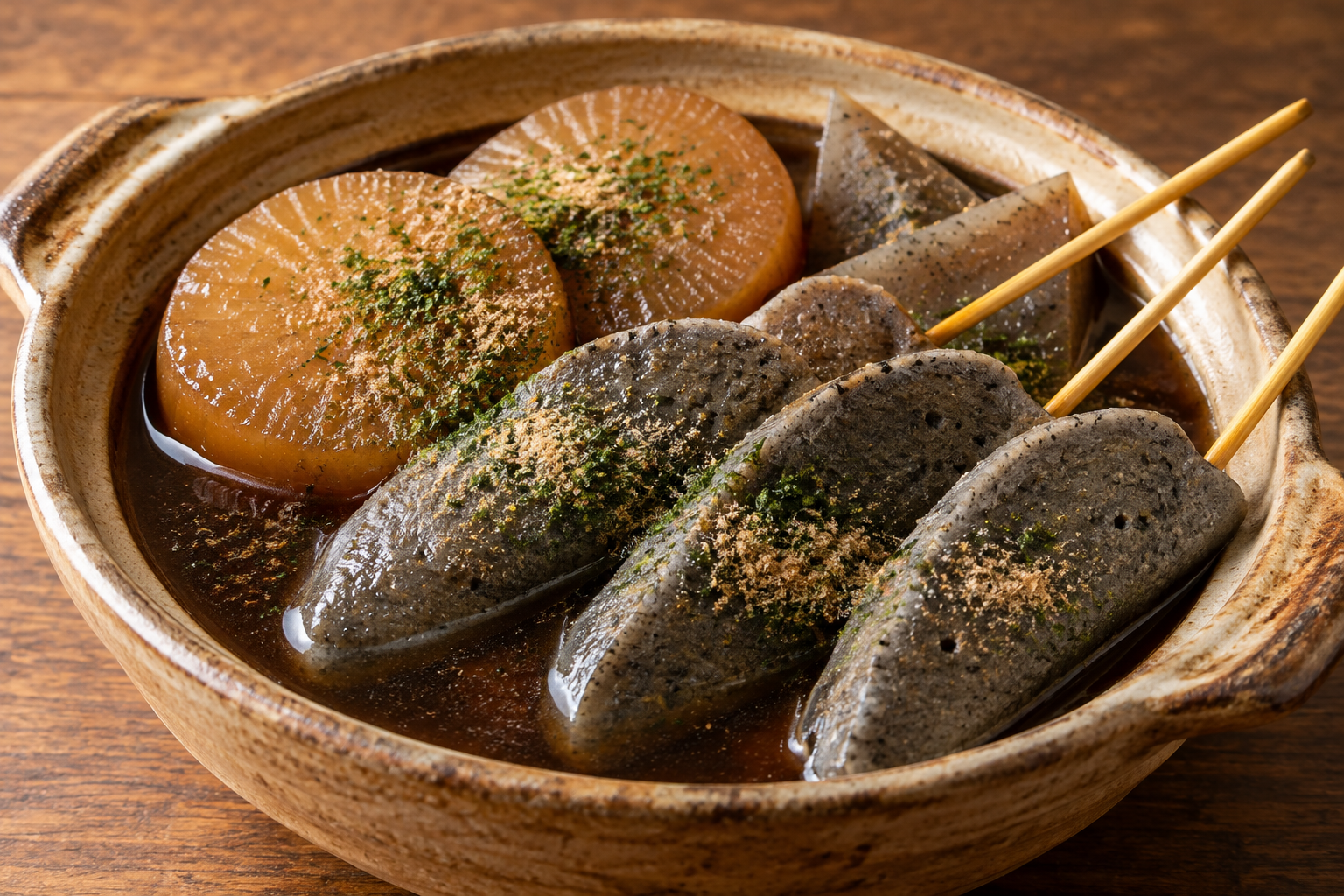
If you want a specific ingredient, save its name and ask whether that version is available. For an ordinary sightseeing day, keep the meal flexible: identify the food, confirm the total and preparation, then eat somewhere permitted. If no suitable oden is available, use the konbini guide to choose another meal without treating a missing pot as a failed outing.
Frequently asked questions
What is oden?
Ingredients such as radish, eggs and fish cakes simmered in seasoned broth. The selection and broth vary.
Does every convenience store have a hot oden pot?
No branch availability was established here. Ask at your shop; an online chain menu does not confirm today’s local stock.
Do I serve myself?
Ask staff or follow the shop’s signs before taking bowls or utensils. Do not assume all stores use the same system.
What should I order first?
Our suggested small tasting is daikon, an egg and one fish cake, provided they meet your dietary needs.
Are chikuwa and chikuwabu the same?
Chikuwa is a fish cake; chikuwabu is made from wheat flour. Check the exact product and broth.
Is the white hanpen tofu?
No. Hanpen is a fish cake. Atsuage is fried tofu; colour alone is not a reliable ingredient check.
Is oden vegetarian or free of meat?
Do not assume so. Check the broth, all ingredients and shared cooking. A vegetable piece can be cooked in animal-based stock.
Does oden cost ¥100 per piece?
Prices vary. The checked regular-Lawson three-piece example totals ¥440. Lawson Store 100’s ingredient-pack promotion is separate.
Can I microwave a sealed oden pack?
Only if that product’s instructions permit it. Kibun’s cited prepared meal explicitly forbids microwaving because its egg may burst.
Official sources
Checked October 30, 2026. Recheck current labels, prices and shop instructions when buying.

Comments