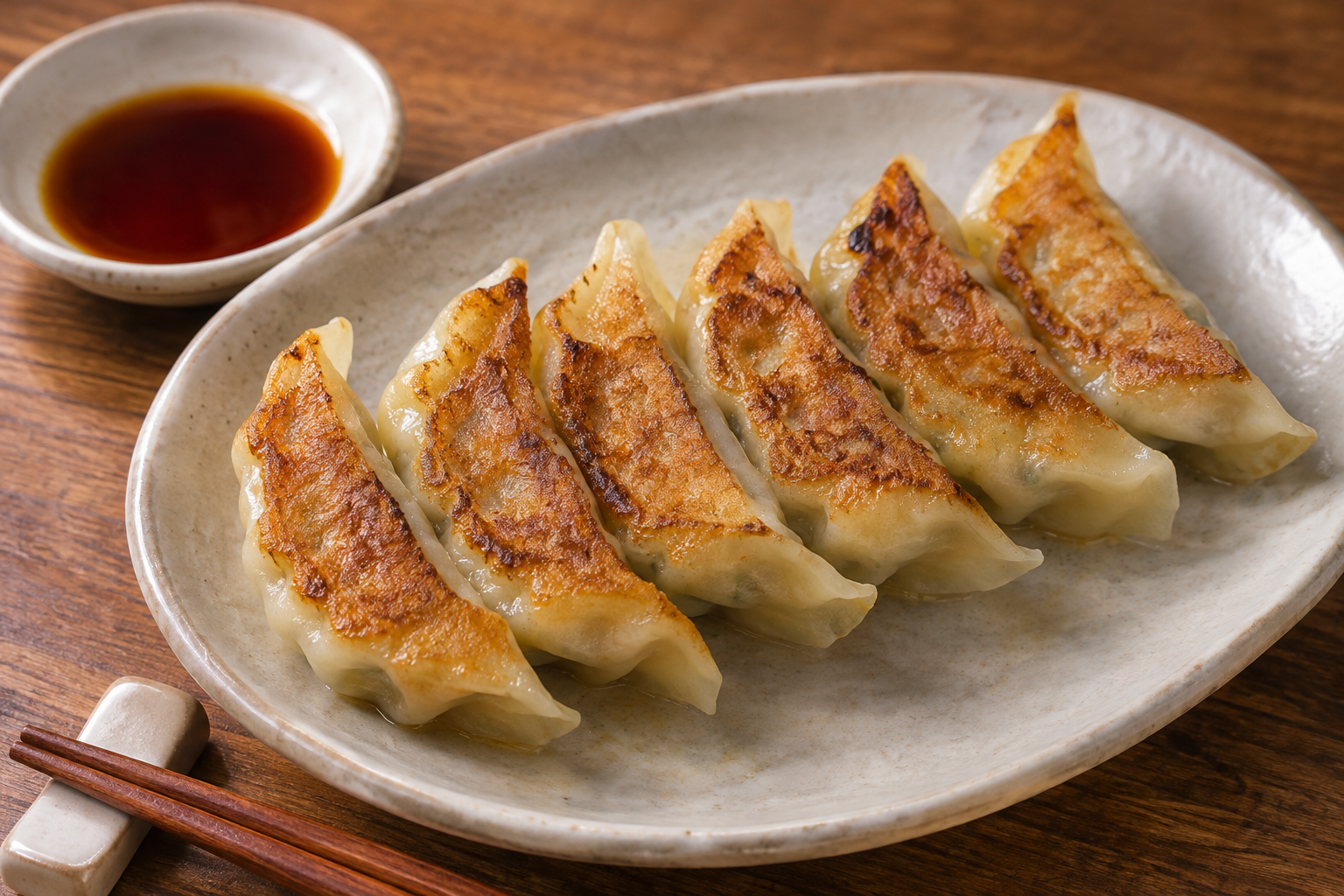
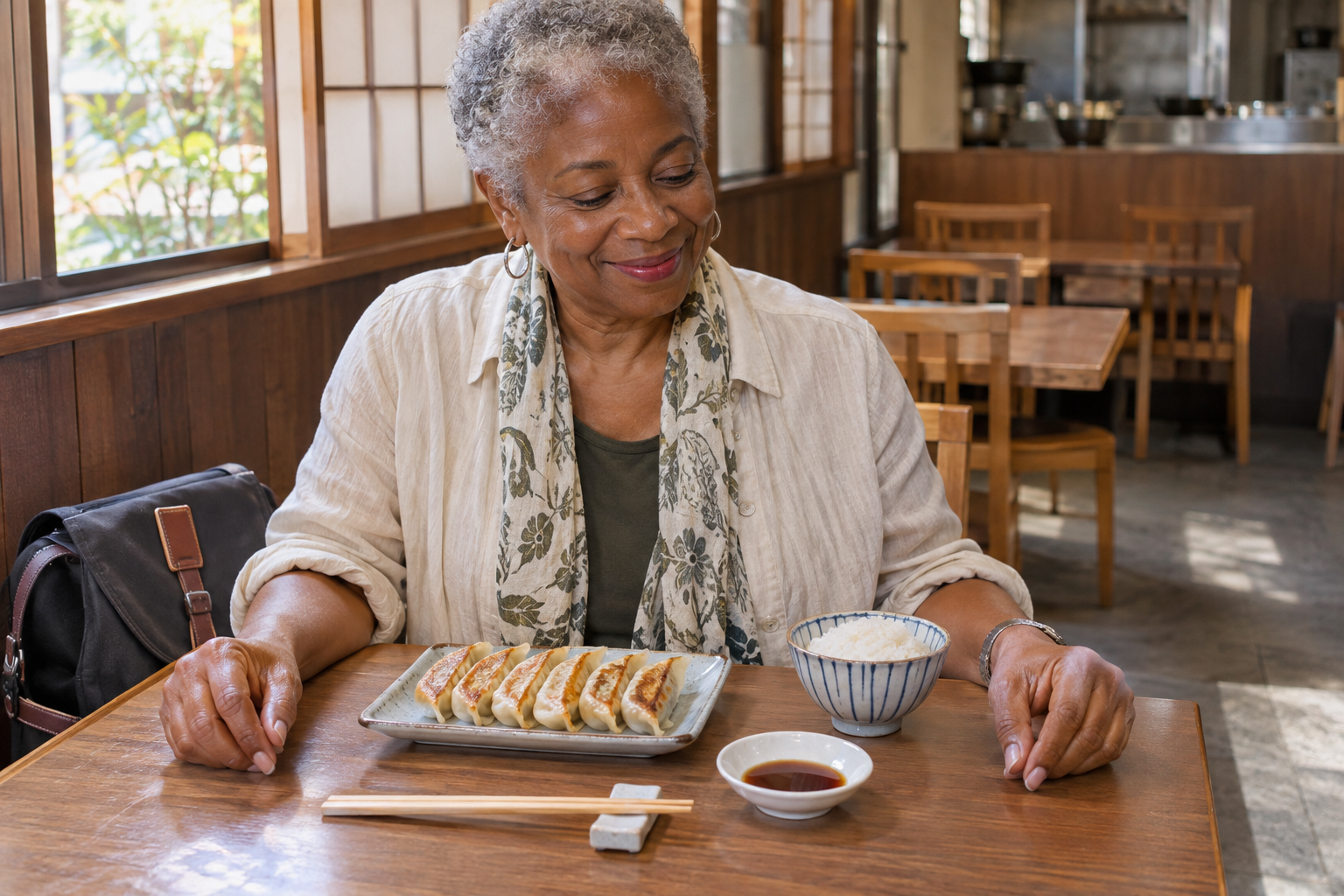
Featured image: AI-generated gyoza illustration; not a photograph of a named restaurant or its food.
For a first gyoza order in Japan, choose pan-fried dumplings, check how many pieces one order contains, then decide whether you want rice or a set meal. A price beside “gyoza” may buy only the dumplings. It does not automatically include the bowl of rice in a nearby photograph.
The checked dine-in examples are six pieces for ¥300 at Hidakaya and ¥363 on Gyoza no Ohsho’s eastern menu, including tax. These are named-menu references, not a national price range. Smaller plates are also available on those menus.
Official information checked November 4, 2026. This is a researched ordering guide, not a tasting report. Prices, availability and service arrangements can differ by location. All six images are AI-generated illustrations of generic food and travel scenes; they do not show the named restaurants, their exact portions or a purchased meal.
- Choose yaki, sui or age gyoza
- Read pieces and order units separately
- Check the current restaurant price
- Turn a dumpling plate into the meal you want
- Place one clear first order
- Try a little sauce before changing the whole plate
- Check garlic, meat and the wrapper
- For takeaway, check cooked versus raw
- Keep a nearby alternative for a busy day
- Frequently asked questions
- Which gyoza should I order first?
- Does one serving always contain six pieces?
- Does a plate of gyoza include rice?
- How much is a six-piece plate?
- Is a three-piece plate exactly half price?
- Do I have to use chili oil?
- Are garlic-free gyoza vegetarian?
- Can I eat nama-gyoza straight from the takeaway box?
- Do these pictures show the restaurants’ products?
- Official sources
Choose yaki, sui or age gyoza
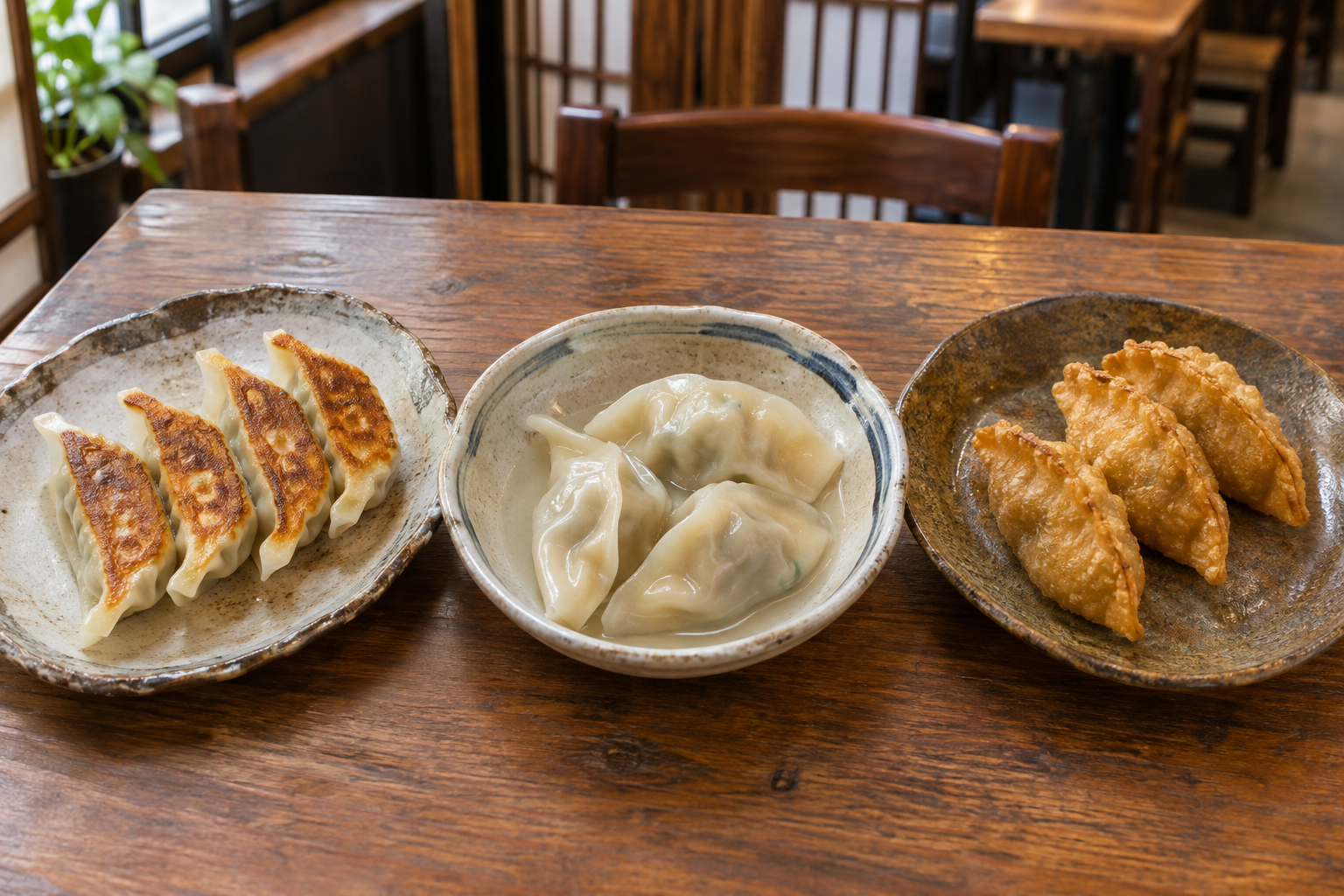
Look for 餃子 / gyōza on the menu, then read the preparation. If you want the browned, crisp-bottomed dumplings in the main image, look for 焼餃子 / yaki-gyōza. The soft folded wrapper and toasted flat side give two textures in the same bite.
| Menu word | Preparation | What to look for |
|---|---|---|
| 焼餃子 / yaki-gyōza | Pan-fried | A browned flat side and softer folded wrapper |
| 水餃子 / sui-gyōza | Boiled | A soft, moist wrapper; serving liquid varies |
| 揚餃子 / age-gyōza | Deep-fried | A crisp wrapper around the dumpling |
These are choices to recognize, rather than options every restaurant must offer. Utsunomiya’s official tourism guide, for example, identifies all three at Minmin’s main shop. Gyoza Bar’s own menu shows how preparations and counts can change within one restaurant.
Our suggestion is to begin with one familiar preparation. If you want to compare two styles, check the contents of both before ordering. A photograph of a pale dumpling cannot tell you its filling or whether its liquid is a meat-based broth.
Read pieces and order units separately
個 / ko counts pieces. 皿 / sara counts plates. 人前 / ninmae describes the restaurant’s serving unit. “One serving” does not promise a complete dinner or a standard number of dumplings across Japan.
Gyoza no Ohsho’s ordinary eastern-menu gyoza is six pieces per serving; its Just Size gyoza is three. Hidakaya labels its three-piece and six-piece plates separately. By comparison, Gyoza Bar lists its thin-wrapper pan-fried version as five or ten pieces. Read your chosen item’s count.
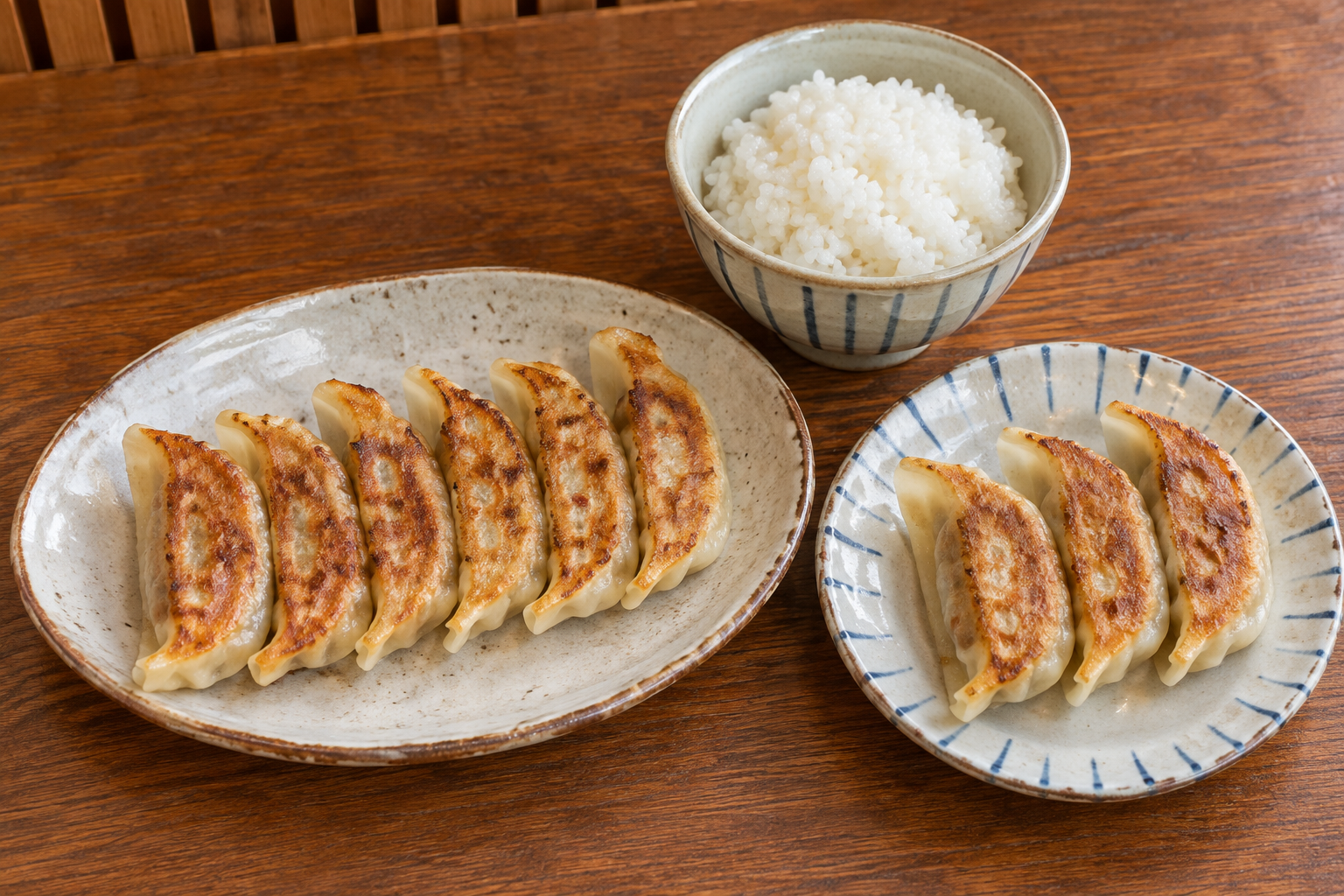
For two people sharing a taste before another meal, our suggested starting point is one plate between you, if the restaurant’s ordering rules allow it. For a dumpling-focused meal, decide how much each person wants and add rice or other dishes deliberately. These are planning suggestions, not appetite guarantees.
Count the food before confirming the quantity: two orders of a six-piece item mean twelve dumplings. Two orders of the three-piece item mean six. If you want six total, selecting “2” on the ordinary plate can double what you intended to buy.
Check the current restaurant price
These dine-in prices include tax and were read from the official menus on the date above. They do not rank equivalent dumplings by quality, weight or value.
| Official menu | Three pieces | Six pieces |
|---|---|---|
| Hidakaya | ¥160 | ¥300 |
| Gyoza no Ohsho, eastern menu | ¥192, Just Size | ¥363 |
Two Hidakaya three-piece plates total ¥320, compared with ¥300 for one six-piece plate. On the Ohsho eastern menu, two Just Size plates total ¥384, compared with ¥363 for six. That is a ¥20 or ¥21 difference respectively, calculated from each menu. Choose the smaller dish when the smaller quantity suits you; do not assume its price is exactly half.
At Ohsho, menus vary by region. Its Hokuriku, Tokai, Kansai, Shikoku and Okayama/Tottori menu lists ordinary six-piece gyoza at ¥341 including tax. The ¥363 eastern example is therefore not a price to apply to every branch. Use the regional menu and the price shown where you actually order.
Turn a dumpling plate into the meal you want
Look for 単品 / tanpin for a standalone item, ライス / raisu for rice and 定食 / teishoku for a set meal. Check the set’s actual contents rather than assuming it includes every bowl shown elsewhere on the page. Our teishoku guide explains the broader set-meal format.
On Ohsho’s eastern menu, small rice is ¥275 including tax. The following are our calculations from separately listed items, not restaurant set offers:
| Example purchase | Calculation | Total |
|---|---|---|
| Six ordinary gyoza and one small rice | ¥363 + ¥275 | ¥638 |
| Twelve ordinary gyoza and one small rice | 2 × ¥363 + ¥275 | ¥1,001 |
| Eighteen ordinary gyoza and two small rice bowls | 3 × ¥363 + 2 × ¥275 | ¥1,639 |
These totals cover only the stated food. Add any drinks, extra dishes and applicable charges separately. A shared dumpling order with two rice bowls is different from buying a complete set for each diner.
Hidakaya separately lists a W gyoza set with Chinese-cabbage kimchi at ¥880 including tax. Check its current contents and any available side choice before comparing it with your own combination. A set name and a standalone plate are different products.
Place one clear first order
At the entrance, follow the queue and seating instructions. Once you know how this branch takes orders, select the preparation, quantity and any rice or set. On a tablet, check the order summary before submitting; with staff, point to the exact item as you speak.

You can show these phrases on your phone. They clarify the purchase; communicate any ingredient restriction separately before the order is prepared.
- 一皿に何個ですか? Hitosara ni nanko desu ka? — How many pieces are on one plate?
- 焼き餃子を一皿ください。 Yaki-gyōza o hitosara kudasai. — One plate of pan-fried gyoza, please.
- ご飯は付いていますか? Gohan wa tsuite imasu ka? — Is rice included?
- 全部でいくらですか? Zenbu de ikura desu ka? — How much is everything?
Our suggestion is to keep the first order small enough to understand. If a dish is taking time, ask staff whether it is already on the order before sending it again. Keep your ticket or bill until the meal and payment are settled. For machine-based ordering, see our restaurant ticket-machine guide.
Try a little sauce before changing the whole plate
Use the small individual dish provided for dipping. Soy sauce, vinegar and chili oil are familiar options, but identify each bottle and follow any recommendation for that dish. A prepared house sauce may already be mixed.
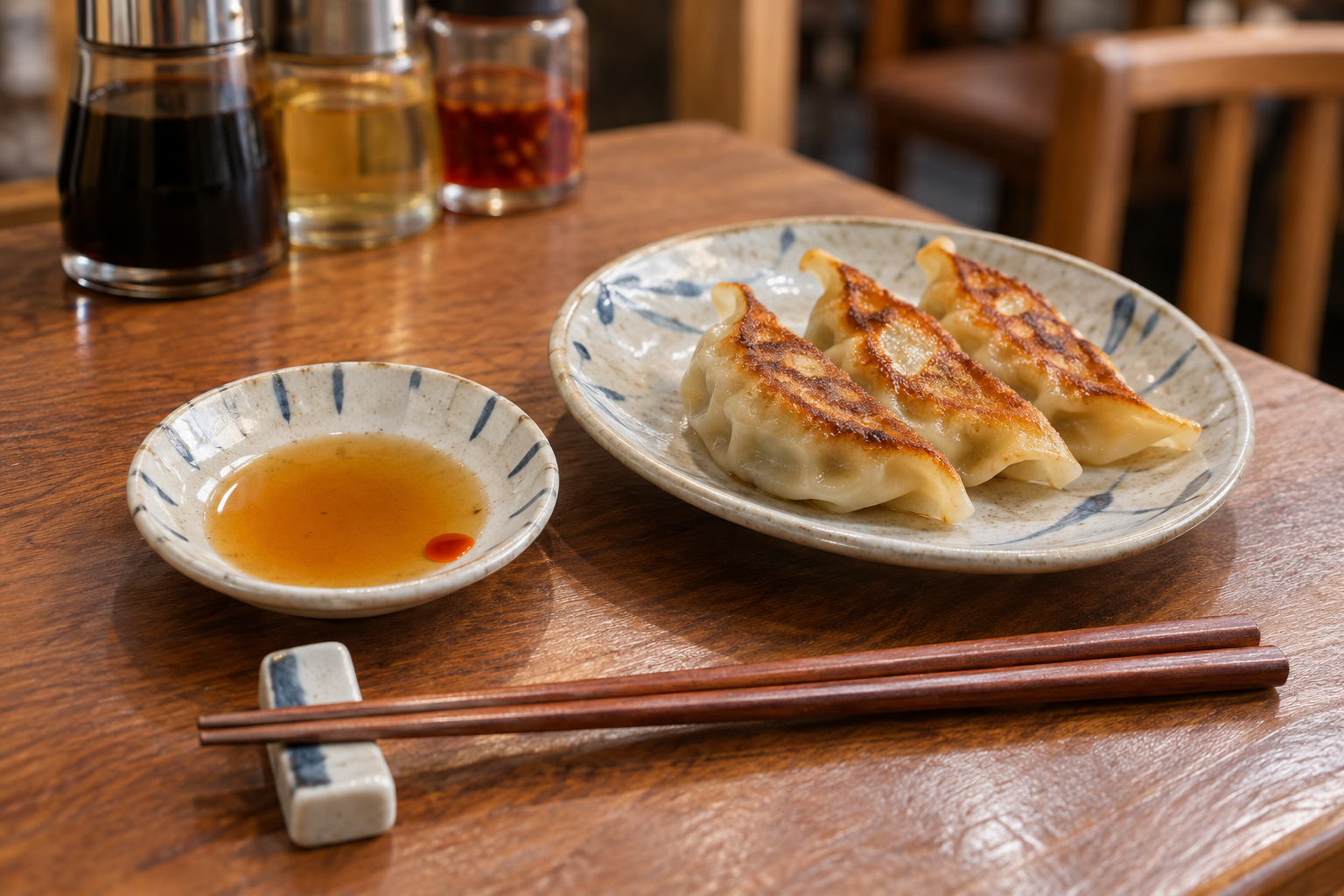
Our suggested first bite is plain or lightly dipped. Then adjust a small amount of sauce to your taste. Keep chili oil optional if you prefer less heat, and avoid soaking the whole plate before you know what you like. There is no need to reproduce an exact sauce ratio.
A restaurant may suggest another accompaniment: Gyoza Bar recommends yuzu-kosho for its thin-wrapper pan-fried gyoza. That is this restaurant’s recommendation, not a universal instruction. If an unfamiliar condiment matters to an ingredient restriction, ask before using it.
Check garlic, meat and the wrapper
A vegetable-rich filling does not establish a vegetarian meal. Hidakaya’s current allergen information lists wheat flour, soy and pork for its three- and six-piece gyoza. Check the exact item, sauce and preparation arrangements before choosing food for a dietary requirement.
Ohsho’s eastern menu currently lists shiso-scented, garlic-free ginger gyoza. “Garlic-free” describes that feature of the recipe; it does not establish that the dish is meat-free or suitable for an allergy. The product page also warns of limited quantities and possible sellouts.
Show staff your specific requirement before ordering and ask for the current information. If the necessary ingredients or preparation cannot be confirmed, choose another meal you can verify. Our food-allergy guide covers broader travel preparation.
For takeaway, check cooked versus raw
持ち帰り / mochikaeri means takeaway; 生餃子 / nama-gyōza means uncooked gyoza that require cooking. If you want food ready to eat, ask for the cooked version. Do not choose a cheaper raw product simply because its picture resembles the plate you wanted.
Takeaway can also have a different tax-inclusive price and a container fee. In the specific Ohsho eastern-menu garlic-free ginger example, the product page lists ¥356 to take away, while the product announcement states a ¥10 charge per container and excludes Just Size takeaway. If your order uses one charged container, ¥356 + ¥10 totals ¥366. Confirm the actual container count and payable total; do not treat ¥356 alone as a guaranteed final bill.
Keep a nearby alternative for a busy day
Pick a restaurant along your existing route and check its current hours, menu and accepted payment methods before relying on it. This guide does not verify today’s stock, queue or table availability. A restaurant’s food photographs cannot answer those questions.
If the wait does not fit your next train, or the menu cannot meet your needs, switch before you become rushed. Our Tokyo restaurant Plan B offers other meal-finding options. At a pub-style venue, also check seating charges and ordering conditions; our izakaya guide explains what to ask.
Frequently asked questions
Which gyoza should I order first?
Our suggestion is yaki-gyoza if you want a browned, crisp bottom. Check the filling and piece count.
Does one serving always contain six pieces?
No. The checked menus include three-, five-, six- and ten-piece options. Use the count beside your item.
Does a plate of gyoza include rice?
Check the menu. Standalone gyoza and rice can be separate purchases; a set has its own contents.
How much is a six-piece plate?
The checked dine-in examples are ¥300 at Hidakaya and ¥363 on Ohsho’s eastern menu, including tax. Recheck your branch.
Is a three-piece plate exactly half price?
Not in these examples. Two small plates cost ¥20 more at Hidakaya or ¥21 more on Ohsho’s eastern menu than one six-piece plate.
Do I have to use chili oil?
No. Try the dish first and use the available sauce to taste, after checking ingredients when needed.
Are garlic-free gyoza vegetarian?
The name does not establish that. Verify the filling, sauce and preparation for your requirement.
Can I eat nama-gyoza straight from the takeaway box?
Nama-gyoza are uncooked. Choose cooked takeaway if you need a ready-to-eat meal.
Do these pictures show the restaurants’ products?
No. Every image is an AI-generated illustration. Use official menus for actual products and quantities.
Official sources
Checked November 4, 2026. Recheck current menus and branch instructions before buying.
- Gyoza no Ohsho: regional menus; six-piece gyoza; Just Size; small rice; western regional menu.
- Gyoza no Ohsho: garlic-free ginger gyoza; product and takeaway conditions.
- Hidakaya: gyoza plates; W gyoza set; allergen information.
- Gyoza Bar: preparations, counts and accompaniments.
- Utsunomiya official tourism: Gyoza Street restaurants.
Comments