- Quick Answer
- Why One Elevator Icon Is Not Enough
- The Five-Segment Route Check
- Operator-by-Operator Verification Decision Table
- Tokyo Metro: Check One-route, Inside-Gate and Outside-Gate Facilities
- JR East: Read the Exact Station Layout
- Transfers Between Different Operators
- Plan B When a Segment Is Unclear or Closed
- A 60-Second Check Before You Enter
- Frequently Asked Questions
- Does every train station in Japan have an elevator?
- Can a route-planning app show a guaranteed elevator route?
- What if my transfer changes railway operators?
- Are stations with the same name always in one building?
- Is a luggage-friendly route the same as a wheelchair-accessible route?
- What should I do if an elevator is closed?
- How should I check a Shinkansen transfer with luggage?
- What should I ask station staff?
- Official Sources
Quick Answer
Check every railway operator separately. For the origin, each transfer and the destination, use the operator's current official station map or barrier-free page to confirm the exact street entrance, ticket gate, platform, transfer passage and street exit you need.
One elevator icon—or a route-planner result—does not prove that those parts join into one continuous elevator route. At Tokyo Metro, even the official term One-route can include a slope, stairlift or wheelchair-accessible escalator as well as an elevator. If any segment is unclear, ask station staff before passing the gate or choose a simpler transfer, a different entrance or a surface-transport Plan B.
Last checked: August 22, 2026.
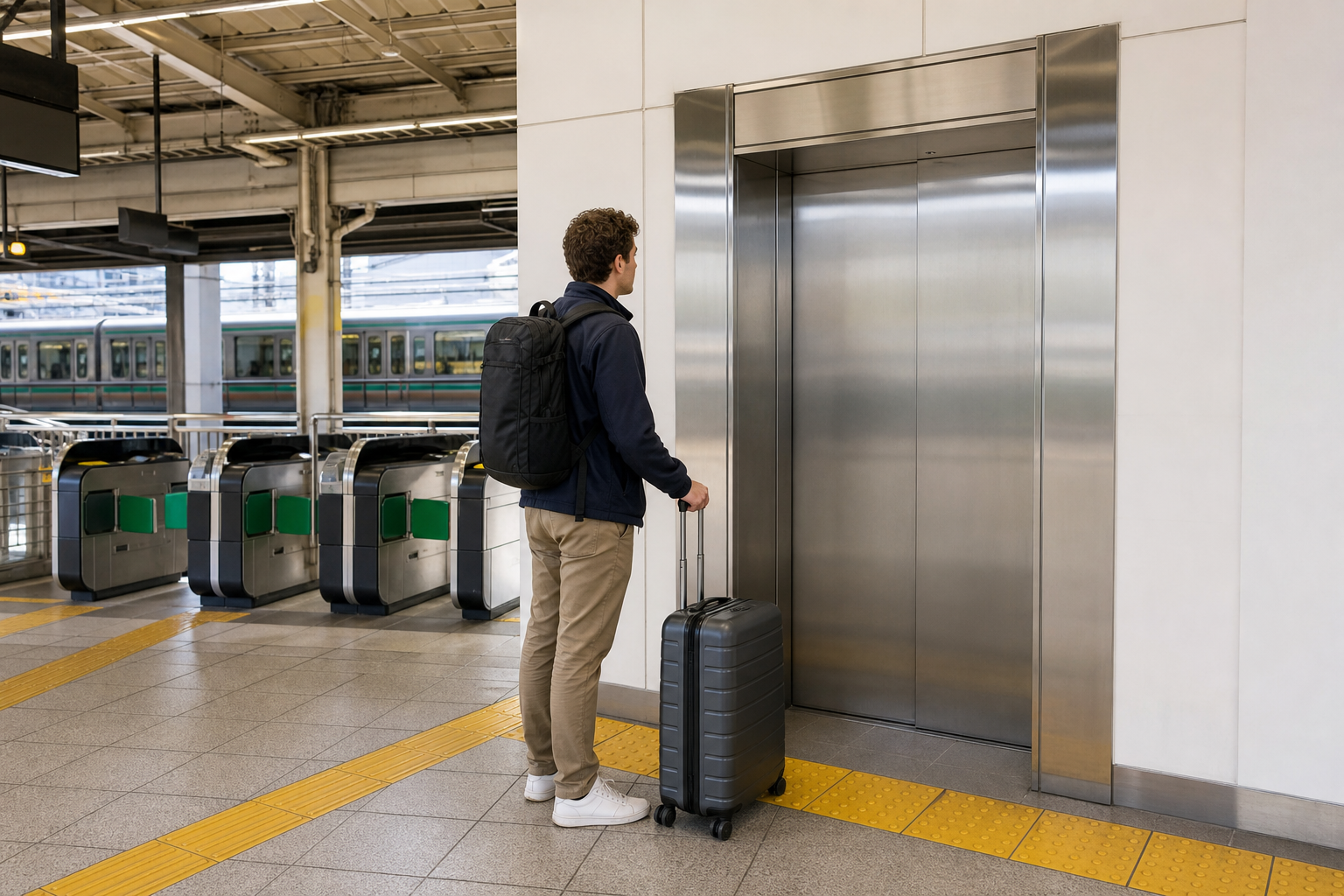
Why One Elevator Icon Is Not Enough
A Japanese station is not one room. A large station can contain several street entrances, multiple gate areas, platforms on different floors and connections operated by different railway companies. An elevator shown somewhere in the station may serve only one of those areas.
Think of the trip as a chain. You need to verify all of these links:
- Street to the correct entrance.
- Entrance to the ticket gate.
- Gate to the correct platform.
- Arrival platform through every transfer passage.
- Destination platform to the exact exit you need.
If one link is unconfirmed, the route is not yet proven. This is especially important with a large suitcase, a stroller or an essential mobility need. A detour that is merely inconvenient with luggage may be unusable for a wheelchair user, so do not treat those needs as identical.

The Five-Segment Route Check
1. Start with the operator, not only the station name
Write down the operator for every train. JR, Tokyo Metro, Toei Subway and private railways publish their own facility information. A station shared by two operators can have separate gates, maps and assistance arrangements.
2. Find the exact street entrance or exit
Do not search only for “elevator at Shinjuku Station” or another station name. Find the numbered or named entrance that serves the area you need. The elevator may be across a road, inside a building or open only when that building is accessible. Treat opening-hours and construction notices as changeable facts.
3. Trace the gate-to-platform route
Confirm the gate name, platform number or line, and elevator location. In a complex station, an elevator on one side of the gate area may not connect to the platform you need without another level change.
4. Prove the transfer passage
For a same-operator transfer, trace the arriving platform to the departing platform. For a different-operator transfer, make two checks: how to leave operator A and how to enter operator B. The same station name does not prove that the gates are adjacent or connected without stairs.
5. Check the destination exit separately
An elevator from the platform to a gate does not prove that your preferred street exit has an elevator. Verify the outside-gate segment and where it brings you to street level.
Operator-by-Operator Verification Decision Table
| Segment | Official evidence to open | What you must match | Stop condition |
|---|---|---|---|
| Origin street to gate | Origin operator's station map or barrier-free page | Exact entrance/exit, outside-gate route and gate name | Do not enter at a convenient-looking staircase if the elevator entrance is elsewhere |
| Gate to platform | Same operator's inside-gate facilities | Correct line, direction and platform | A station-wide elevator icon is not proof for the chosen platform |
| Same-operator transfer | Operator's transfer layout | Arrival platform, passage and departure platform | Two platform elevators do not prove the passage between them |
| Different-operator transfer | Both operators' pages | Exit/gate from A, public passage, entrance/gate to B, then platform | The same station name is not enough |
| Destination platform to street | Destination operator's map | Gate plus the exact street exit needed | A platform elevator does not prove the chosen street exit |
The stop conditions are deliberate. If you cannot match a segment, do not fill the gap with an assumption. Ask staff or redesign that part of the trip.
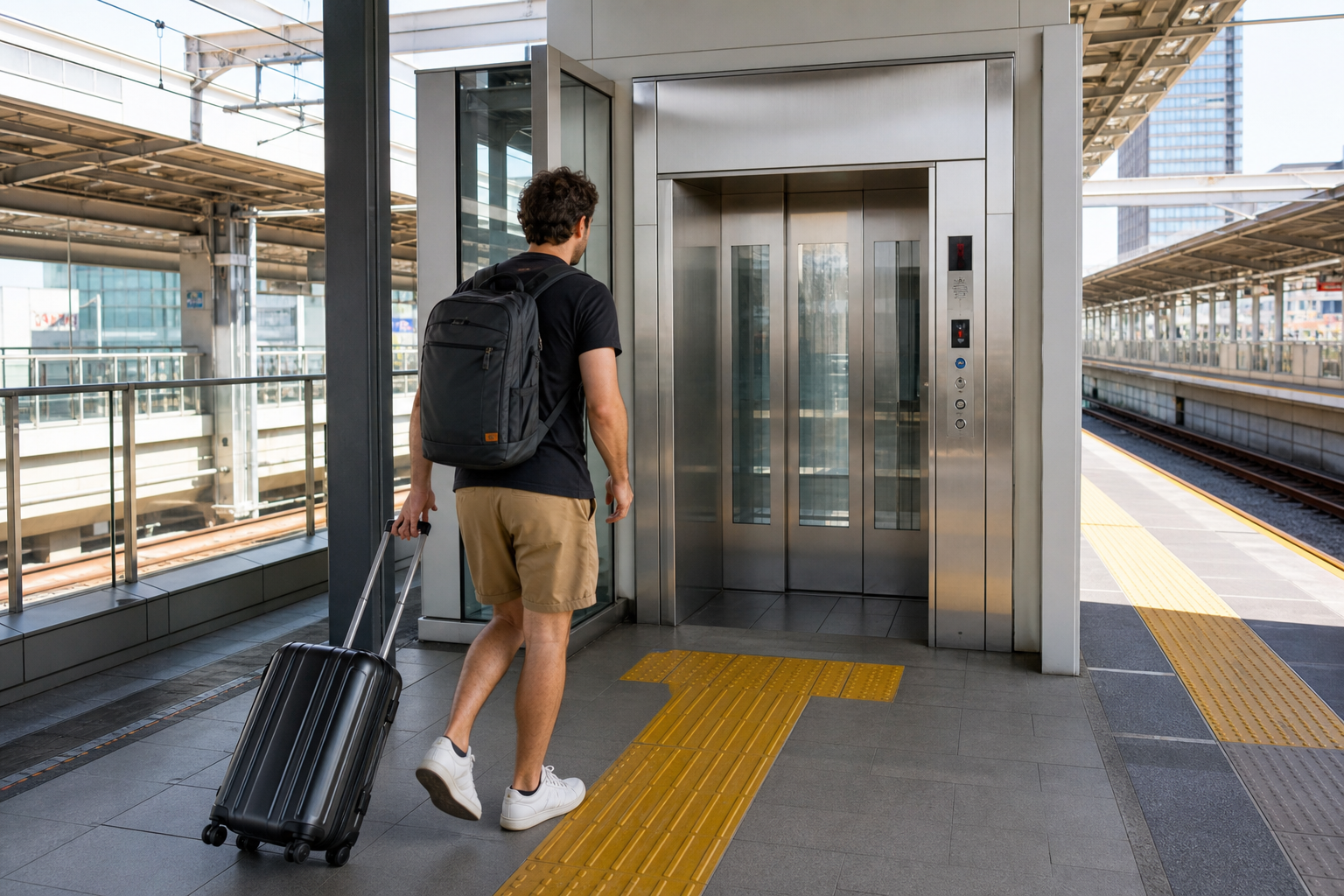
Tokyo Metro: Check One-route, Inside-Gate and Outside-Gate Facilities
Tokyo Metro's official barrier-free search is useful because it separates three ideas:
- One-route: one or more routes connecting ground, gate and platform using an elevator, slope, stairlift or wheelchair-accessible escalator.
- Elevator inside the gate: vertical access on the paid side.
- Elevator outside the gate: vertical access between a public area and a gate area.
That distinction prevents a common error: seeing “One-route” and assuming every entrance or every part of the route uses an elevator. Use the search as a starting point, then open the exact station information and match the entrance, gate and platform you plan to use.
Search Tokyo Metro stations by barrier-free facility
JR East: Read the Exact Station Layout
JR East publishes an English station-map index for most of its stations, but the official page says not all stations are included. Open the exact station and trace the levels, gate names, platform numbers and elevator symbols.
At a transfer to another operator, stop the JR East check at the point where you leave JR East. Then open the next operator's official information. Do not assume the public passage between the two maps is short, indoors or free of stairs.
Open JR East's official station-map index
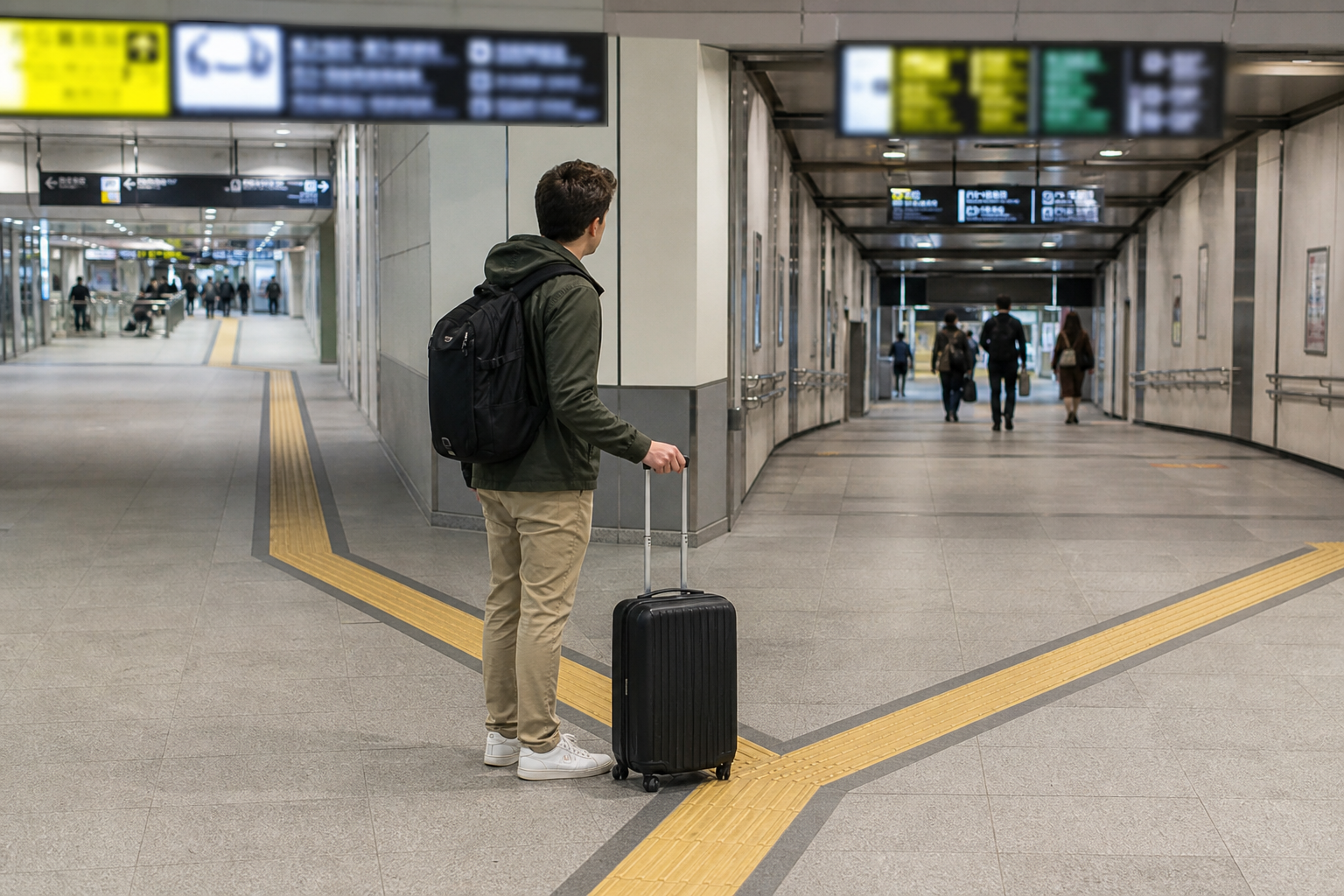
Transfers Between Different Operators
Use this four-part handoff check:
- Arrival: Which platform and elevator take you to operator A's required gate?
- Public passage: Which street, corridor or building connects the two operators?
- Re-entry: Which entrance and gate of operator B have the verified route?
- Departure: Which inside-gate elevator reaches the correct platform and direction?
Allow extra time. A step-free transfer can be longer than the most direct stair route. If a route app proposes a very short transfer, treat that as a timetable connection—not proof of the physical path.
For a wheelchair, boarding ramp or staff escort, contact or ask the railway operator directly. JNTO's accessibility guidance recommends asking railway personnel for assistance and telling staff where you need to get off. Staff coordination is operational help; it does not turn this article into a guarantee.
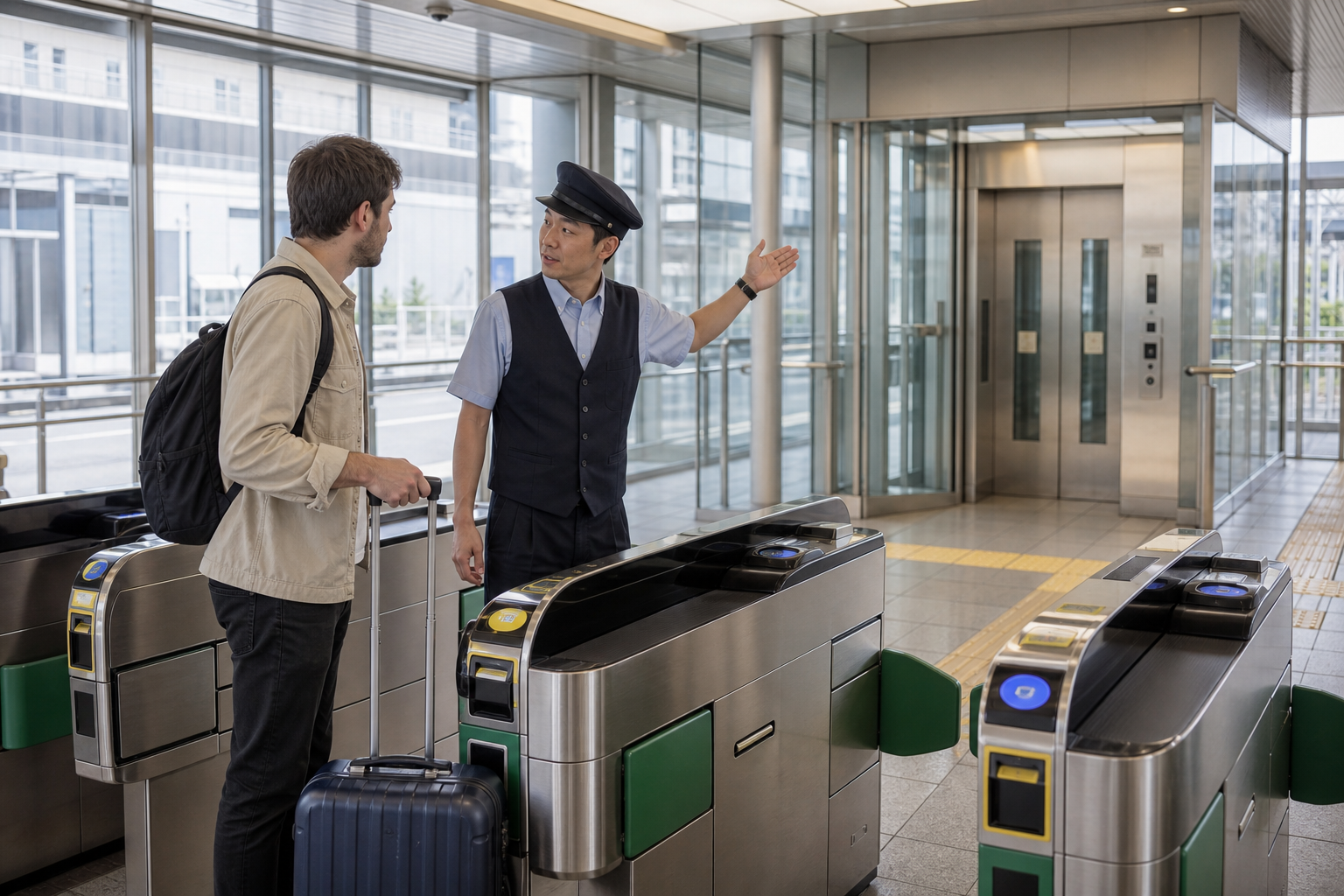
Plan B When a Segment Is Unclear or Closed
Do not force the suitcase onto stairs or an escalator if that is unsafe. Before entering the gate, ask staff to confirm the complete route and show the destination exit on your phone.
Possible Plan B options are:
- Use another entrance or exit at the same station.
- Use a different gate or platform route suggested by staff.
- Transfer at a less complex station, even if the train trip is slightly longer.
- Stay with one operator longer and reduce the number of inter-operator handoffs.
- Leave at a nearby verified exit and use a taxi or other surface transport for the final segment.
- For an essential accessibility need, contact the operator in advance and allow time for staff coordination.
Elevators can be affected by inspection, construction or temporary failure. A saved map proves what you checked, not what will be operating later. Recheck high-risk transfers on the travel day.

A 60-Second Check Before You Enter
At the station entrance, pause and verify:
- Is this the entrance or gate shown on the official map?
- Does the route reach my exact line, direction and platform?
- Have I checked every transfer operator separately?
- Does the destination route reach the street exit I need?
- Is there a current closure, construction notice or elevator inspection?
- If one answer is unclear, have I asked staff before entering?
For related planning, see our Japan IC-card guide, Japan train etiquette guide and luggage-delivery guide.
Frequently Asked Questions
Does every train station in Japan have an elevator?
No. Do not assume every station has one, or that every entrance, gate, platform and exit is connected by one. Check the current page of each operator and station.
Can a route-planning app show a guaranteed elevator route?
Treat a route app as timetable and line guidance unless it explicitly provides current operator-backed facility details. Verify the physical route on the operator's official station page.
What if my transfer changes railway operators?
Check both operators. Trace the exit from the first operator, the public passage, the entrance to the second operator and the second operator's platform route.
Are stations with the same name always in one building?
No. A shared or similar station name does not prove that gates are adjacent, indoors or connected without stairs. Verify the physical handoff.
Is a luggage-friendly route the same as a wheelchair-accessible route?
No. Luggage convenience and wheelchair accessibility have different requirements. For an essential mobility need, confirm the facilities and any boarding assistance directly with the operator.
What should I do if an elevator is closed?
Ask station staff before proceeding. Use another verified entrance, exit or transfer route, or change stations. Keep a surface-transport or taxi Plan B when the trip cannot tolerate stairs.
How should I check a Shinkansen transfer with luggage?
Identify the operators and gates involved, then trace the arriving platform, Shinkansen transfer gate, departing platform and destination exit. Also check the train's separate baggage rules when relevant.
What should I ask station staff?
Show the destination, operator, line and exit. Ask whether the complete route uses an elevator or another accessible facility and where you should enter, transfer and leave.

Comments