- Quick Answer
- Why Rain and Typhoons Feel Hard for Tourists
- The 3-Minute Check Before You Leave
- How to Read Warning Levels Without Panicking
- What To Do If Trains Are Delayed or Suspended
- Long-Distance Travel: Shinkansen, Flights, Ferries and Buses
- The Tourist Plan B Decision Tree
- Hotel, Airbnb and Luggage Steps
- What Not To Do in Heavy Rain or Typhoon Conditions
- Good Rainy-Day Plan B Ideas
- Useful Phrases
- If Something Goes Wrong
- Next Useful Guides
- FAQ
- When is typhoon season in Japan?
- What app should tourists use for weather warnings in Japan?
- Where should I check official Japanese weather warnings?
- What should I do if a weather warning is issued while sightseeing?
- What should I do if evacuation information is issued?
- Do trains stop during typhoons in Japan?
- Is it safe to use an umbrella during a typhoon?
- Should I go to the airport early during a typhoon?
- What is a good rainy-day Plan B in Tokyo?
- Can I still visit outdoor temples and shrines in heavy rain?
- Sources Checked
Quick Answer
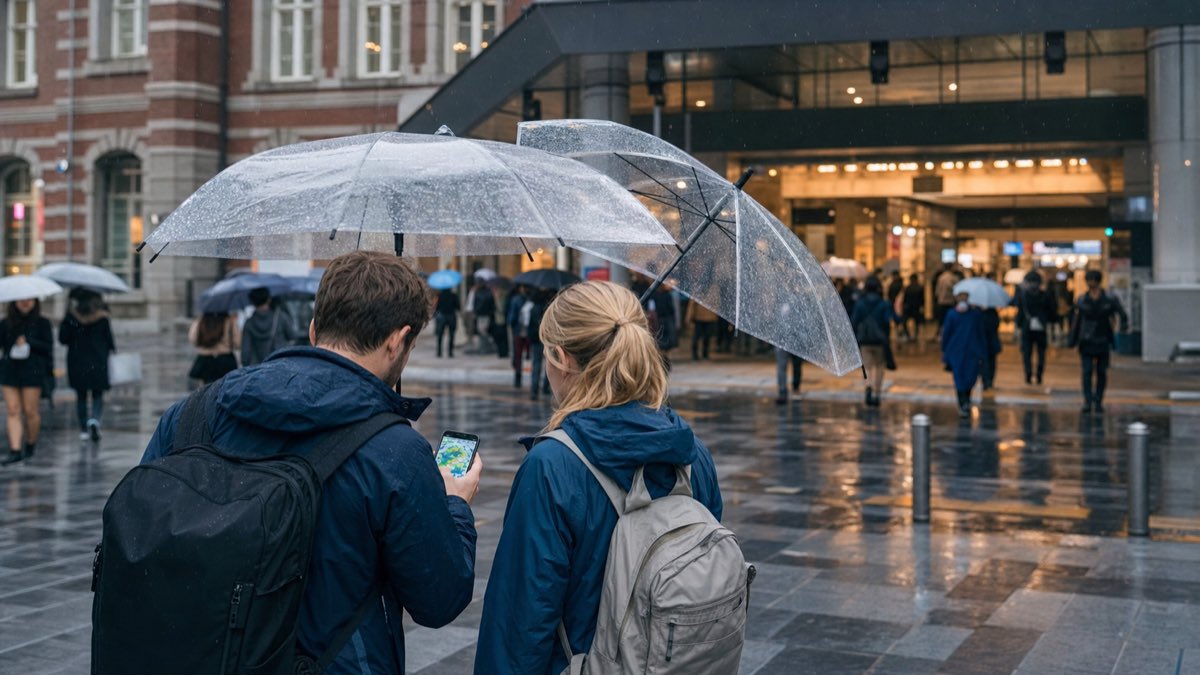
If heavy rain or a typhoon affects your Japan trip in 2026, do not start by asking, "Can I still go?" Start with three checks:
- Check the Japan Meteorological Agency for weather warnings, advisories, risk maps, tropical cyclone information, and precipitation nowcasts.
- Use JNTO's Safety tips app or website for tourist-facing alerts, evacuation guidance, and emergency links.
- Check your actual train operator, airline, bus company, event organizer, hotel, or Airbnb host before you move.
The practical tourist rule is simple:
- Light rain: keep the plan flexible and carry rain gear.
- Heavy rain, strong wind, warnings, or train disruption: shorten the day and stay near a station, hotel, or indoor area.
- Evacuation information, emergency warnings, flooding, landslide risk, storm surge risk, or staff instructions to stay inside: stop sightseeing and follow local instructions.
Last checked: July 6, 2026.
This guide is not emergency, legal, medical, or transportation advice. It is a travel-planning guide for tourists who need a calm order of operations when weather changes the day.
Why Rain and Typhoons Feel Hard for Tourists
Japan is very good at operating through normal rain. Trains run, shops open, umbrellas appear, and daily life continues.
The hard part for visitors is knowing when "normal rain" has become a different kind of travel problem.
A rainy temple visit is one thing. A river walk during heavy rain is another. A delayed subway is annoying. A long-distance train suspended by a typhoon can change your hotel night, luggage plan, airport transfer, and next city.
For many tourists, the friction is not the weather itself. It is the chain reaction:
- Do I keep the reservation?
- Which warning matters?
- Are trains still running?
- Is it safer to stay in the hotel?
- What should I do if I am in an Airbnb and cannot ask a front desk?
- Should I go to the airport early?
- What can I do indoors without wasting the day?
This article is built for that moment.
Use it with the right next click:
- If your main concern is heat, read Japan Heat Survival Guide 2026.
- If your rainy day affects a festival, read Japan Festival Survival Guide 2026.
- If your event is fireworks, read Japan Summer Fireworks 2026.
- If your problem is trains, keep Tokyo Train Guide for Tourists 2026 nearby.
- If you arrive late after a delay, use Tokyo Late-Night Arrival Guide 2026.
- If you need to move between airport and city, use Tokyo Airport Transfer: Narita or Haneda Guide.
The 3-Minute Check Before You Leave
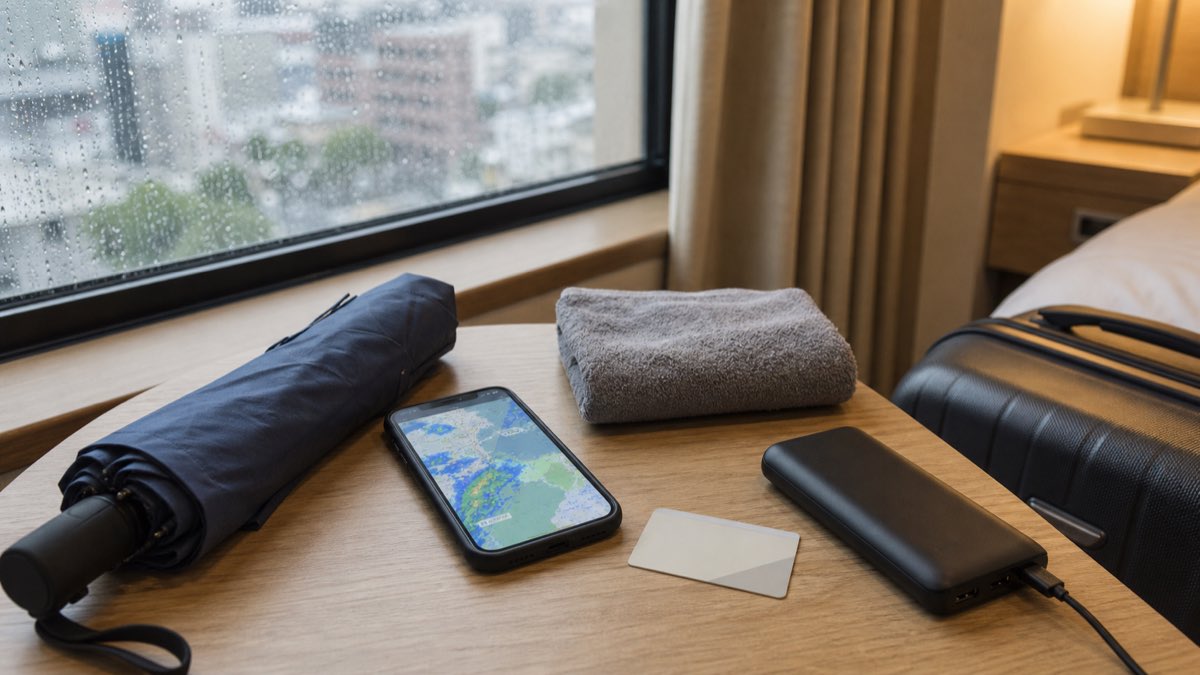
Before you leave your hotel, Airbnb, station locker, cafe, or museum, run this three-minute check.
1. Check Official Weather Information
Start with the Japan Meteorological Agency. Its English menu links to:
- Weather Warnings/Advisories
- Risk Maps
- Tropical Cyclone Information
- Hazardous Wind Watch
- Precipitation Nowcasts
- Daily Forecasts
- Three-hourly Forecasts
Do not make a generic weather app icon your full check. A small umbrella icon does not tell you whether the problem is flooding, landslide risk, storm surge, wind, thunder, or local train disruption.
For a tourist, the most useful question is:
Is the area I am going to under a warning, advisory, risk map color, or typhoon-related notice today?
If yes, slow the plan down.
2. Check Safety tips
JNTO's Safety tips app is built for foreign tourists. The official page describes it as a push-enabled alert app for earthquake early warnings, tsunami warnings, and other weather warnings in Japan. It supports multiple languages and includes evacuation flowcharts, helpful phrases, and disaster-related links.
If you are visiting Japan during rainy season or typhoon season, install it before the problem day. During weather disruption, you do not want to learn a new safety app while standing in a crowded station.
3. Check the Operator or Organizer
After the official weather check, look at the thing you are actually trying to use:
- train operator
- subway operator
- Shinkansen operator
- airline
- airport
- highway bus company
- ferry company
- event organizer
- museum or attraction
- restaurant reservation page
- hotel or Airbnb message thread
Weather information tells you the risk. Operators tell you whether your actual plan is still working.
JR East says its English train status page reports anticipated and actual delays in excess of 30 minutes from 4 a.m. until 2 a.m. the following day, and that the screen does not update automatically. Tokyo Metro says its service information covers actual or expected delays of 5 minutes or more.
The detail matters: refresh the page and check the operator you are actually using.
How to Read Warning Levels Without Panicking
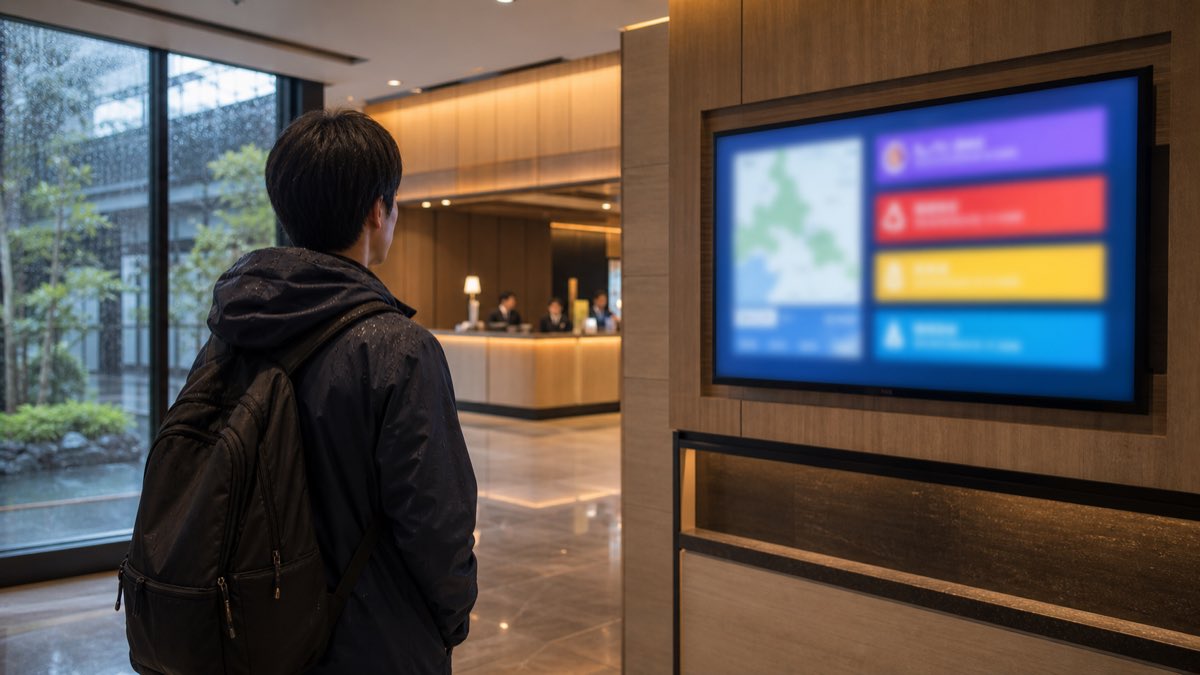
Tourists often see words like advisory, warning, alert level, evacuation, typhoon, heavy rain, and emergency warning in a short time. It can feel bigger than it is, or smaller than it is.
Use this calm reading order.
Weather Warnings
JNTO's Safety tips weather warning page groups weather-warning information for floods, heavy rain, landslides, and storm surges into levels such as:
- Level 2 Advisory
- Level 3 Warning
- Level 4 Urgent Warning
- Level 5 Emergency Warning
For a tourist, the practical meaning is not "memorize the whole system." The practical meaning is:
- Advisory: pay attention and adjust the plan.
- Warning: stop casual outdoor plans and check transport before moving.
- Urgent warning or emergency warning: do not treat the day as ordinary tourism.
If you see Level 4 or Level 5 language, your plan should become conservative. Move less, stay closer to a safe indoor place, and follow local instructions.
Evacuation Information
JNTO's evacuation information page lists:
- Emergency Safety Measures [Alert Level 5]
- Evacuation Instruction [Alert Level 4]
- Evacuation of the Elderly, Etc. [Alert Level 3]
The same page explains that evacuation information may be provided when disasters such as flooding, sewer overflows, landslides, storm surges, and tsunamis occur or may occur.
If you receive evacuation information, do not try to translate it into "but my reservation is non-refundable." Ask your hotel, host, station staff, police box, or local staff what to do, and follow official instructions.
Typhoon Information
Typhoons can affect Japan in different ways depending on route, strength, timing, and region. The weather at your current location may look manageable while trains, flights, ferries, beaches, mountain roads, or next-day plans are already being changed elsewhere.
When typhoon information appears, check:
- where the typhoon is now
- when it may affect your area
- whether your next city is in the path
- whether long-distance trains or flights are already announcing changes
- whether your hotel night, baggage transfer, or airport route depends on one connection
For tourists, one avoidable mistake is waiting until the last connection. If your next movement is long-distance, check early.
What To Do If Trains Are Delayed or Suspended
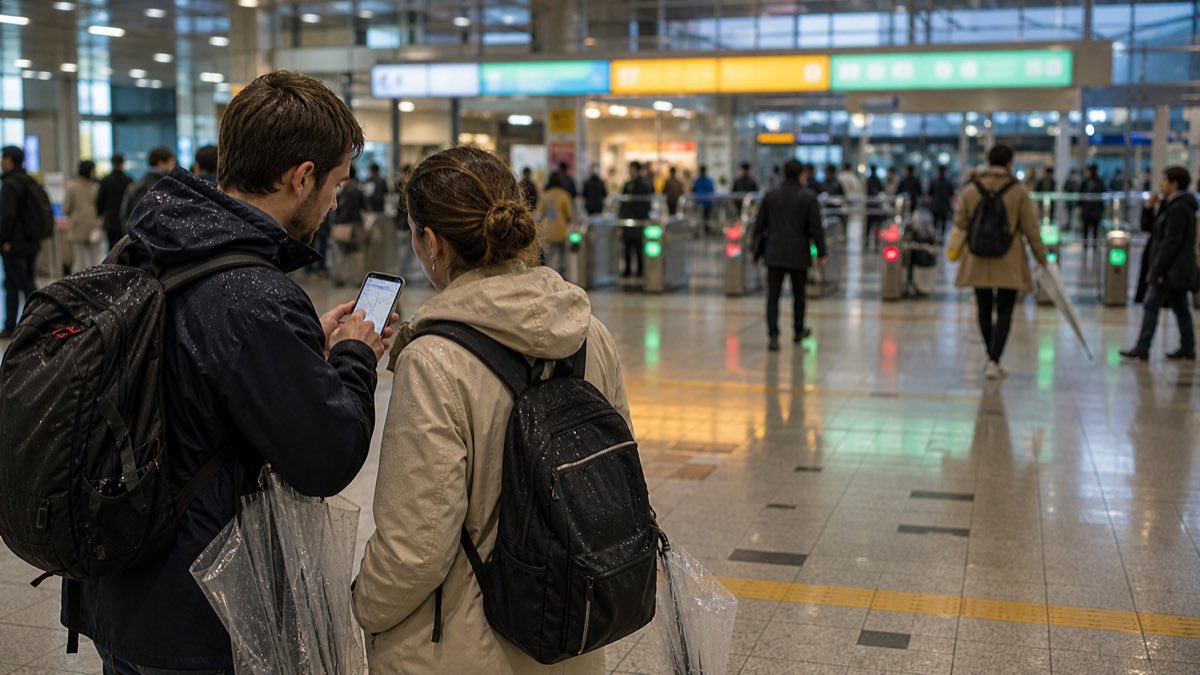
On an ordinary rainy day, trains may keep running, but heavy rain, strong wind, lightning, flooding, landslide risk, fallen objects, or safety inspections can slow or stop service.
When this happens, use a sequence.
Step 1: Confirm the Line, Not Just the Station
Large stations can have many operators. Tokyo Station, Shinjuku, Shibuya, Ueno, Osaka, Kyoto, and major airport stations are not one simple "train system."
Check:
- operator name
- line name
- direction
- section affected
- delay or suspension
- restart estimate, if posted
- transfer options, if posted
Do not assume the whole station is stopped. Also do not assume one running line can absorb the crowd calmly.
Step 2: Decide Whether You Need to Move Today
Ask the blunt question:
Is this movement necessary today?
If you are going to a museum, shopping area, garden, or dinner, the answer may be no. Switch to a nearby indoor plan.
If you are going to an airport, next hotel, medical appointment, or non-changeable transport, the answer may be yes. In that case, move earlier, reduce transfers, and contact the relevant company before you commit.
Step 3: Avoid Last-Train Thinking
Do not build your weather day around the last train. If conditions are worsening, aim to return while you still have choices.
A good weather-day transport plan has:
- one main route
- one backup route
- one place where you can wait indoors
- one person or desk you can ask
- enough phone battery for maps and messages
If you are using mobile IC, preserve battery. A dead phone can become both a map problem and a ticket-gate problem.
Step 4: Treat Taxis as a Backup, Not a Guarantee
A taxi may help for short local movement, but it is not magic during a typhoon, downpour, road closure, airport disruption, or event crowd. In bad weather, many other people may have the same idea.
Before relying on a taxi, check:
- road conditions
- distance
- queue length
- whether your destination is reachable
- whether you have enough cash or accepted payment
- whether you can wait indoors instead
For late arrival planning, use Tokyo Late-Night Arrival Guide 2026.
Long-Distance Travel: Shinkansen, Flights, Ferries and Buses
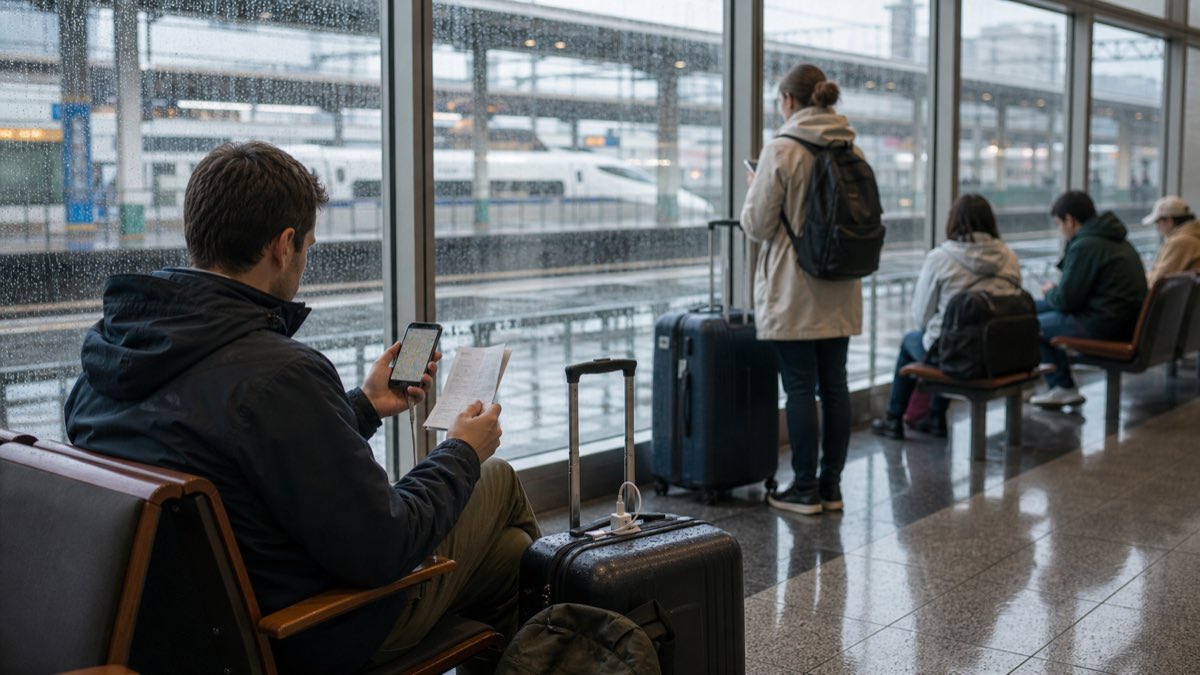
Weather disruption becomes more serious when your plan crosses regions.
A Tokyo indoor day can be rescued with a museum and dinner. A Tokyo-to-Kyoto travel day during a typhoon may affect:
- hotel check-in
- luggage forwarding
- restaurant reservations
- next-day tour reservations
- airport connection
- rail pass timing
- family or group coordination
Shinkansen and Limited Express
For long-distance rail, check the operator for your exact route. Japan has several JR companies, and a tourist route can cross company areas.
Practical steps:
- Check official operation information before leaving the hotel.
- Avoid sending your luggage to a place you may not reach.
- Keep chargers, medicine, passport, and one change of essentials with you.
- If service is suspended, ask staff whether waiting, changing routes, or postponing is the normal option.
- Keep screenshots of reservation numbers, but do not rely on screenshots for live status.
Flights
Airports may look normal hours before weather hits, then change quickly. Airlines make their own operational decisions, so check the airline and airport instead of using the weather map by itself.
If a typhoon may affect your flight:
- check the airline app or website
- check the airport website
- keep your passport and charger accessible
- leave extra time for airport access
- do not assume train access will be unaffected
- check hotel cancellation and extension options early
Ferries, Beaches and Islands
Ferries and coastal plans are sensitive to wind, waves, and port conditions. Even if rain in the city feels light, a ferry, island, beach, or coastal road may be affected.
Do not improvise around storm surge, high waves, or closed waterfront areas. Switch inland and indoors.
The Tourist Plan B Decision Tree
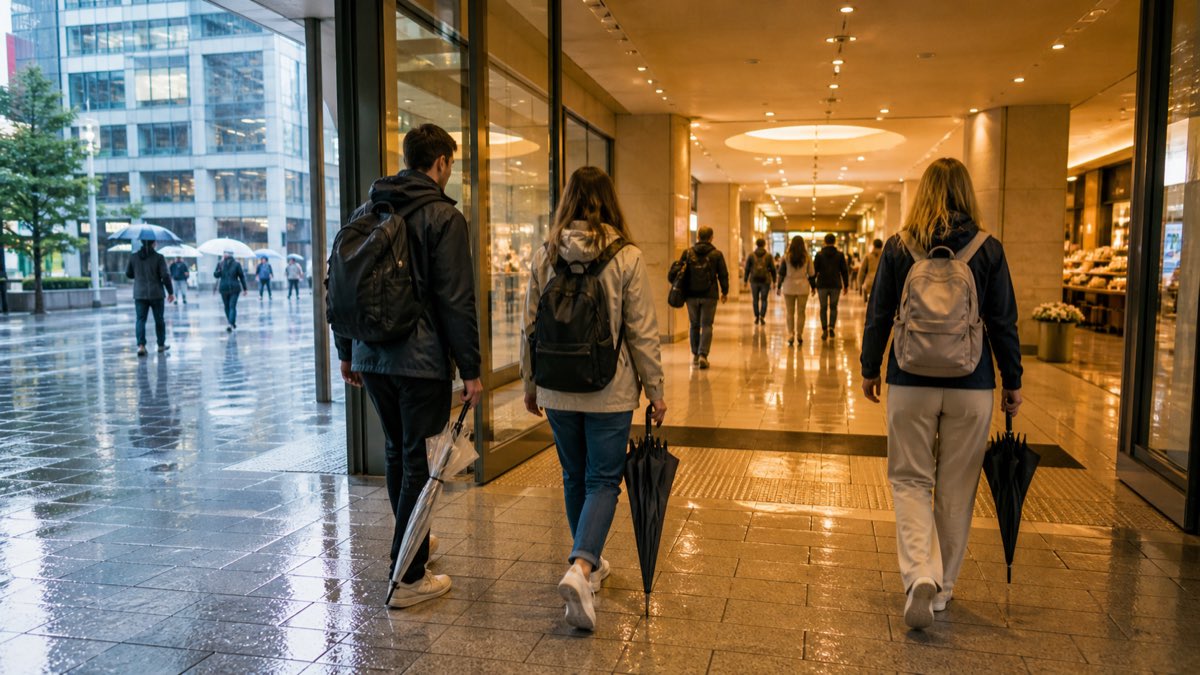
Use this simple color system when you are not sure how much to change.
Green: Rainy but Manageable
Use Green when:
- rain is light or moderate
- no serious warning affects your area
- trains are running normally enough for your plan
- your destination is indoor or close to a station
- you can return before conditions worsen
Good Green plans:
- museum
- department store
- station building
- cafe
- covered shopping street
- short shrine or temple visit with rain gear
- nearby restaurant reservation
Yellow: Adjust the Day
Use Yellow when:
- heavy rain is expected
- a weather advisory affects your area
- wind makes umbrellas difficult
- outdoor events may change
- some train lines are delayed
- you have a long transfer or luggage
Yellow plan:
- shorten the route
- move earlier
- keep to one neighborhood
- choose a station-connected destination
- cancel optional outdoor stops
- eat near your hotel or main station
- keep a second indoor stop ready
Orange: Stay Close and Stop Chasing the Schedule
Use Orange when:
- warning-level information affects your area
- a typhoon may affect your city or next city
- trains are suspended or crowded in a way that changes the day
- event organizers cancel or shorten an event
- staff advise against leaving
- roads, rivers, hillsides, or coastal areas are part of your plan
Orange plan:
- stay near your accommodation or a major station
- move after you have checked the route
- contact your hotel, host, airline, or tour provider
- keep food, water, charger, and medication nearby
- avoid rivers, underpasses, beaches, hiking trails, and exposed viewpoints
- accept that the day's goal is stability, not sightseeing
Red: Follow Official Instructions
Use Red when:
- evacuation information applies to your area
- emergency warning language appears
- flooding, landslide, storm surge, or dangerous wind is possible near you
- police, station staff, hotel staff, city staff, or local announcements tell people to move or stay
- you are unsure and local staff are giving clear instructions
Red plan:
- stop sightseeing
- follow local instructions
- ask hotel, host, station staff, police box, or local staff for help
- use Safety tips, JMA, local government information, and official transport pages
- keep your phone charged
- message your travel group with your location and plan
Do not try to "beat" the weather.
Hotel, Airbnb and Luggage Steps
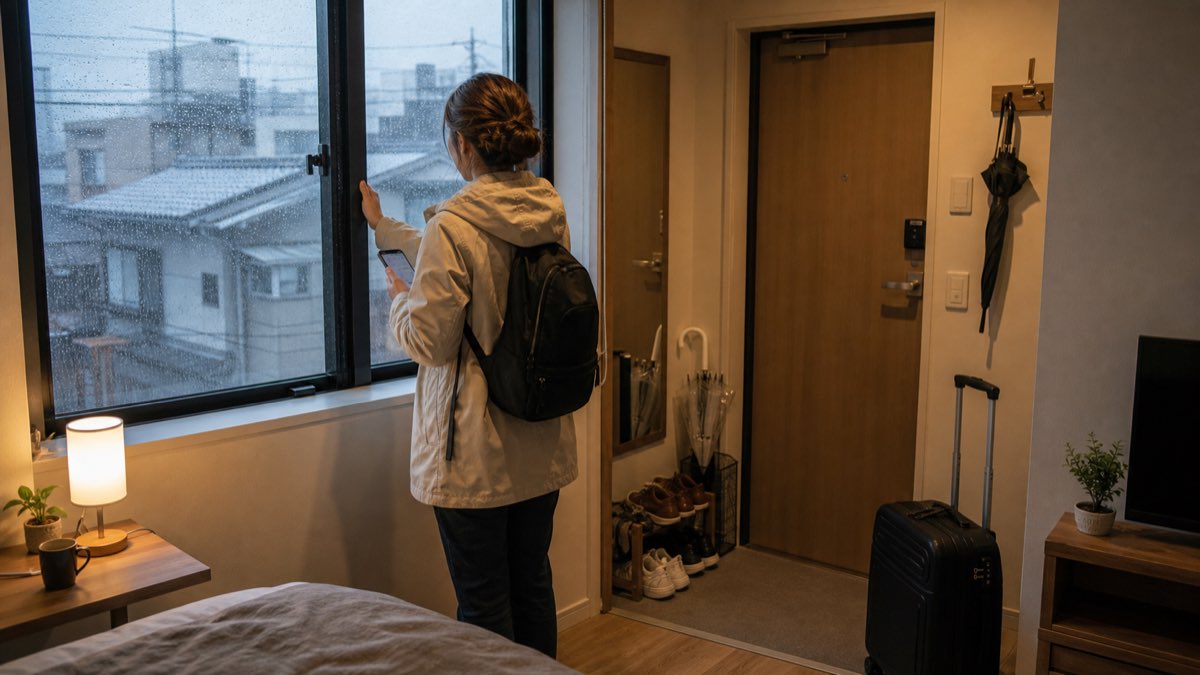
Bad weather becomes easier when your accommodation plan is stable.
If You Are in a Hotel
Use the front desk. This is a useful reason to ask before leaving.
Ask:
- Is there any weather warning for this area?
- Is it safe to go to this destination today?
- Are trains to this area running?
- If I return late, is there any entrance rule?
- Can I extend my stay if trains or flights are stopped?
- Where is the nearest convenience store or indoor food option?
Hotels may not be able to solve transport disruption, but they can often tell you what local guests are doing.
If You Are in an Airbnb or Apartment
You may not have a front desk. Prepare earlier.
Message your host:
Heavy rain or a typhoon may affect my plan today. Is there any local warning or instruction I should know about?
Japanese:
今日、大雨または台風の影響があるかもしれません。この地域で注意すべき警報や避難情報はありますか?
Also check:
- building entrance rules
- whether windows should be closed
- where to put wet umbrellas or shoes
- local trash rules if you stay inside longer
- nearby convenience store or supermarket
- nearest station-connected indoor area
For arrival basics, see How to Check In at Japanese Accommodation and Tokyo Airbnb Starter Guide 2026.
Luggage
Luggage makes bad-weather days harder.
If heavy rain or typhoon disruption is possible:
- do not carry a suitcase through crowded wet stations unless necessary
- use station lockers when you are confident you can return
- avoid sending luggage to a hotel you may not reach
- keep passport, medicine, charger, glasses or contacts, and one essential layer with you
- if you use luggage forwarding, confirm dates and delivery limits with the provider
If your day becomes a station-waiting day, Tokyo Luggage Storage Guide 2026 may help.
What Not To Do in Heavy Rain or Typhoon Conditions
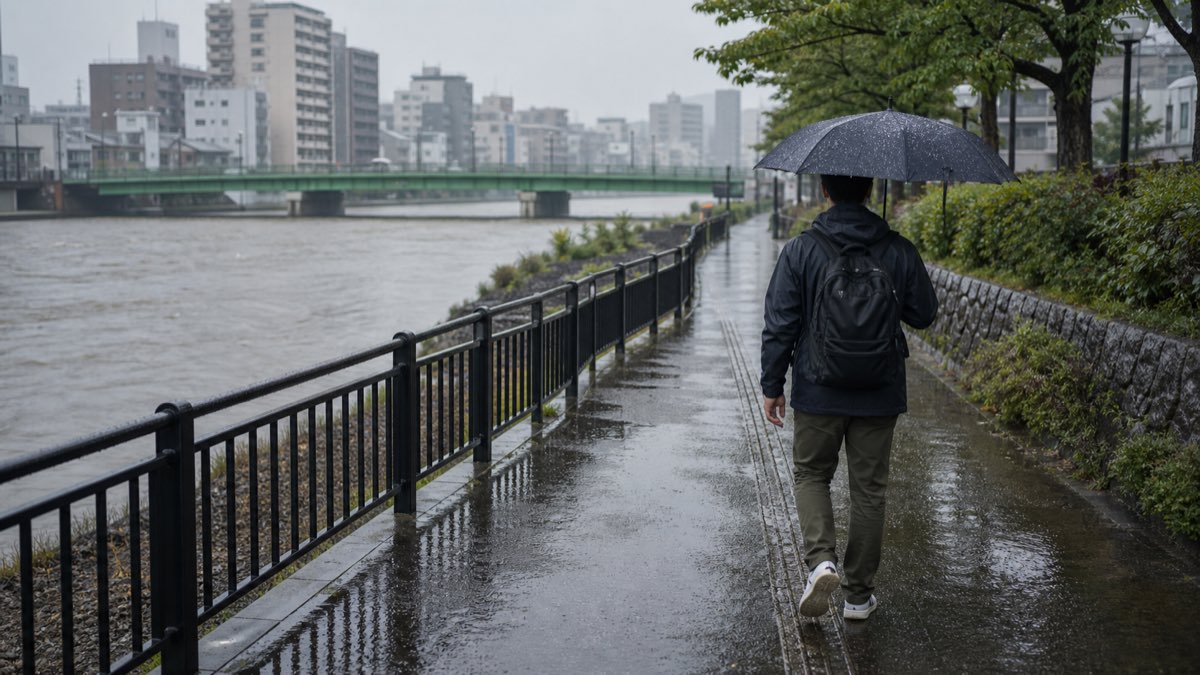
Japan has beautiful rivers, coasts, mountains, shrines, alleys, and night views. Some of those places become bad choices in severe weather.
Avoid:
- riverside walks during heavy rain
- underpasses or low roads where water may collect
- beaches, breakwaters, and coastal viewpoints during stormy conditions
- mountain trails, waterfalls, and gorge walks after heavy rain
- cycling in strong wind or poor visibility
- trying to photograph waves, flooded streets, or storm damage
- standing near temporary signs, umbrellas, branches, or construction covers in strong wind
- crossing a closed area because other people are doing it
- waiting until the last train when conditions are worsening
A cancelled plan feels frustrating. A preventable weather mistake can consume the rest of the trip.
Good Rainy-Day Plan B Ideas
Your Plan B should be boringly reachable. That is the point.
Choose places that are:
- indoors
- close to a station
- easy to leave
- not dependent on one outdoor route
- not on a hillside, beach, river, or island
- flexible with tickets or reservations
Good options:
- large station buildings
- department stores
- underground shopping streets
- museums
- aquariums
- indoor observation decks, if transport and weather conditions are suitable
- cafes
- bookshops
- supermarkets or food halls
- casual restaurants near your accommodation
- karaoke or cinema for a longer wait
- hotel lobby or lounge
If the day is Yellow, a station-connected museum can save the day. If the day is Orange or Red, entertainment is not the priority. Stay close, wait indoors, and keep checking official information.
Useful Phrases
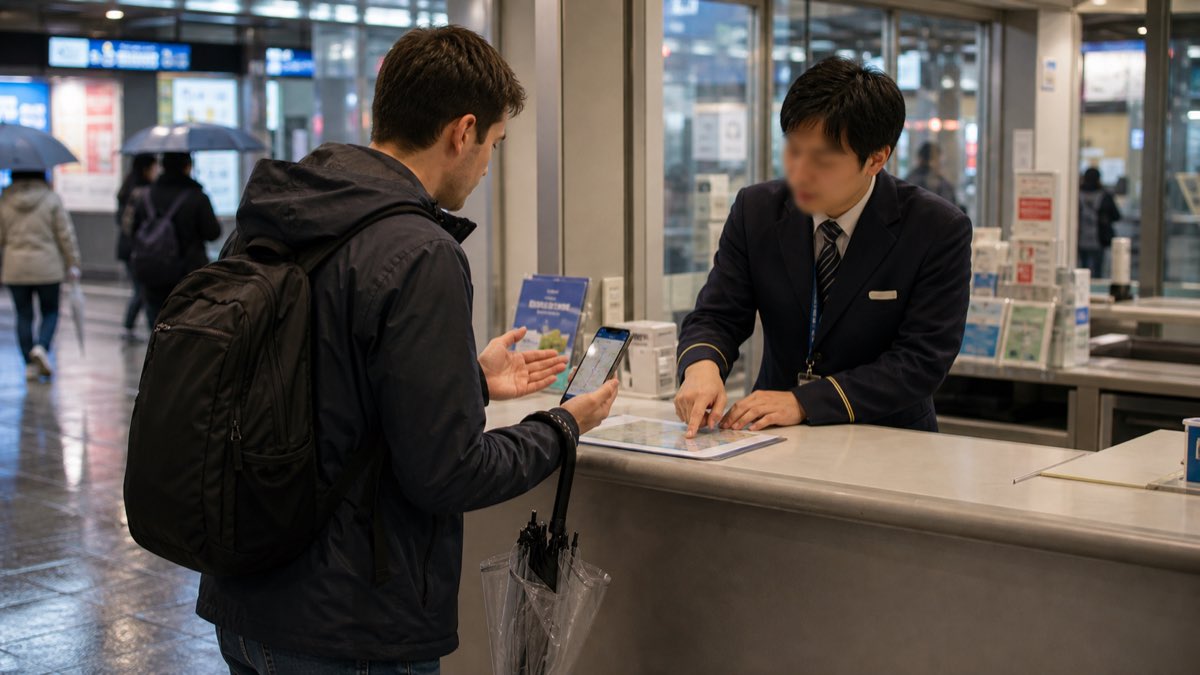
Keep these short. In bad weather, staff do not need a long story.
Weather and Safety
Is there a weather warning for this area?
Japanese:
この地域に気象警報は出ていますか?
Romaji:
Kono chiiki ni kisho keiho wa dete imasu ka?
Trains
Is this train running now?
Japanese:
この電車は今、動いていますか?
Romaji:
Kono densha wa ima, ugoite imasu ka?
Is there another route?
Japanese:
別の行き方はありますか?
Romaji:
Betsu no ikikata wa arimasu ka?
Hotel or Airbnb
Is it safer to stay here for now?
Japanese:
今はここにいた方が安全ですか?
Romaji:
Ima wa koko ni ita ho ga anzen desu ka?
Cancelling or Changing a Reservation
Because of heavy rain, can I change the reservation time?
Japanese:
大雨のため、予約時間を変更できますか?
Romaji:
Oame no tame, yoyaku jikan o henko dekimasu ka?
Asking for Help
I am a tourist and I do not understand the announcement. Could you please help me?
Japanese:
旅行者で、アナウンスが分かりません。手伝っていただけますか?
Romaji:
Ryokosha de, anaunsu ga wakarimasen. Tetsudatte itadakemasu ka?
If Something Goes Wrong
Do the small stabilizing things first.
You Are Stuck at a Station
Move out of the walking flow. Check the operator page again. Look for station staff, information counters, signs, and indoor waiting areas. Message your group with your station name, line, and whether you are staying or moving.
Do not block ticket gates while translating your phone screen.
Your Phone Battery Is Low
Stop video, turn on low power mode, reduce screen brightness, and save battery for maps, train gates, hotel messages, and emergency information. If you use mobile IC, battery is part of your transport plan.
You Cannot Reach Your Next Hotel
Contact the hotel or booking platform early. Explain that weather or transport disruption may prevent arrival. Ask about late check-in, date change, cancellation, or extension options.
If you are still at your previous hotel, ask whether you can extend before rooms are gone.
You Are Outside and Conditions Worsen
Enter a safe indoor place if you can do so calmly. Avoid rivers, underpasses, beaches, hillsides, and exposed open areas. Ask nearby staff or a police box for help if you are unsure.
JNTO's emergency page recommends Safety Tips, Japan Safe Travel Information, and NHK WORLD-JAPAN as information sources during significant natural disasters such as typhoons, earthquakes, tsunamis, and volcanic eruptions. It also lists the JNTO Japan Visitor Hotline for emergency support such as illness and disasters.
Next Useful Guides
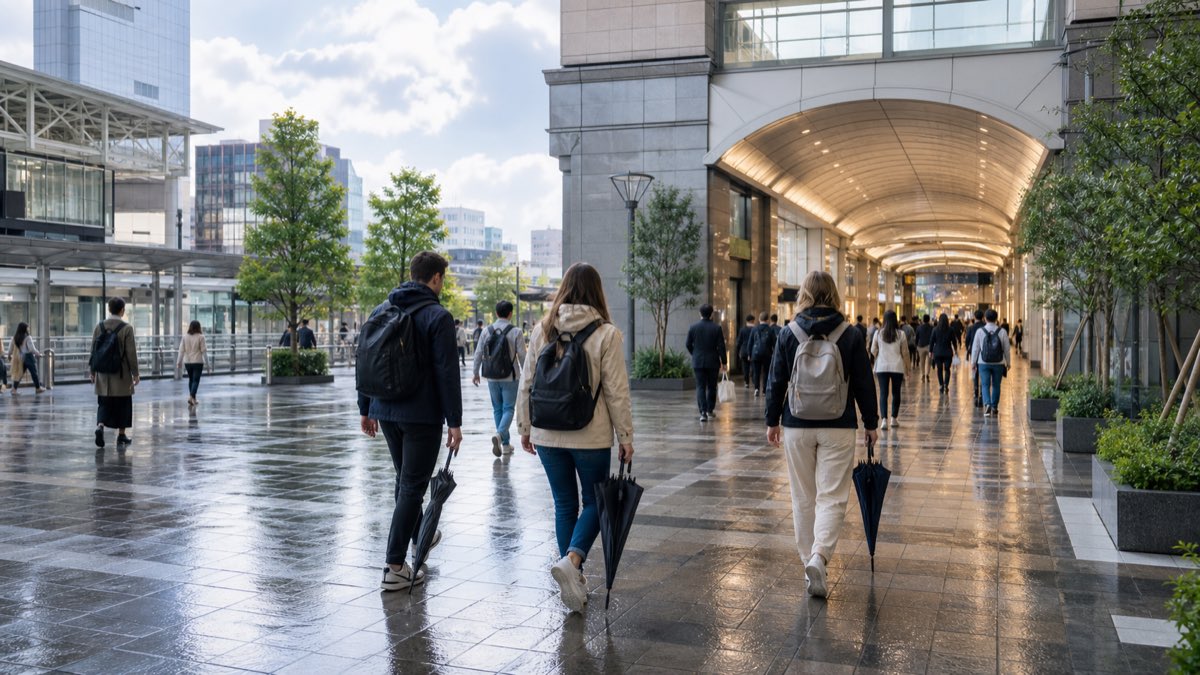
Use these based on the problem you are solving next:
- Heat is the bigger risk: Japan Heat Survival Guide 2026.
- You are going to a summer event: Japan Festival Survival Guide 2026.
- Your fireworks plan may be affected: Japan Summer Fireworks 2026.
- You need train basics: Tokyo Train Guide for Tourists 2026.
- Your arrival may become late: Tokyo Late-Night Arrival Guide 2026.
- You need airport movement: Tokyo Airport Transfer: Narita or Haneda Guide.
- Your luggage is the problem: Tokyo Luggage Storage Guide 2026.
- You are staying in an apartment: Tokyo Airbnb Starter Guide 2026.
Rain does not have to ruin a Japan trip. The good version is not heroic. It is simple: check official information, reduce movement, keep a reachable indoor backup, and let one day become smaller before it becomes stressful.
FAQ
When is typhoon season in Japan?
Typhoons can affect Japan at different times depending on the year and region, but travelers often pay closer attention from summer into autumn. If you are traveling between July and October, it is especially sensible to check tropical cyclone information and transport updates when forecasts look unstable.
What app should tourists use for weather warnings in Japan?
JNTO's Safety tips app is designed for foreign tourists and provides push alerts for earthquake early warnings, tsunami warnings, and other weather warnings in Japan. It also includes evacuation flowcharts, useful phrases, and emergency links.
Where should I check official Japanese weather warnings?
Use the Japan Meteorological Agency. Its English site links to weather warnings and advisories, risk maps, tropical cyclone information, precipitation nowcasts, and forecasts.
What should I do if a weather warning is issued while sightseeing?
Slow down and check the exact area, warning type, transport status, and your route back. For warning-level information, cancel optional outdoor plans and move toward a safe indoor place near a station or your accommodation.
What should I do if evacuation information is issued?
Stop sightseeing and follow local instructions. Ask hotel staff, your host, station staff, police, or local staff for help. JNTO's Safety tips evacuation page lists evacuation information such as Alert Level 3, Alert Level 4, and Alert Level 5.
Do trains stop during typhoons in Japan?
They can. Some trains may run, some may be delayed, and some may suspend service depending on route, operator, wind, rain, inspections, and safety conditions. Check the train operator for your exact line and direction.
Is it safe to use an umbrella during a typhoon?
In strong wind, umbrellas can be difficult or unsafe to use. If wind is strong enough to make walking hard, do not treat the problem as simple rain. Move indoors and follow local guidance.
Should I go to the airport early during a typhoon?
Check your airline, airport, and airport access route first. Going early can help in some cases, but it is not useful if trains are suspended, roads are affected, or the airline has already changed the flight. Confirm the route before moving.
What is a good rainy-day Plan B in Tokyo?
Choose a station-connected or station-near indoor plan: museum, department store, underground shopping street, cafe, food hall, cinema, aquarium, or a restaurant near your hotel. Avoid river walks, beaches, mountain trails, and exposed viewpoints during severe weather.
Can I still visit outdoor temples and shrines in heavy rain?
For ordinary rain, many outdoor sights can still be visited with proper footwear and rain gear. For heavy rain, warnings, lightning, strong wind, flooding risk, or typhoon conditions, switch to an indoor plan and return when conditions improve.
Sources Checked
- Japan Meteorological Agency: Weather, Climate & Earthquake Information, checked July 6, 2026.
- JNTO Safety tips: The App "Safety tips", checked July 6, 2026.
- JNTO Safety tips: When a weather warning is issued, checked July 6, 2026.
- JNTO Safety tips: When evacuation information is issued, checked July 6, 2026.
- JNTO: Staying Safe in Japan, checked July 6, 2026.
- JR East: Train Status Information, checked July 6, 2026.
- Tokyo Metro: Service Status, checked July 6, 2026.


Comments