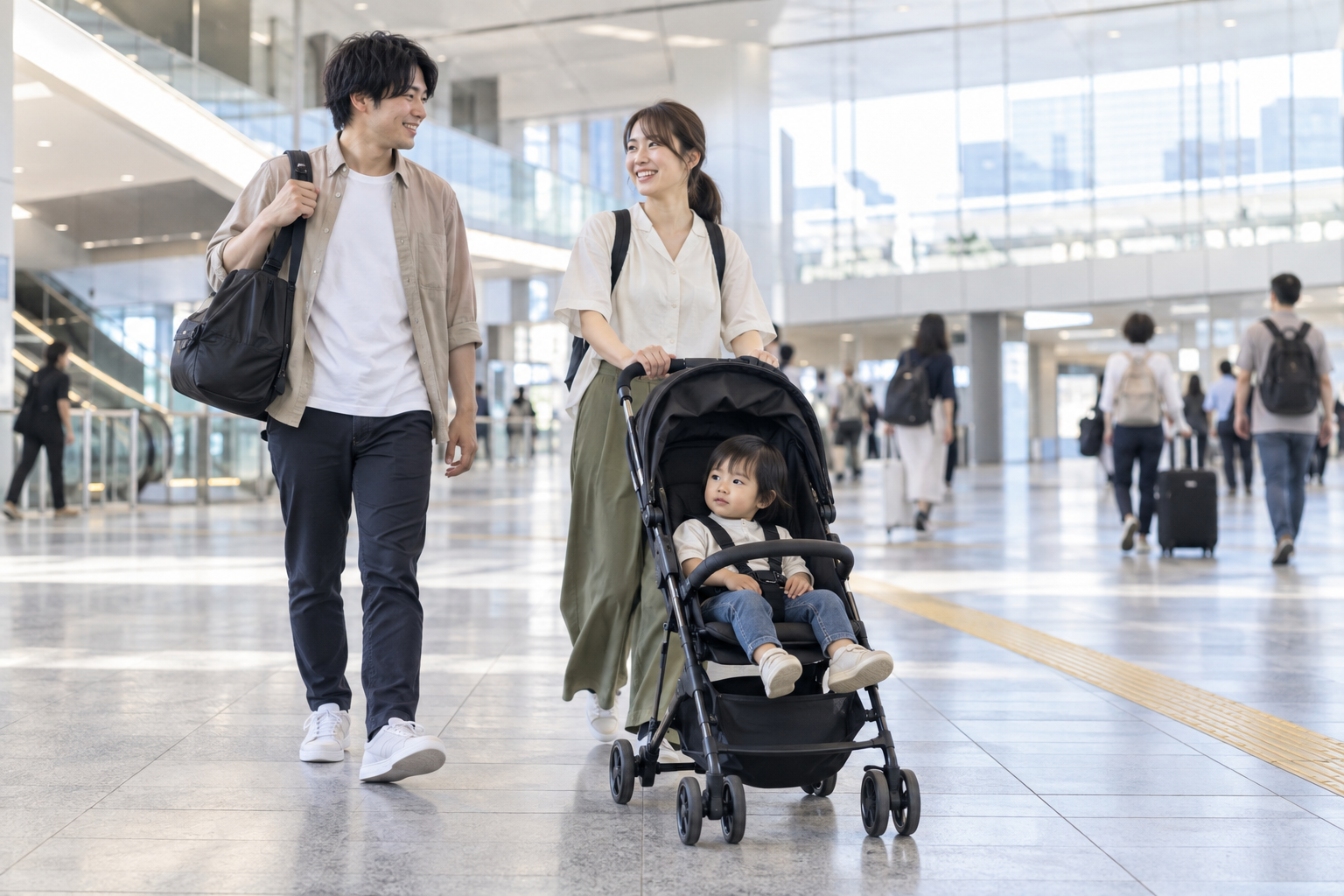
AI-generated illustration. It does not document a specific station, operator or facility.
- Quick Answer
- Make Three Decisions Before You Buy Tickets
- Who Needs a Train Ticket?
- When a Baby Needs a Paid Reserved Seat
- Can You Keep a Stroller Open on Trains?
- Plan the Station Route
- Shinkansen With a Stroller
- A Low-Stress Family Travel Routine
- Plan B: No Elevator, No Adjacent Seats or an Overcrowded Train
- Final Booking Checklist
- FAQ
- Do babies ride trains free in Japan?
- What age pays a child fare on JR trains?
- Does a baby need a ticket for a reserved Shinkansen seat?
- Can I take an unfolded stroller on Tokyo trains?
- Should I fold the stroller during rush hour?
- Can I take a stroller on a Shinkansen?
- Do I need to reserve oversized-baggage space for a stroller?
- How do I find elevators in Japanese train stations?
- What is the best Plan B if the elevator or family seating does not work?
- Official Sources and Editorial Note
Quick Answer
For Japan train travel with a baby, decide the ticket and the stroller plan separately. On JR services, ages 6 to 11 generally use a child fare, while younger children may travel free only under stated conditions. If a baby or infant occupies a reserved seat, a child fare and the relevant charge are required. JR Central’s school-status exceptions at ages 6 and 12 apply only when the elementary school is established under Japanese law, so check the operator’s exact category before buying.
Tokyo Metro says a stroller may remain open, but it must not obstruct other passengers. Use the elevator, apply the brake and keep hold of the handle on the platform, and share multipurpose space considerately. For intercity travel, check the exact operator, buy a seat for every child who will occupy one, decide where the stroller will go, and keep a baby carrier or a quieter train as Plan B.
Last checked: September 21, 2026 (JST).
Make Three Decisions Before You Buy Tickets
A family rail plan works better when you answer three questions before opening the booking screen.
- Who needs a ticket? Record each child’s age and, at age 6 or 12, whether the relevant elementary school is established under Japanese law.
- Who needs their own seat? A child traveling free is not automatically entitled to occupy a reserved seat.
- How will the stroller move through each leg? Check the elevator route, train space, transfer and storage plan rather than treating “stroller-friendly” as a nationwide guarantee.
This separates three rules that travelers often mix together: the passenger’s fare category, the right to occupy a seat, and the handling of the stroller.
Who Needs a Train Ticket?
AI-generated illustration. Ticket appearance, fares and booking screens are intentionally not shown.
JR Central publishes these categories for its tickets. Other operators may use different products or wording, so use this table as a JR decision check, not a universal rule for every railway.
| JR Central category | Published definition | Practical booking meaning |
|---|---|---|
| Adult | 12 or older | Adult fare normally applies. A 12-year-old still attending an elementary school established under Japanese law counts as a child under the published exception. |
| Child | 6 to 11 | Basic fare, limited express, express and reserved-seat tickets are half the adult price, with 5 yen rounded down. Green Car and sleeper charges are not halved. |
| Infant | 1 to 5 | Normally no fare when accompanied, subject to the exceptions below. A 6-year-old who has not entered an elementary school established under Japanese law counts as an infant under the published exception. |
| Baby | Younger than 1 | Normally no fare when accompanied, subject to the same exceptions below. |
JR Central lists three important cases where an infant or baby is not free:
- more than two infants or babies accompany one adult or child—the third and each additional young child needs fares and charges;
- the infant or baby uses a reserved seat, Green Car seat other than an unreserved Green Car seat, or a bed;
- the infant travels alone.
JR East’s English FAQ gives the same practical boundary for ordinary planning: tickets are required from age 6, ages 6 to 11 use child fares, and a child under 6 needs a ticket or pass to secure a reserved seat.
Do not use age alone at the boundary
The school-status exceptions matter, but JR Central limits them to an elementary school established under Japanese law. If a child is 6 but has not entered such a school, or is 12 and still attending one, check the published rule and ask the operator if the booking interface is unclear. Attendance at an overseas elementary school does not automatically qualify. Do not guess from the adult or child labels on a third-party booking site.
When a Baby Needs a Paid Reserved Seat
“My baby rides free” and “my baby has a reserved seat” are different decisions. If you want the baby or infant to occupy a reserved seat on the JR service covered by the published rule, buy the required child ticket and charge.
That choice can be useful on a long journey, but it should be deliberate. Before paying, check:
- whether the child will occupy the seat for the journey;
- whether the seats can be reserved together;
- whether the chosen train is all-reserved during a peak period;
- where the stroller will be stored without blocking the aisle;
- whether a later departure has a better seating arrangement.
JR Central states that all Nozomi seats become reserved during designated major peak periods. If the family cannot find suitable seats together, the official guidance is to consider a different date, time or train with availability rather than boarding without a workable seat plan.
Can You Keep a Stroller Open on Trains?
Tokyo Metro’s current English FAQ says passengers may board without folding the stroller. It also asks that the stroller not touch or obstruct other passengers and explains that multipurpose spaces marked for stroller use are shared.
That is permission, not a promise of empty space. The safe decision depends on the actual train and crowd:
- keep the stroller under control and leave the aisle and doors usable;
- use the multipurpose area when available, while sharing it with other passengers who need it;
- avoid the busiest commuter periods when the itinerary allows;
- be ready to wait for a less crowded train rather than forcing the stroller into a packed car;
- follow staff instructions and the rules of the specific operator.
Do not turn “strollers may remain open on Tokyo Metro” into “every train in Japan must accept an open stroller in every condition.”
Plan the Station Route
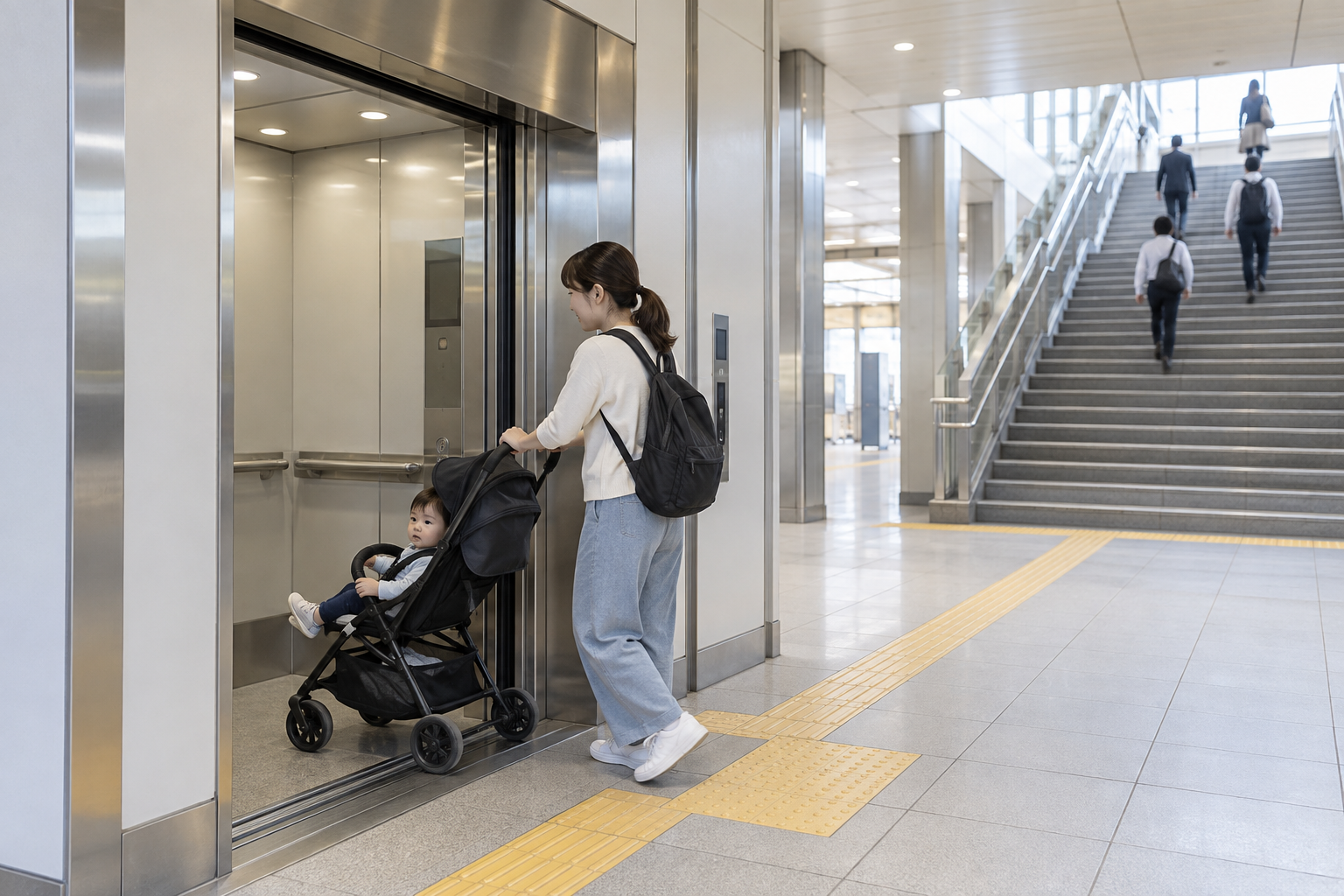
AI-generated illustration. The station layout is conceptual, not an access map.
The hardest part is often not the ride. It is reaching the correct platform and exit without an unsafe staircase or rushed transfer.
Tokyo Metro’s baby-travel guidance says to use an elevator route from ground level to the gate and platform. It specifically warns not to take a stroller carrying a baby onto an escalator. It also advises applying the stroller brake and holding the handle on platforms, watching the train-platform gap, and allowing extra time because elevators and corridors can be indirect or crowded.
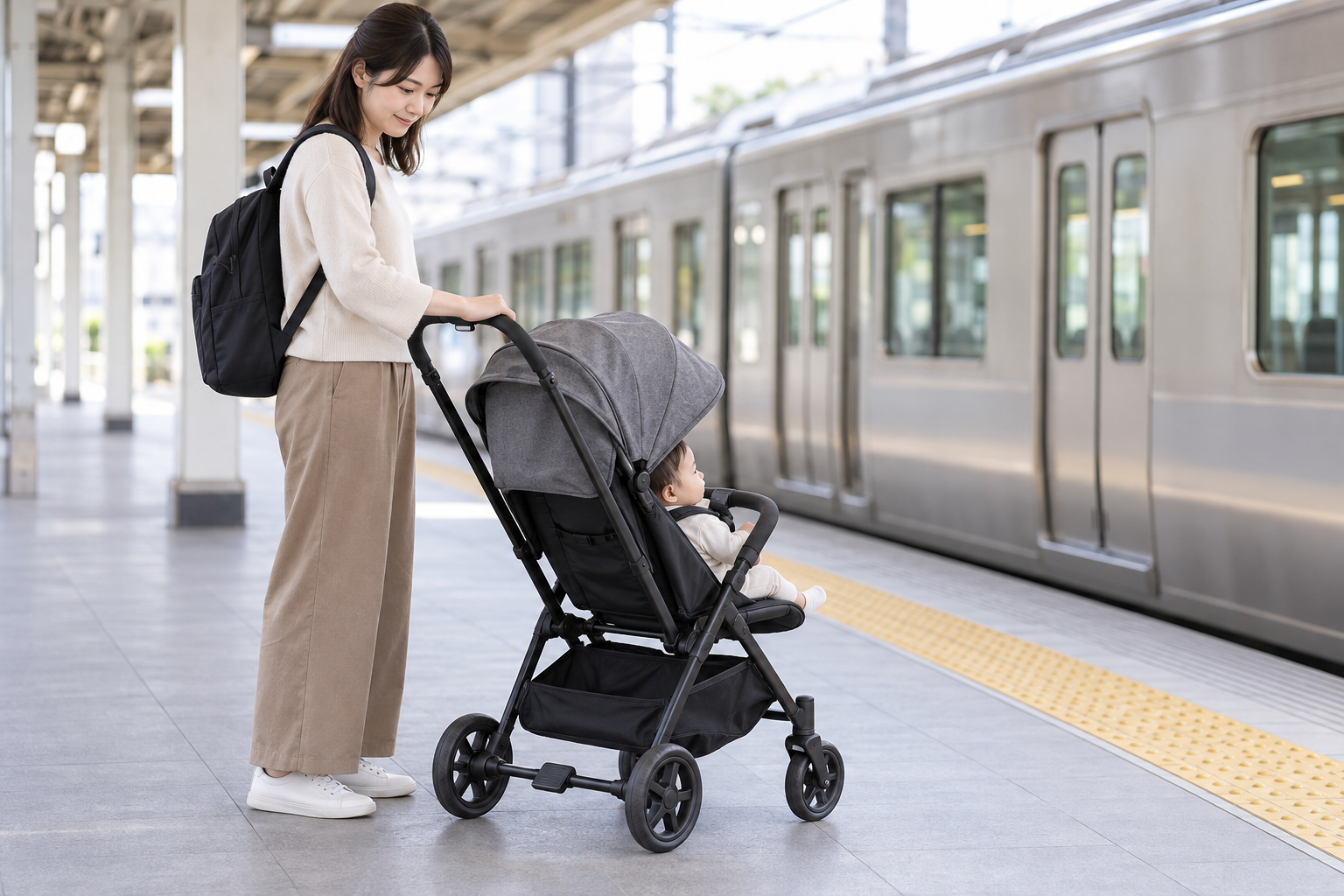
AI-generated illustration. It does not represent a specific platform or safety marking.
For each important station, save:
- the elevator-equipped entrance at the origin;
- the elevator-equipped exit at the destination;
- the car position nearest the useful elevator when the operator publishes it;
- a realistic transfer time rather than the fastest map estimate;
- one alternate station or surface route.
The Japan Train Stations with Luggage guide explains how to check elevator routes. Families who need a fully step-free chain can also use the route-check method in the Wheelchair Travel in Japan guide without assuming the two travel needs are identical.
Shinkansen With a Stroller
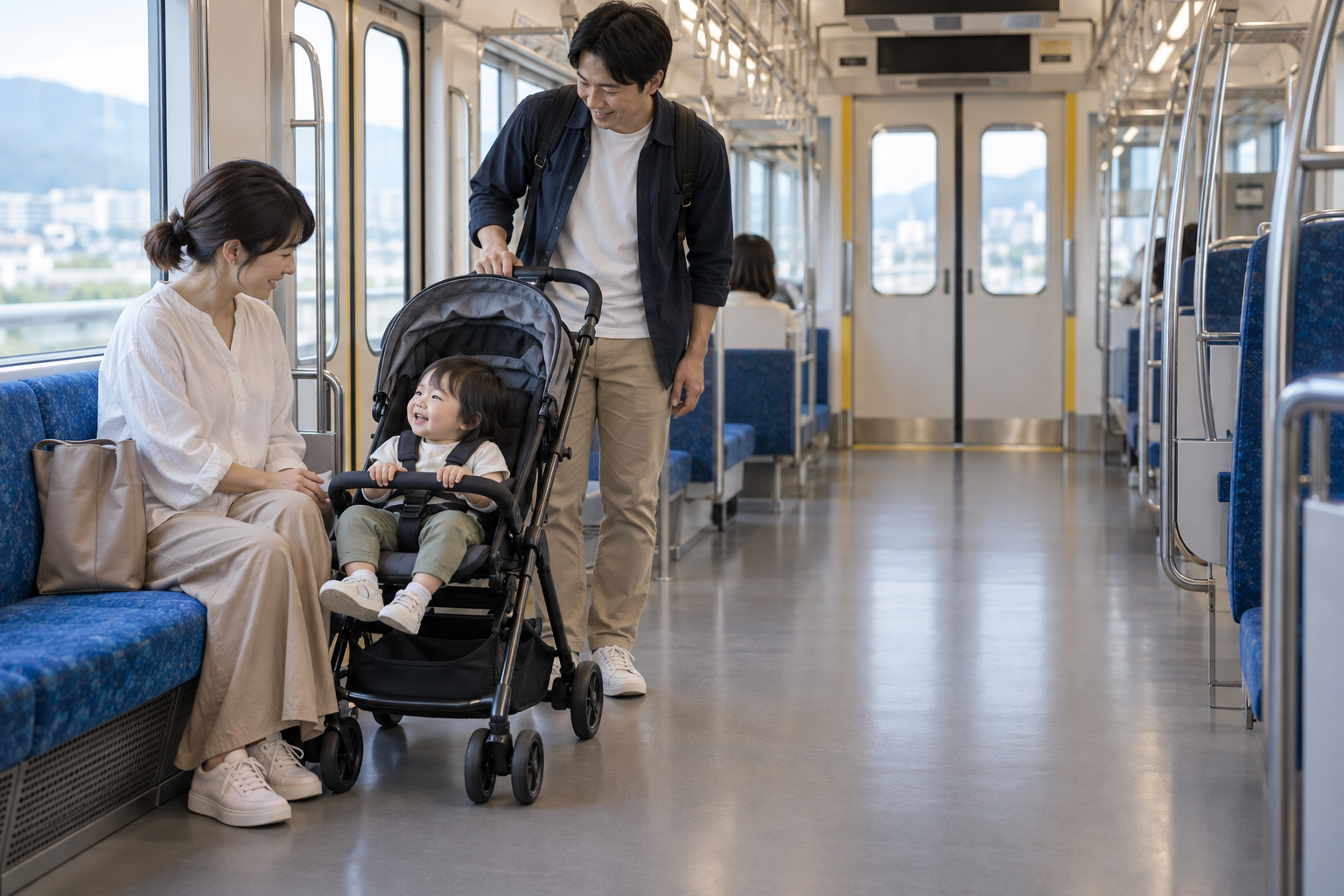
AI-generated illustration. It is not a diagram of a specific Shinkansen or operator layout.
JR Central says strollers may be placed in baggage racks, baggage compartments or oversized luggage spaces. If you want to use a reserved oversized baggage space, reserve the corresponding seat when purchasing the ticket. The passenger remains responsible for the stroller and other baggage.
This does not mean every stroller automatically requires an oversized-baggage reservation. It means you should decide where your actual folded stroller can safely fit. Measure it when folded, compare the train’s current official baggage information, and reserve the appropriate space when you intend to use a reservation-controlled area.
Before an intercity journey:
- Reserve every seat the family plans to occupy.
- Confirm whether the stroller will be folded and where it will be stored.
- Keep the aisle, doors and seat-recline space clear.
- Avoid making the final train of the day the only workable option.
- Recheck peak-period seating rules shortly before purchase.
For the full size and reservation rules, use the Shinkansen luggage guide.
A Low-Stress Family Travel Routine
The most useful plan is not the one with the fewest theoretical minutes. It is the one the family can repeat safely.
Before leaving the hotel
- confirm that the chosen entrance and exit still fit the stroller route;
- screenshot the station exits and accommodation address;
- pack one compact bag that can stay with the adult handling the child;
- keep feeding, changing and medication essentials reachable;
- charge the phone and save the operator’s official page;
- choose a time that avoids the sharpest crowd peak when possible.
At the station
- use the elevator with the child in the stroller;
- allow other passengers to leave the elevator before entering;
- apply the brake whenever stopped on the platform;
- keep a hand on the handle;
- ask station staff rather than improvising an unsafe route.
On the train
- keep doors and aisles clear;
- share multipurpose areas;
- do not assume a priority seat is guaranteed;
- move to a quieter carriage or wait for another service when crowding makes the setup unsafe.
For local fares and child IC-card context, see the Suica, PASMO and ICOCA guide. Check the issuing operator’s current identity and purchase requirements before relying on a child IC card.
Plan B: No Elevator, No Adjacent Seats or an Overcrowded Train
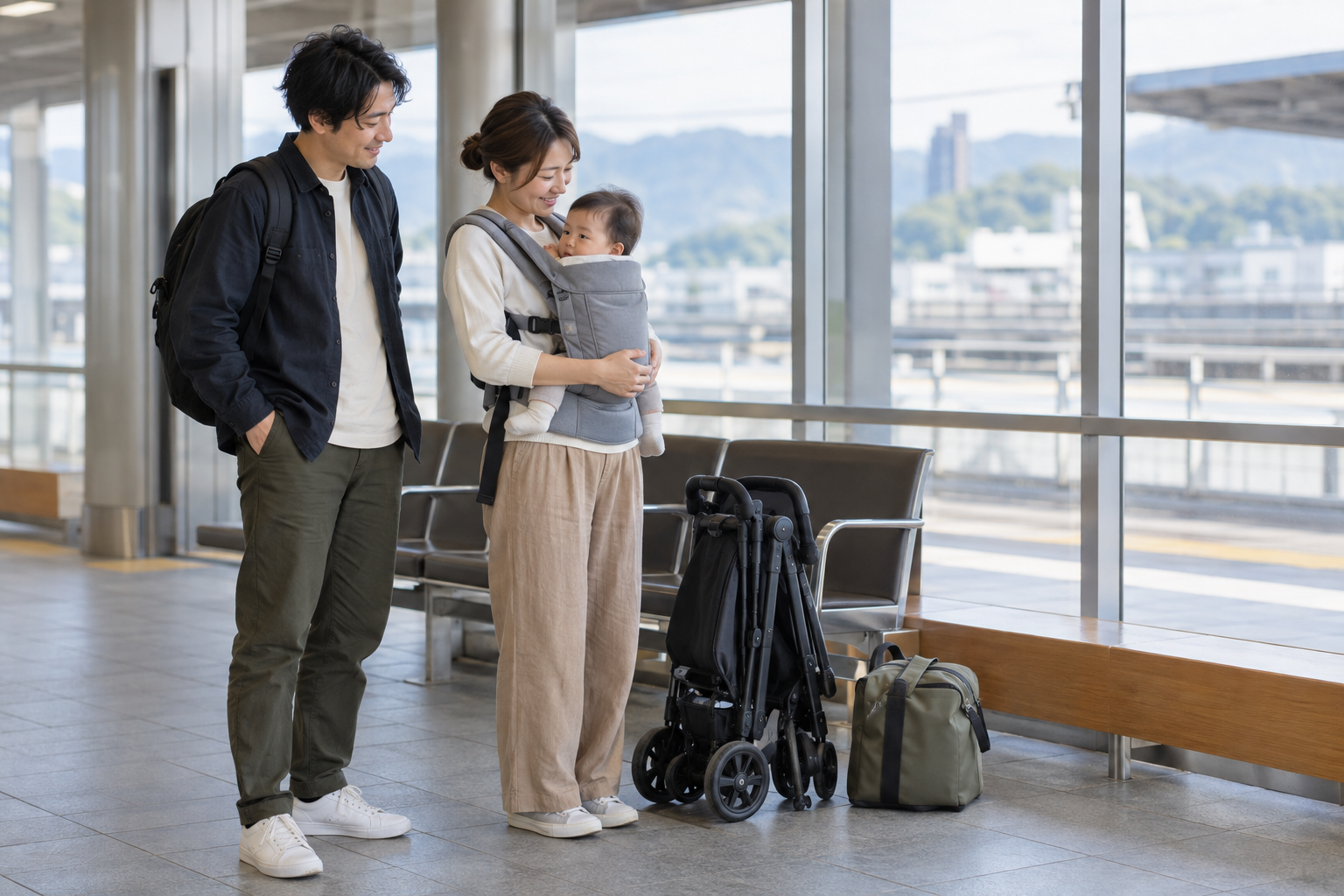
AI-generated illustration. A carrier is an optional fallback, not a universal recommendation for every child or adult.
If the elevator route, train space or adjacent reserved seats do not work, do not force the original connection.
| Failure | Lower-friction Plan B |
|---|---|
| Elevator is unavailable or the planned exit is wrong | Ask staff for another elevator route, use a nearby accessible station, or switch to a surface route. |
| Train is too crowded for safe stroller control | Wait for a quieter service or travel outside the peak. |
| Family cannot reserve suitable seats together | Choose another train or time before purchase; buy a child ticket for every child who will occupy a reserved seat. |
| Folded stroller does not fit the intended space | Recheck the operator’s baggage options and reserve an appropriate space where required. |
| Stroller becomes impractical for one leg | Use a suitable baby carrier only if it is safe and comfortable for the child and adult, then return to the stroller when the route permits. |
JNTO notes that parents in Japan often switch between strollers and baby carriers according to the route. That is a planning option, not a requirement. A carrier must fit the child and adult, and it does not remove the need to plan luggage, rest and feeding.
If the family changes to a rental car, the Japan Rental Car Child Seat guide covers the separate legal and booking decision. For urgent help, save the Japan Emergency Numbers guide.
Final Booking Checklist
- Each child is assigned the correct operator fare category.
- Any baby or infant who will occupy a reserved seat has the required child ticket and charge.
- The family has confirmed whether the seats are together.
- Origin, transfer and destination elevator routes are saved.
- The stroller has a safe on-train storage or use plan.
- Peak-period reservation rules have been checked.
- The first choice and Plan B do not depend on the final train.
- Official pages and accommodation details are saved offline.
FAQ
Do babies ride trains free in Japan?
On JR Central, babies and infants are normally free when accompanied, but exceptions apply. A fare and charge are required if the young child occupies a reserved seat or specified paid space, travels alone, or exceeds the published number of free young children per accompanying adult or child. Check the exact operator.
What age pays a child fare on JR trains?
JR Central defines children as ages 6 to 11. Its school-status exceptions apply only to an elementary school established under Japanese law: a 6-year-old who has not entered such a school counts as an infant, while a 12-year-old still attending one counts as a child. An overseas elementary school does not automatically qualify.
Does a baby need a ticket for a reserved Shinkansen seat?
Yes, when the baby or infant occupies a reserved seat under the JR Central rule, the relevant child fare and charge are required. Free accompanying-child status does not provide a separate reserved seat.
Can I take an unfolded stroller on Tokyo trains?
Tokyo Metro says a stroller may remain open, but it must not obstruct other passengers. Use shared multipurpose space considerately and follow staff instructions and actual crowd conditions.
Should I fold the stroller during rush hour?
Tokyo Metro does not make folding universal in its English FAQ, but a crowded train may make an open stroller impractical. Avoid peak time or wait for a quieter service rather than forcing an unsafe setup.
Can I take a stroller on a Shinkansen?
JR Central includes strollers among items that may use baggage racks, compartments or oversized luggage spaces. Decide where the folded stroller will fit and keep aisles and doors clear.
Do I need to reserve oversized-baggage space for a stroller?
Not automatically. JR Central says a reservation is required if you want to use a reserved oversized baggage space. Check the folded stroller’s size and the current train-specific options before purchase.
How do I find elevators in Japanese train stations?
Use the operator’s official station map or accessibility search, save the exact entrance and exit, and allow extra transfer time. Ask station staff if the planned elevator route is unavailable.
What is the best Plan B if the elevator or family seating does not work?
Choose another station, route, train or departure time that reduces dependencies. A suitable baby carrier can help for one leg, but only when safe and comfortable for the child and adult.
Official Sources and Editorial Note
- JNTO: Traveling With Children
- JR Central: Adults and Children
- JR Central: Luggage Information
- JR Central: Peak-Period Nozomi Reservations
- Tokyo Metro: Stroller FAQ
- Tokyo Metro: Safety and Comfort Measures
- Tokyo Metro: Things to Consider When Riding the Subway
- JR East: Multilingual FAQ
This is an independent decision guide based on official information checked on September 21, 2026. Rules, schedules, facilities and seat availability can change. Recheck the operator before purchase. No firsthand family trip, stroller test or station inspection is claimed.
All six article images are AI-generated conceptual illustrations, not documentary evidence of a specific station, train, ticket, stroller policy or facility layout.
Comments