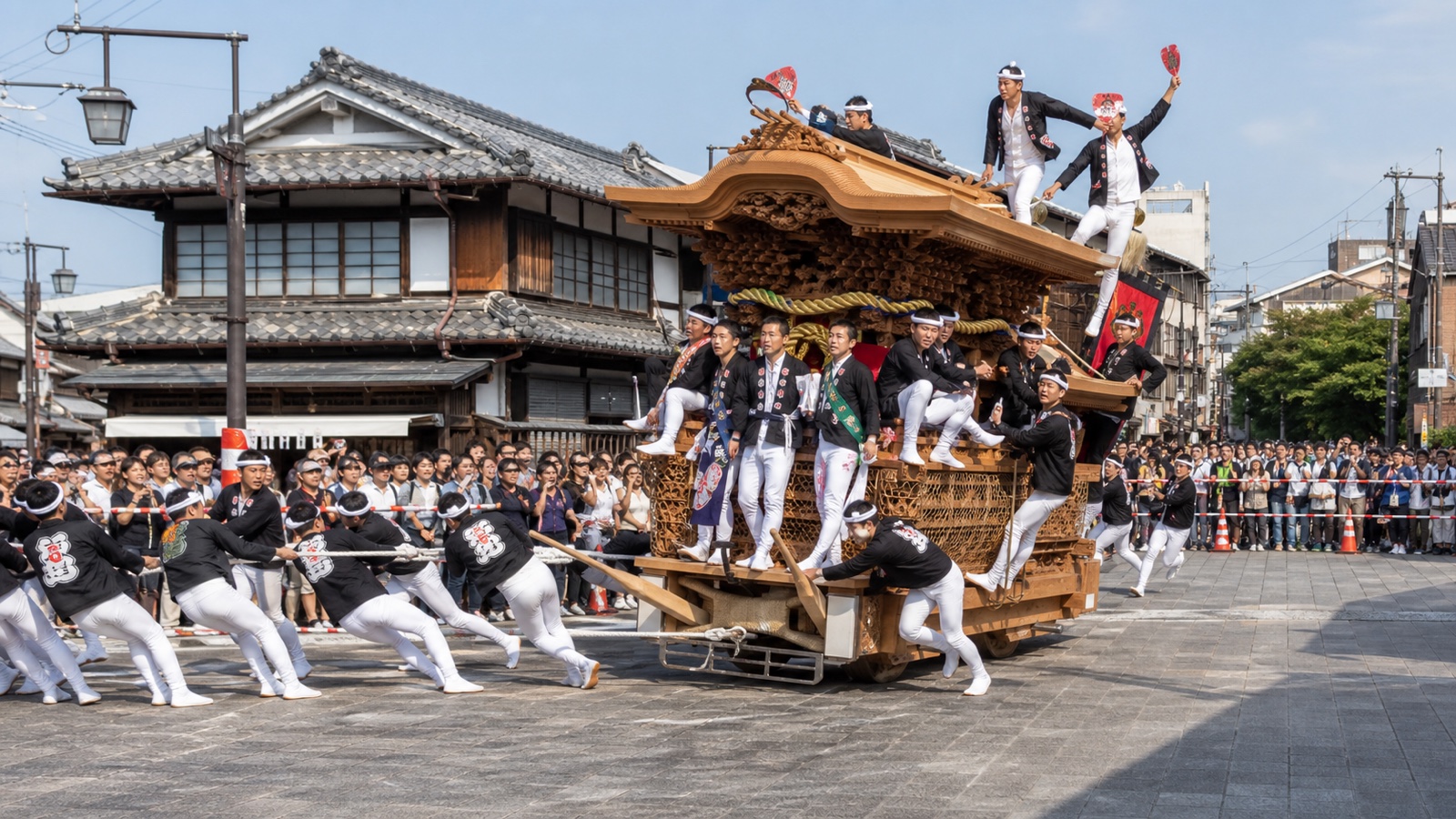
Kishiwada Danjiri is thrilling because huge carved wooden festival carts move through ordinary city streets at speed. That is also why this is not an event to approach with a random map pin and a plan to “stand near a corner.” The safest useful plan is to choose the correct festival weekend, travel by Nankai train, watch from behind the managed spectator line, and decide your exit station before the crowds move.
For 2026, the best-known September festival in the Kishiwada and Haruki districts takes place on Saturday, September 19 and Sunday, September 20. There are also two September test pulls. A separate October festival in several other districts takes place on October 10 and 11, with an October 4 test pull.
This guide separates those editions, explains the railway choices from Osaka and Kansai Airport, and gives you a practical safety and Plan B checklist. It does not reproduce an old parade order as if it were current.
- Quick answer: the 2026 plan that avoids the common mistakes
- Confirmed Kishiwada Danjiri Festival dates for 2026
- September 19 or 20: which day should you choose?
- Getting there from Osaka, Namba and Kansai Airport
- 2026 road restrictions: why driving fails
- Safe viewing: the corner is not your photo spot
- Station, viewing and exit decision matrix
- Luggage, toilets, food and photography manners
- Rain, heat, crowds and disruption: your Plan B
- Before-you-go checklist
- Kishiwada Danjiri Festival 2026 FAQ
- Is Kishiwada Danjiri Festival confirmed for 2026?
- Which weekend is the famous Kishiwada Danjiri Festival?
- How do I get to the festival from Osaka-Namba?
- Can I visit from Kansai Airport?
- Can I drive or take a taxi to the festival?
- Where is the safest place to watch yarimawashi?
- Can I use an umbrella if it rains?
- Is the 2026 parade order available?
Quick answer: the 2026 plan that avoids the common mistakes
- Choose September 19 or 20 if you mean the famous Kishiwada/Haruki edition most overseas visitors have seen online.
- Choose the September test pull on September 6 or 18 when a two-hour daytime operation fits your trip. It is still a live cart-pulling event, not a rehearsal you can walk through casually.
- Do not confuse the October 10–11 district festival with the September Kishiwada/Haruki routes.
- Use the Nankai Line. Kishiwada Station is the primary access point in this plan, but Kishiwada City warns that it becomes crowded and also names Takojizo and Izumi-Omiya as alternatives.
- Do not drive. Official 2026 restrictions close streets to vehicles, nearby roads are no-parking, and the city says there are no nearby visitor parking lots.
- Do not stand on the road, at the outside of a corner, or where a cart crew needs space. A danjiri needs roughly twice its own width to turn, according to the city’s spectator guidance.
- Carry a raincoat instead of using an umbrella in the viewing crowd.
- Save two exit options and follow police and festival staff even if their direction differs from your saved route.
| Your priority | Best starting choice | Main risk | Plan B |
|---|---|---|---|
| The classic September atmosphere | September 19 or 20, Kishiwada/Haruki | Long operating day, street closures and dense station crowds | Arrive early, stay away from corners and leave via the station staff direct you to |
| A shorter daytime visit | September 6 or 18 test pull, 14:00–16:00 | Assuming “test” means quiet or risk-free | Treat it as a real moving-cart event and keep the same safety margin |
| A lantern-lit scene | September 19 evening | Darkness, fatigue and a concentrated late exit | Watch from a managed position and leave before you are exhausted |
| The October district festival | October 10 or 11 | Using a September route or station plan for different districts | Wait for current district-specific instructions before fixing your route |
| Travelers with luggage or a hard airport connection | Do not combine the festival with transfer day | Road closures, slow walking and station crowd control | Store or forward luggage and attend on a schedule-free day |
Information checked August 9, 2026. The festival schedule is confirmed, but detailed parade orders, temporary viewing controls, train operations and weather decisions can change.
Confirmed Kishiwada Danjiri Festival dates for 2026
The official Kishiwada Danjiri Festival page lists two sets of dates. They are not one continuous festival.
September festival: Kishiwada and Haruki districts
| Event | Date | Official operating time |
|---|---|---|
| Test pull | Sunday, September 6 | 14:00–16:00 |
| Test pull | Friday, September 18 | 14:00–16:00 |
| Eve festival | Saturday, September 19 | 06:00–22:00 |
| Main festival | Sunday, September 20 | 09:00–22:00 |
This is the edition most first-time visitors mean when they say “Kishiwada Danjiri.” The program covers the Kishiwada and Haruki districts, so a single social-media clip does not tell you which station, street or neighborhood it shows.
October festival: separate districts
| Event | Date | Official operating time |
|---|---|---|
| Test pull | Sunday, October 4 | 13:00–17:00 |
| Eve festival | Saturday, October 10 | 06:00–22:00 |
| Main festival | Sunday, October 11 | 07:00–22:00, varying by district |
The city identifies the October edition with districts including Higashi-Kishiwada, Minami-Sakamori, Yagi, Yamanae, Yamanae-Minami and Yamataki. Do not copy the September Kishiwada Station plan automatically. Confirm the district you want first, then use its current route information.
As of August 9, the city had confirmed the 2026 operating dates, but the current 2026 parade and shrine-entry order was not available on the official festival pages checked for this article. A 2025 order is not a substitute.
September 19 or 20: which day should you choose?
There is no universally “best” day. The right choice depends on what you can safely manage.
Choose Saturday, September 19 for the longest range of scenes
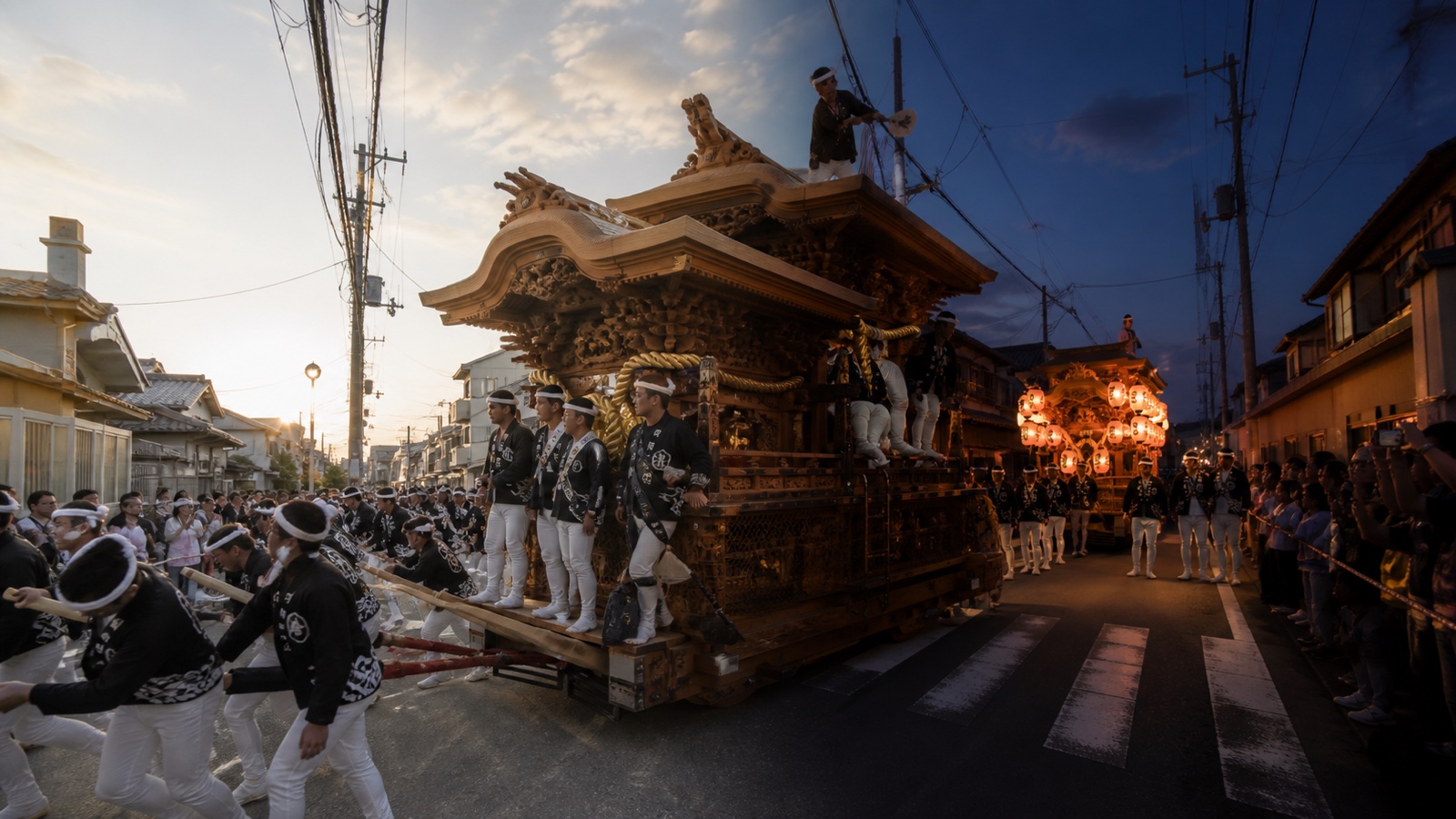
The eve festival runs from 06:00 to 22:00. That makes it possible to see early movement, daytime pulling and the evening lantern atmosphere without trying to arrive for a single short moment. The tradeoff is fatigue. Twelve or more hours outdoors around road closures is a poor plan for children, older travelers, anyone with limited mobility, or anyone carrying luggage.
You do not need to stay for the entire schedule. A defined two- or three-hour viewing block plus an exit plan is more useful than chasing multiple carts.
Choose Sunday, September 20 for a later start
Sunday’s festival operation is scheduled from 09:00 to 22:00. It avoids the 06:00 public schedule of the previous day but still creates a long operating day and late return. If your goal is the Sunday atmosphere rather than dawn activity, this is the simpler choice.
Choose a test pull for a short daytime window—not a safety shortcut
The September test pulls run from 14:00 to 16:00 on September 6 and 18. The city describes a test pull as checking the course and the condition of the danjiri before the festival. The shorter window can be easier to fit into a trip, but the cart is moving and the same corner-space rule applies. Do not step into the route because the word “test” sounds informal.
Getting there from Osaka, Namba and Kansai Airport
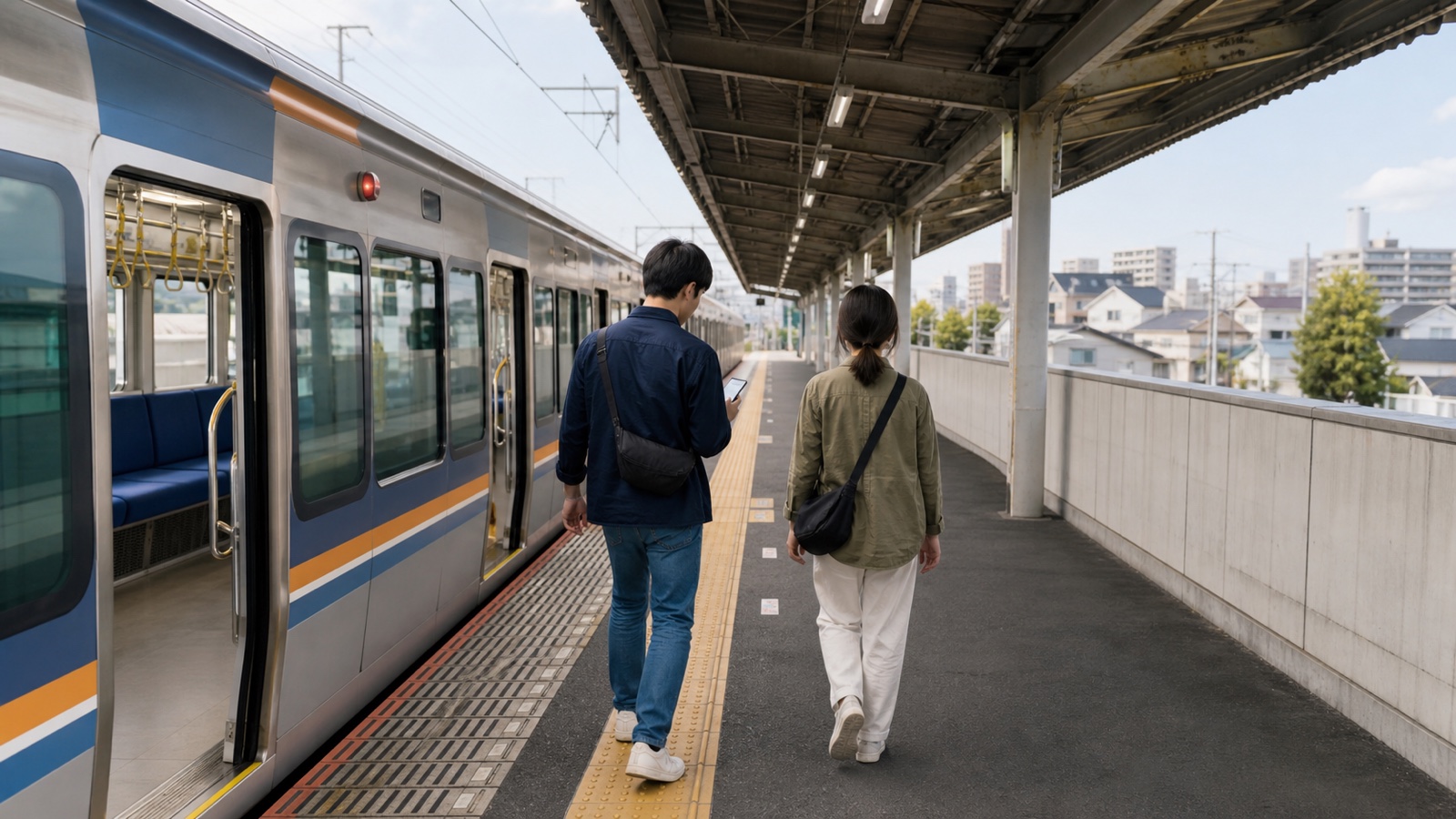
The practical railway is the Nankai Line. The official English Kishiwada Station page identifies it as station NK24, between Izumi-Omiya and Takojizo.
From Osaka-Namba
Search from Nankai Namba to Kishiwada, not from JR Namba. Express, Airport Express and several other Nankai services stop at Kishiwada, but stopping patterns and departure platforms can change. Use Nankai’s live timetable and fare search on the day instead of saving one departure months ahead.
Some limited express services require an additional limited-express ticket. You do not need to buy one merely because the festival is crowded. Choose the service that stops at Kishiwada and leaves you enough time to walk through a managed crowd.
From Kansai Airport
Kishiwada is also on Nankai’s airport corridor. Enter Kansai Airport → Kishiwada in the live search and confirm that your train stops there. Nankai’s English service guide warns that Rapi:t alpha does not stop at Kishiwada; the direction toward Namba is not enough to confirm the stop.
The festival is a bad activity immediately before a flight. A normal railway timetable cannot promise that you will reach the station entrance quickly during a street festival.
Three stations to save before you arrive
| Station | Use in your plan | Important limitation |
|---|---|---|
| Kishiwada (NK24) | Main access, staffed central gate, many stopping services | The city specifically warns that it becomes crowded |
| Takojizo (NK25) | Useful south-side alternative and close to Danjiri Kaikan | Fewer train types stop; staffing is limited |
| Izumi-Omiya (NK23) | Useful north-side alternative named in city guidance | The best walking path depends on live restrictions and your viewing area |
Do not treat an alternative station as a secret shortcut. It is useful when the walking route is open and police or festival staff allow movement in that direction.
Save the railway search and your stations in an offline note. RJG’s Google Maps in Japan guide explains how to keep platform and route information usable when your connection is slow.
2026 road restrictions: why driving fails
Kishiwada City’s official 2026 traffic notice applies to the September festival dates. The PDF lists vehicle restrictions, excluding bicycles, during these windows:
| Date | 2026 vehicle-restriction time |
|---|---|
| September 6 | 13:00–16:30 |
| September 18 | 13:00–16:30 |
| September 19 | 05:15–23:00 |
| September 20 | 08:00–23:00 |
The official traffic-restriction page and its current PDF tell visitors to use trains and buses. They also state that roads around the area are no-parking and that there are no nearby parking lots for visitors.
That closes three common loopholes:
- a rental car parked “just outside” the route can still be trapped by congestion or a later closure;
- a taxi cannot promise to cross a restricted street or reach your chosen corner;
- a tour-bus reservation system is not permission for a private car to park.
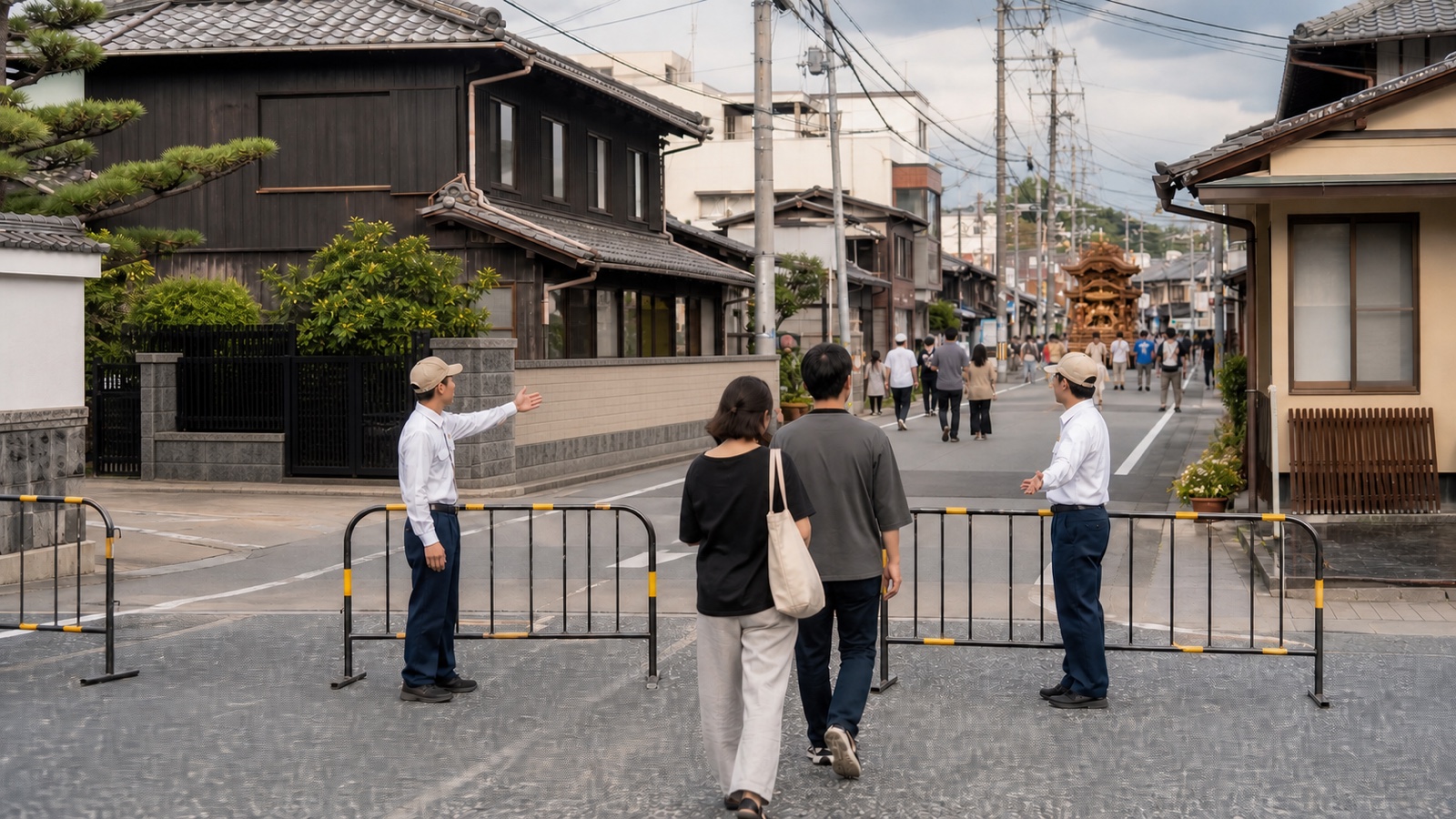
The restriction map is useful for understanding the broad area, but it does not promise that each pedestrian lane stays open. Police and festival staff can redirect people for safety. Their live instruction outranks your saved route.
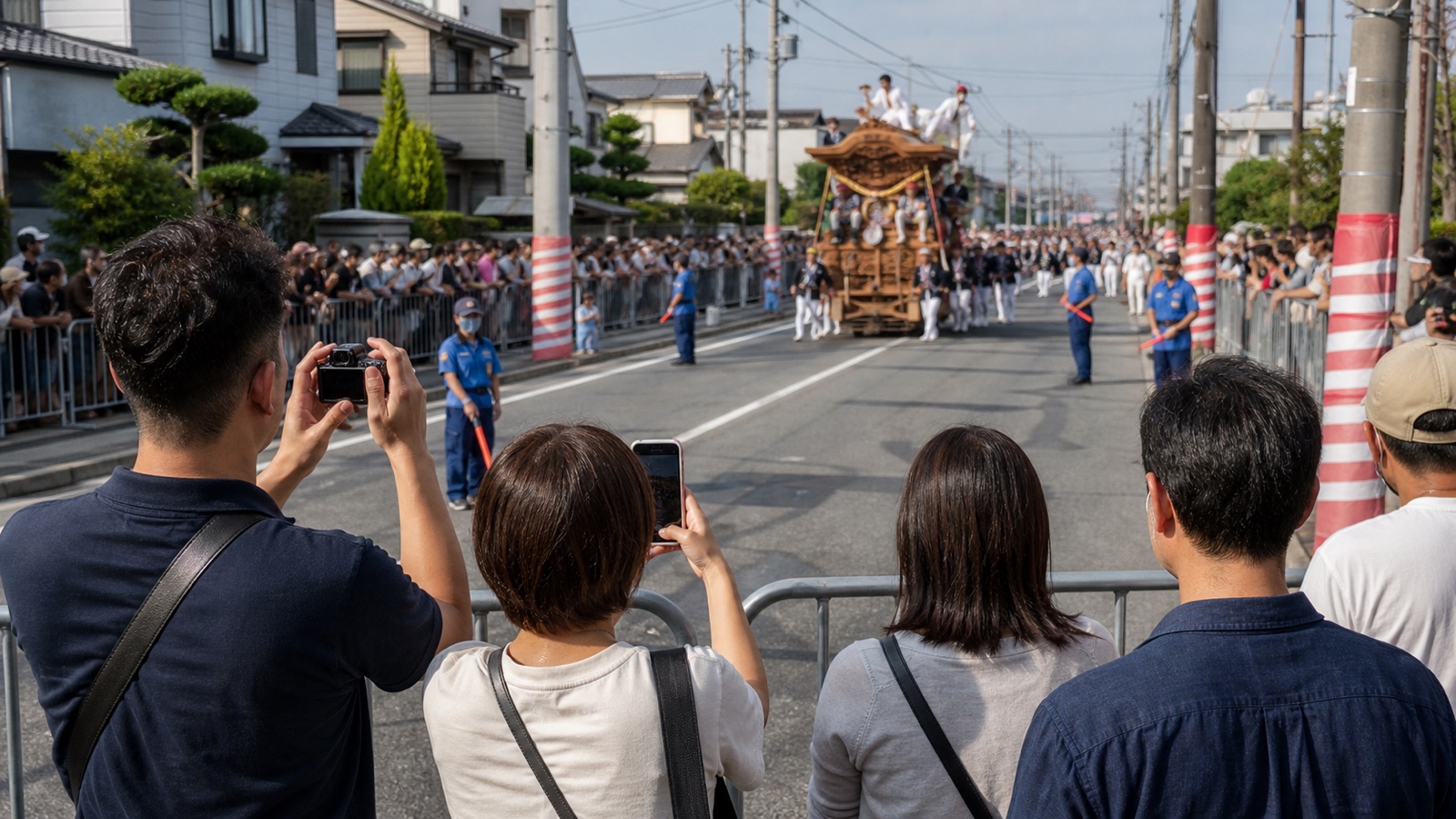
Safe viewing: the corner is not your photo spot
The signature movement is yarimawashi, a fast change of direction at a street corner. It is exciting because a very heavy wooden cart, pulled and controlled by a large team, does not move like a parade float on rails.
The city’s official spectator safety guidance says a danjiri needs roughly twice its own width to turn. Spectators must clear the road and follow police and festival staff immediately.
Use these rules even when other viewers seem relaxed:
- stay behind barriers, ropes or the crowd line set by staff;
- leave the outside and exit of a corner completely open;
- do not stand in the road for a front-facing photo;
- do not back into the route while filming;
- do not sit on a curb that crews may need;
- do not use a step stool or ladder;
- if staff move the crowd, move first and check your camera later;
- keep children on the building side of your group, not nearest the route.
There is no image worth forcing a cart team or police officer to react to you. Use moderate zoom, keep both feet in a legal spectator space, and accept that another person may block the frame.
A safer viewing-position test
Before you stop, ask four questions:
- Is there a physical or clearly managed line between me and the route?
- Am I away from the outside of the next turn?
- Can I step farther from the road without crossing another flow of people?
- If staff tell everyone to move, do I have an exit that does not enter the cart route?
If any answer is no, keep walking. A position that looks attractive because nobody else is standing there may be empty for a reason.
Station, viewing and exit decision matrix
Use this matrix before leaving Osaka. It is a planning aid, not a substitute for the final 2026 parade order or live police direction.
| Decision | Lower-friction option | What to confirm live | Exit trigger |
|---|---|---|---|
| September day | September 20 if a 09:00 public start is easier than 06:00 | Weather, current route, service notices | Leave before fatigue makes crowd navigation difficult |
| Short visit | September 6 or 18 test pull | The active pulling area and temporary restrictions | Start moving toward the station before the two-hour window ends |
| Arrival station | Kishiwada for the broadest train choice | Which gate and pedestrian approach remain open | Switch only if staff direct you or your saved alternative remains legal |
| South-side viewing | Takojizo may reduce dependence on Kishiwada Station | Local route controls and trains that stop at NK25 | Walk to Takojizo only while the route is open |
| North-side viewing | Izumi-Omiya can be an alternate station | The day’s permitted pedestrian flow | Do not cross the cart route to reach it |
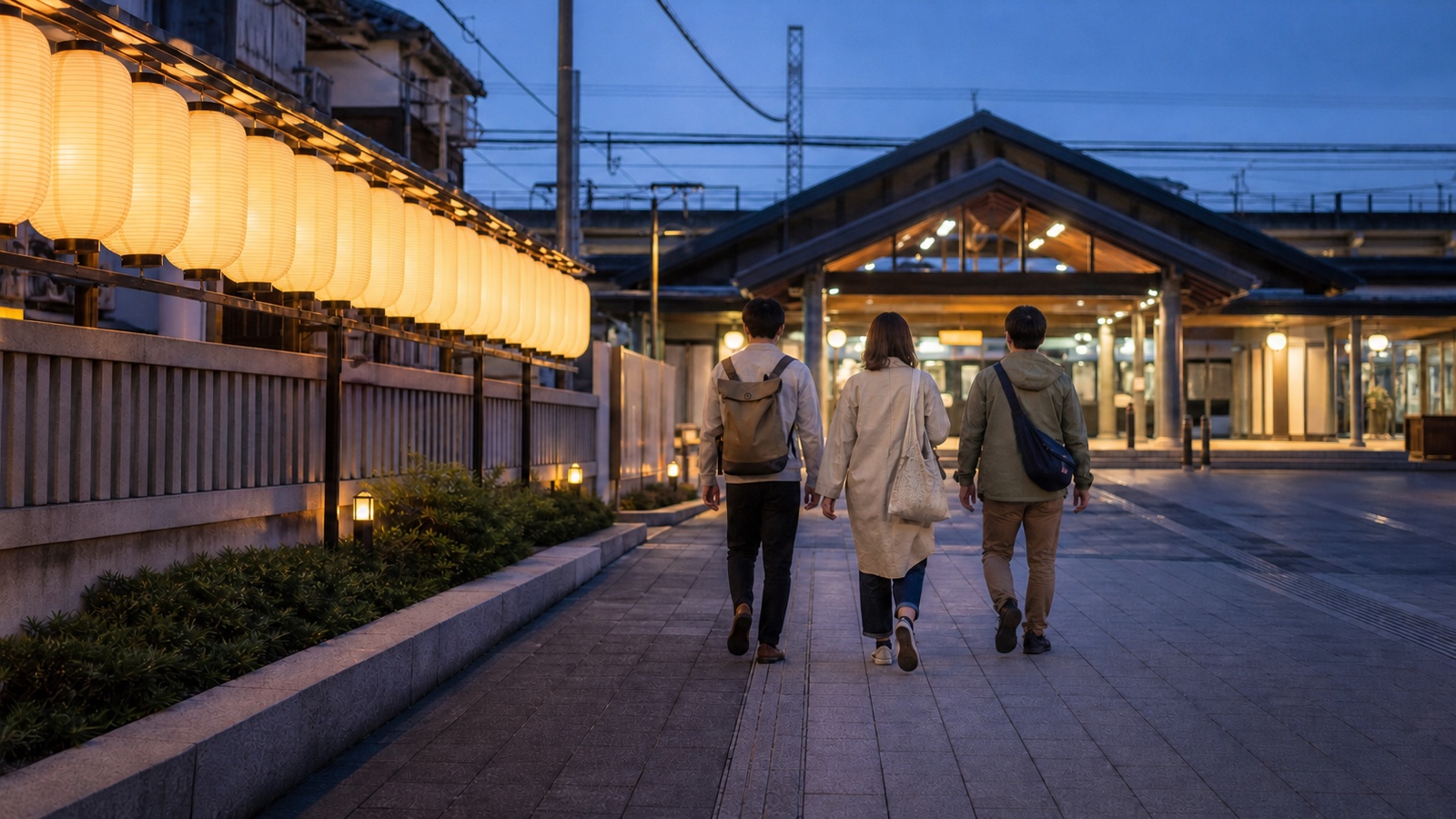
| Night viewing | A defined lantern-viewing block | Last useful train options and crowd direction | Leave while you still have energy and two train choices |
| Rain | Raincoat and waterproof bag | Official festival and Nankai status | Abandon the viewing position if footing or visibility becomes unsafe |
Write your chosen festival day + arrival station + viewing side + exit station in one phone note. Share it with everyone in your group. If you become separated, agree to meet outside the active route—not at a famous corner.
Luggage, toilets, food and photography manners
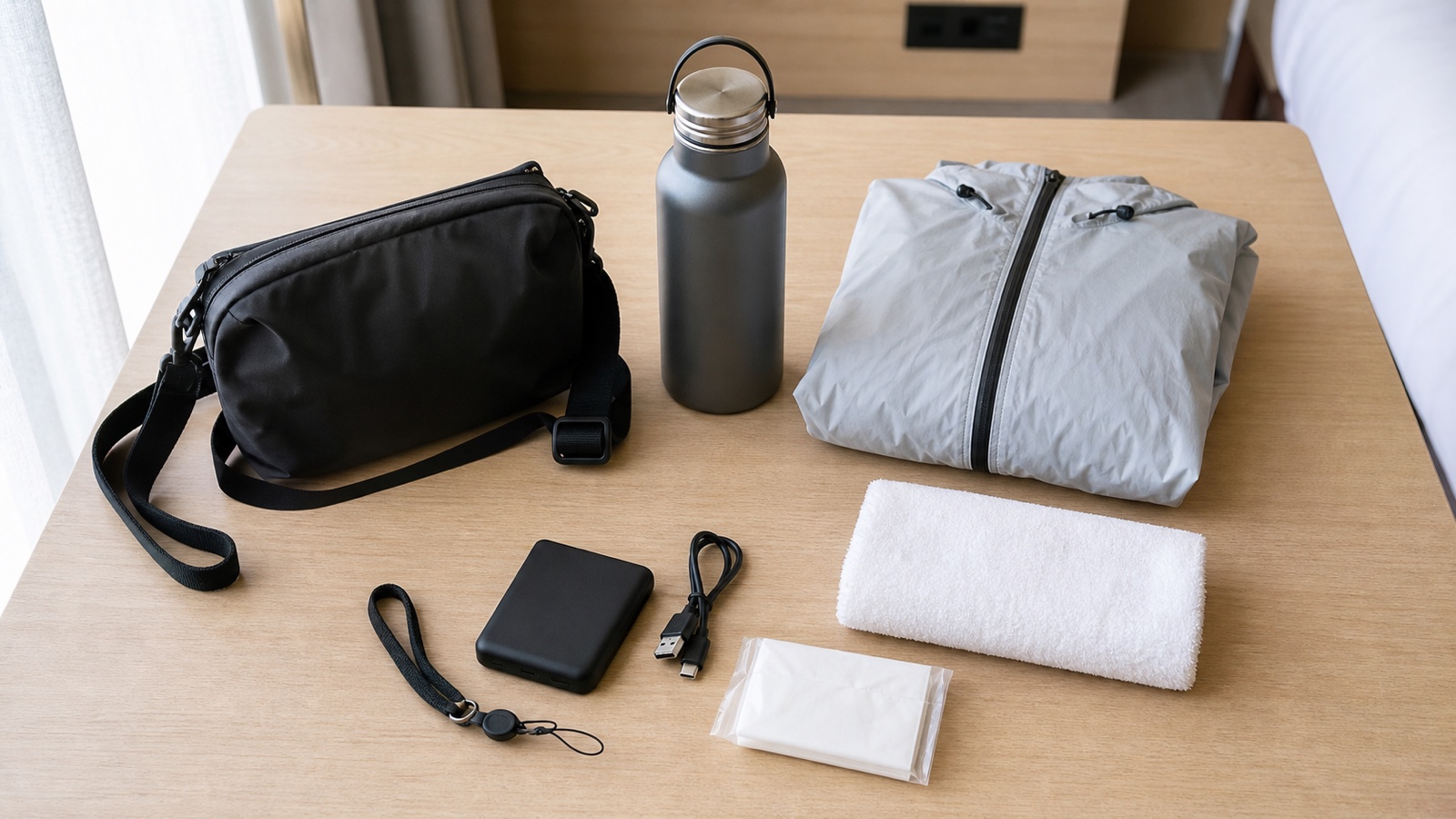
Do not bring travel-day luggage
Large suitcases make narrow crowd movement harder and can block other people. Although Kishiwada Station normally has station facilities, festival demand and access restrictions make lockers a weak single point of failure. Leave luggage at your accommodation or use a forwarding plan in advance. RJG’s Japan luggage delivery guide explains the timing and address checks.
Use facilities before entering the densest streets
Use the toilet at your accommodation or station before approaching the route. Do not assume you can cross an active road to reach a toilet you saw on an old map. Carry tissues, hand sanitizer and any personal supplies you need, but keep the bag compact.
Eat before you claim a viewing position
Food stalls and nearby businesses may be busy, relocated or unreachable from your side of a closure. Eat early, carry water, and keep enough energy for the walk back. Take your rubbish with you; the city explicitly asks spectators not to leave trash.
Photograph without becoming part of the hazard
Use a wrist strap or secure neck strap. Avoid wide tripods, selfie sticks and any setup that makes you step backward without looking. Keep equipment behind the managed line. Do not photograph identifiable children as your primary subject without permission, and do not obstruct residents’ entrances.
For a broader packing and crowd checklist, use RJG’s Japan Festival Survival Guide.
Rain, heat, crowds and disruption: your Plan B
September in Osaka can still be warm, humid or wet. This article does not predict festival-day weather weeks in advance. Check the current forecast, the Kishiwada festival page and Nankai service status before departure.
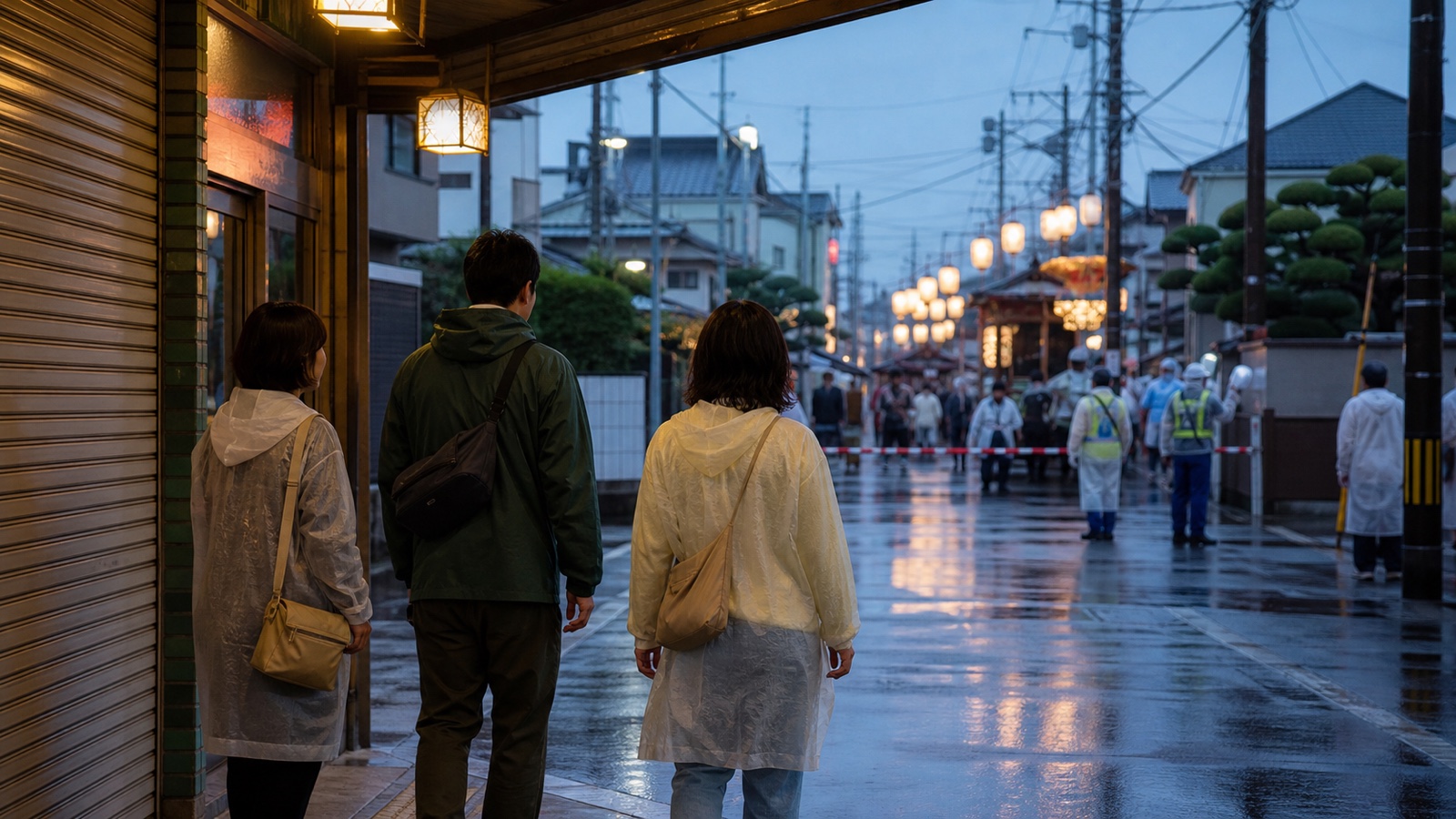
The city tells spectators not to use umbrellas because they are dangerous in the crowd. Wear a raincoat and protect your phone in a small waterproof pouch. Wet streets also reduce your ability to move quickly, which is another reason to stay far outside the cart’s turning space.
| Problem | Safer response |
|---|---|
| Heavy rain or dangerous conditions | Follow the organizer’s current notice; do not travel based on an old repost |
| Umbrella is your only rain gear | Buy a raincoat before entering the viewing area |
| Kishiwada Station approach is packed | Follow staff and use Takojizo or Izumi-Omiya only if the walking route is currently permitted |
| Your group separates | Use the pre-agreed meeting point outside the route; do not push upstream |
| Phone battery is low | Stop filming, use low-power mode and preserve the saved route and train search |
| Child, older traveler or companion is exhausted | End the visit before the night crowd peaks |
| October district details remain unclear | Do not guess from the September map; choose the September edition or another confirmed event |
| You no longer feel safe | Move away from the route and leave; missing a cart pass is better than forcing the plan |
RJG’s Japan Rain and Typhoon Plan gives a wider go/no-go framework for transport disruption.
A quieter alternative on another day
If a dense street festival is not right for your group, visit the Kishiwada Danjiri Kaikan on a separate day. The city lists normal hours of 10:00–17:00, with last entry at 16:00, and a standard Monday closure unless Monday is a holiday. The museum is about a 13-minute walk from Kishiwada Station or 7 minutes from Takojizo.
Recheck its calendar before visiting. This article does not assume normal museum hours apply on festival days.
Before-you-go checklist
- [ ] I chose September Kishiwada/Haruki or the separate October district edition.
- [ ] I checked the official 2026 schedule rather than a previous-year graphic.
- [ ] I saved Nankai’s live timetable for Kishiwada and at least one alternative station.
- [ ] I am traveling without a car and without a large suitcase.
- [ ] I chose a viewing side, not a dangerous corner.
- [ ] I packed a raincoat, water, charged phone and compact bag.
- [ ] My group has a meeting point outside the active route.
- [ ] I removed any hard airport, dinner or last-train commitment after the festival.
- [ ] I will follow police and festival staff even if the live route differs from my map.
The goal is not to see the greatest possible number of danjiri. It is to see a remarkable living festival without making yourself part of the route-management problem.
Kishiwada Danjiri Festival 2026 FAQ
Is Kishiwada Danjiri Festival confirmed for 2026?
Yes. Kishiwada City lists the September Kishiwada/Haruki festival for September 19–20, with test pulls on September 6 and 18. It also lists a separate October district festival for October 10–11, with a test pull on October 4.
Which weekend is the famous Kishiwada Danjiri Festival?
Most overseas visitors mean the September Kishiwada and Haruki edition. In 2026, its eve festival is September 19 and its main festival is September 20. The October edition covers different districts.
How do I get to the festival from Osaka-Namba?
Use the Nankai Line from Nankai Namba and search for Kishiwada Station, NK24. Check the live stopping pattern and fare before travel. Save Kishiwada, Takojizo and Izumi-Omiya as possible stations, but keep to a currently open pedestrian route.
Can I visit from Kansai Airport?
Yes, Kishiwada is on Nankai’s airport corridor. Confirm that your chosen train stops at Kishiwada; Rapi:t alpha does not. Do not combine the festival with a tight flight connection because street and station access can be slow.
Can I drive or take a taxi to the festival?
Driving is a poor plan. The 2026 city notice lists extensive vehicle restrictions, no-parking roads and no nearby visitor parking. A taxi also cannot guarantee access through a restricted street. Use the Nankai Line.
Where is the safest place to watch yarimawashi?
Watch from behind the managed spectator line and stay away from the outside and exit of corners. The city says a danjiri needs roughly twice its width to turn. Follow police and festival staff immediately.
Can I use an umbrella if it rains?
No. Kishiwada City’s spectator guidance says umbrellas are dangerous during viewing. Wear a raincoat and keep your hands free instead.
Is the 2026 parade order available?
The 2026 operating dates are confirmed, but a current 2026 parade and shrine-entry order was not available on the official pages checked on August 9. Do not substitute a 2025 order; recheck the city festival site before travel.
Comments