The 67th Tokyo Koenji Awa Odori is scheduled for Saturday, August 29 and Sunday, August 30, 2026, from 5:00 p.m. to 8:00 p.m. The dancing moves through eight performance areas around JR Koenji Station, Tokyo Metro Shin-koenji Station, the neighborhood shopping streets and Konan-dori.
The first decision is not which dance troupe to see. It is which station to use. JR Chuo Line rapid trains will not stop at Koenji on either event day. Use a Chuo-Sobu Line local train to JR Koenji, transfer from a rapid train at Nakano or Mitaka as shown on the official access guide, or take the Tokyo Metro Marunouchi Line to Shin-koenji.
For free roadside viewing, arrive before the 5:00 p.m. start, choose one side of the route, and avoid building a plan that requires repeated crossings. For a seated view, the organizer offers special viewing seats in return for a ¥10,000 or ¥15,000 contribution, while capacity remains. Before traveling, save the official access map and check the official event website for same-day changes.
For the rules that apply to most Japanese summer events—meeting points, toilets, trash, food and the train ride home—use this plan with our Japan Festival Survival Guide 2026.
- Tokyo Koenji Awa Odori 2026: quick facts
- Who should choose this festival?
- Free roadside viewing or a special seat?
- How to choose a viewing area
- When should you arrive?
- How to get to Koenji without taking the wrong train
- Leaving after the festival: do not follow the entire crowd by default
- Heat, rain, toilets and what to bring
- Photography and viewing manners
- Plan B when the street event is too crowded
- Final checklist for August 29 or 30
- Tokyo Koenji Awa Odori 2026 FAQ
- When is Tokyo Koenji Awa Odori in 2026?
- Is Tokyo Koenji Awa Odori free?
- Does the Chuo Line rapid train stop at Koenji during the festival?
- Which station is best for Koenji Awa Odori?
- When should I arrive for free viewing?
- Can I bring a tripod, chair or selfie stick?
- What happens if it rains?
- Is Koenji Awa Odori suitable for children or strollers?
- Sources and verification
Tokyo Koenji Awa Odori 2026: quick facts
| Item | 2026 information |
|---|---|
| Dates | Saturday, August 29 and Sunday, August 30, 2026 |
| Dance time | 5:00 p.m.–8:00 p.m. both days |
| Road restrictions | 4:10 p.m.–8:30 p.m. both days |
| Main stations | JR Koenji and Tokyo Metro Shin-koenji |
| Important train rule | JR Chuo Line rapid trains do not stop at Koenji on August 29 or 30 |
| Performance areas | Chuo, Higashi, Junjo, Pal, Momozono, Minami, Look First and Look Second |
| Free viewing | Permitted roadside areas; space cannot be reserved with tape or sheets |
| Special viewing | ¥15,000 for Chuo; ¥10,000 for Junjo, Momozono or Minami, while available |
| Weather | Usually proceeds in rain; severe weather can cause cancellation |
| Recent scale | 158 troupes and 1.02 million attendees in the prior year, according to the organizer |
| Last verified | July 20, 2026 JST |
The prior-year attendance figure is a crowd warning, not a prediction for 2026. Streets, crossings and station entrances can still become difficult to navigate.
Who should choose this festival?
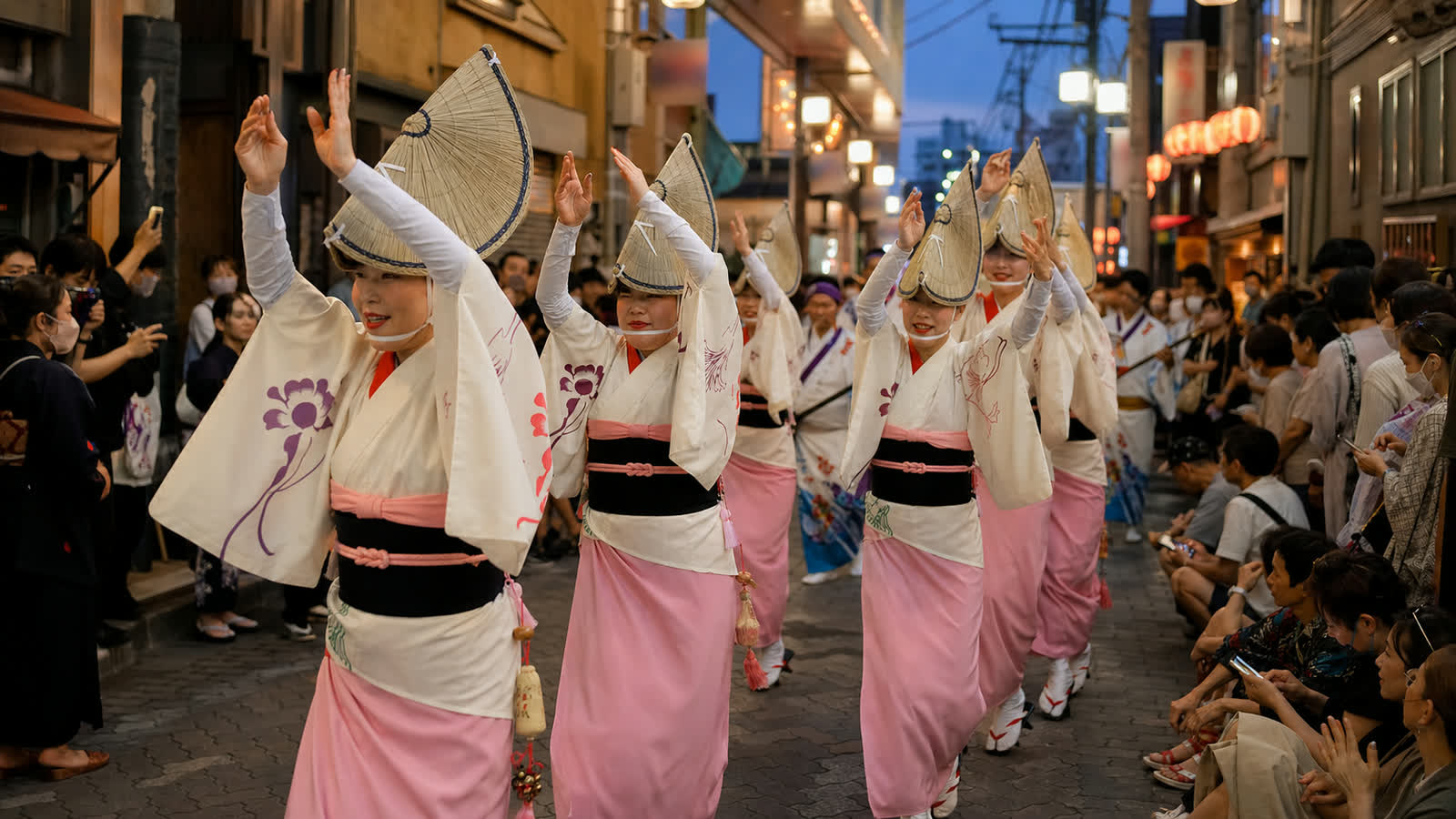
Koenji suits travelers who want a street-level dance festival with drums, flutes, gongs and tightly organized groups called ren. It began here in 1957 and now fills shopping streets on both sides of JR Koenji Station.
It is less suitable for someone who cannot stand for long, needs a stroller or becomes distressed in dense crowds. The organizer asks visitors not to bring bicycles or strollers. Consider a reserved seat or daytime stage performance instead. There is no walk-in troupe, and spectators may not join a performing ren; remain outside the dance lane.
Free roadside viewing or a special seat?
Free viewing
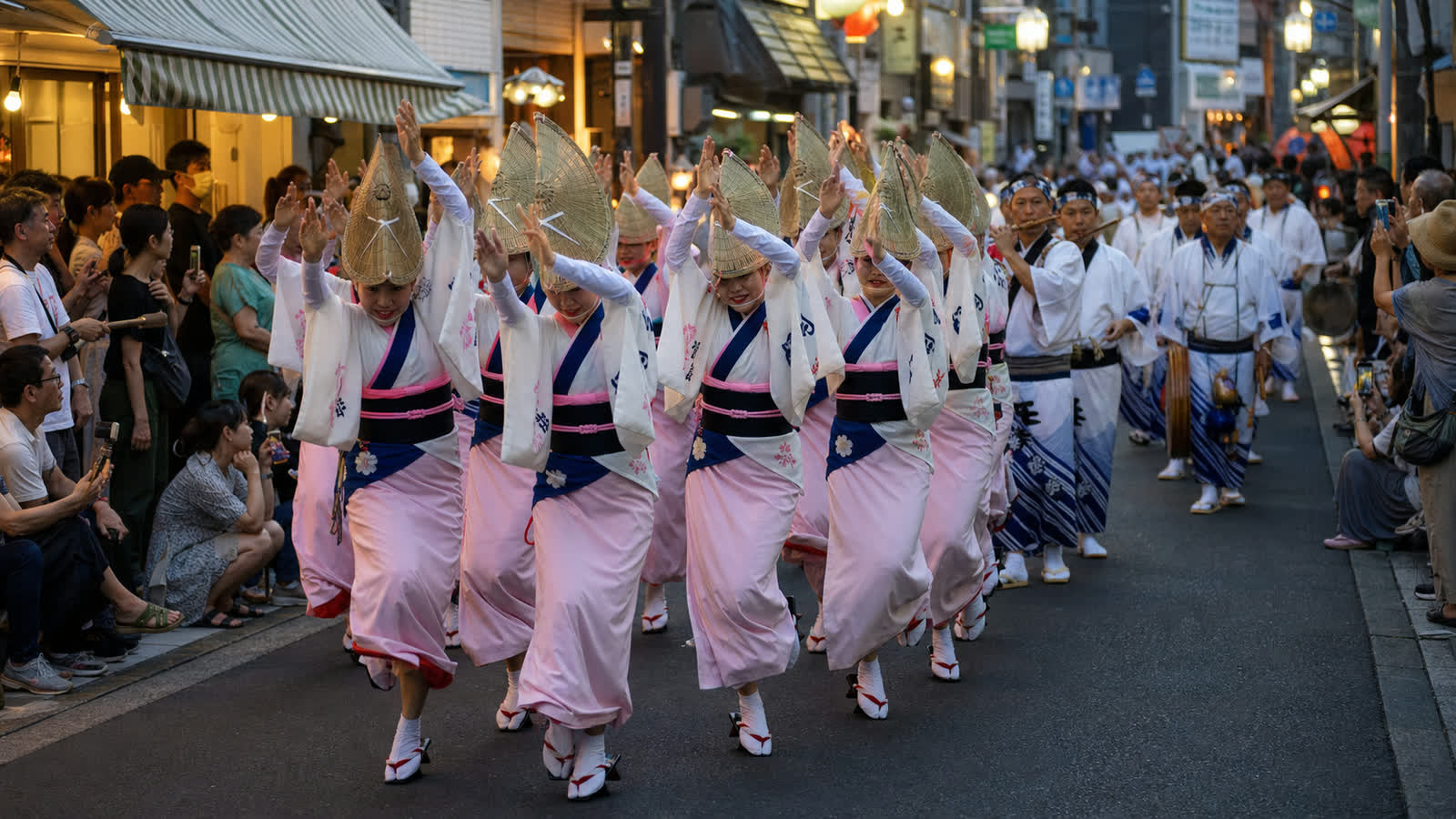
You do not need a ticket to watch from permitted roadside areas. Free viewing offers flexibility, but you do not have an assigned position or a chair.
Do not tape off road space, place a sheet, or block a shop entrance. The official FAQ says tape placed on the road before the event will be removed. Choose a position where staff allow spectators to stand and pedestrians can still pass.
For a first visit, arriving in the neighborhood around 3:30–4:00 p.m. is a reasonable editorial target. It is not an official opening time and does not guarantee front-row space. Use the buffer to confirm barriers, buy water, use a restroom and identify your departure station before vehicle restrictions begin at 4:10 p.m.
Special viewing seats
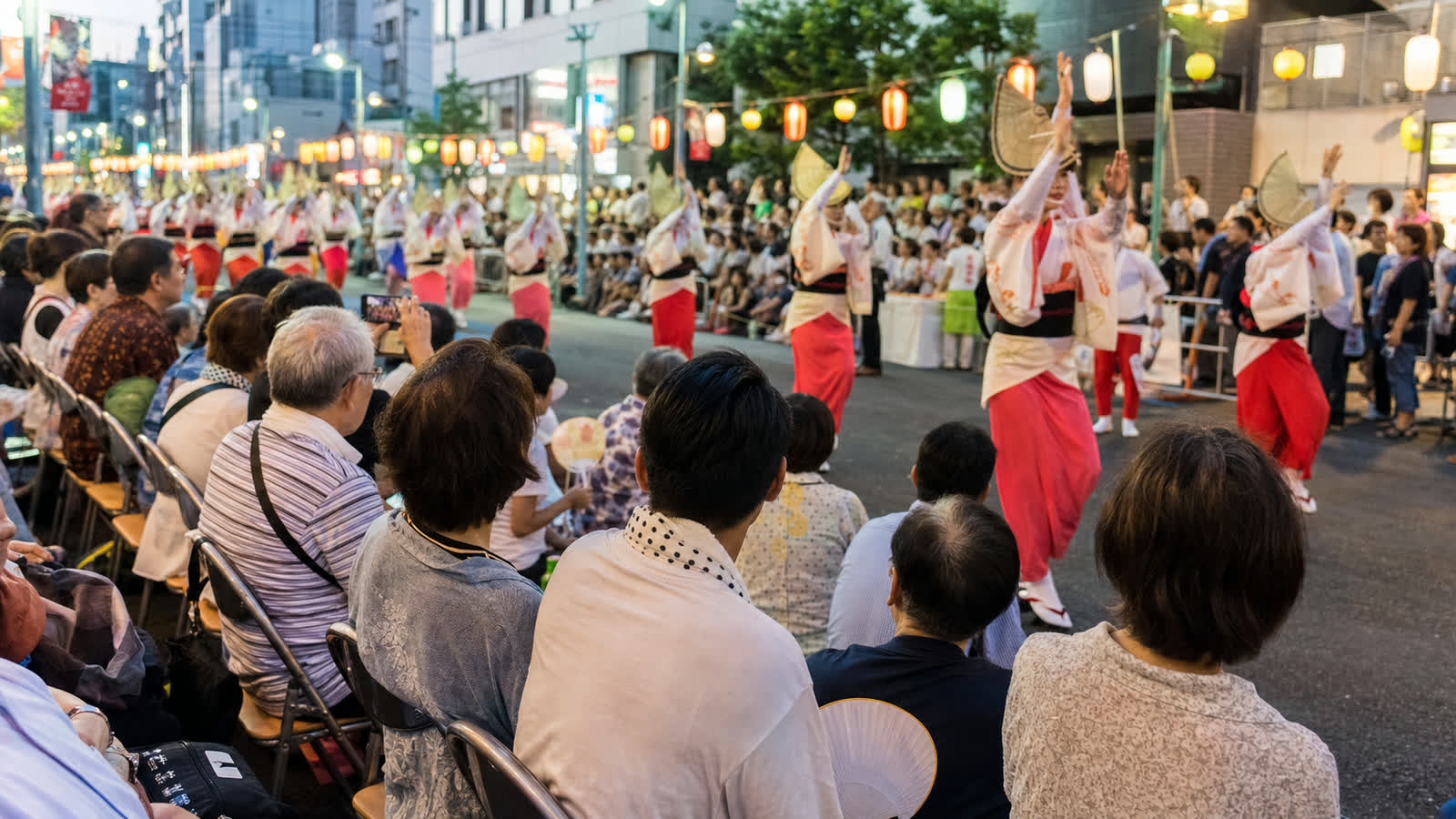
The organizer's 2026 contribution program offers one special-seat ticket per contribution:
- ¥15,000: Chuo performance area
- ¥10,000: Junjo, Momozono or Minami performance area
Internet applications run from July 1 at 9:00 a.m. until 11:59 p.m. on the day before the event, but they are first-come, first-served and close when the allocation is full. Payment is by credit card or convenience store, and the ticket must be issued at Seven-Eleven or FamilyMart. Application and ticketing fees apply.
The contribution is treated as a donation. There is no refund if weather cancels the event, and lost tickets are not reissued. Read the current terms on the official special viewing seat page before paying.
A special seat makes sense if sitting and having a defined base matter more than flexibility. It does not remove the train crowd, the outdoor heat or the walk to and from the performance area.
How to choose a viewing area
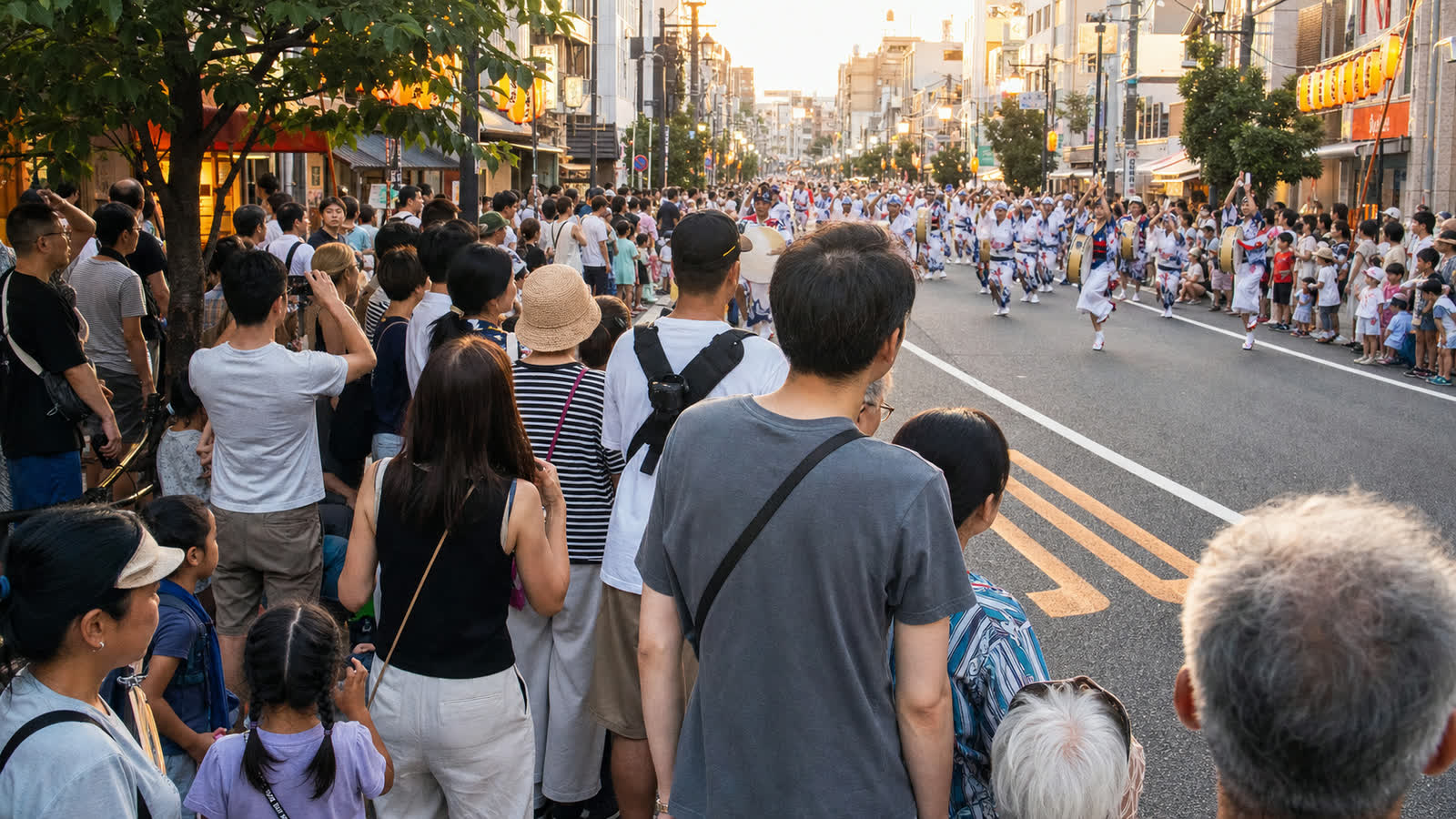
The event has eight named performance areas: Chuo, Higashi, Junjo, Pal, Momozono, Minami, Look First and Look Second. They form a connected event zone rather than eight independent venues. You may see different groups at different times, but moving between areas can be slower than the map suggests.
Use three questions:
- Which station will you enter from? JR Koenji is the natural anchor for the northern and central areas. Shin-koenji is useful for the southern side and the Look shopping street.
- Do you need a fast exit? Stand on the same side of the route as your planned departure. Do not assume you can cross at any corner during a performance.
- Is the view or comfort more important? The busiest central approaches may feel dramatic, but a position farther along the shopping streets can be easier to leave.
For adults traveling with children, the organizer's FAQ says that the end of Higashi, the starting areas of Junjo and Pal, and Look Second have been relatively easy to view in past years. The organizer explicitly warns that this is historical guidance, not a guarantee for 2026.
Save the official access map, then use barriers and staff directions as the live source of truth. A map cannot predict a temporarily closed crossing, a full sidewalk or a change made for emergency access.
When should you arrive?
If a close free view matters
Aim for 3:30–4:00 p.m. and commit to one area. Road restrictions begin at 4:10 p.m., and the dancing starts at 5:00 p.m. Arriving early does not authorize space-taking; it simply gives you time to understand the live layout before the crowd thickens.
If atmosphere is enough
Arrive nearer to 5:00 p.m., stay behind the established viewing line and accept that you may be several people back. Awa odori is strongly auditory: drums, flutes and group calls remain part of the experience even when the dancers are not continuously visible.
If your group is heat-sensitive
Plan a short visit and set a departure time in advance. Late August can remain hot and humid after sunset; leave if anyone develops symptoms.
How to get to Koenji without taking the wrong train
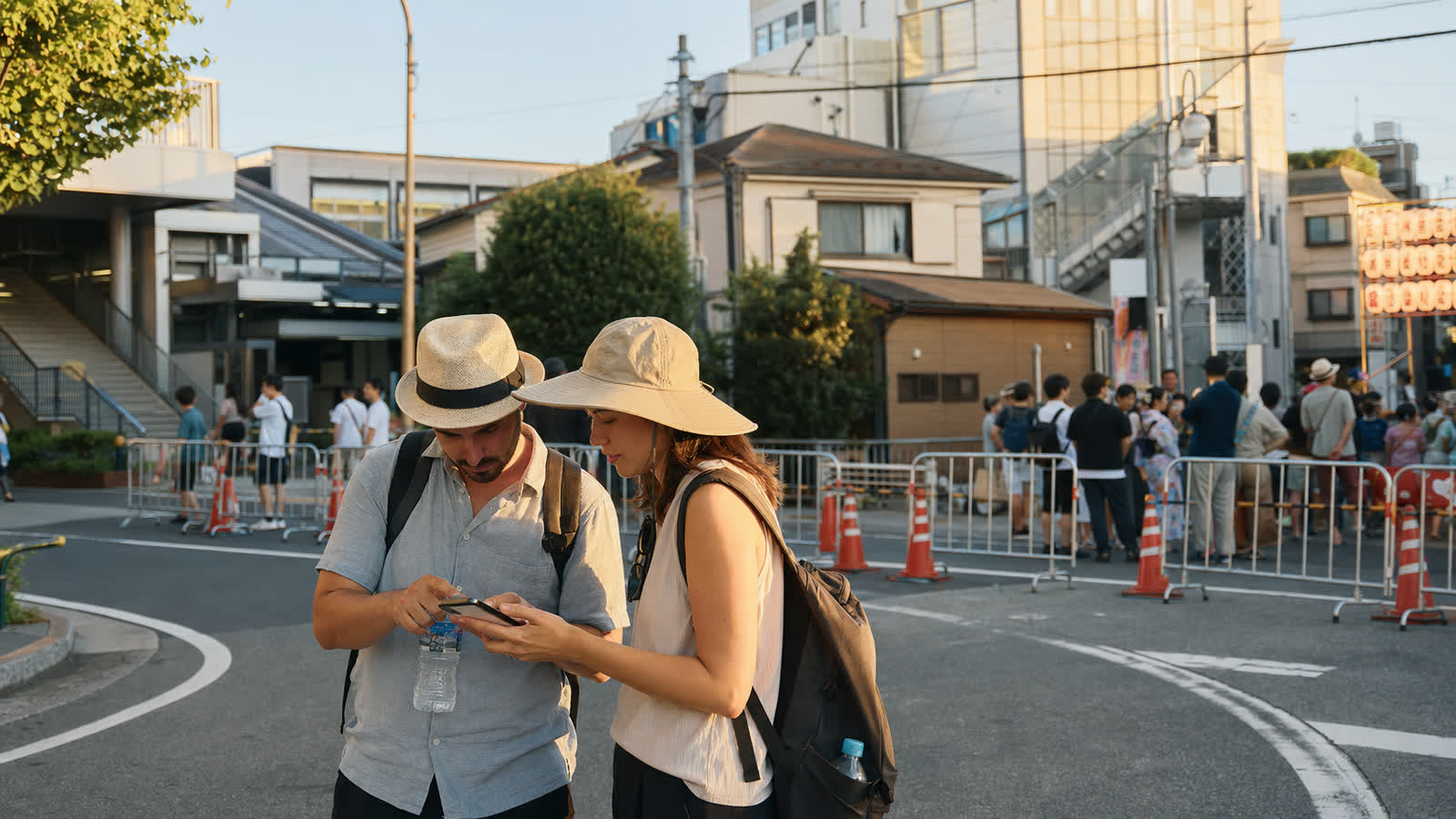
This is the mistake most likely to disrupt a first visit: boarding an orange JR Chuo Line rapid train and expecting it to stop at Koenji. On Saturday, August 29 and Sunday, August 30, rapid trains pass Koenji.
From Shinjuku or Tokyo by JR
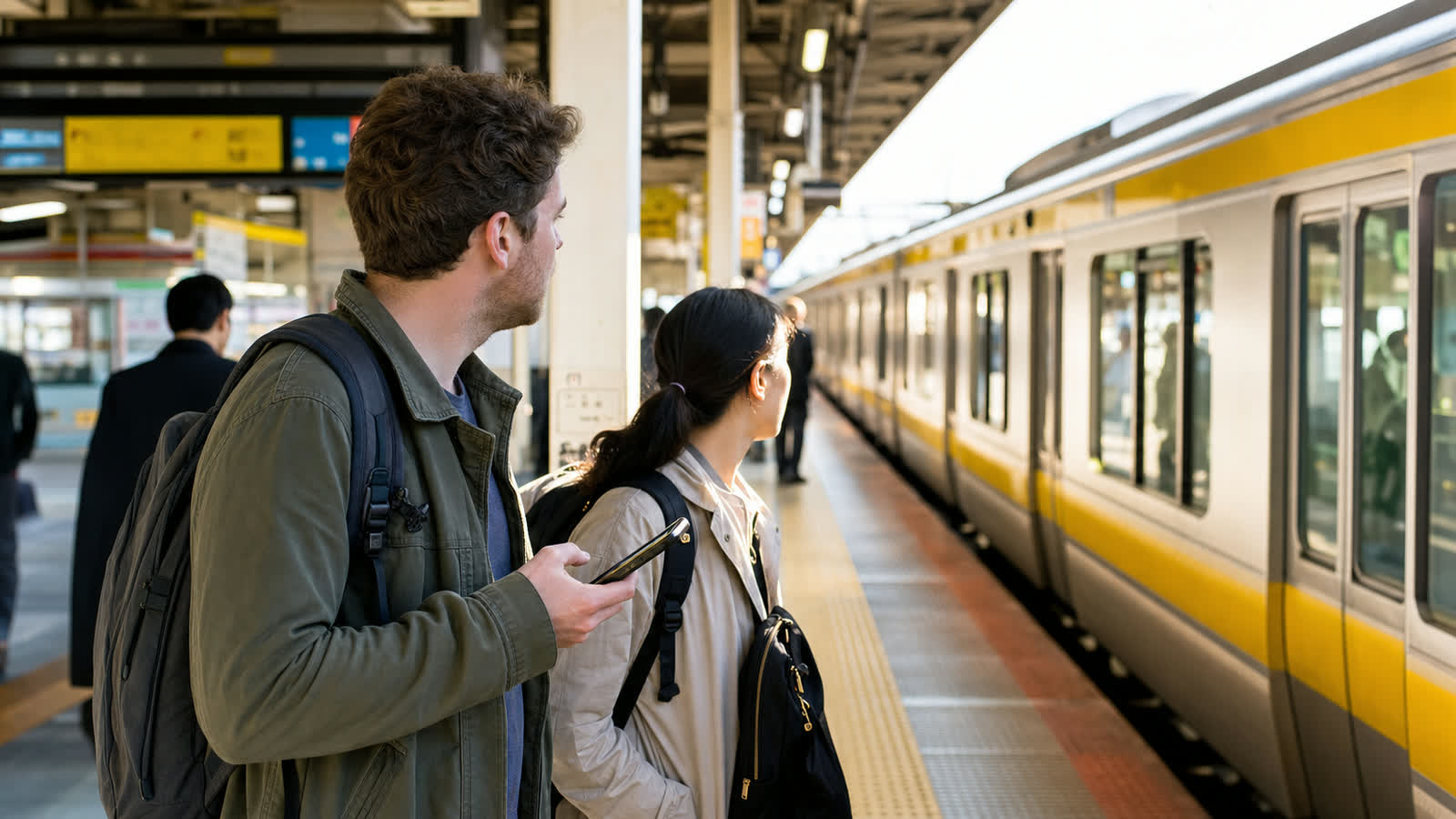
Use the Chuo-Sobu Line local train, often shown in yellow in route apps, to JR Koenji. If you use a Chuo Line rapid from the Tokyo side, the official event guide tells travelers to change at Nakano for a local train. From the western side, it shows a change at Mitaka.
Route apps can offer several combinations. Read the final train's stopping pattern rather than relying on color, platform or the word “Chuo.” The official access page lists JR Koenji as about a five-minute walk from the event area.
From Shinjuku by Tokyo Metro
The Marunouchi Line runs directly from Shinjuku to Shin-koenji Station (M03). This approach avoids the JR rapid-stop issue and places you near the southern side of the event. Tokyo Metro lists Shin-koenji between Higashi-koenji and Minami-asagaya, with exits on both sides of Ome-kaido.
Walking backup stations
The official event access page also lists approximate walks of 12 minutes from Higashi-koenji, 15 minutes from Asagaya, 15 minutes from Nakano and 20 minutes from Minami-asagaya. These are backup options, not promises of an easier journey. Walk on open routes and follow traffic-control staff.
For a broader explanation of JR, Tokyo Metro and transfers, see our Tokyo Trains Guide 2026.
Leaving after the festival: do not follow the entire crowd by default
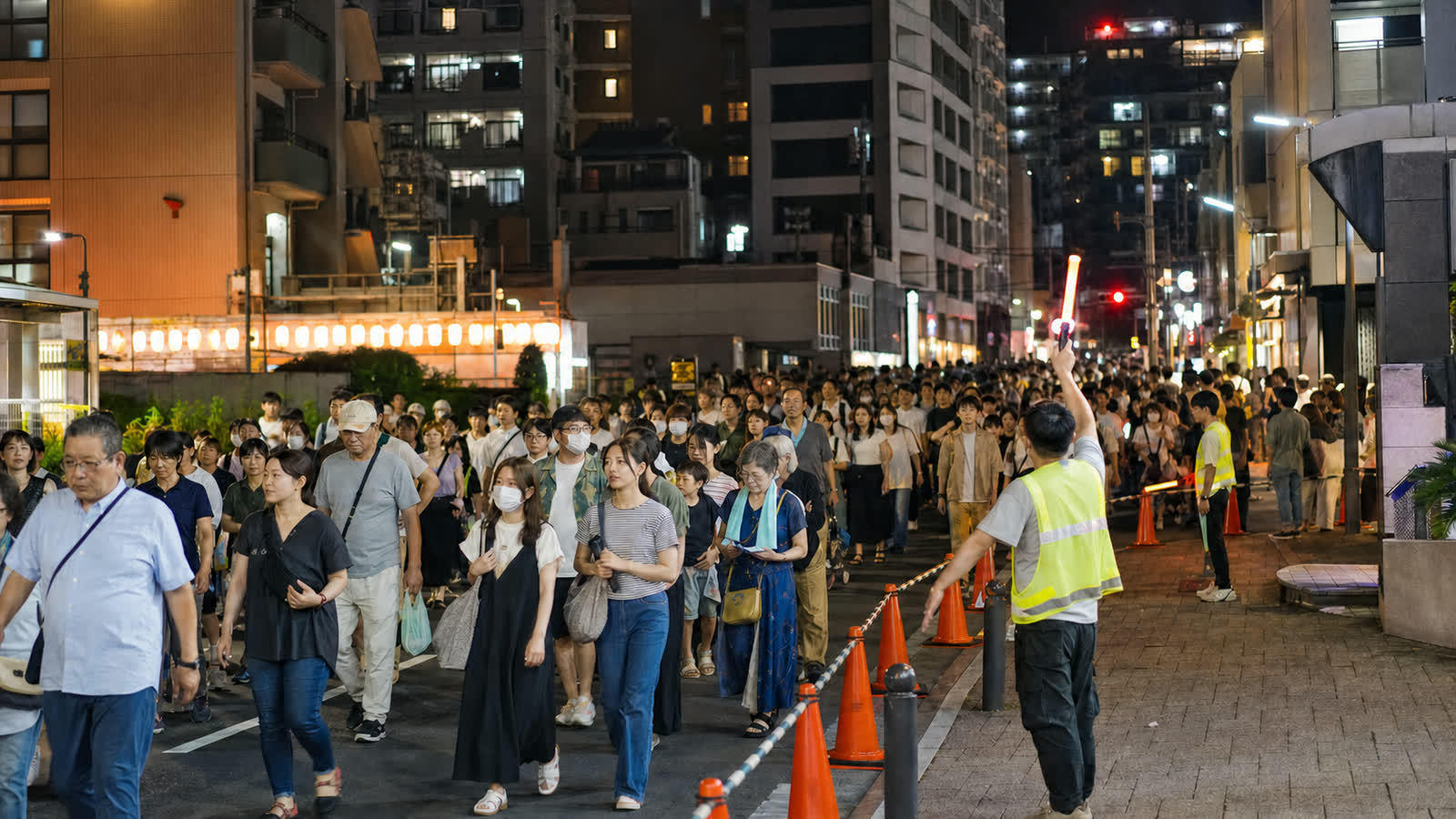
The dancing ends at 8:00 p.m., while road restrictions continue until 8:30 p.m. The difficult period is the collective movement toward stations immediately after the final performances.
Build the exit before you arrive:
- Save two stations. Pair JR Koenji with Shin-koenji, or keep Higashi-koenji, Asagaya or Nakano as a walking alternative.
- Stay on your exit side. Avoid a northern viewing position if your plan requires crossing the route toward Shin-koenji at 8:00 p.m.
- Set a departure trigger. Leaving ten or fifteen minutes before the end may reduce friction, but it does not guarantee an empty station.
- Follow station controls. Staff may meter entrance access or direct passengers to a different path.
- Avoid a tight reservation. Do not schedule a fixed dinner, airport transfer or last train connection immediately after 8:00 p.m.
During traffic restrictions, the official FAQ says the normal south-side bus and taxi boarding area at JR Koenji cannot be used; a temporary boarding point operates on the north side. That does not make a taxi a reliable escape plan. The surrounding roads are restricted and demand will be high.
If the JR approach is saturated and your location makes it safe to walk south, Shin-koenji gives you a different rail operator. If you are east or west of the core, a longer walk to Higashi-koenji, Nakano or Asagaya may be more rational than pushing back toward JR Koenji. This is a decision framework, not a predictable crowd shortcut.
If your evening may continue late, save our Tokyo Last Train & Taxi Plan 2026 before entering the crowd.
Heat, rain, toilets and what to bring
Heat
Carry your own water. The official FAQ mentions four water stations for dancers and says visitors can use them when necessary, but this is not a reason to arrive without a drink. Buy water before you enter the densest streets and check the Ministry of the Environment's Heat Illness Prevention Information on the day.
Move to a cooler place and ask staff for help if you feel dizzy, nauseated, confused or unusually weak. The organizer provides first-aid points and asks anyone who feels unwell to contact the nearest staff member.
Our Japan Heat Survival Guide 2026 covers warning signs and a practical day plan.
Rain
The official FAQ says the event proceeds unless rain is unusually strong, but severe weather can still cause cancellation. Check the official website before leaving your accommodation.
Use a compact rain jacket or poncho rather than opening a large umbrella inside a packed viewing line. A waterproof phone pouch and a small towel are useful. Special-seat contributions are not refunded if weather cancels the event.
Toilets
Use a station or public facility before entering the densest area. Save the official map and ask at an information desk rather than crossing a performance lane in search of a restroom.
What to carry
- Water or an electrolyte drink
- A breathable hat and small towel
- Sunscreen and a cooling item
- A compact rain jacket or poncho
- A charged phone and small power bank
- A small trash bag
- An IC card with enough balance
- A light bag that you can keep in front of you
Leave suitcases and large camera bags at your accommodation or in storage. The event streets are narrow, and large luggage makes crowd transitions harder for everyone.

Photography and viewing manners
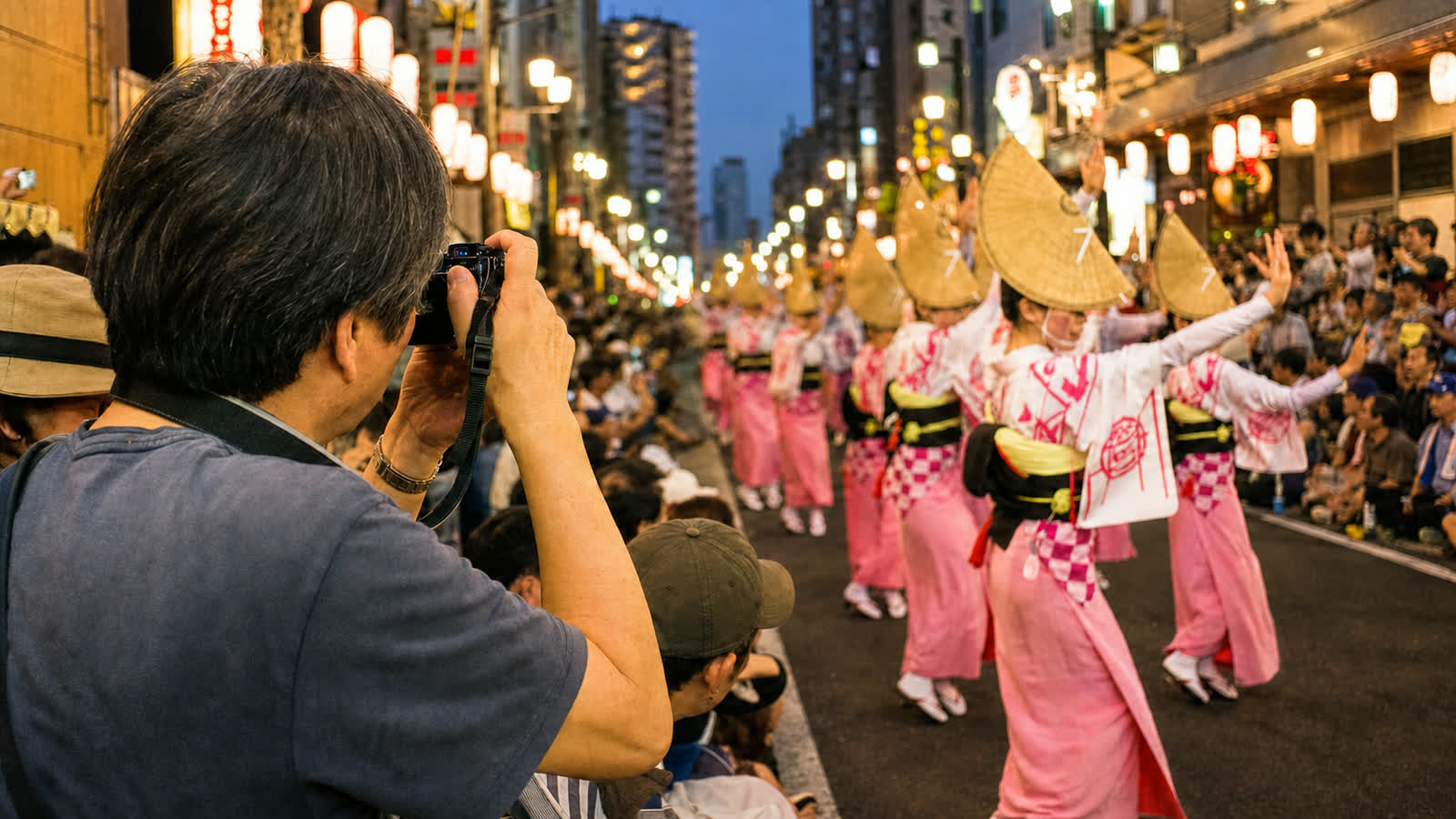
Photography is permitted from the performance areas and roadside. The organizer prohibits equipment that obstructs others: tripods, monopods, stepladders, chairs and selfie sticks are not allowed.
Keep a phone or camera near your own sightline. Do not raise it above other spectators for an entire dance, lean into the route or step through barriers. Follow staff and security directions immediately.
Other official rules are equally practical:
- Do not block shop entrances or interfere with business.
- Do not reserve road space with tape or sheets.
- Do not enter the dance lane or join a troupe.
- Take trash with you or return it to the shop where you bought the item. Large bins are also installed at general information desks; sort waste there.
- The surrounding area is a no-smoking zone. Smoke in designated locations.
- Avoid arriving with a bicycle or stroller because of crowd danger.
Koenji is a living neighborhood, not a closed festival park. The street must still work for residents, shops, performers and emergency access.
Plan B when the street event is too crowded
A useful Plan B should reduce the same friction instead of sending you deeper into it.
Plan B1: watch one section and leave early
Choose one performance area, watch several groups and depart before 8:00 p.m. You still experience the sound, movement and scale before much of the audience begins moving toward trains.
Plan B2: switch to the daytime stage performance
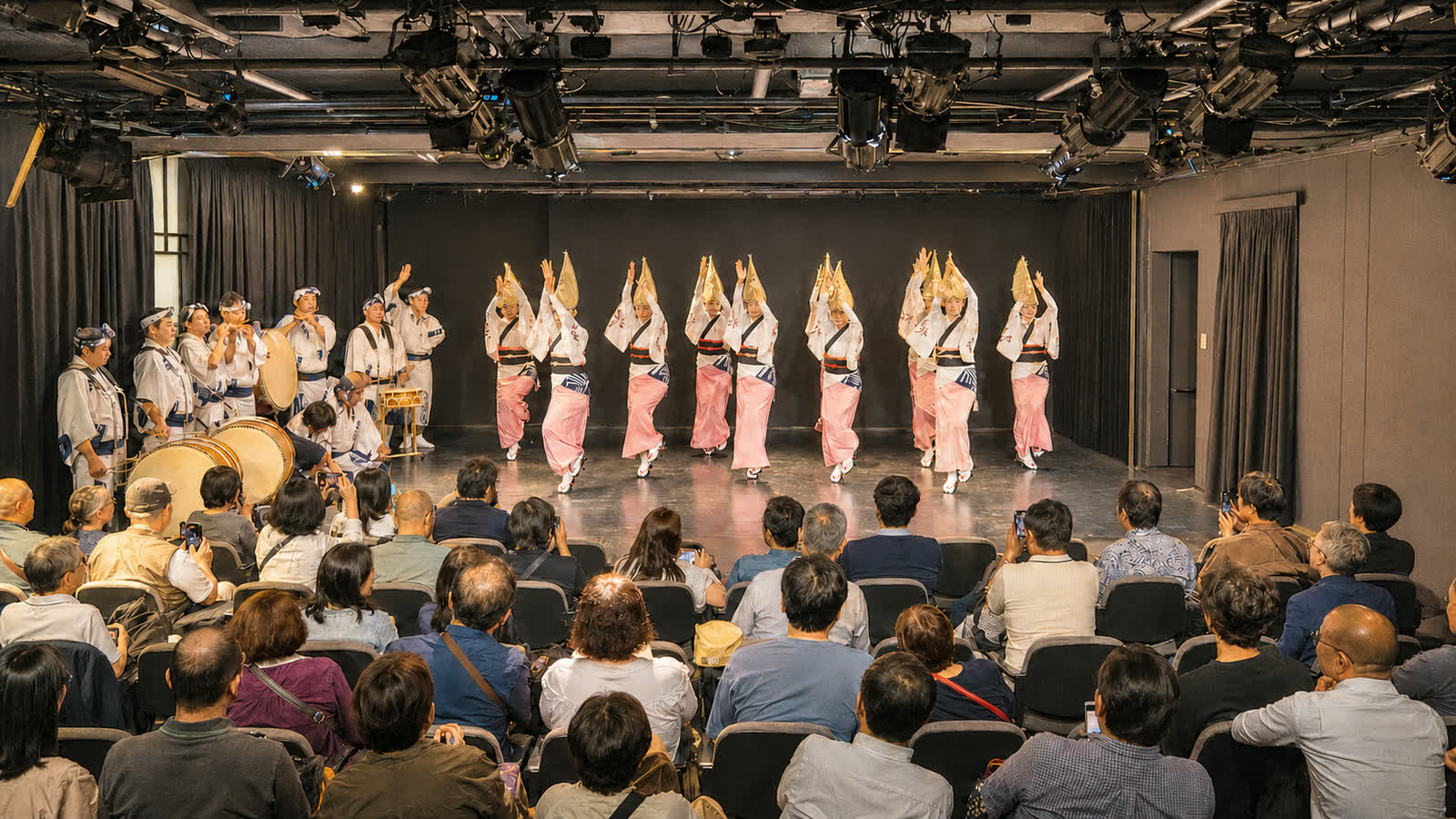
The official 2026 Summer Za Koenji Stage Awa Odori runs on both August 29 and 30. Performances begin at 11:30 a.m. and 2:00 p.m. Tickets are ¥2,500 per performance, fully reserved and sold in advance; there are no same-day tickets. This is not a spontaneous fallback once you reach the street, but it is a strong pre-booked alternative for someone who needs a seat or a more controlled setting. Check availability and terms on the official stage performance page.
Plan B3: use the neighborhood, then return to the route briefly
Arrive early, eat or cool down away from the controlled streets, and enter for a short viewing period. Finish shopping before the event starts: the official FAQ warns that the town becomes extremely crowded during the festival.
Plan B4: leave Koenji
If your group is tired, overheated or uncomfortable, walk to the station that matches your current side and end the visit. A successful festival night does not require staying until 8:00 p.m.
For other event formats and dates, compare options in our Tokyo Matsuri Guide 2026.
Final checklist for August 29 or 30
The night before:
- Recheck the official event website for weather and operation notices.
- Save the official access map offline.
- Confirm that your JR route uses a local train for the final leg to Koenji.
- Choose an arrival station and a different backup station.
- Check the heat index and rain forecast.
Before entering the event area:
- Top up your IC card.
- Use a restroom and buy water.
- Agree on a reunion point outside the dance route.
- Choose your departure time and station.
- Remove anything bulky from your bag.
Tokyo Koenji Awa Odori rewards a simple plan. Take the correct train, choose one viewing area, protect yourself from late-summer heat, and keep an exit that does not depend on the nearest station entrance being easy.
Tokyo Koenji Awa Odori 2026 FAQ
When is Tokyo Koenji Awa Odori in 2026?
It is scheduled for Saturday, August 29 and Sunday, August 30, 2026. Street performances run from 5:00 p.m. to 8:00 p.m. on both days, with road restrictions from 4:10 p.m. to 8:30 p.m.
Is Tokyo Koenji Awa Odori free?
Roadside viewing from permitted areas is free. The organizer also offers special viewing seats in return for a ¥10,000 or ¥15,000 contribution, subject to availability.
Does the Chuo Line rapid train stop at Koenji during the festival?
No. The official 2026 access guide states that JR Chuo Line rapid trains do not stop at Koenji on August 29 or 30. Use a Chuo-Sobu Line local train for the final leg, or use the Tokyo Metro Marunouchi Line to Shin-koenji.
Which station is best for Koenji Awa Odori?
JR Koenji is convenient for the northern and central performance areas, while Shin-koenji is useful for the southern side. Your best station is the one on the same side as your viewing position and departure route. Keep a second station as a backup.
When should I arrive for free viewing?
Arriving around 3:30–4:00 p.m. is a practical editorial target if a close free view matters. It is not an official opening time or a guarantee of space. Dancing begins at 5:00 p.m., and road restrictions begin at 4:10 p.m.
Can I bring a tripod, chair or selfie stick?
No. The official FAQ prohibits tripods, monopods, stepladders, chairs and selfie sticks. Handheld photography is allowed from the roadside as long as you do not obstruct other spectators or enter the performance lane.
What happens if it rains?
The festival normally proceeds in rain but can be cancelled in severe weather. Check the official website before traveling. Special-seat contributions are non-refundable if the event is cancelled.
Is Koenji Awa Odori suitable for children or strollers?
Children can attend, but the streets are extremely crowded. The organizer asks visitors not to bring strollers because of the risk in dense crowds. Plan a short visit, use a fixed reunion point and consider reserved seating or a daytime stage performance if standing is difficult.
Sources and verification
Last checked: July 20, 2026 JST.
- Tokyo Koenji Awa Odori official 2026 overview
- Official 2026 access map and train guidance
- Official special viewing seat terms
- Official traffic restriction information
- Official event FAQ
- Official viewing manners
- Official Za Koenji stage performance
- JR East Koenji Station information
- Tokyo Metro Shin-koenji Station information
- Ministry of the Environment heat illness prevention information
Comments