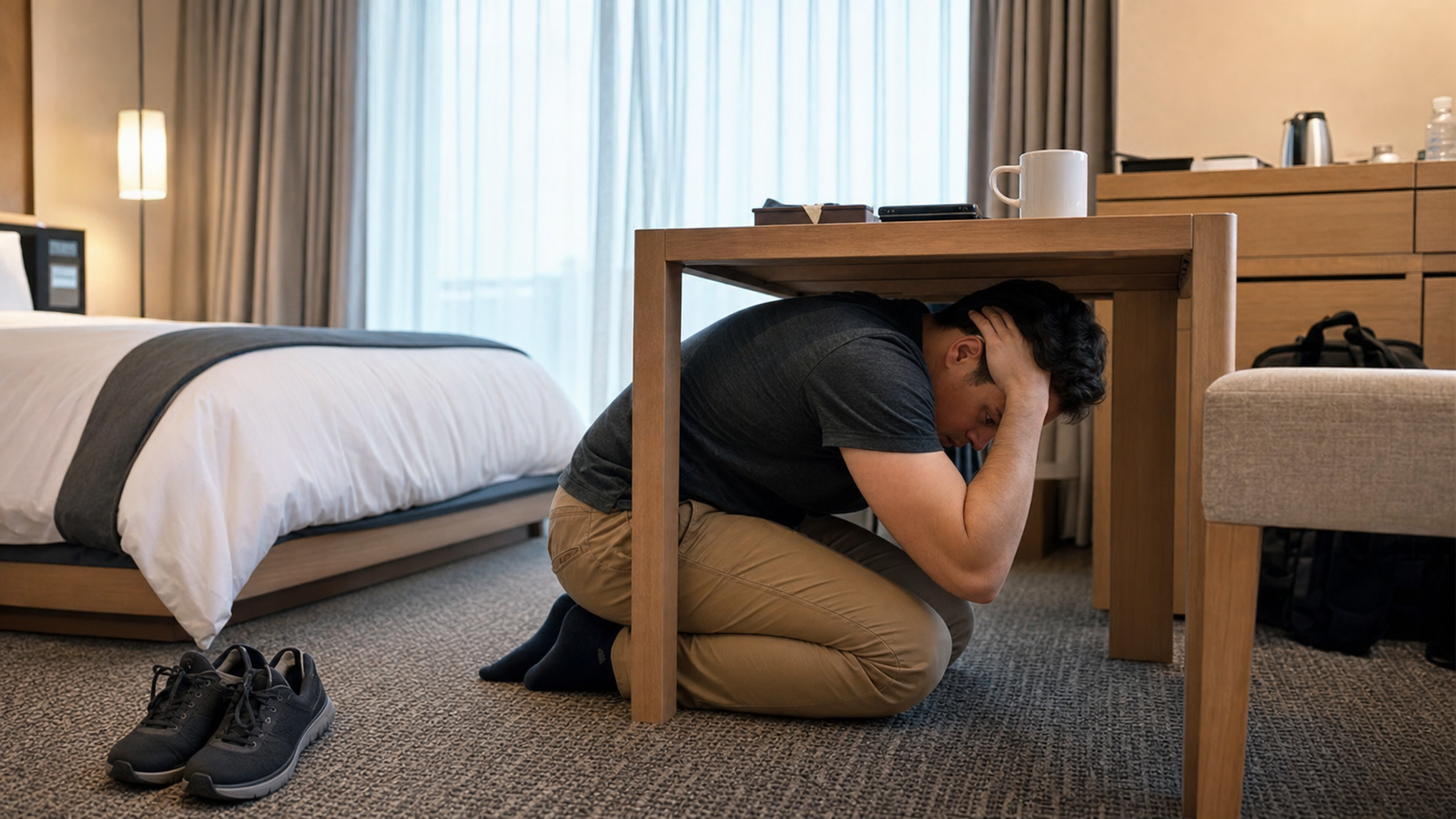
An earthquake during a Japan trip can feel frightening, especially when the announcement is in Japanese and everyone around you reacts before you understand why. JMA's first protective actions are simple: protect yourself from falling objects, do not rush outside, and follow staff or official instructions.
What comes next depends on where you are. A person inside a hotel has a different risk from someone beside the sea. This guide gives you a location-based plan, English alert options and a fallback for a dead phone or interrupted transport.
This is preparedness guidance, not live emergency information or an earthquake forecast. During an event, follow the Japan Meteorological Agency (JMA), local authorities, transport operators and staff at your location.
- Quick answer
- What an earthquake alert means
- What to do where you are
- What to do after the shaking stops
- Get English alerts before you need them
- Plan B when your phone or transport stops
- Emergency numbers and traveler help
- Should you cancel or change your Japan trip?
- Prepare in five minutes
- FAQ
- What should I do first during an earthquake in Japan?
- Should I run outside when an earthquake starts?
- What should I do if I am near the sea?
- Will my phone warn me about an earthquake in Japan?
- Is the Japan Visitor Hotline available in English?
- Should I use an elevator after an earthquake?
- Is Japan unsafe after a large earthquake?
- Can Japan predict the exact date of the next earthquake?
Quick answer
- During shaking, protect your head and stay away from glass and falling objects. If a sturdy table is close, get under it and hold on. Do not run for an exit while objects are moving.
- Follow staff on trains, at stations, in shops and at hotels. Do not enter tracks, force train doors or crowd an exit.
- If you are on or near the coast, treat strong shaking or weak but long shaking as a tsunami warning sign. Move to higher ground or a designated tsunami evacuation building without waiting to inspect the sea.
- After the shaking, check for injuries and immediate hazards. Put on shoes before walking over possible broken glass. Do not use a damaged elevator.
- Use official English information. The Safety tips app sends earthquake, tsunami and weather alerts in multiple languages. JNTO's 24-hour Japan Visitor Hotline is 050-3816-2787.
- Keep an offline Plan B. Save your accommodation address, evacuation route and emergency contacts before the trip. If your phone or data fails, follow staff, public-address announcements and local evacuation signs.
Information checked August 4, 2026. Disaster conditions, transport operations and evacuation orders can change quickly. Use live official information during an actual event.
What an earthquake alert means
Japan's Earthquake Early Warning can arrive shortly before strong shaking, but sometimes the warning and the shaking feel almost simultaneous. JMA explains that the useful warning time may range from several seconds to a few tens of seconds. Use those seconds to protect yourself rather than trying to leave the building or film the event.
An earthquake alert and a tsunami warning are not the same instruction:
| Alert or signal | Immediate meaning | What a traveler should do |
|---|---|---|
| Earthquake Early Warning | Strong shaking may arrive very soon | Protect your head, move away from glass and secure your position |
| Shaking with no phone alert | The phone, network or alert setting may not have delivered a warning | Act on the shaking itself; do not wait for an app |
| Tsunami warning or advisory | Dangerous sea-level changes are possible in the named coastal area | Leave the coast and riverside route; go to higher ground or a designated evacuation building |
| Strong shaking, or weak shaking that continues for a long time, near the coast | A tsunami may follow even before you understand an announcement | Evacuate uphill immediately and remain away until authorities cancel the warning |
| Emergency warning from JMA or a local authority | An extraordinary hazard is expected or occurring | Take all protective measures and follow the location-specific evacuation instruction |
Do not use social media rumors, an unsourced map or a stranger's prediction to decide that a place is safe. JMA says it is difficult to predict an earthquake's exact date, place and magnitude; a claim that specifies the date, place and magnitude should generally be treated as misinformation.
What to do where you are
The first protective action changes with your surroundings. Use the closest row in this table.
| Where you are | During the shaking | After the shaking |
|---|---|---|
| Hotel room, restaurant or indoor attraction | Protect your head; get under a sturdy table if one is close; stay away from windows, shelves and hanging objects; do not rush outside | Put on shoes, check the exit for hazards, take essentials only if immediately available, and follow staff or evacuation instructions |
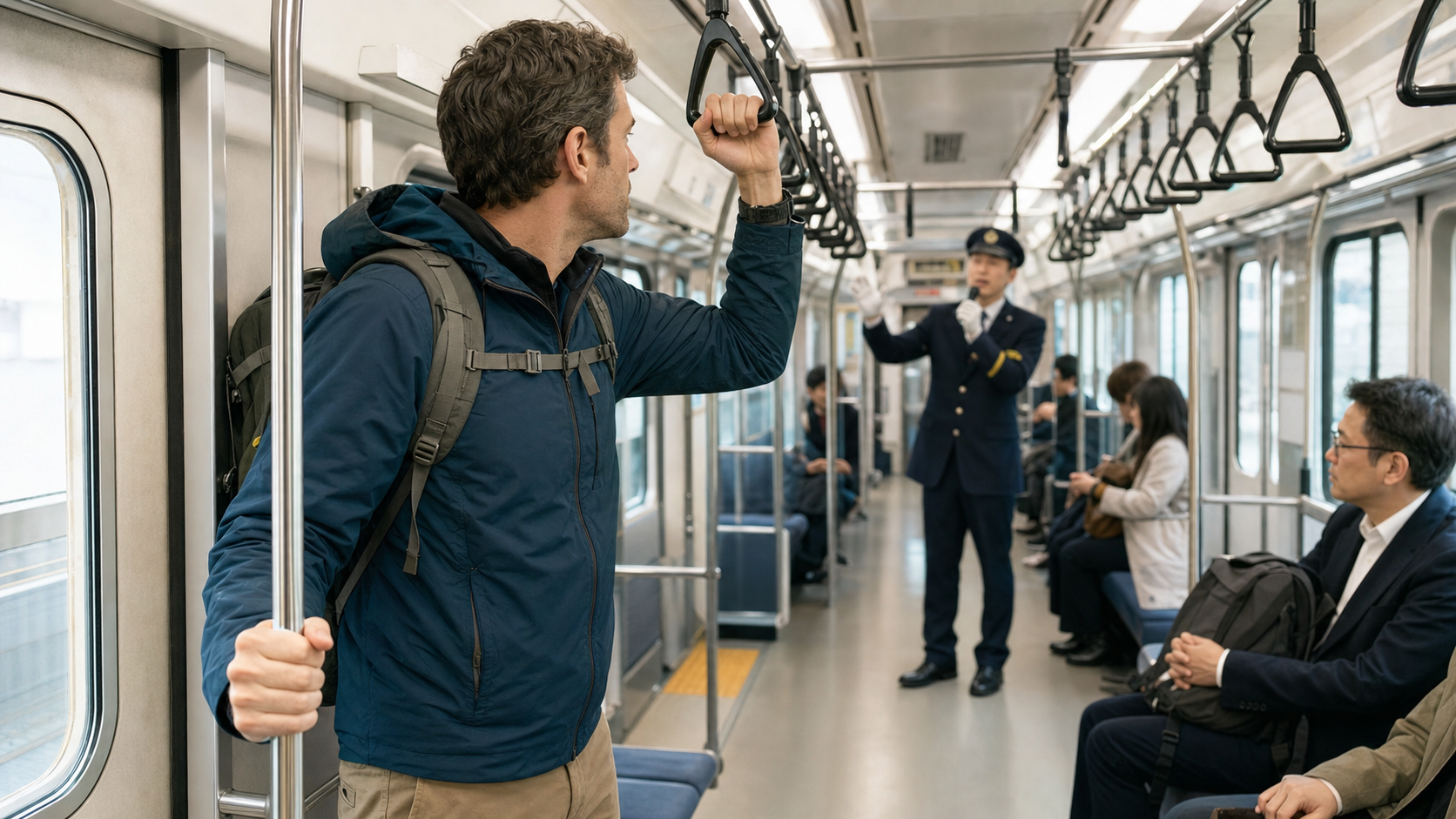
| Station or train | Hold a strap, rail or stable surface; protect your head; follow crew instructions; do not force doors or jump onto tracks | Remain where staff direct you, check the operator's official status, and do not enter restricted areas |
| Elevator | Press buttons for nearby floors if you can do so safely; leave at the first floor where the doors open | Do not use a stopped or damaged elevator; use stairs only when staff or building conditions indicate they are safe |
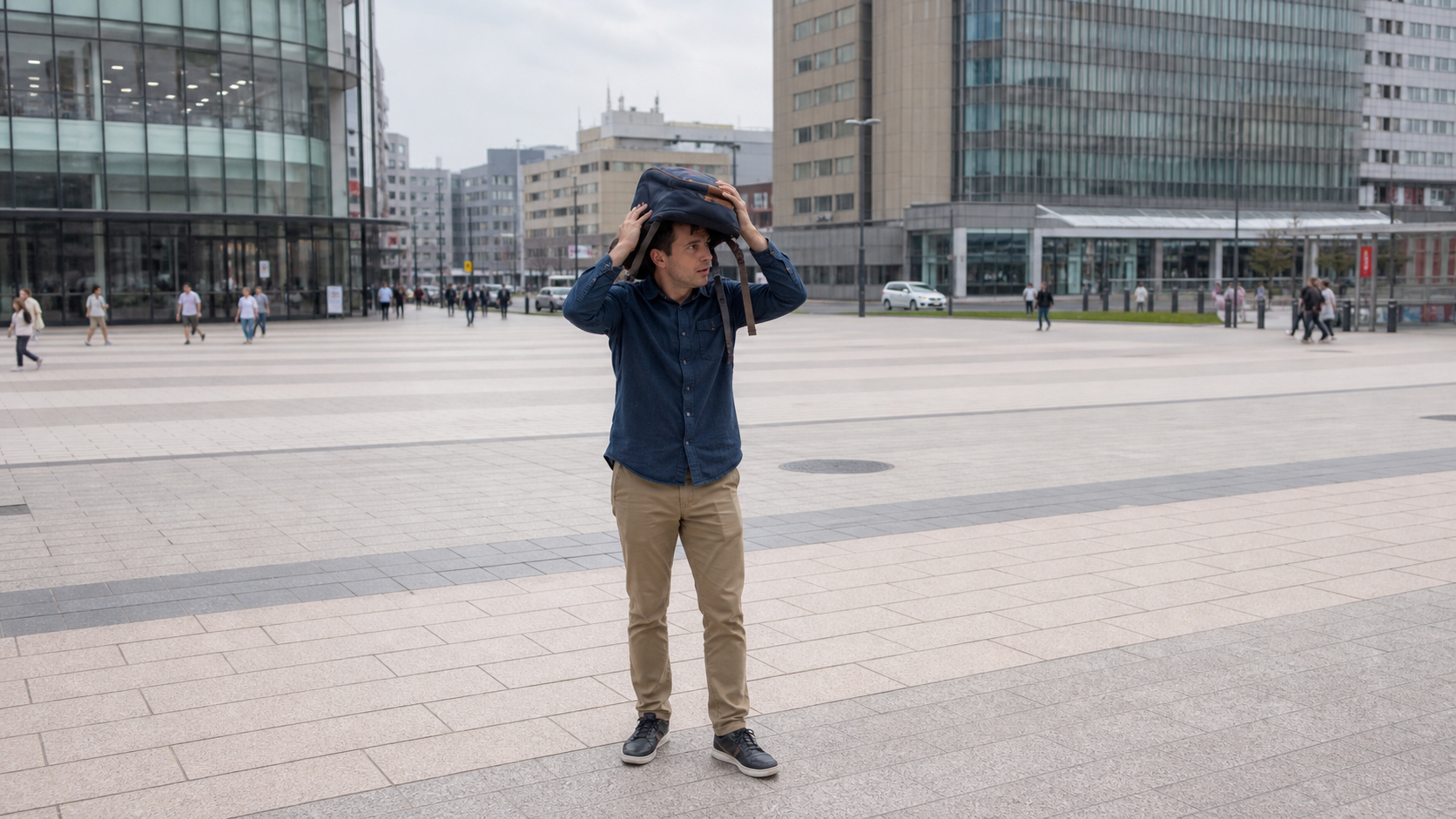
| Street or shopping district | Move away from glass, signs, roof tiles, vending areas and concrete walls; protect your head with a bag if available | Avoid visibly damaged buildings, fallen wires and blocked roads; enter a sturdy building only when that is the safer immediate shelter |
| Coast, harbor or beach | Protect yourself from the shaking, then leave the shoreline immediately after strong or long shaking | Go uphill or to a designated tsunami evacuation building; do not stop to watch the water; stay until the warning is canceled |
| Cliff, mountain path or steep slope | Move away from the rockfall or landslide side when possible without entering a worse hazard | Do not continue through a damaged trail; follow local closure and evacuation instructions |
In a hotel or other building
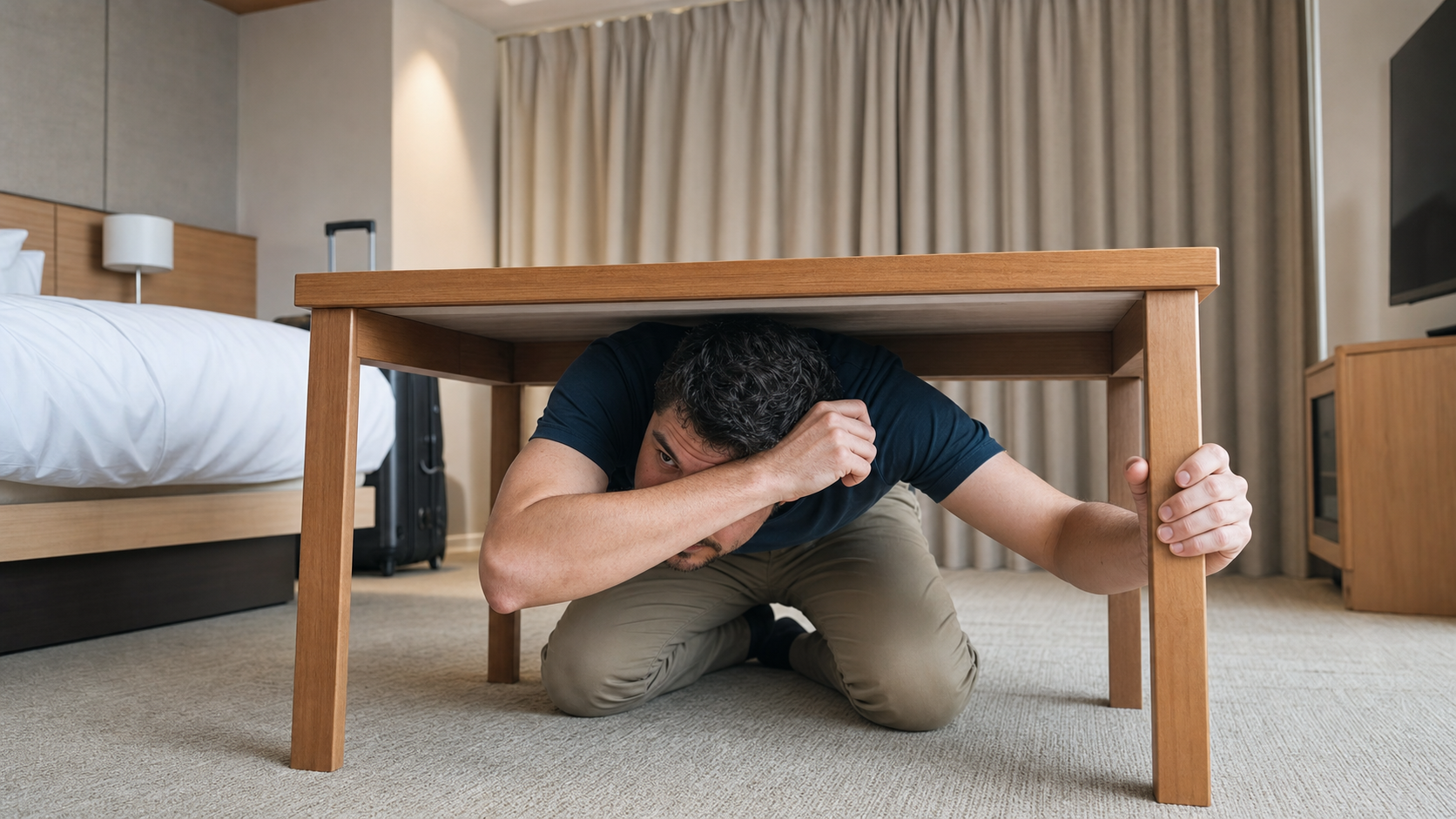
Do not assume the doorway is the safest place. The practical priority is protection from objects that can fall, move or break. If a sturdy table is within reach, get under it and hold a leg so it does not move away. Otherwise, crouch beside a stable interior area and cover your head and neck.
Do not run down stairs while the building is moving. Do not stand next to windows to look outside. If cooking equipment is operating, do not take a dangerous route through falling objects merely to turn it off. JMA specifically warns people not to force themselves to extinguish a fire when doing so is unsafe.
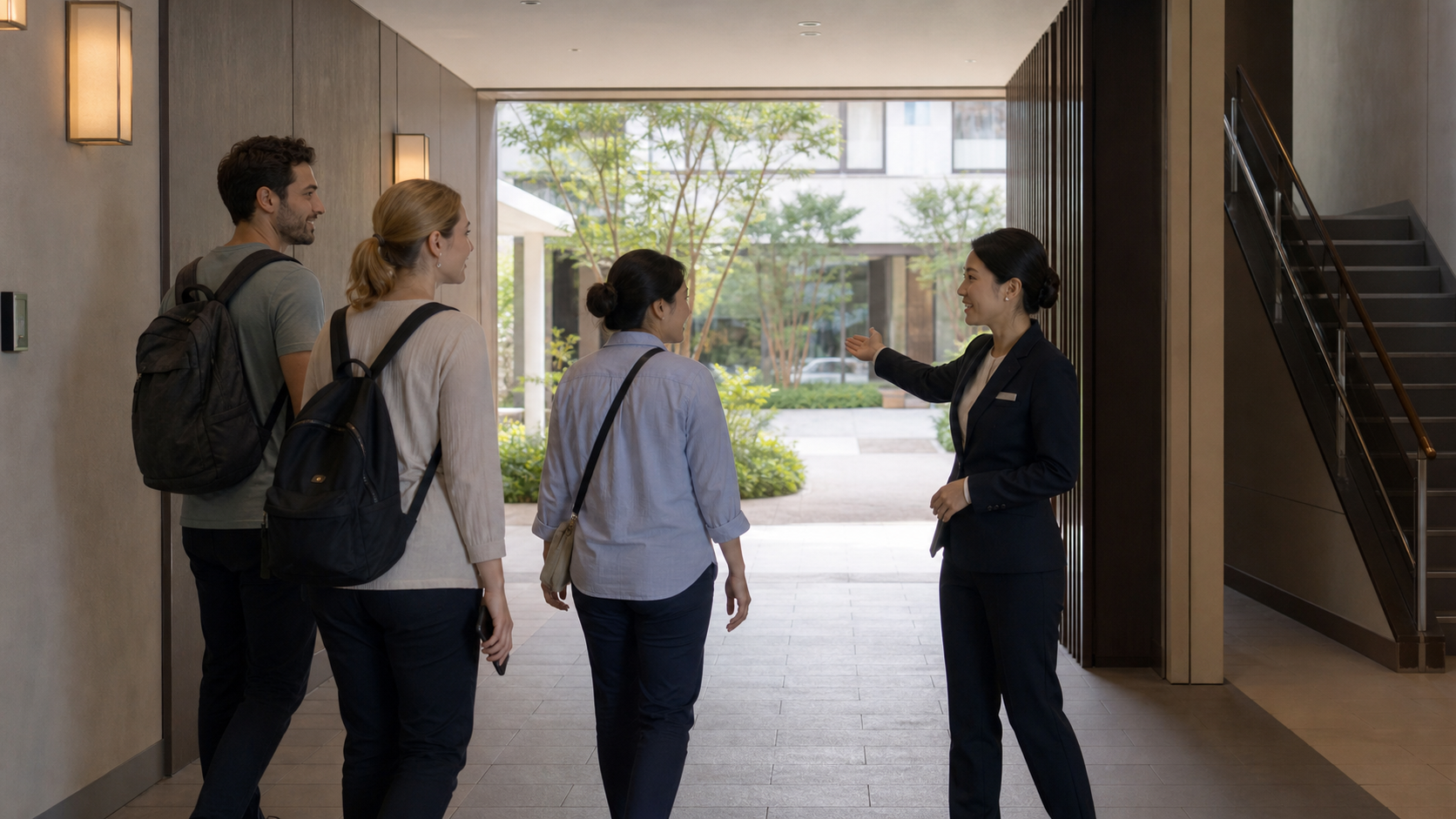
Once the shaking stops, put on shoes and check for smoke, a gas smell, broken glass or an unsafe corridor. Take your phone, room key and passport when they are close and doing so does not delay an evacuation. At check-in, ask where the emergency stairs and assembly area are. For hotel procedures before a problem occurs, see How to Check In at Japanese Accommodation.
On a train or at a station
A train may brake suddenly when an alert is received. Hold a strap or handrail, protect your head and follow the crew. Do not pull emergency equipment unless there is a separate immediate danger and the instructions require it. Do not force a door open or climb down onto tracks, where electrical and passing-train hazards may remain.
At a station, move away from the platform edge, glass and overhead objects. Avoid running toward one exit with a crowd. After the shaking, railway staff may hold passengers in a safe area while tracks and power are inspected. A stopped line is not evidence that walking along the tracks is safe.
In an elevator
JMA advises pressing the buttons for nearby floors and leaving when the elevator stops and opens. If it becomes trapped, use the emergency intercom and wait for professional assistance. Do not try to force the doors or climb out between floors.
After a significant earthquake, do not use an elevator simply because the doors still open. It may stop during an aftershock or be withdrawn from service for inspection. Follow the building's instructions and use designated stairs when the route has been confirmed safe.
On a street
Immediate hazards include falling glass, signs, roof tiles and exterior materials. Move away from building fronts, block walls and unsecured objects. Cover your head with a bag or clothing if that is what you have. Do not stop in the road to check your phone.
If you are in a dense shopping area, staff may direct people into or away from a building based on local damage. Follow that instruction rather than treating “outside” or “inside” as automatically safer in any situation.
Near the sea or a river connected to the coast
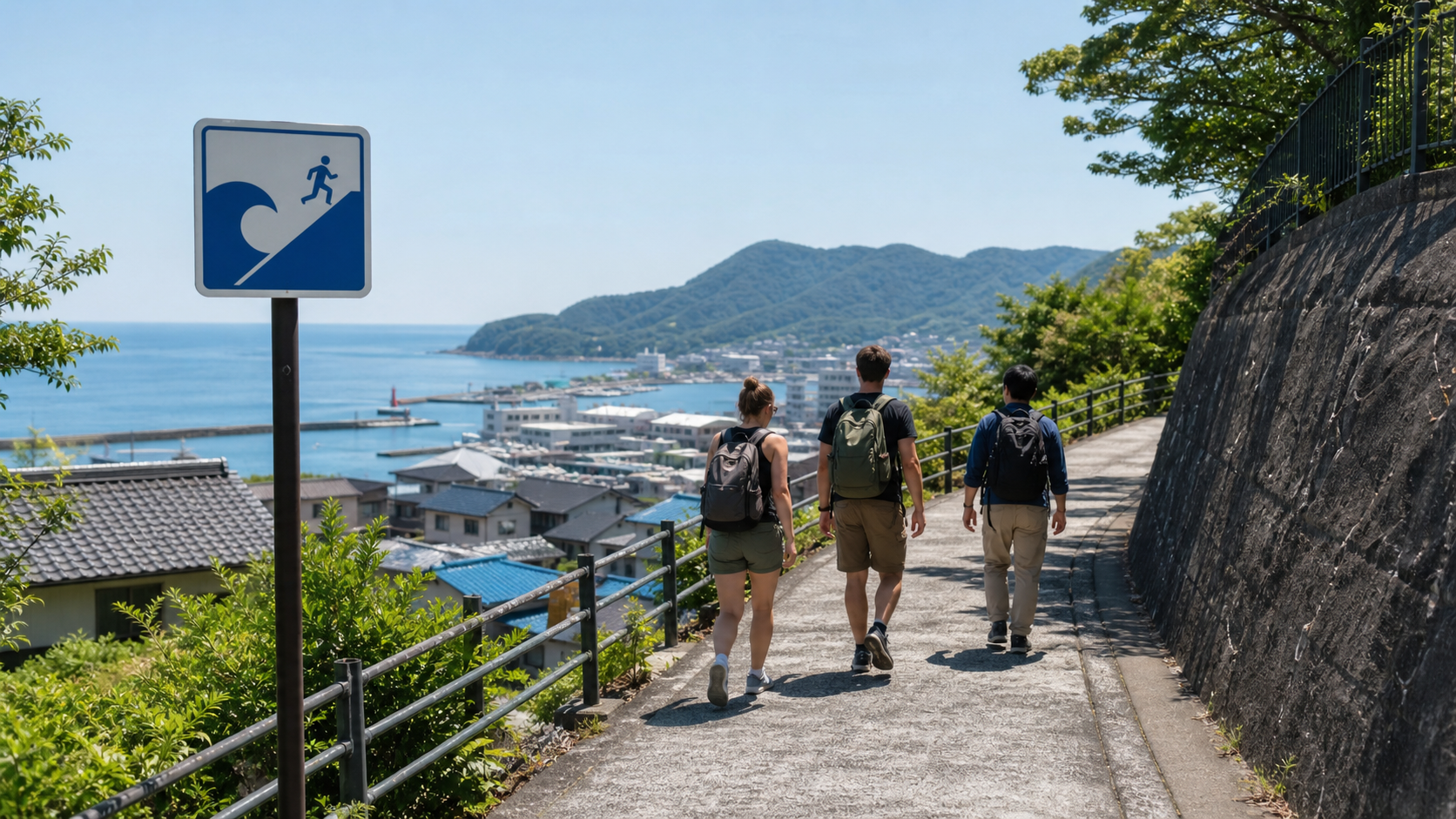
The coastal rule is different: after strong shaking, or weak shaking that lasts a long time, leave the shore and go higher. JNTO and JMA tell people not to decide for themselves that no tsunami will arrive. A tsunami can arrive in repeated waves, and a later wave can be larger than the first.
Use a marked tsunami evacuation route, higher ground or a designated tall evacuation building. Do not wait to collect luggage, drive into a traffic jam, return to the hotel by the waterfront or take photos of the sea. Remain in the safe area until the tsunami warning or advisory is officially canceled.
What to do after the shaking stops
Expect aftershocks. A damaged shelf, ceiling panel or wall may fall during later shaking even if it remained in place the first time.
Use this sequence:
- Check yourself and the people immediately beside you. Call emergency services for serious injury or fire when a call can be made safely.
- Check the immediate environment. Look and smell for smoke, gas, broken glass, water leaks and unstable objects. Do not touch fallen cables.
- Move when you have identified a safer destination. In a sound building away from the coast, waiting for staff instructions may be safer than joining a crowd outside.
- Check official information. Use JMA, Safety tips, local-government notices and the transport operator responsible for your route.
- Send one short status message. Text is often more practical than repeated voice calls on a congested network. Tell your contact where you are, whether you are safe and what you plan to do.
- Prepare for disruption. Charge devices when safe, conserve battery, fill a water bottle if the supply is confirmed safe and keep shoes on.
Do not spread an unconfirmed casualty number, evacuation location or “next earthquake” prediction. Share the official link or screenshot with its time and source.
Get English alerts before you need them
Safety tips app
The Japan Tourism Agency and JNTO provide the free Safety tips app for international visitors. It supports 15 languages, including English, and provides push notifications for earthquake early warnings, tsunami warnings and weather warnings. It also includes response flowcharts, emergency phrases and links to useful information.
Install it from the official Safety tips app page, then allow notifications. Check that the app's selected locations include the places on your itinerary.
iPhone emergency alerts in Japan
Apple says supported iPhones using a Japanese carrier SIM or eSIM can receive Japan Government Alerts. In Settings → Notifications, scroll to Emergency Alerts and keep the relevant alert settings on. Apple notes that availability depends on the supported carrier environment and that the alert language follows the device language.
Do not depend on a phone alert as your sole warning route. A device may be off, out of coverage, in a failed network area or configured differently. The Safety tips app and staff instructions are important additional routes.
Official web and broadcast sources
Use:
- JNTO Emergency Information for traveler-focused contacts and current links;
- JMA earthquake and tsunami information for official hazard information;
- Japan Safe Travel Information and @JapanSafeTravel for traveler updates;
- NHK WORLD-JAPAN for English-language news; and
- the official site or app of the railway, airline or bus operator responsible for your trip.
Plan B when your phone or transport stops
A dead phone is an inconvenience; unsafe movement is a larger problem. If the network or battery fails:
- follow uniformed staff, local officials and public-address announcements;
- use posted evacuation maps and tsunami signs;
- show your accommodation address written in Japanese;
- conserve battery by lowering brightness and closing unnecessary apps;
- use a staffed tourist information counter, police box or accommodation desk when safe; and
- avoid starting a long walk until you know the route is open and your destination can receive you.
If railway service stops, do not enter the tracks or walk into a road tunnel. Check the operator's official information and MLIT disaster information when data returns. A station, hotel or designated shelter may be the safer temporary destination.
Prepare for battery trouble with Phone Died in Japan: Charging Plan B. For severe rain or a typhoon occurring at the same time, use Japan Rain and Typhoon Plan.
Emergency numbers and traveler help
| Need | Number | Use |
|---|---|---|
| Ambulance or fire service | 119 | Serious illness, injury or fire |
| Police emergency | 110 | Crime, dangerous incident or traffic accident requiring police |
| Japan Visitor Hotline | 050-3816-2787 | JNTO's 24-hour assistance in English, Chinese, Korean and Japanese for accidents, emergencies and disasters |
| Japan Visitor Information Center | 050-3416-0010 | General travel information, currently listed by JNTO as 9:00 a.m.–5:00 p.m. daily |
When calling 119 or 110, state the service you need, your location and what happened. Ask a nearby staff member or Japanese speaker for help if you cannot describe the address. Do not call an emergency number just to ask whether a train is running.
If your passport is missing during an evacuation, prioritize immediate safety first, then follow Carry Your Passport in Japan: Lost-Passport Plan.
Should you cancel or change your Japan trip?
An earthquake somewhere in Japan does not automatically make the country unsafe. Japan is geographically large, and the useful decision depends on the affected area, damage, tsunami information, transport status and local instructions.
Do not decide from a viral video alone. Check:
- JMA information for the affected region;
- the local government's official evacuation and damage updates;
- the railway, airport or airline responsible for your route;
- your accommodation's ability to receive guests; and
- your travel insurer or booking provider for applicable change conditions.
Change the plan when an official evacuation order, closure, accommodation cancellation or unsafe access route affects you. If the event is elsewhere and your route is operating normally, continue monitoring rather than assuming a nationwide shutdown. No authority can guarantee that another earthquake will or will not happen on a particular travel date.
Prepare in five minutes
Do these actions now:
- open the official Safety tips app page and install the app;
- save 050-3816-2787 as “Japan Visitor Hotline”;
- save your accommodation name, address and phone number offline;
- photograph or note the emergency-exit map without including another guest's personal information;
- identify whether any planned accommodation or attraction is beside the coast;
- pack a small power bank, charging cable, water and any essential medication; and
- agree on one meeting point and one overseas contact if traveling with others.
The goal is not to predict an earthquake. It is to make the first safe action obvious even when the room shakes, the announcement is unfamiliar and your phone is not useful.
FAQ
What should I do first during an earthquake in Japan?
Protect your head, move away from glass and falling objects, and get under a sturdy table if one is close. Do not rush outside while objects are moving. Follow staff instructions in hotels, stations, trains and attractions.
Should I run outside when an earthquake starts?
No. JMA advises people inside buildings not to rush outdoors because glass, signs and exterior materials may fall. Protect yourself during the shaking, then move after checking conditions and official instructions.
What should I do if I am near the sea?
After strong shaking, weak but long shaking, or a tsunami warning, leave the shore immediately. Go to higher ground or a designated tsunami evacuation building and remain there until authorities cancel the warning or advisory.
Will my phone warn me about an earthquake in Japan?
It may, but a phone alert should not be your sole warning route. Install the official Safety tips app, allow notifications and keep the relevant iPhone emergency-alert settings on when supported. Act on the shaking and staff instructions even when no alert appears.
Is the Japan Visitor Hotline available in English?
Yes. JNTO lists 050-3816-2787 as a 24-hour hotline in English, Chinese, Korean and Japanese for accidents, emergencies and disasters affecting visitors.
Should I use an elevator after an earthquake?
Do not use a stopped or potentially damaged elevator. During shaking, press nearby floor buttons and leave when it opens. If trapped, use the emergency intercom and wait for assistance rather than forcing the doors.
Is Japan unsafe after a large earthquake?
Not necessarily. Check the affected region, tsunami information, transport status, local authority instructions and your accommodation. Do not infer nationwide conditions from one video or one disrupted route.
Can Japan predict the exact date of the next earthquake?
No reliable method can predict an earthquake's exact date, location and magnitude. JMA says claims that specify the date, location and magnitude should generally be treated as misinformation. Prepare for earthquakes, but use official current information for travel decisions.

Comments