- Quick Answer
- What the February numbers mean—and what they do not
- February decision matrix: clothes, timing, and Plan B
- A compact packing system for central Tokyo
- Use the longer February day without overplanning it
- Plum blossoms: treat the season as an option, not a promise
- Snow, rain, and wind Plan B
- February 2027 holiday checkpoints
- The 7-day and 24-hour update routine
- Official sources used
- FAQ
- Is Tokyo cold in February?
- What coat should I wear in Tokyo in February?
- Does it snow in Tokyo in February?
- Do I need an umbrella in February?
- What shoes are practical for Tokyo in February?
- Can I see plum blossoms in Tokyo in February 2027?
- Can I see cherry blossoms in Tokyo in February 2027?
- What time does it get dark in Tokyo in February 2027?
- Will the February 11 or February 23 holidays affect my trip?
- What is a practical February Plan B?
Quick Answer
Tokyo is still winter-cold in February. For broad planning, the Japan Meteorological Agency's 1991–2020 Tokyo normals are 6.1°C (43.0°F) mean, 10.9°C (51.6°F) daily maximum, 2.1°C (35.8°F) daily minimum, and 56.5 mm (2.22 in) monthly precipitation. These are 30-year climate normals, not a forecast for your February 2027 dates.
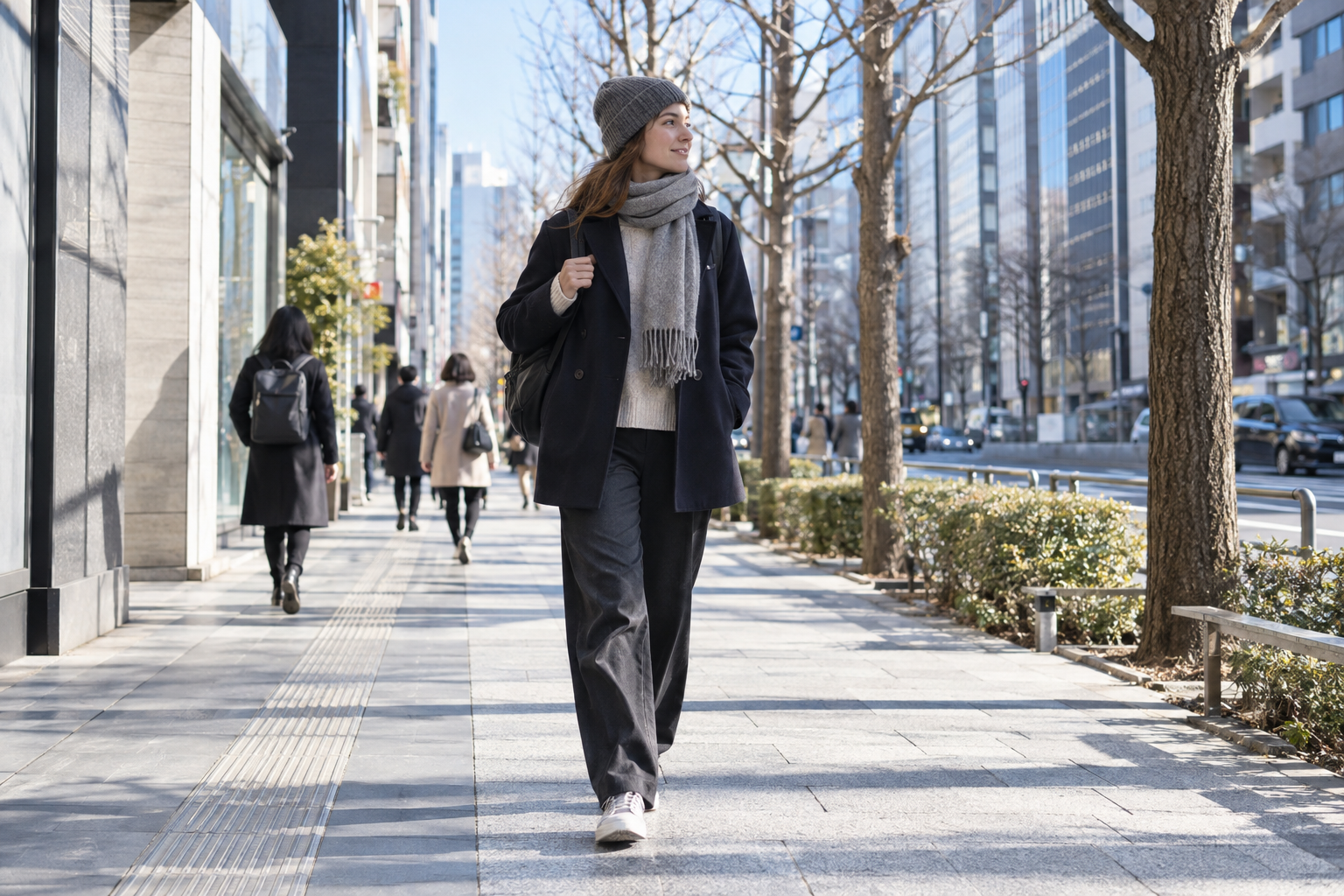
Pack removable layers: a breathable base, a sweater or fleece, and a warm wind-resistant coat. Keep gloves and a scarf easy to reach for morning, evening, shade, or a long outdoor wait. Comfortable closed shoes with useful grip are a better default than footwear chosen only for a dry forecast.
Plan one main outdoor block and one indoor backup in the same district. Check the live forecast before deciding which comes first. If flowers matter, treat plum blossoms as a possible February bonus—not a fixed 2027 appointment. Exact bloom timing, event schedules, venue hours, and transport status all need a later official check.
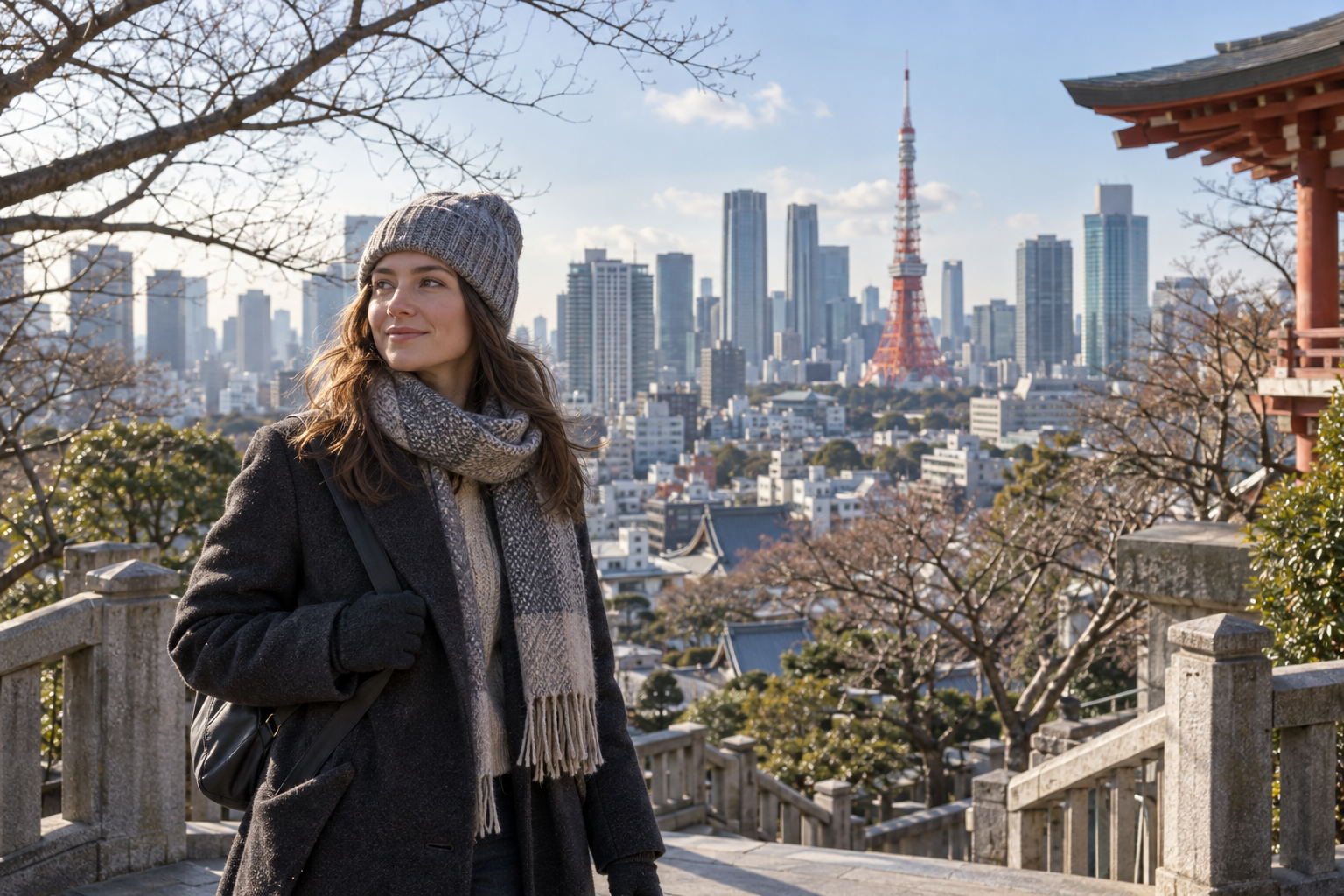
AI-generated editorial illustration; not field evidence.
What the February numbers mean—and what they do not
| Information | Use it for | Do not use it for |
|---|---|---|
| JMA 1991–2020 climate normals | Broad packing and itinerary shape | Predicting the weather on your dates |
| GO TOKYO February guidance | Current destination advice and past-year context | Turning its 2025 figures into a 2027 forecast |
| JNTO February and flower guides | Understanding the broad season | Promising an exact 2027 bloom date |
| NAOJ 2027 sunrise and sunset | Placing daylight-dependent activities | Promising clear skies or unobstructed light |
| Cabinet Office holiday list | Flagging dates that need a venue check | Assuming every attraction closes or becomes crowded |
| Live JMA and operator pages | Making the final day-by-day decision | Planning months ahead as if nothing can change |
A monthly normal is not the temperature you will feel all day. Sun, shade, wind, walking speed, a station platform, and a heated train can change comfort within one hour. The useful packing decision is therefore not “How heavy is my coat?” by itself. It is “Can I add or remove one layer without returning to the hotel?”
JMA also lists a February normal of 170.4 sunshine hours and 52% relative humidity for Tokyo. Those monthly figures can describe the climate, but they cannot tell you whether your garden morning will be sunny, wet, windy, or snowy. Use them only as background.
February decision matrix: clothes, timing, and Plan B
| Live condition or trip priority | Clothing decision | Put outdoors here | Plan B trigger and move |
|---|---|---|---|
| Dry, calm forecast | Base layer, mid-layer, coat; carry gloves and scarf | Main walk from late morning through mid-afternoon | Move indoors when a long shaded wait starts to feel cold |
| Sunny midday but cold morning/evening | Full layers at departure; remove scarf or open coat while walking | Put the longest outdoor block around the warmer forecast window | Use breakfast or early evening for an indoor activity |
| Rain or sleet risk | Water-resistant outer layer, compact umbrella, shoes with grip | Keep exposed walking short and close to stations | Replace a garden, waterfront, or viewpoint with a verified indoor stop nearby |
| Snow or strong-wind warning | Warm layers plus shoes that handle wet or slippery surfaces | Keep only essential outdoor transfers | Follow JMA and operator notices; shorten, delay, or cancel nonessential travel |
| Plum blossoms are a priority | Dress for standing still outdoors, not only walking | Use the best live bloom update and weather window | Switch to a garden-free neighborhood day if flowers or weather disappoint |
| February 11 or 23 | Use the same weather logic as any other day | Keep the priority venue only after checking its dated calendar | Use a nearby unticketed or flexible option if hours or inventory do not fit |
This matrix is the article's core decision tool. It separates three questions that travelers often mix together: what the climate is usually like, what the live forecast says, and whether a specific venue or seasonal sight is actually available.

AI-generated editorial illustration; not field evidence.
A compact packing system for central Tokyo
- Breathable base tops that can be repeated
- One sweater, cardigan, or light fleece
- One warm wind-resistant coat
- Gloves and a scarf that fit in a day bag
- A warm hat if you feel cold easily or expect long outdoor waits
- Comfortable closed walking shoes with useful grip
- Socks that stay comfortable over a full walking day
- A compact umbrella or light rain shell after checking the forecast
- A small day bag with room for one removed layer
- Optional disposable heat packs for cold-sensitive travelers
Layering matters because an outfit that feels right during a slow outdoor wait may feel too warm on a crowded train or inside a department store. Remove or open the outer layer before you overheat, then put it back on before an exposed platform or queue.
Do not use central Tokyo's monthly average as a packing rule for every side trip. Western Tokyo, Mt. Takao, inland areas, and mountain destinations can need a separate forecast and a different layer set. If you plan to drive outside the center, use the Japan rental-car winter tires and snow-driving guide before committing to the route.
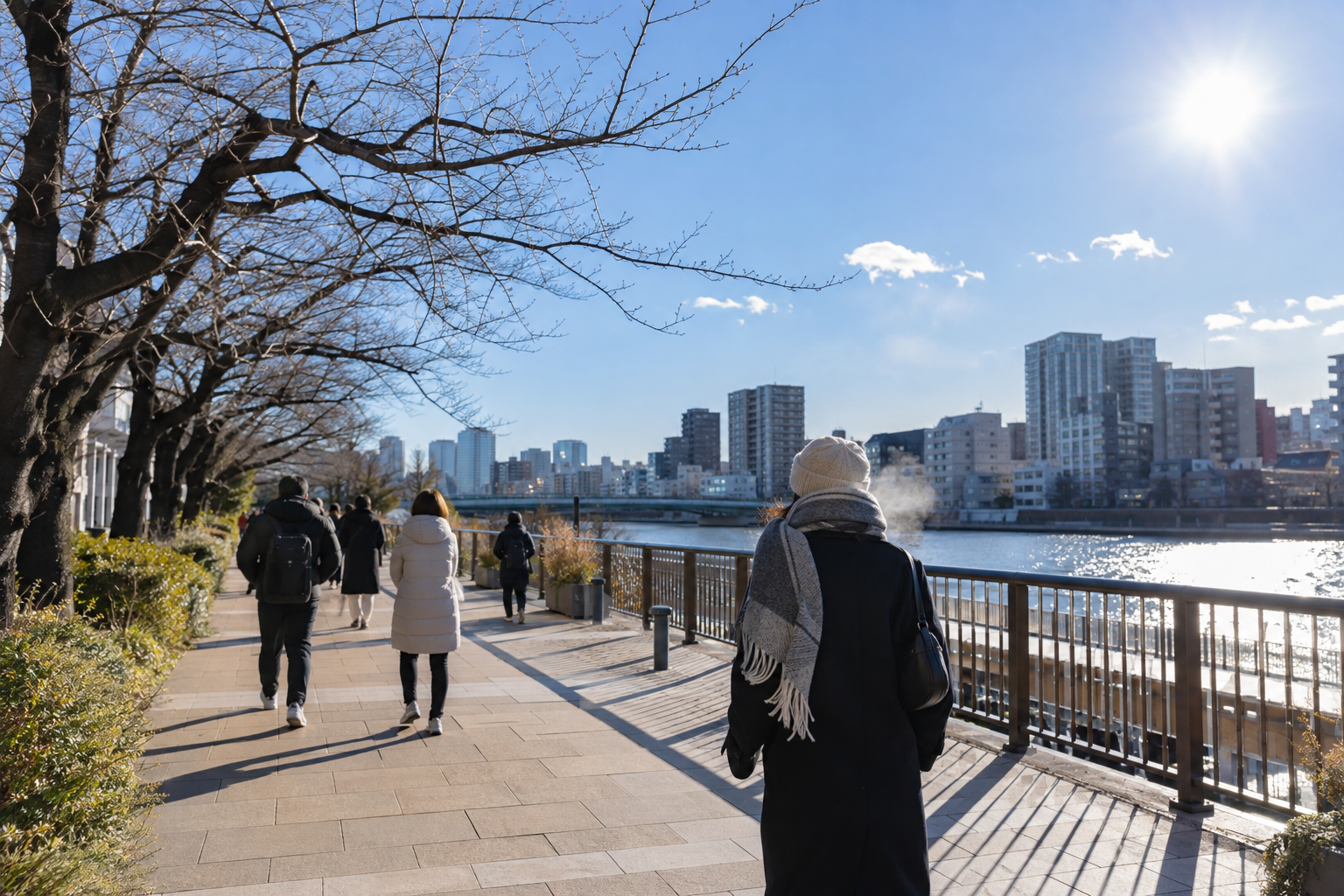
AI-generated editorial illustration; not field evidence.
Use the longer February day without overplanning it
The National Astronomical Observatory of Japan lists Tokyo sunrise at 06:41 and sunset at 17:08 on February 1, 2027. On February 28, sunrise is 06:13 and sunset is 17:35. That is about 10 hours 27 minutes between sunrise and sunset at the start of the month and about 11 hours 22 minutes at the end.
Those times help with order, not with weather. Put the activity that most needs daylight—such as a garden, architecture walk, neighborhood photography, or outdoor viewpoint—into the clearest forecast window. Keep a museum, shopping complex, bath facility, or indoor attraction as the movable block.
A practical day pattern is:
- Arrive in one target district by mid-morning.
- Complete the most weather-sensitive outdoor activity first if conditions are good.
- Take lunch indoors and recheck wind, rain, and energy.
- Use a second short outdoor block only if it still adds value.
- Move to the saved indoor option before a poor-weather transfer becomes necessary.
- Keep the evening in the same area or on one simple rail corridor.
Use the Tokyo Area Guides or the Tokyo Area Map to build a compact day. Then confirm the actual venue's opening day, last entry, admission method, and temporary notices on its official page.
Plum blossoms: treat the season as an option, not a promise
Official tourism sources place plum blossoms broadly in February and March. GO TOKYO says Tokyo's plum season begins in early February, while JNTO describes the warmer latter half of the month as a period when plum trees begin to bloom. That supports a flexible February flower option. It does not support an exact 2027 bloom date.
Build a flower plan in three steps:
- Choose a garden or park only after checking its official page.
- Look for a recent bloom update close to the visit date.
- Pair it with an indoor or non-flower activity in the same area.
Early-blooming cherry varieties can also appear in February, but JNTO places Tokyo's main cherry season generally later, around mid- to late March, and says timing changes by year. Do not book a February Tokyo trip on the promise of ordinary cherry blossoms. If a specific flower is essential, wait for current bloom information and keep the rest of the day useful without it.
Update label — bloom-dependent: Recheck the official garden or park page near the visit. A general month guide is not a 2027 bloom report.
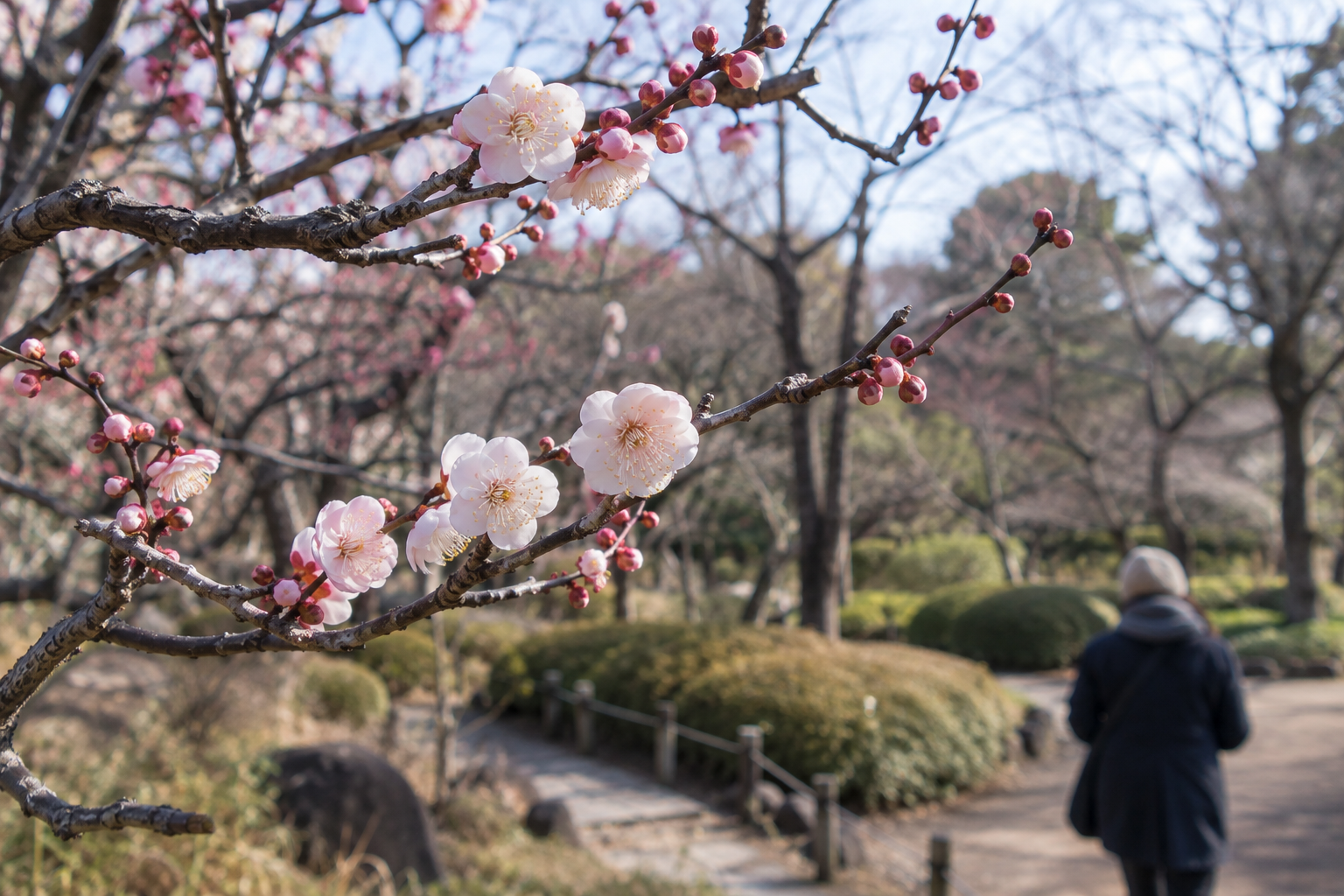
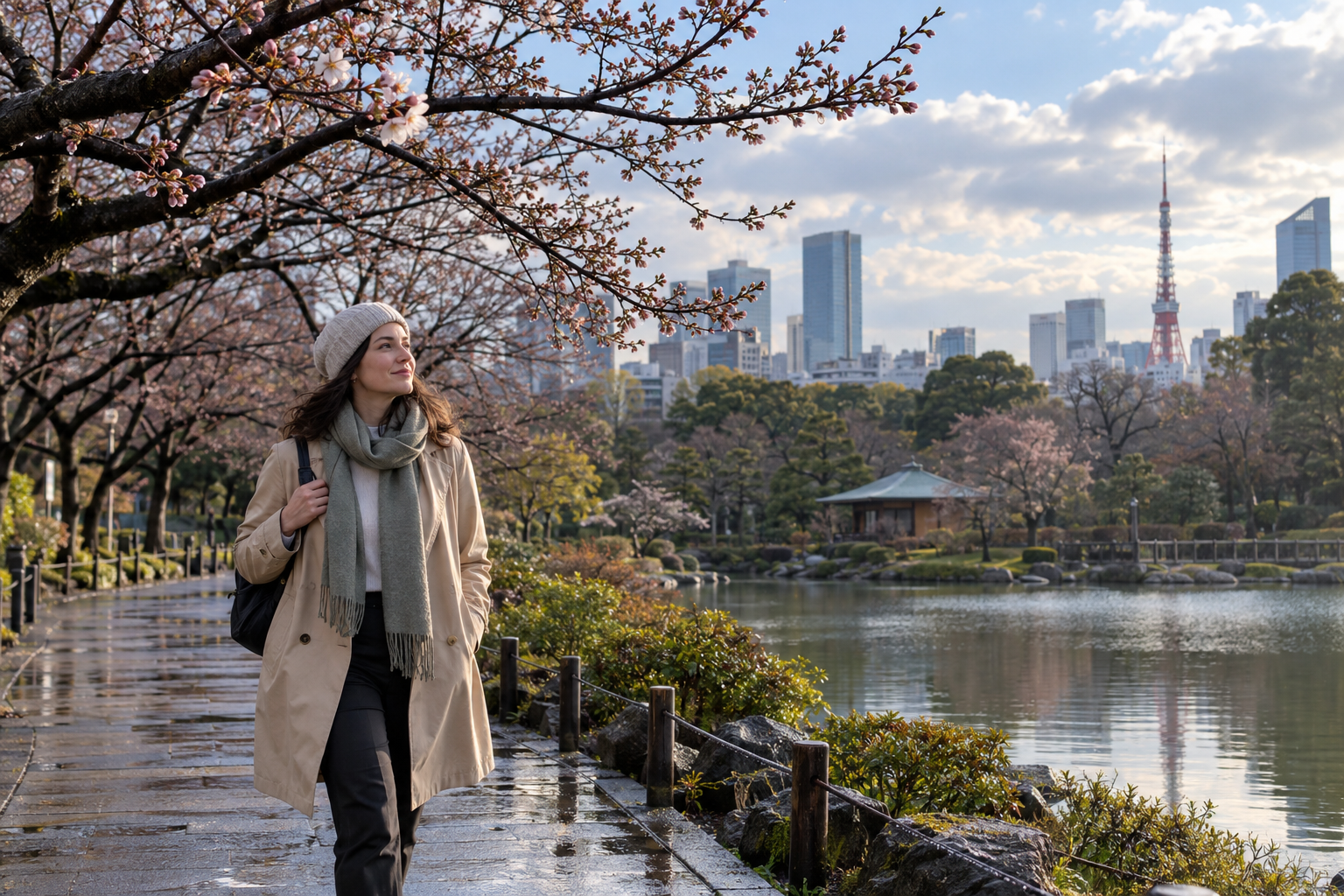
AI-generated editorial illustration; not field evidence.
Snow, rain, and wind Plan B
JNTO says snow can fall in Tokyo but is uncommon. GO TOKYO similarly says winter snow rarely settles in central Tokyo. “Uncommon” does not mean “impossible,” and it does not tell you whether your route will operate normally.
If snow or sleet is forecast
Open the live JMA forecast and warnings, then open the official service page for every rail, subway, or bus operator you will actually use. A route app can help with directions, but it is not a substitute for an operator notice. Replace a distant outdoor day with a compact indoor route near your accommodation or on one simple rail corridor.
If rain lasts through the outdoor window
Do not force a flower garden or exposed walk simply because it was on the original itinerary. Choose a museum, shopping complex, indoor observation option, bath facility, or long meal whose hours and admission rules you have verified. Move the outdoor block to another day if your schedule allows.
If strong wind is forecast
Move waterfront walks, bridges, observation decks, and long exposed queues out of the windy period. Check the attraction as well as the train. A running train does not prove that an outdoor deck or program is operating.
If conditions change after you leave
The Plan B should be close. A backup one hour away is a second itinerary, not a fallback. Choose one district with several indoor options, and leave enough battery and data to recheck official notices.
Update label — 24 hours before use: Recheck weather, warnings, transport status, venue hours, and ticket conditions. Recheck again on departure morning if snow, rain, or strong wind is possible.
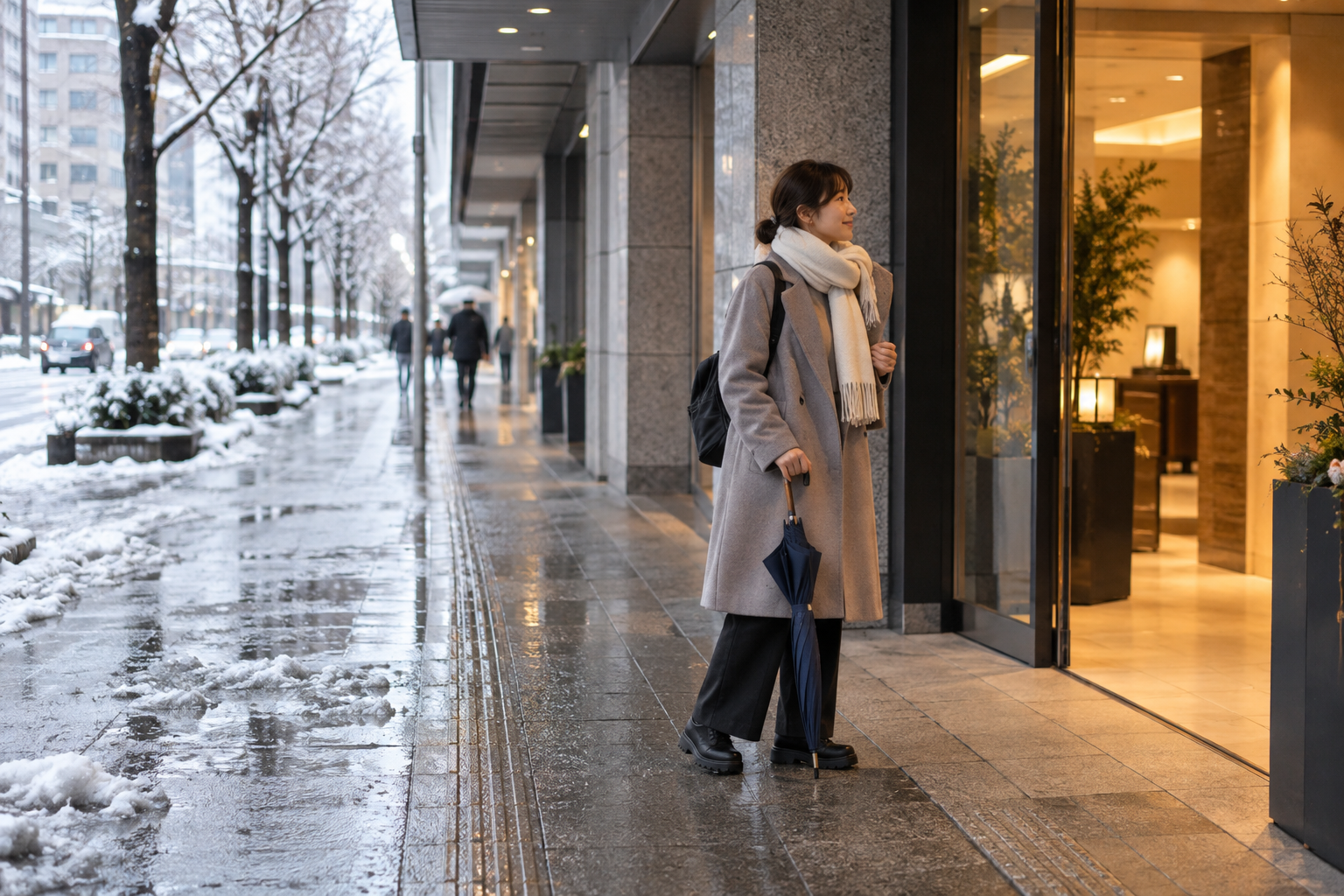
AI-generated editorial illustration; not field evidence.
February 2027 holiday checkpoints
Japan's Cabinet Office lists two national holidays in February 2027:
- February 11: National Foundation Day
- February 23: The Emperor's Birthday
Treat each date as a checkpoint. A national holiday does not prove that every attraction is closed, that every shop uses holiday hours, or that every location will be crowded. Check the official calendar and ticket inventory for the exact place you want to visit. If it is important, save a nearby option that does not depend on the same timed ticket.
Recurring February themes such as Setsubun, plum festivals, illuminations, and other ceremonies may appear in destination guides. This article does not assign any of them an exact 2027 date, venue program, price, or admission rule. Use the organizer's dated 2027 page when it becomes available.
Update label — date-sensitive: Event and venue details remain unconfirmed until a dated 2027 official notice is live. Do not use a previous year's schedule as the 2027 schedule.
The 7-day and 24-hour update routine

AI-generated editorial illustration; not field evidence.
About 7 days before an outdoor priority
- Open the JMA one-week forecast for Tokyo.
- Check whether the flower, garden, event, or viewpoint has a dated official update.
- Confirm opening day, last entry, reservation method, and cancellation rules.
- Save an indoor alternative in the same district.
- Identify the actual transport operator, not only the station name.
About 24 hours before use
- Recheck temperature, wind, precipitation, and warnings.
- Recheck the operator's service-information page.
- Put the main outdoor block in the best forecast window.
- Pack gloves, scarf, umbrella, and one removable layer where you can reach them.
- Shorten or move the exposed block when the official information changes.
The goal is not to predict February perfectly. It is to make one decision easy: when weather, bloom status, venue operations, or transport changes, you already know which block moves and where you go instead.
Official sources used
- JMA climate normals for 1991–2020
- JNTO: Japan in February
- JNTO flower seasons
- GO TOKYO February guide
- GO TOKYO winter guide
- NAOJ February 2027 sunrise and sunset in Tokyo
- Cabinet Office 2027 national holidays
- JMA forecast services
- Tokyo Metro service information
FAQ
Is Tokyo cold in February?
Yes. JMA's 1991–2020 February normals for Tokyo are 6.1°C mean, 10.9°C daily maximum, and 2.1°C daily minimum. Your dates may be warmer, colder, wetter, or windier, so use these only for broad planning.
What coat should I wear in Tokyo in February?
For many central-Tokyo itineraries, a warm wind-resistant coat over a removable mid-layer and base layer is practical. Add gloves and a scarf for mornings, evenings, shade, and long waits. Adjust for your cold tolerance and the live forecast.
Does it snow in Tokyo in February?
It can, but official tourism guidance describes snow in Tokyo as uncommon and says it rarely settles in the center. Check JMA and each transport operator near the travel date instead of assuming either normal service or disruption.
Do I need an umbrella in February?
The February precipitation normal is 56.5 mm, not zero. Carry a compact umbrella or rain shell when the live forecast shows rain or sleet; the monthly total cannot tell you which day will be wet.
What shoes are practical for Tokyo in February?
Comfortable closed walking shoes with useful grip are a sensible default. They help with long city walks and give you more margin if surfaces are wet or slippery. A mountain or snow trip needs a separate footwear decision.
Can I see plum blossoms in Tokyo in February 2027?
Possibly, but the exact timing is not confirmed. Official tourism sources describe February into March as the broad plum season. Check a recent update from the specific garden or park and keep a nearby non-flower Plan B.
Can I see cherry blossoms in Tokyo in February 2027?
Some early-blooming varieties may appear, but JNTO places Tokyo's main cherry season generally later, around mid- to late March, and says timing changes by year. Do not treat February as a guaranteed ordinary cherry-blossom trip.
What time does it get dark in Tokyo in February 2027?
NAOJ lists sunset at 17:08 on February 1 and 17:35 on February 28. Put daylight-dependent activities before sunset, but remember that clouds, buildings, and venue hours affect usable time.
Will the February 11 or February 23 holidays affect my trip?
They are national holidays in 2027, but that does not prove a specific venue is closed or crowded. Check the exact attraction's calendar, ticket inventory, and the operator timetable you will use.
What is a practical February Plan B?
Choose one verified indoor option in the same district or on the same simple rail corridor. Move the garden, waterfront, or viewpoint to a better forecast window, and shorten nonessential travel when official warnings or operator notices show disruption.
Last checked: September 27, 2026 JST. Climate normals are not a forecast. General flower seasons are not exact 2027 bloom forecasts. Recheck weather, warnings, transport status, venue operations, tickets, and bloom updates before travel. Field evidence status: not applicable; no firsthand visit or observation is claimed.
Comments