- Quick Answer
- The Five-Step Accident Order
- Step 1: Make the Scene Safe
- Step 2: Call 119 for Injuries
- Step 3: Report the Accident to Police on 110
- Step 4: Contact Your Rental Company
- Step 5: Record the Facts Without Creating New Risk
- Insurance, Deductibles and NOC Are Separate Questions
- What Not to Do
- Plan B if Language, Battery or Signal Fails
- Frequently Asked Questions
- Do I call 119 or 110 first after a car accident in Japan?
- Must I call police for a minor rental-car accident?
- Should I call the rental company before police?
- Can I agree to pay the other driver directly?
- Can I drive the rental car after a small collision?
- What is a Non-Operation Charge?
- What information should I collect?
- What if I cannot speak Japanese?
- Sources and One Next Action
Quick Answer
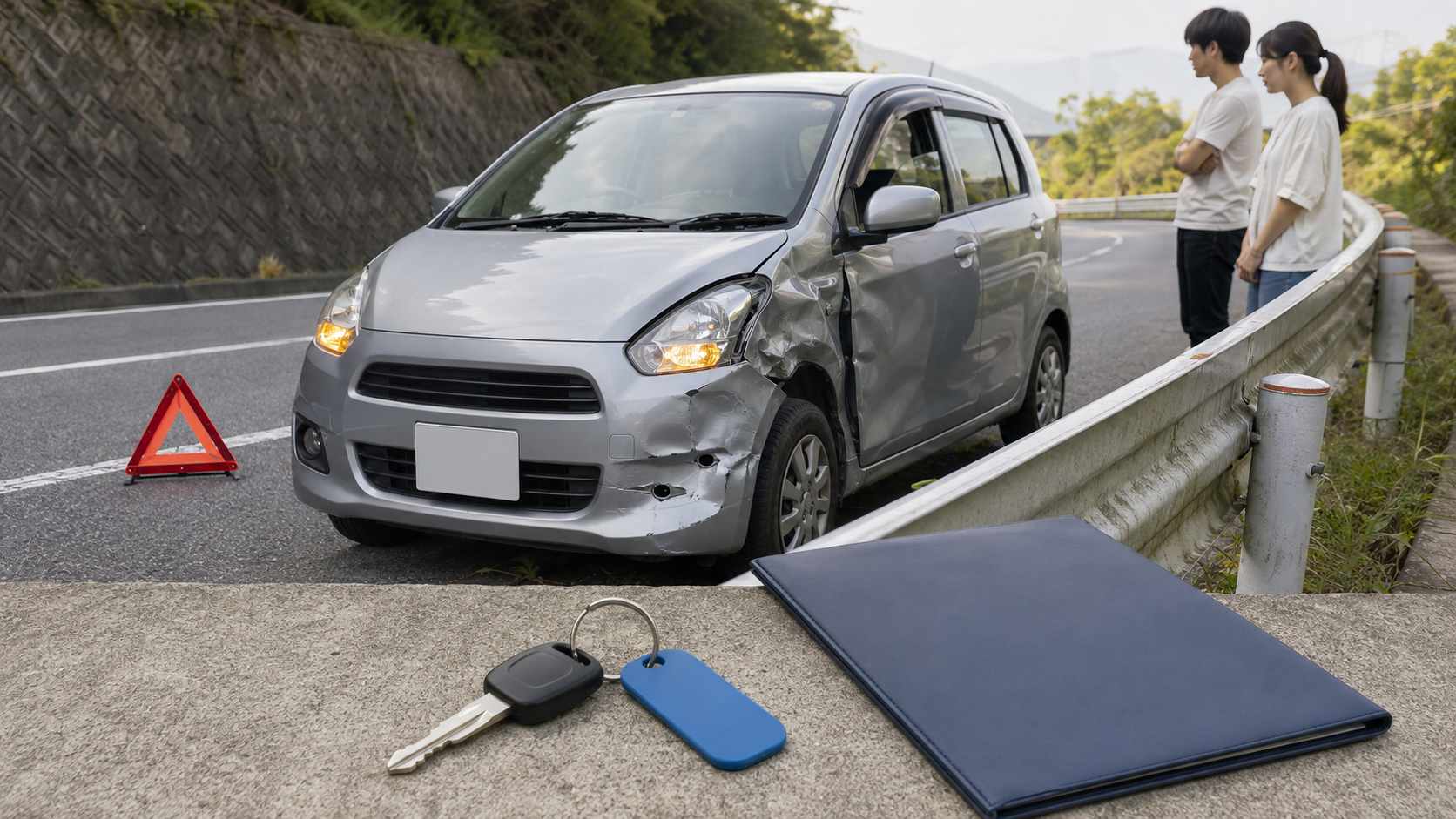
If you have a rental-car accident in Japan, use this order: make the scene safe, call 119 if anyone may be injured, report the accident to police on 110, contact the rental company using the number in your rental agreement, then preserve the information the police, operator and insurer request. Do this even when the damage looks minor.
Do not leave without reporting the crash, agree to a private cash settlement, arrange repairs yourself, or keep driving simply because the car still moves. JAF says an accident must be reported to police, and an unreported accident may not produce the documentation needed for insurance handling. Your rental company’s own agreement and support number control the operator-specific steps.
If you cannot make the call yourself, ask someone nearby to call. For a language barrier, say your location first and ask your hotel, rental counter or a nearby person to help after emergency calls are underway. RJG’s Japan emergency numbers guide gives a separate quick reference.
The Five-Step Accident Order
| Step | What to do | Why it comes now |
|---|---|---|
| 1. Prevent a second crash | Stop. If the vehicle is obstructing traffic or creates a secondary-collision risk, move it to a safer place only when this can be done safely. Switch off the engine, use hazard lights and keep people away from traffic | Immediate danger comes before paperwork |
| 2. Help injured people | Call 119 for an ambulance and give reasonable first aid while waiting | Injury response has priority |
| 3. Report to police | Call 110, give the location, injuries and damage, and follow the officer’s instructions | Police reporting is required and supports the official accident record |
| 4. Call the rental company | Use the accident or emergency number in the rental agreement or handover papers | The operator controls towing, repair, replacement and insurer routing |
| 5. Preserve the record | Keep names, contact and vehicle/insurance details; photograph the scene only when safe; save police and operator references | The police, rental company and insurer may need the same facts later |
This sequence is the article’s main decision tool. It is not a substitute for instructions from emergency services, police, the rental company or the insurer.
Step 1: Make the Scene Safe
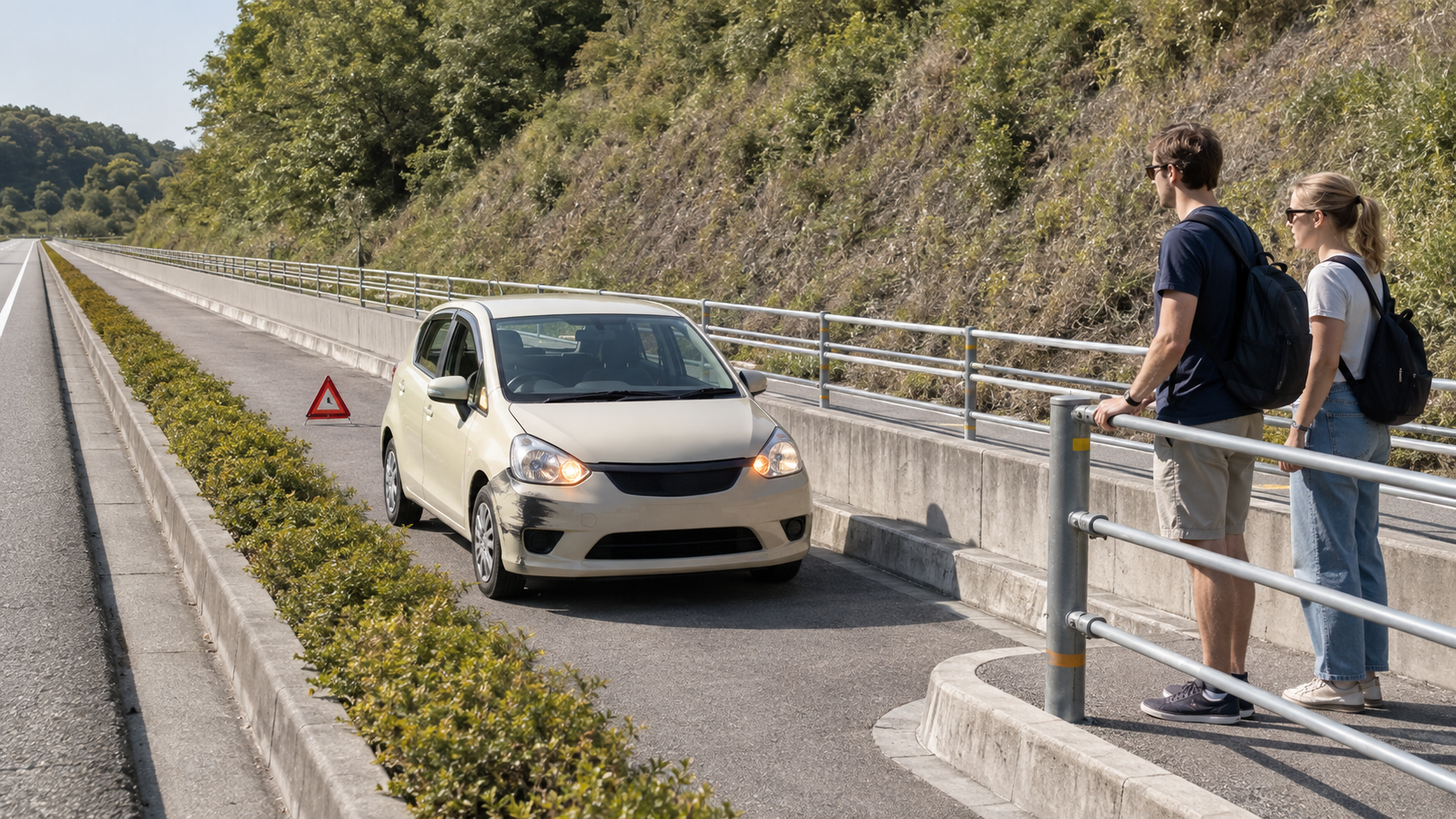
Stop immediately. If the vehicle is obstructing traffic or creates a secondary-collision risk, move it to a safer place only when this can be done safely, then turn off the engine. If the vehicle is already in a safe place and is not obstructing traffic, do not move it unnecessarily; call 110 and follow police instructions. Do not stand in a traffic lane to inspect damage or take photographs.
If movement is required, and there is no immediate danger and doing so will not delay first aid or traffic-safety measures, take a quick photograph of the vehicles’ original positions from a safe place before moving them. If movement is required but photographing first is unsafe, move first. Never leave a vehicle in live traffic merely to preserve evidence. After moving to safety, remain nearby in a safe place, report the accident on 110 and follow police instructions.
If the car cannot be moved safely, prioritize people over the vehicle. Leave the danger area if you can do so without crossing moving traffic, and follow police or road-operator instructions. For an expressway accident, Central Nippon Expressway’s English safety guidance says to warn following traffic, evacuate behind a guardrail or to another safe place, avoid standing on the road or remaining in the vehicle, and report the emergency by 110, emergency telephone or road emergency dial #9910. Follow the operator responsible for your exact road. For ordinary toll and rental planning, see RJG’s Japan expressway guide; emergency instructions take priority.
Do not assume that a warning triangle, hazard lights or a movable vehicle makes the scene safe. Road shape, visibility, weather and traffic speed change the risk.
Step 2: Call 119 for Injuries
Call 119 if anyone is injured or may be injured. JAF instructs drivers to call 119 first when there are injuries and to provide whatever first aid they reasonably can until the ambulance arrives.
Give the location before a long explanation. Useful location clues include the road name or route number, direction of travel, nearest interchange, bridge, tunnel, convenience store or other stable landmark. If your phone map is working, read the place name shown without walking into traffic.
Do not diagnose a person as “fine” merely because they can speak or walk. Describe what you can observe and follow the dispatcher’s instructions. This guide does not provide medical advice.
Step 3: Report the Accident to Police on 110
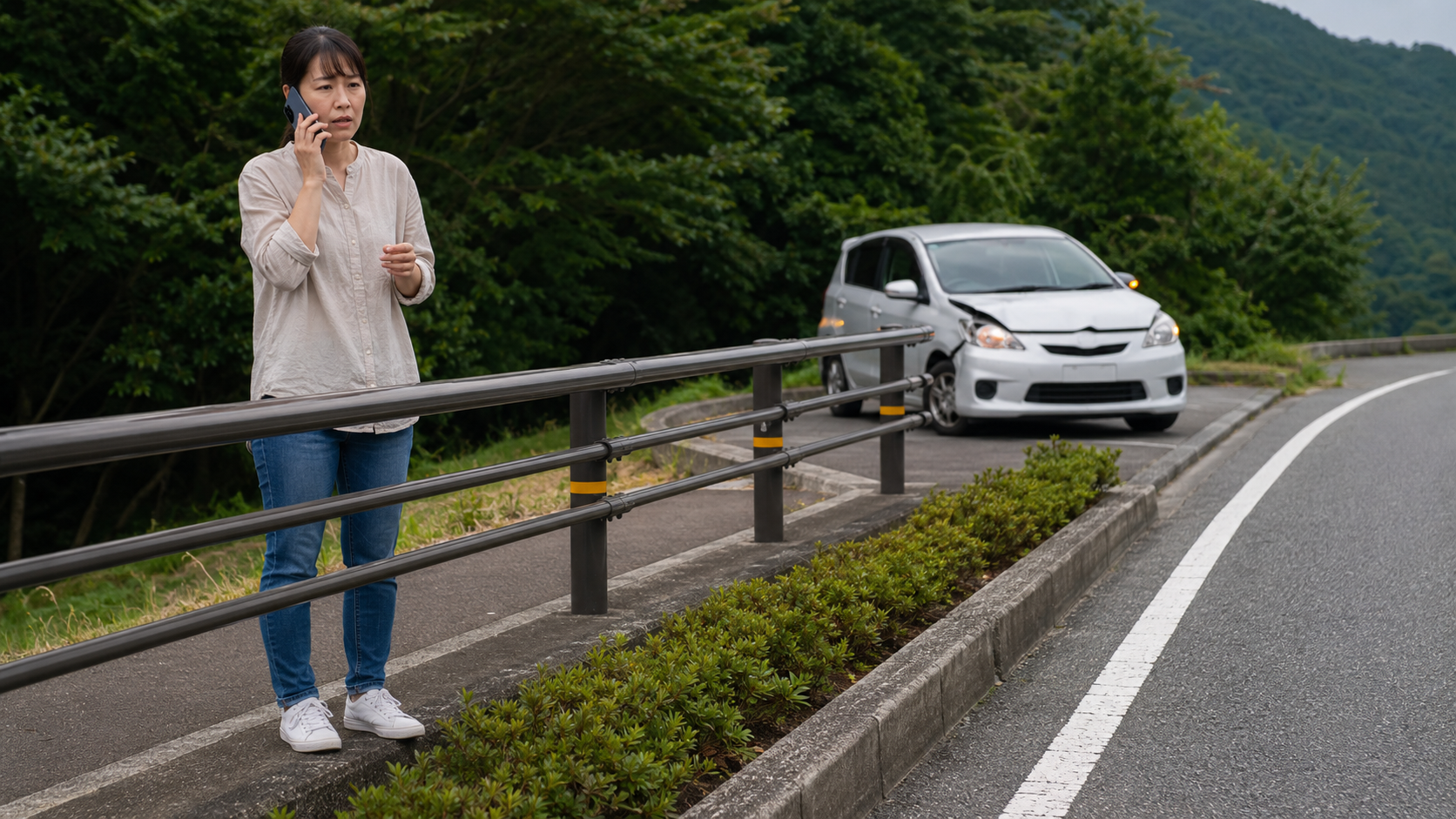
Call 110 and report the accident even when the visible damage looks small or the other party suggests handling it privately. JAF states that traffic accidents must be reported to police. Japan’s Ministry of Land, Infrastructure, Transport and Tourism also explains that the Traffic Accident Certificate is the official document proving involvement in an accident and that it is not issued for an accident that was not reported to police.
Tell police:
- the accident location;
- whether anyone is injured;
- the number of vehicles or people involved;
- the apparent damage; and
- any immediate road danger.
Stay available and follow the officer’s directions. JAF warns that leaving the scene can create serious legal consequences. If you cannot call, ask another person to call for you.
Step 4: Contact Your Rental Company
After the immediate safety and police calls, contact the rental company through the number printed on your rental agreement, key tag, handover sheet or booking record. Do not rely on a generic number from an old blog post when your contract gives a dedicated accident line.
Tell the operator:
- your name and rental agreement or reservation number;
- the vehicle and current location;
- whether 119 or 110 has been called;
- whether anyone is injured;
- whether the car is drivable; and
- the police instructions or reference you have received.
Then follow the operator’s directions about towing, recovery, repair, replacement transport and the insurer. Toyota Rent a Car’s English FAQ, for example, tells customers to help injured people, call police and obtain the accident report, then contact the reservation center or pickup shop. Its rental agreement also requires immediate reporting to the company and company consent before a settlement. Other operators can have different telephone numbers, coverage and procedures, so your own agreement remains the authority.
Step 5: Record the Facts Without Creating New Risk
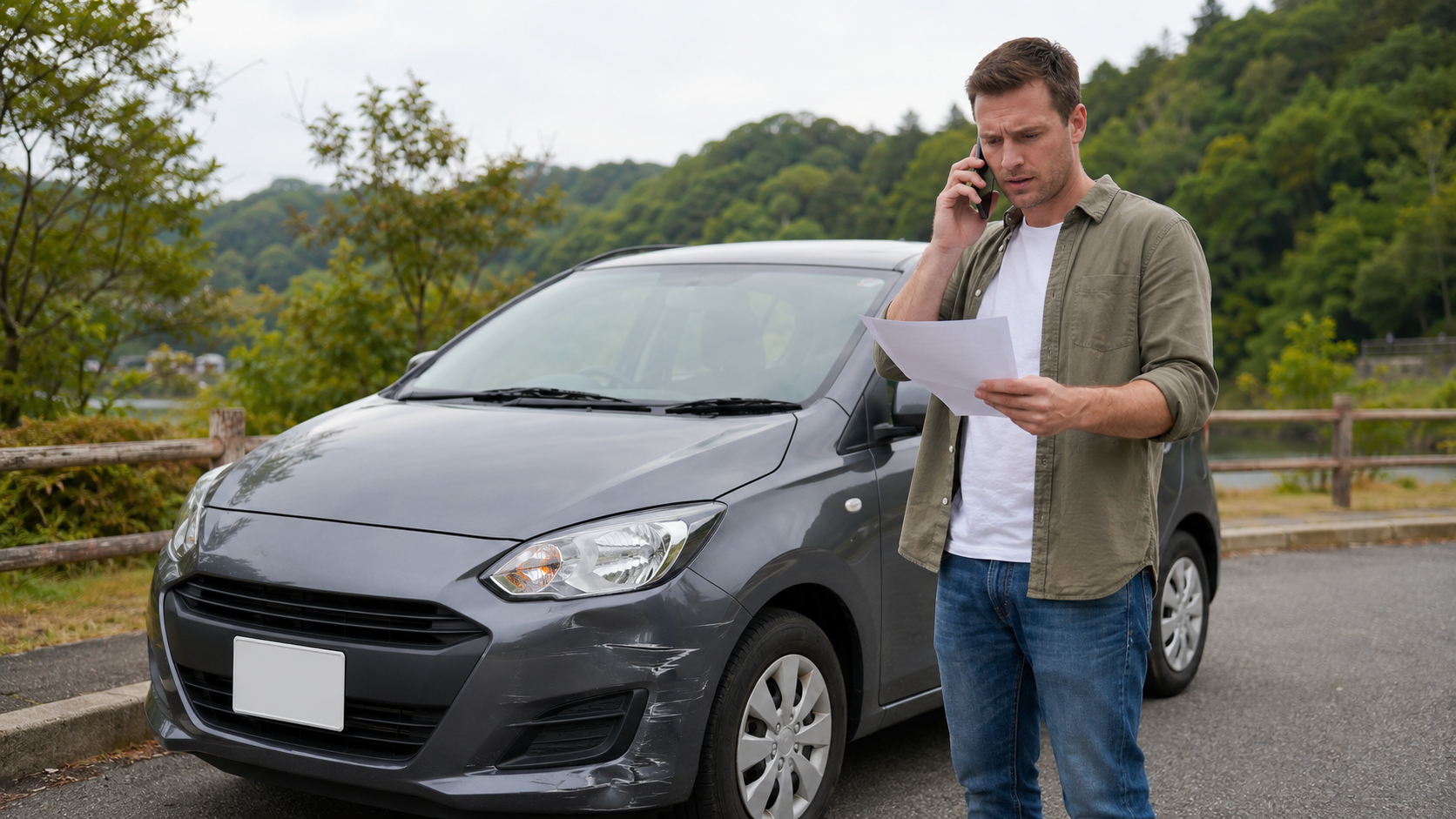
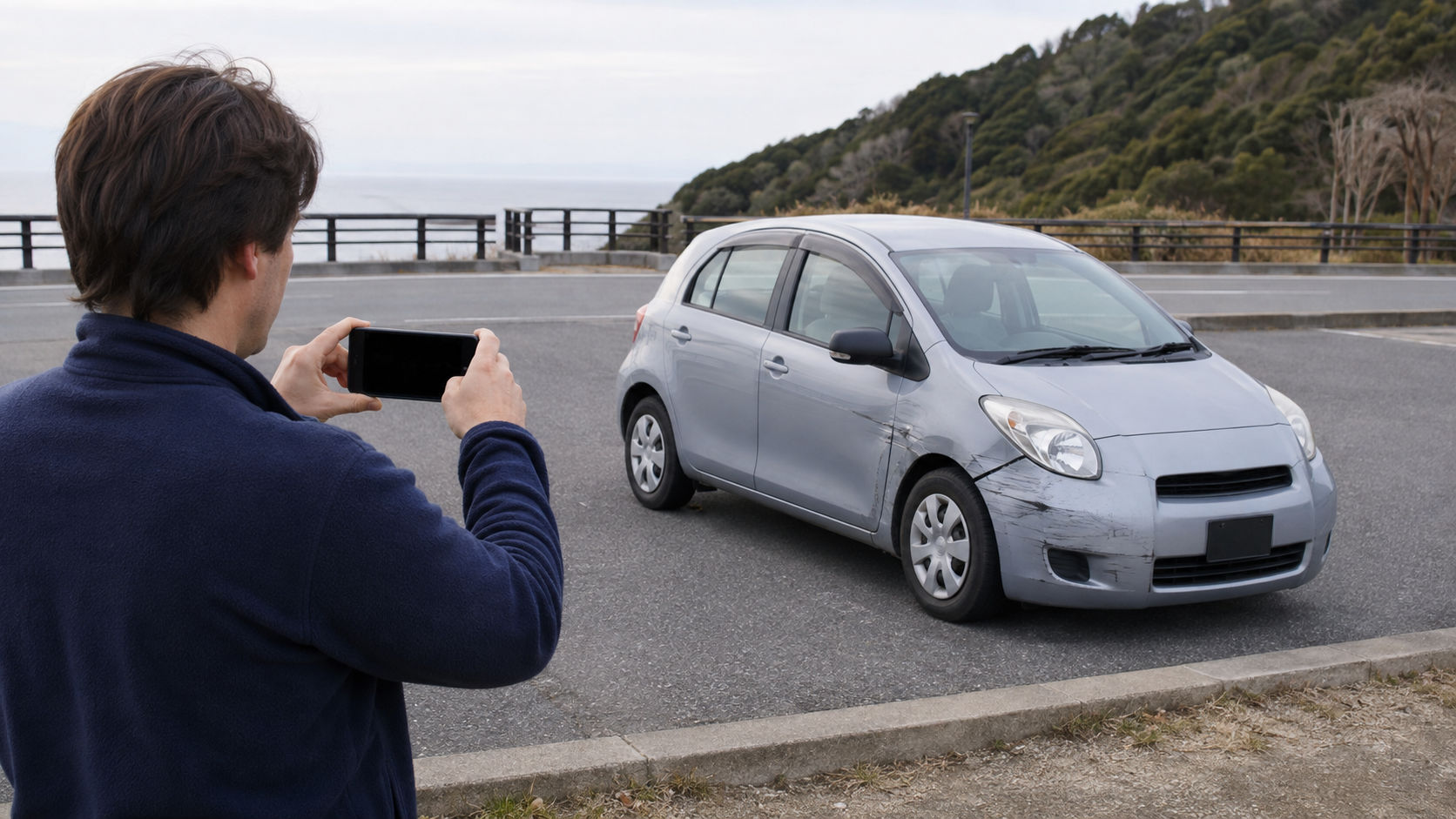
After emergency action and police reporting, preserve information if it is safe and the police allow it. MLIT advises confirming the other vehicle’s registration number, the other party’s name and contact details, and insurance information. Also keep your own rental agreement and the operator’s instructions.
A practical record can include:
- the other vehicle’s registration number;
- names and contact details of involved people;
- insurer information provided by the other party;
- wide photographs showing the road and vehicle positions;
- close photographs of damage;
- the time, weather and direction of travel;
- police station, officer or reference details provided to you; and
- the rental company case or call reference.
Photographs are secondary to safety. Do not block traffic, enter a dangerous lane, photograph injured people unnecessarily, or argue about fault at the roadside. Record what happened in neutral words while your memory is fresh.
Insurance, Deductibles and NOC Are Separate Questions
Do not assume that “insurance included” means every cost is covered. A rental can involve several separate items: liability coverage, vehicle-damage coverage, a deductible, optional deductible-waiver products, roadside or towing conditions, and a Non-Operation Charge (NOC) for the period when the vehicle cannot be rented.
The exact amounts and exclusions depend on the rental company, vehicle and protection product. Toyota’s current English insurance page is one operator example: it says an unreported accident may be outside coverage and explains that NOC is separate from the insurance/compensation system. That example does not set the terms for another company.
Ask the operator these questions:
- Is the accident recorded under my rental agreement?
- What police document or reference do you require?
- May the vehicle be driven, or will you arrange towing?
- Which deductible, waiver and NOC terms apply to my booking?
- What receipts, photographs or forms must I keep?
- Who arranges a replacement car or other transport, if any?
Do not authorize repairs or promise payment to another party before the rental company or insurer tells you how to proceed.
What Not to Do
- Do not leave the scene without police reporting and instructions.
- Do not skip 110 because the damage seems minor.
- Do not make a private cash settlement at the roadside.
- Do not sign a document you do not understand without asking what it means.
- Do not arrange your own repair or tow unless the operator authorizes it.
- Do not continue driving a damaged car merely because it starts.
- Do not post another person’s identifying information or accident images online.
- Do not use this article to decide legal liability or medical condition.
Plan B if Language, Battery or Signal Fails
If language is the main problem, start with the location and the numbers 119 or 110, then ask a nearby person, hotel, shop or rental counter to help explain. If your phone battery is failing, keep enough power for emergency and operator calls rather than documenting every detail.
If there is no mobile signal, move only to a safer nearby place—not farther along a dangerous road—and seek nearby staffed help. On an expressway, use an official emergency telephone only by following the road operator’s safe-access guidance; Central Nippon Expressway says these phones connect to the road control center and can report an accident even when conversation is difficult. If the rental car cannot continue, wait for police, road-service or rental-company instructions. A self-booked taxi, train or replacement car may solve your onward journey, but confirm first what the operator or insurer will arrange and what evidence they need.
If the trip must stop, protect people first and rebuild the itinerary later. RJG’s driving-in-Japan permit guide can help prevent licensing mistakes on a future rental, while the rental-car refueling guide is for ordinary returns—not accident handling.
Frequently Asked Questions
Do I call 119 or 110 first after a car accident in Japan?
Call 119 first when anyone is injured or may be injured. Then report the accident to police on 110. If there is no injury, make the scene safe and call 110.
Must I call police for a minor rental-car accident?
Yes. JAF says to report a traffic accident to police without fail, and MLIT says the official Traffic Accident Certificate is not issued for an unreported accident.
Should I call the rental company before police?
Immediate safety and injury response come first, followed by police reporting. Then contact the rental company promptly using the accident number in your own agreement, unless emergency personnel tell you otherwise.
Can I agree to pay the other driver directly?
Do not make a private settlement or promise payment before the rental company and insurer advise you. Some rental agreements expressly require company consent before settlement.
Can I drive the rental car after a small collision?
Do not decide this yourself. Tell the police and rental company about the damage and follow their instructions about driving, towing or repair.
What is a Non-Operation Charge?
NOC is an operator-defined charge related to the time a damaged or soiled vehicle cannot be rented. It is separate from ordinary insurance/compensation in some rental systems; check your exact agreement and protection product.
What information should I collect?
When safe, keep the other vehicle’s registration number, names and contact details, insurance information, neutral scene and damage photographs, police details, and the rental company’s case reference.
What if I cannot speak Japanese?
Give your location first, state 119 for injury or 110 for police, and ask a nearby person, hotel, shop or rental counter to help. Do not delay the emergency call while searching for perfect translation.
Sources and One Next Action
Primary information checked on September 2, 2026 JST:
- JAF: Emergency Measures
- MLIT: What should you do first if you are in a traffic accident?
- Toyota Rent a Car: FAQ — What should I do if I have an accident?
- Toyota Rent a Car: Insurance and Non-Operation Charge
- Toyota Rent a Car: Rental Agreement, accident procedure
- Central Nippon Expressway: Expressway accident and emergency-phone guidance
Your next action is simple: before driving away from the rental counter, photograph the accident-contact section of your own rental agreement and save the operator’s emergency number offline.

Comments