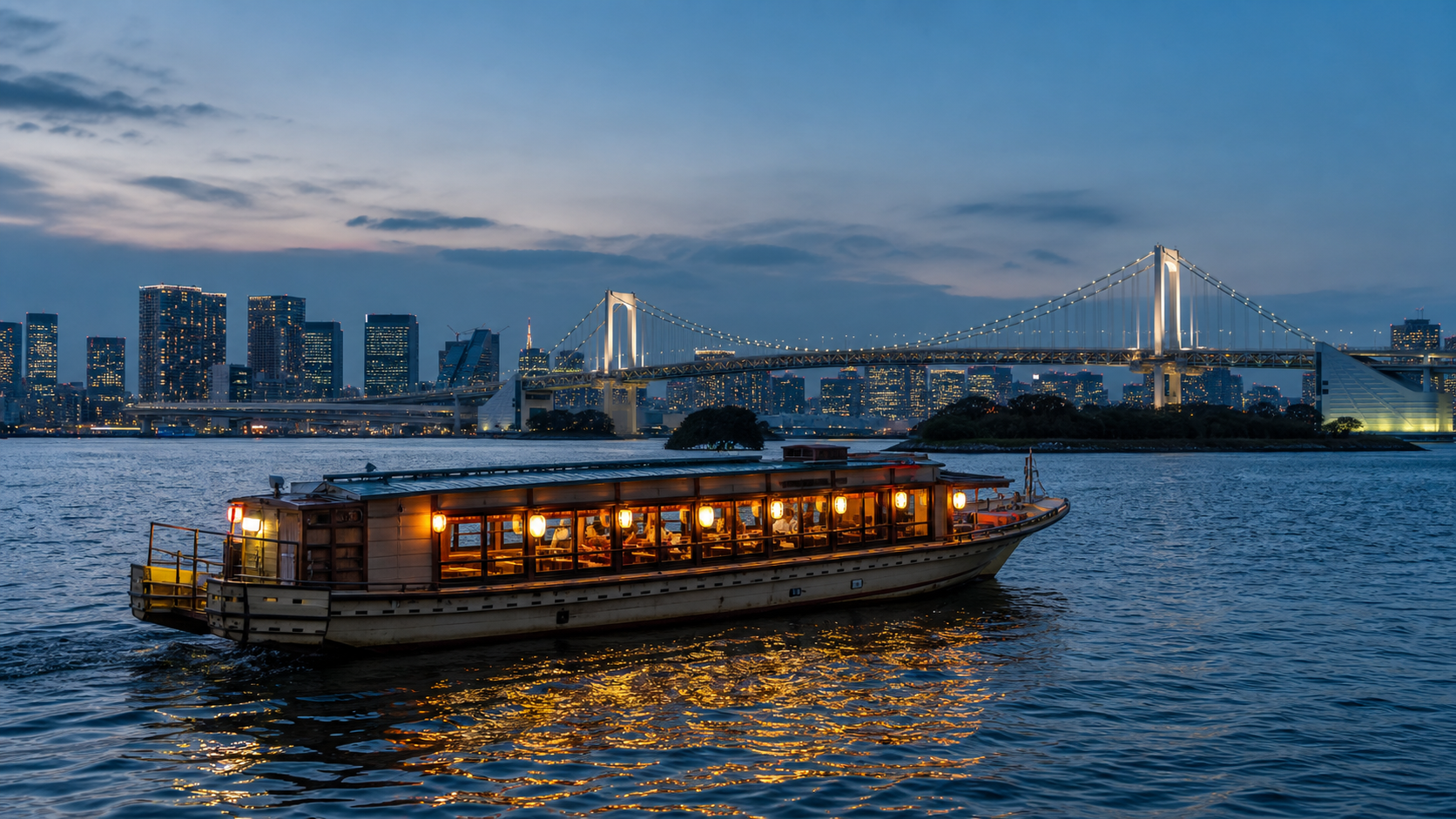
A yakatabune dinner cruise can combine three Tokyo experiences in one evening: a meal on a traditional-style boat, drinks such as Japanese sake, and close-up views of the illuminated waterfront. The difficult part is choosing the right boat. A classic yakatabune commonly serves Japanese dishes such as sashimi and tempura, while a specialist “monja boat” may let you cook monjayaki at your table. They are not the same product.
This guide explains the difference, what published plans include, how to judge the night-view route, and what to confirm about shoes, seating, toilets, weather, dietary needs, and the journey back to your hotel.
- Quick answer
- What is a yakatabune?
- Standard yakatabune or monja boat?
- Monja, Japanese sake, and drink plans
- How to choose a good Tokyo night-view route
- Shared cruise or private charter?
- How much does a Tokyo yakatabune cost?
- How to book: a foreign-traveler checklist
- Shoes, seating, toilets, deck access, and motion
- Rain, wind, dietary needs, and the trip home
- Five-minute booking checklist
- FAQ
- Do Tokyo yakatabune cruises generally serve monja?
- Is Japanese sake included in a yakatabune cruise?
- How much does a Tokyo yakatabune cost in 2026?
- Can a couple or solo traveler book a yakatabune?
- Do you have to remove your shoes on a yakatabune?
- Do yakatabune cruises operate when it rains?
- Can I expect an outside observation deck?
- Can yakatabune operators accommodate dietary restrictions?
- Official sources
- Tokyo yakatabune photo guide
Quick answer
Choose the cruise by your priority:
Your priority: A traditional Japanese dinner / Best starting point: A standard shared yakatabune cruise / Check before paying: Menu, seating style, drink list, and route
Your priority: Monja with friends / Best starting point: A specialist monja/teppan yakatabune / Check before paying: Who cooks, language support, and whether there is an open deck
Your priority: Sake / Best starting point: A plan that names sake in its drink list / Check before paying: Brand, serving format, and whether it is included
Your priority: Tokyo night views / Best starting point: An evening departure with a clearly published route / Check before paying: Landmarks, deck access, window visibility, and route-change rules
Your priority: A small group / Best starting point: A shared cruise / Check before paying: Minimum passenger rules and assigned seating
Your priority: A private event / Best starting point: A charter / Check before paying: Minimum guarantee, capacity, and cancellation charges
Useful benchmark: the Tokyo Yakatabune Association’s English guide lists dinner cruises from ¥12,000 per adult, while its current Japanese guidance describes about ¥13,000 as a common standard. A specialist monja operator can be less expensive; Edomae Kisen currently lists ¥7,900 daytime/afternoon and ¥8,900 evening for adults. Prices and inclusions vary, so treat these as comparison points rather than a universal fare.
Information and example prices checked July 14, 2026. Operators may change menus, routes, timetables, and rules. Recheck the official booking page before travel.
What is a yakatabune?
A yakatabune is a Japanese pleasure boat with an enclosed dining room. Modern Tokyo boats preserve the atmosphere of a traditional banquet while adding practical facilities such as air conditioning and flush toilets. Many cruises travel for about two to two and a half hours, serve a set meal, and include a drink package.
The word describes a broad category, not one standardized experience. The menu may be a multi-course Japanese meal, sushi, tempura, or food cooked on a hot plate. Routes may focus on Odaiba and Rainbow Bridge, Tokyo Skytree and the Sumida River, or another part of Tokyo Bay. Some boats have an outside observation deck; others do not.
That is why “Book a yakatabune” is not enough of a plan. First decide whether the food, the atmosphere, the view, or private use matters most.
Standard yakatabune or monja boat?
The most important choice is between a classic dinner cruise and a specialist monja format.
Standard Japanese dinner cruise
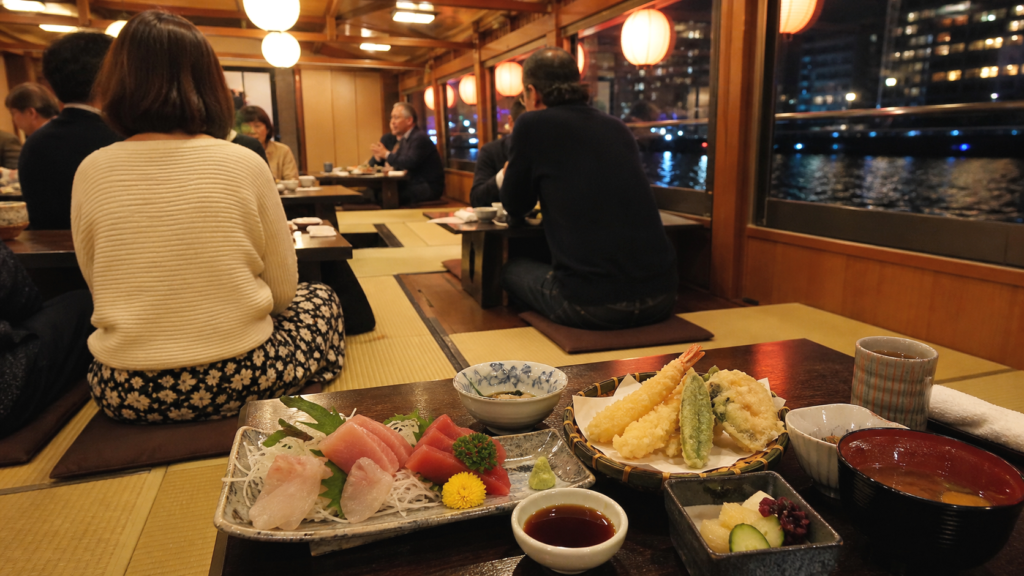
The Tokyo Yakatabune Association describes typical food as Japanese cuisine featuring sashimi and freshly cooked tempura. Exact dishes and drinks depend on the operator. This is the better fit if you want a calm banquet atmosphere, a broader introduction to Japanese food, or a meal served course by course.
Specialist monja cruise
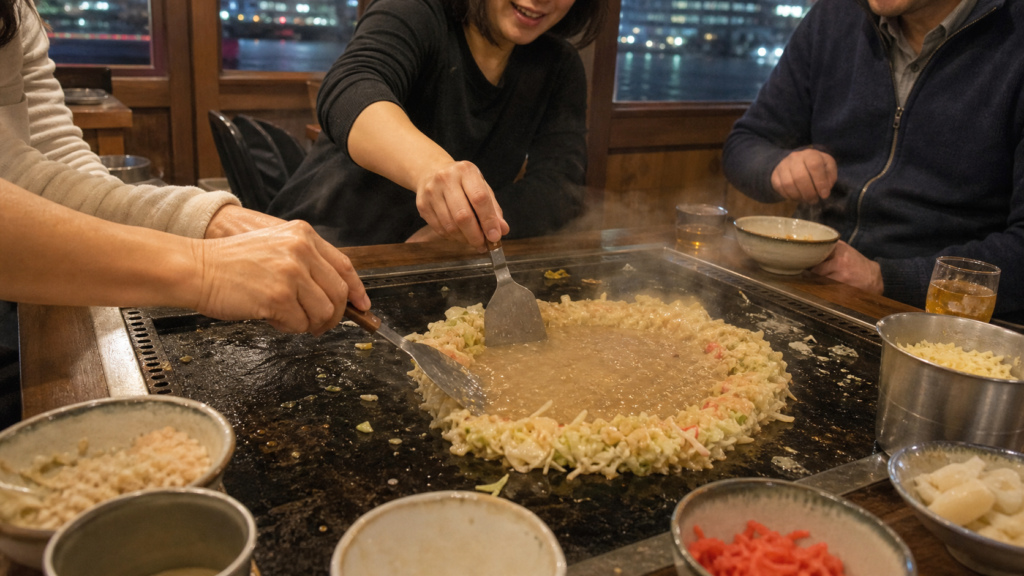
On a monja boat, the hot plate is part of the entertainment. Edomae Kisen’s official English guide currently advertises unlimited monjayaki, okonomiyaki, yakisoba, and other teppan dishes with drinks included. Its FAQ says guests normally cook the monja themselves, with staff available to explain and help.
This can be lively and memorable for a group, but it is a different mood from a formal Japanese dinner. Hot plates also mean heat, cooking aromas, and active participation at the table. If monja is new to you, see our Tokyo okonomiyaki and monjayaki guide before deciding.
Difference: Main food / Standard dinner boat: Sashimi, tempura, and other Japanese dishes / Specialist monja boat: Monja, okonomiyaki, yakisoba, teppan dishes
Difference: Cooking / Standard dinner boat: Mainly prepared and served by staff / Specialist monja boat: Guests may cook at the table
Difference: Atmosphere / Standard dinner boat: Banquet-style and relatively relaxed / Specialist monja boat: Casual, social, and hands-on
Difference: View access / Standard dinner boat: Some boats have an outside deck / Specialist monja boat: Do not assume a deck; Edomae Kisen states that its boats have no observation deck
Difference: Best for / Standard dinner boat: First-time traditional experience, couples, mixed-age groups / Specialist monja boat: Friends, repeat visitors, casual groups
Decision rule: if monja is essential, choose a boat that explicitly sells a monja plan. Do not book a generic yakatabune and expect monja to appear.
Monja, Japanese sake, and drink plans
What eating monja on board is like
Monjayaki is a loose, savory batter cooked on a tabletop iron plate. The group mixes the ingredients, builds a ring with the solid ingredients, pours the liquid into the center, and eats the cooked mixture directly from the hot plate with small spatulas. Staff instructions matter, especially for first-time visitors.
Before booking, check four points:
- Is monja included, or limited to a particular plan?
- Do guests cook it, and can staff explain the process in a language you understand?
- Is the meal unlimited, set-menu, or à la carte?
- Can the operator handle allergies when the same hot plate and shared ingredients are used?
Edomae Kisen says its menus are available in English, Chinese, and Korean, and asks guests with allergies to contact the company in advance. It also warns that some stock and extract ingredients cannot be changed. “We can note the allergy” does not necessarily mean “the kitchen can guarantee complete avoidance.”
Is sake included?
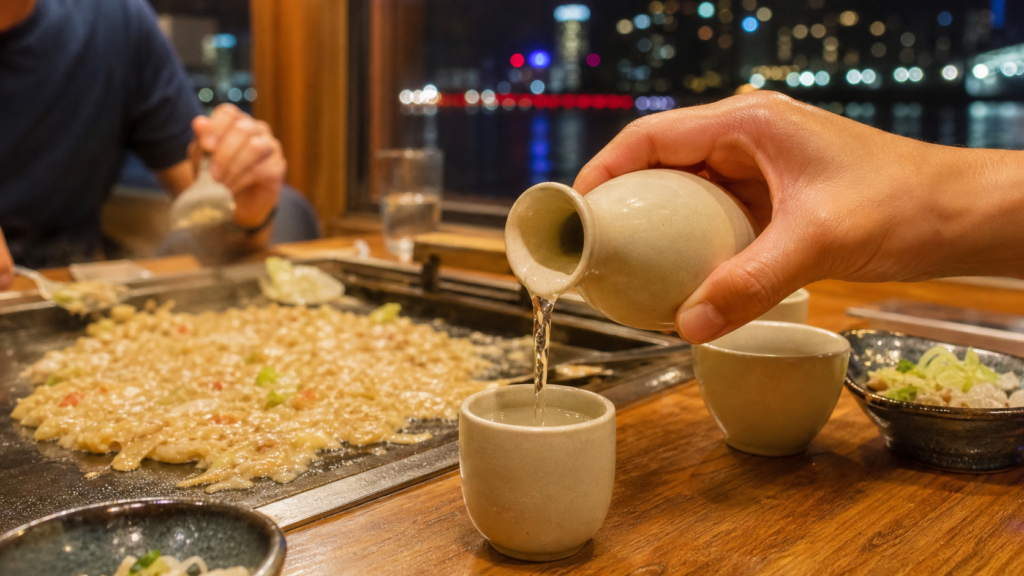
Package contents differ. The association says alcohol and soft-drink selections vary by boat. Edomae Kisen’s current English page specifically names Hakushika One Cup, a Japanese sake, in its drink lineup.
If sake is important, ask the operator:
- Is Japanese sake included in the base price?
- Is it served chilled, at room temperature, warm, or in a single format?
- Is there one label or a choice of labels?
- Can it be ordered throughout the cruise, and when is the final drink order?
- Are non-alcoholic drinks included for guests who do not drink?
The safest booking decision comes from the current drink list, not from a photo or an old review.
How to choose a good Tokyo night-view route
The words “Tokyo night cruise” do not guarantee the same skyline. Look for a route map or named landmarks on the official page.
Common highlights include:
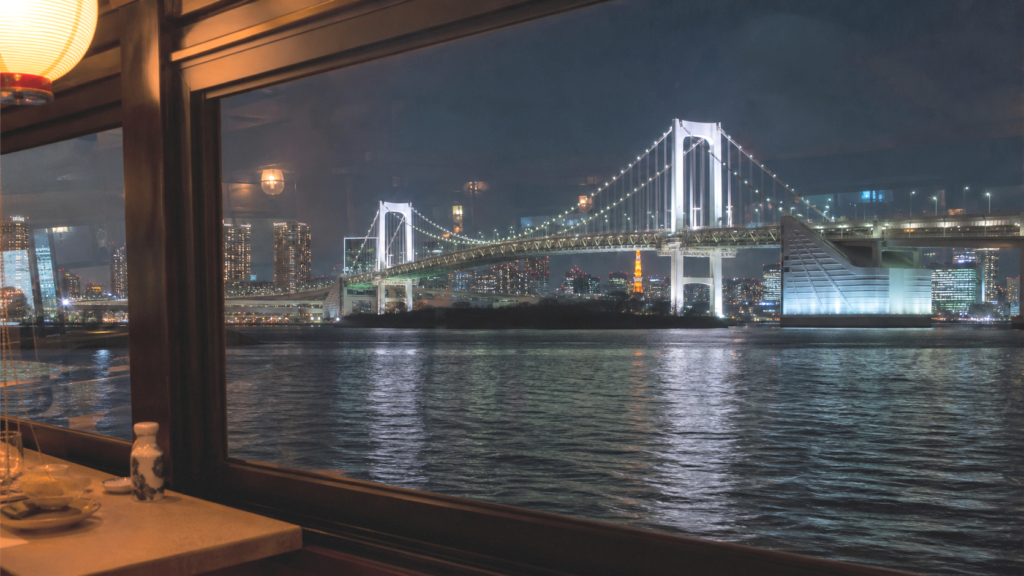
- Odaiba and Rainbow Bridge: broad bay views, illuminated bridge structure, and a recognizable modern Tokyo skyline.
- Sumida River and Tokyo Skytree: river bridges, waterside neighborhoods, and the tower rising above eastern Tokyo.
- Toyosu and the bay area: newer waterfront architecture and open views between central Tokyo and Odaiba.
Edomae Kisen’s Odaiba route, for example, passes the Toyosu area and Rainbow Bridge and approaches the Fuji Television building. Standard association boats may offer Odaiba or Skytree-focused routes. However, wind, tide, traffic, events, and operating conditions can cause a route or stopping point to change.
Window view or outside deck?
This question changes the experience more than many travelers expect.
- An outside deck gives clearer photographs and a more open sense of the skyline, but access can be restricted by weather or safety conditions.
- A window view is warmer and easier during dinner, but reflections, condensation, seating position, and other guests may affect photographs.
Do not infer deck access from the word “yakatabune.” The association notes that facilities differ among boats, and Edomae Kisen specifically says its boats do not have an observation deck. If skyline photography is your main goal, request the exact boat name and confirm where passengers may stand.
For a view-first evening without dinner-cruise variables, compare our Tokyo observation decks guide.
Shared cruise or private charter?
Shared cruise
A shared cruise is the practical choice for a couple, family, or small group. You book seats on a scheduled departure with other parties. The Tokyo Yakatabune Association lists shared cruises of roughly two to two and a half hours, generally with a Japanese meal and drinks.
Confirm:
- the minimum number of guests accepted per reservation;
- whether the departure itself requires a minimum total passenger count;
- whether seating is at a shared table, a separate table, or assigned by the operator;
- the meeting point and check-in deadline;
- whether the quoted price includes food, drinks, service, and tax.
Some departures can be canceled if the operator does not reach its required number of passengers. This is different from you canceling your reservation, so read both rules.
Private charter
A charter gives your group private use of the boat and more control over the event. The association describes boats for about 20 to 120 people, but the commercial minimum may be a passenger count or minimum contracted charge rather than the physical capacity.
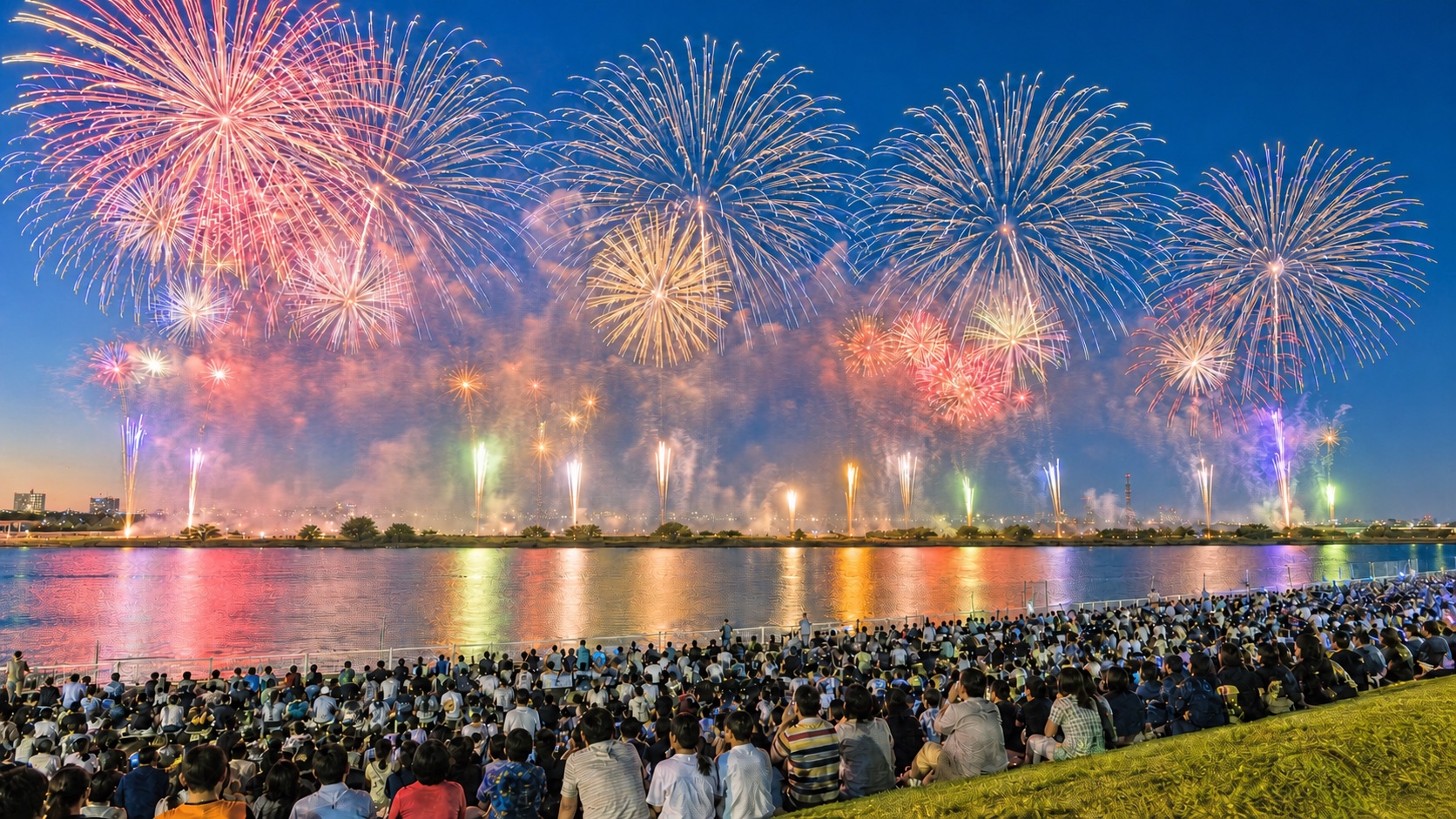
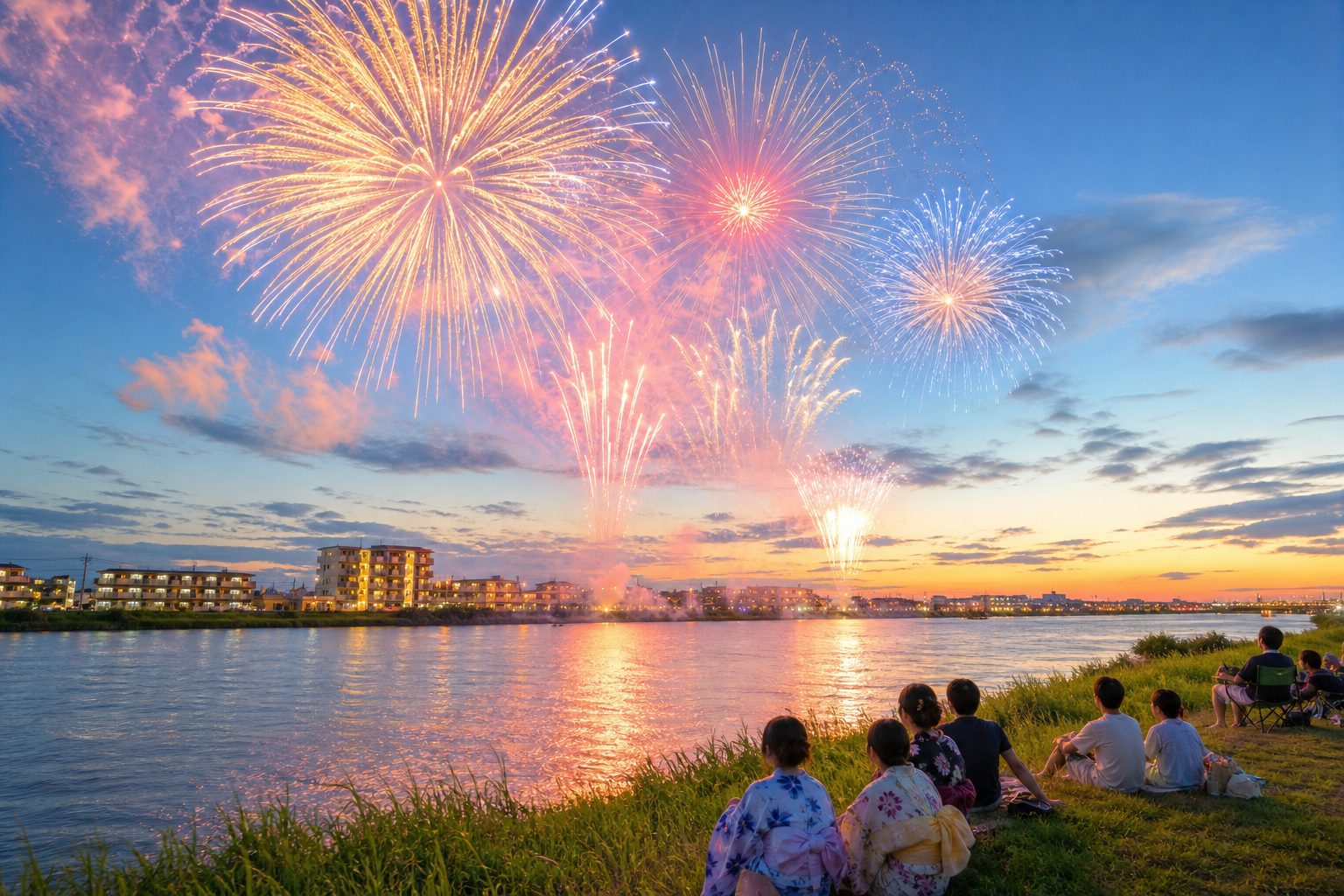
Ask for a written quote covering the date, boat, route, duration, meal, drinks, equipment, minimum guarantee, overtime, and cancellation schedule. Fireworks dates and other peak events can cost several times more than a normal cruise and may use special terms.
How much does a Tokyo yakatabune cost?
Use the total experience—not the headline fare—to compare plans.
Example checked July 2026: Association dinner benchmark / Adult price: From ¥12,000; about ¥13,000 commonly described in current Japanese guidance / Typical inclusion shown by operator: Around 2–2.5 hours, Japanese meal, drink plan; details vary
Example checked July 2026: Edomae Kisen daytime/afternoon / Adult price: ¥7,900 / Typical inclusion shown by operator: Around 2 hours, monja and teppan food, drinks
Example checked July 2026: Edomae Kisen evening / Adult price: ¥8,900 / Typical inclusion shown by operator: Around 2 hours, monja and teppan food, drinks, evening route
Potential extra costs include transport to the pier, optional premium drinks, special menus, event-date pricing, and a taxi if you miss your last train. Children’s prices and age bands vary. A low headline price is not automatically better if the departure point is inconvenient or the view format does not match your priority.
Cancellation terms can differ sharply
The association’s English booking service currently shows one schedule for its shared cruises, while individual operators publish their own rules. Edomae Kisen, for example, currently applies different timing and percentages from the association service. Weather cancellation by the operator may be refundable, while your own late cancellation can be charged at 100%.
Save the terms displayed for your exact reservation. Check:
- the time zone and deadline used for cancellation;
- whether a passenger-number reduction is treated as a partial cancellation;
- what happens if the operator changes the route;
- what is refunded if the operator cancels before departure;
- whether your transport or hotel costs are excluded from compensation.
How to book: a foreign-traveler checklist
Step 1: Choose the experience before the date
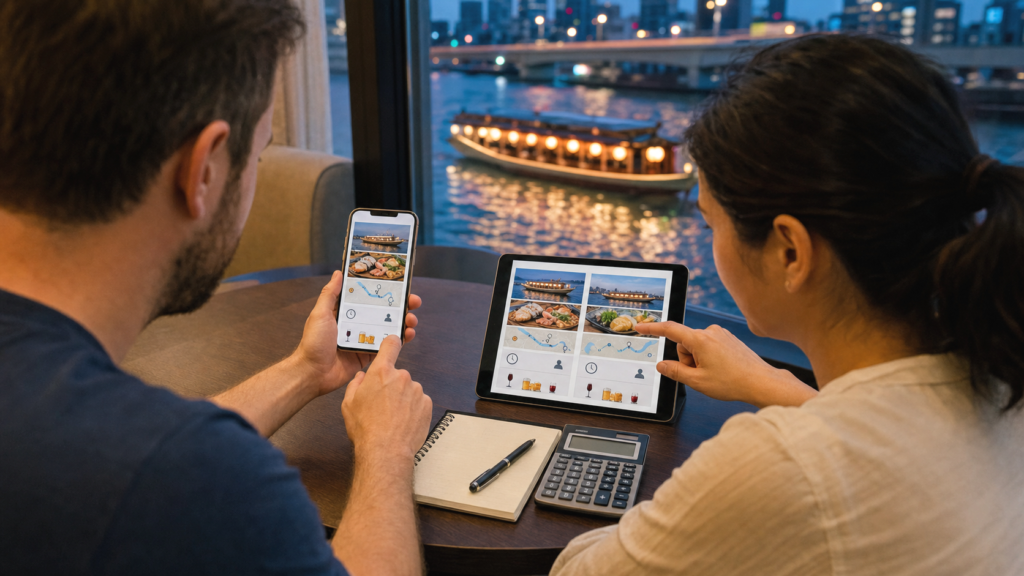
Write one sentence: “We want a traditional dinner,” “We want to cook monja,” or “The night view is most important.” This prevents a beautiful-looking listing from overriding your real priority.
Step 2: Open the operator’s official plan page
Check the route, duration, menu, drink list, deck, seating, toilets, departure point, and operating language. If a reseller description conflicts with the operator, ask the operator before paying.
Step 3: Confirm availability and minimum-passenger rules
For an association boat, the English reservation form accepts shared-cruise and charter inquiries and uses email for contact. A Japanese telephone number is not required on that form. Edomae Kisen also provides an English TableCheck reservation page.
Step 4: Disclose practical needs before payment
Tell the operator about allergies, mobility limitations, children, pregnancy, or anything that affects safe boarding and seating. Ask questions rather than assuming that a request can be accommodated.
Step 5: Save the confirmation and pier instructions
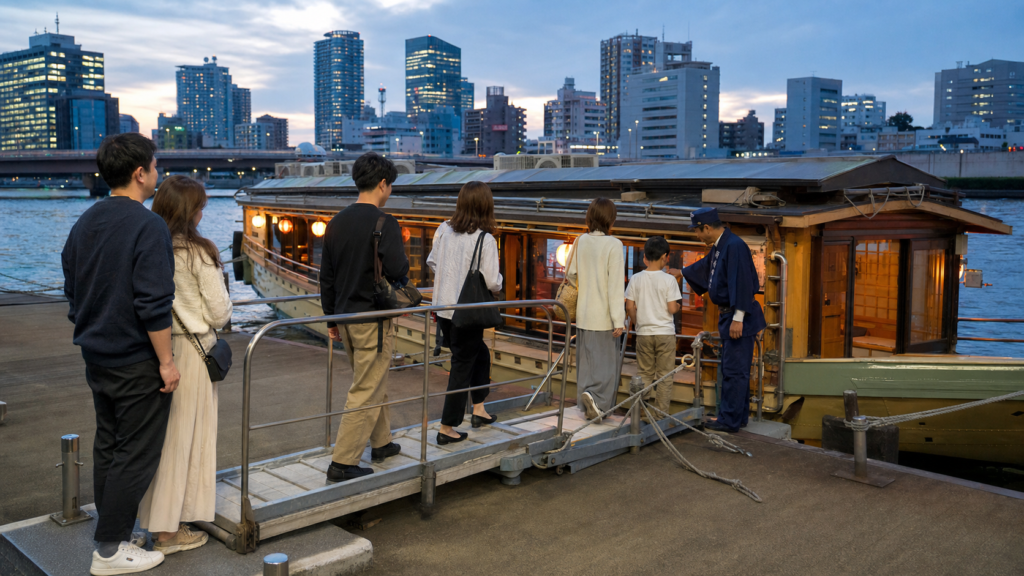
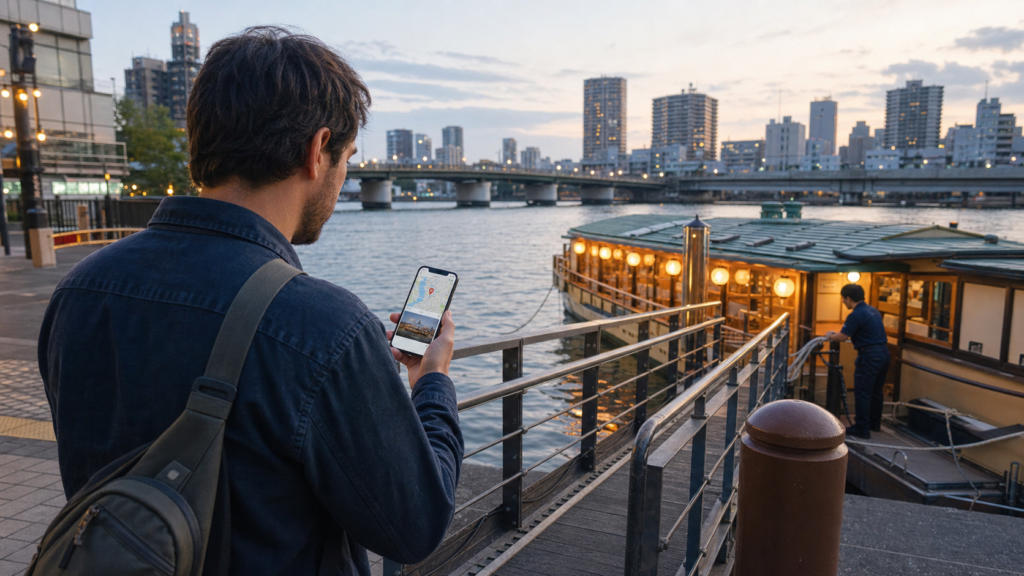
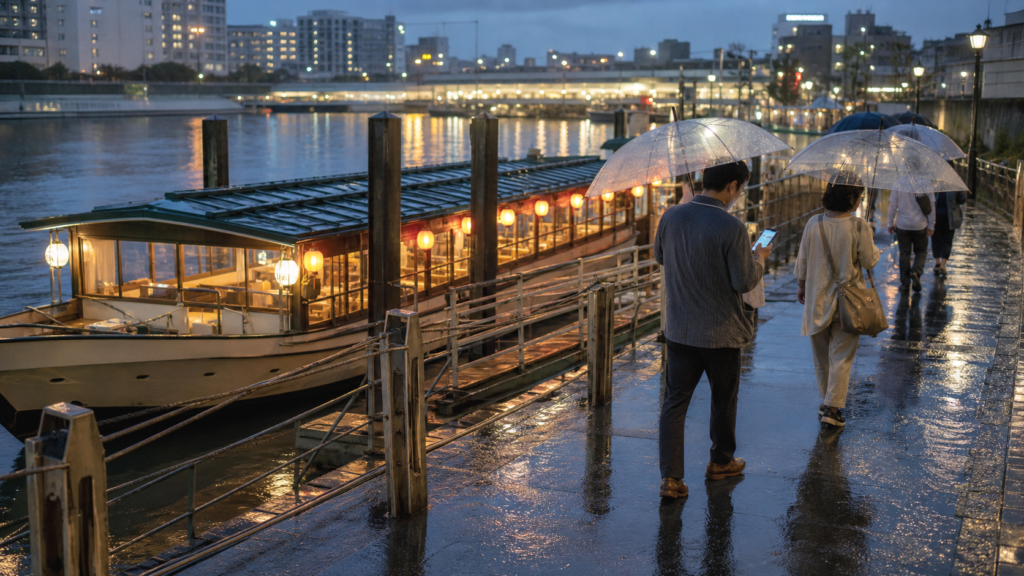
“Tokyo Bay” is not a meeting point. Save the exact pier or shuttle location, check-in time, emergency contact, route from your hotel, and cancellation terms. Some monja cruises use a shuttle from Shin-Kiba Station; other boats depart from different riverside piers.
Step 6: Recheck the day before
Review the weather notice, operating status, meeting point, and last train. Keep enough time for station transfers and unfamiliar streets. Our Tokyo restaurant reservation guide explains general Japanese booking etiquette and late-arrival risks.
Shoes, seating, toilets, deck access, and motion
Do you remove your shoes?
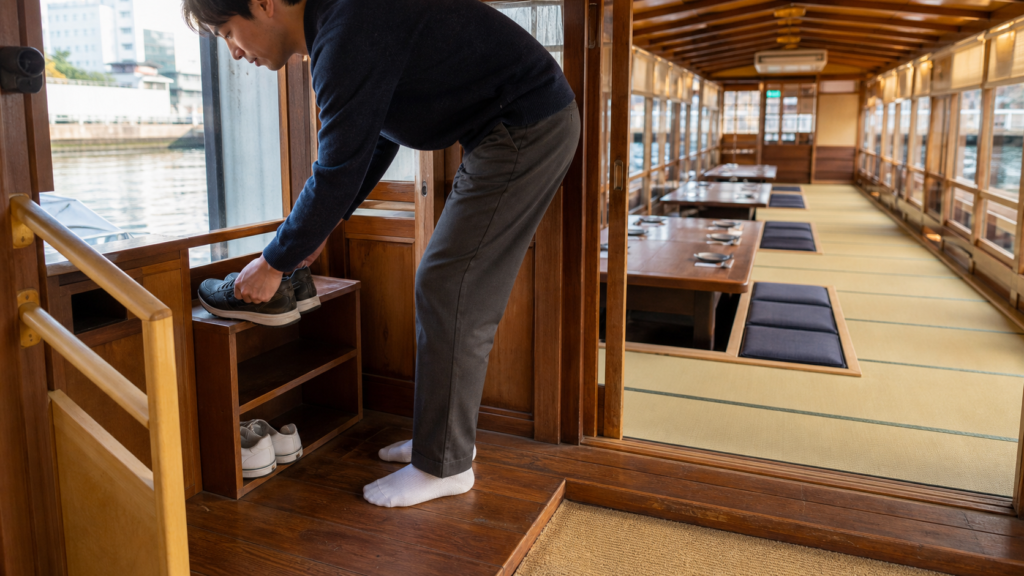
Often, yes. The association says shoes are normally removed before entering the tatami dining room and stored in shoe shelves. Wear clean socks that are easy to walk in. Do not assume that a western-style interior means shoes remain on.
Is the seating on the floor?
Traditional appearance does not necessarily mean kneeling. Many modern boats use horigotatsu-style recessed leg space, while some have chairs or other arrangements. Ask about the exact boat if a guest has knee, hip, back, or mobility concerns. Also ask about the gangway, steps, toilet access, and whether crew assistance is available; “chair seating” alone does not prove step-free access.
Are there toilets and air conditioning?
Association guidance says member boats generally have at least two flush toilets and air conditioning, but facilities differ. Confirm the exact boat if this is essential.
What if you are prone to motion sickness?
Tokyo’s rivers and inner bay can be calmer than open sea, but the association notes that some rocking is possible. Eat and drink moderately, look toward a stable horizon when possible, and ask the operator where movement tends to be less noticeable. If you use motion-sickness medicine, follow its label and ask a pharmacist or doctor about personal suitability rather than relying on travel-blog advice.
Bring a light outer layer. Even on a warm day, an outside deck can feel cool and windy after sunset.
Rain, wind, dietary needs, and the trip home
Does a yakatabune operate in rain?
Rain alone does not necessarily stop an enclosed boat. The association says cruises may operate in rain or wind, while a typhoon or unsafe conditions can lead to cancellation. The operator may also change the course for safety. This is an operational decision, not a promise based on the general forecast.
For a wet-weather day, read our Japan rain and typhoon plan, then check the operator’s own notice.
Vegetarian, halal, allergies, and other diets
Contact the operator before booking with the ingredients you cannot eat. Japanese stock may contain fish, meat, soy, wheat, or other ingredients that are not obvious from the finished dish. Shared kitchens, fryers, grills, and tabletop plates can also create cross-contact.
Ask for a concrete answer:
- Can the meal be changed, or can certain items simply be removed?
- Does the stock or sauce contain restricted ingredients?
- Is cross-contact possible on the grill or in the kitchen?
- Can you bring approved food if no suitable meal is available?
- Will the full plan price still apply?
Do not interpret “vegetable dish available” as a guarantee of vegetarian preparation, and do not interpret “no pork” as halal certification.
Plan the return before boarding
Evening cruises end at a fixed pier or shuttle stop, not at your hotel. Confirm the scheduled return time, walking route to the station, final shuttle, and last train on your actual travel date. Build in a delay buffer and keep a taxi fallback. Use our Tokyo last train and taxi plan to prepare the backup.
Five-minute booking checklist
Before you pay, confirm each point:
- [ ] Standard Japanese dinner or specialist monja cruise?
- [ ] Shared departure or private charter?
- [ ] Exact date, check-in time, cruise duration, and return time?
- [ ] Exact pier or shuttle point—not just the general area?
- [ ] Route and likely night-view landmarks?
- [ ] Outside deck, window-based view, or restricted deck access?
- [ ] Menu, guest cooking, allergy limits, and dietary response in writing?
- [ ] Sake and non-alcoholic drinks explicitly included?
- [ ] Shoes, seating, steps, toilets, and mobility needs confirmed?
- [ ] Minimum-passenger and departure-cancellation rules understood?
- [ ] Your cancellation fees and the operator’s weather policy saved?
- [ ] Last train checked and taxi fallback prepared?
If the operator cannot confirm your non-negotiable point, choose a different plan. The best yakatabune is not the one with the longest inclusion list; it is the one whose food, view, access, and rules match your group.
FAQ
Do Tokyo yakatabune cruises generally serve monja?
No. Many standard yakatabune serve Japanese dishes such as sashimi and tempura. Choose a specialist monja plan if cooking and eating monjayaki is essential.
Is Japanese sake included in a yakatabune cruise?
It depends on the operator and plan. Some drink packages include sake, while others have a different selection. Confirm the current drink list; Edomae Kisen currently names Hakushika One Cup in its lineup.
How much does a Tokyo yakatabune cost in 2026?
The Tokyo Yakatabune Association lists standard dinner cruises from ¥12,000 per adult and currently describes about ¥13,000 as common in Japanese guidance. Edomae Kisen lists ¥7,900 for daytime/afternoon monja cruises and ¥8,900 for evening cruises. Recheck the date and inclusions before booking.
Can a couple or solo traveler book a yakatabune?
Couples and small groups can use shared cruises, subject to each plan’s minimum booking and departure rules. Solo acceptance varies, so check the official booking page or ask the operator.
Do you have to remove your shoes on a yakatabune?
Often, yes. Traditional dining rooms commonly require shoes to be removed. The exact interior and seating differ by boat, so wear clean socks and confirm accessibility needs in advance.
Do yakatabune cruises operate when it rains?
They may operate in ordinary rain because the dining room is enclosed. Typhoons, strong wind, or unsafe conditions can cause cancellation or a route change. Follow the operator’s notice for your departure.
Can I expect an outside observation deck?
No. Some boats have a deck, but access can depend on the vessel and weather. Some operators, including Edomae Kisen, state that their boats do not have an observation deck.
Can yakatabune operators accommodate dietary restrictions?
Sometimes, but the response depends on the menu, stock, shared cooking equipment, and operator. Contact the company before booking, list the exact ingredients you avoid, and ask what can and cannot be changed.
Official sources
- Tokyo Yakatabune Association: guide
- Tokyo Yakatabune Association: plans
- Tokyo Yakatabune Association: FAQ
- Tokyo Yakatabune Association: English reservation form and terms
- GO TOKYO: Yakatabune Boat Cruises
- Edomae Kisen: English plan guide
- Edomae Kisen: route
- Edomae Kisen: FAQ
- Edomae Kisen: terms
Tokyo yakatabune photo guide
Official planning source: Tokyo Yakatabune Association English guide
Comments