- Quick Answer: Confirm the Fuel and Return Rule at Pickup
- The Three Fuel Types and Nozzle Colors in Japan
- Self-Service and Full-Service Gas Stations
- How to Use a Self-Service Pump Safely
- How to Ask for a Full Tank at a Staffed Station
- Payment and Receipt Checks
- Rental-Car Return Rules Are Not Universal
- If You Choose the Wrong Fuel
- Pickup-to-Return Checklist
- Plan B When the Pump or Fuel Type Is Unclear
- Frequently Asked Questions
- Which fuel should I put in a rental car in Japan?
- What do the red, yellow and green nozzles mean in Japan?
- Are all gas stations in Japan self-service?
- How do I ask for a full tank at a staffed gas station?
- Do Japanese gas stations accept foreign credit cards?
- Must every rental car be returned with a full tank?
- Should I keep the fuel receipt when returning a rental car?
- What should I do if I put in the wrong fuel?
- Official Sources Checked
Quick Answer: Confirm the Fuel and Return Rule at Pickup
Before leaving the rental counter, ask staff to confirm the exact fuel for that vehicle and record it on your phone or rental papers. Japan's three common pump choices are regular gasoline (レギュラー, usually red), high-octane gasoline (ハイオク, yellow), and diesel (軽油, green). Do not choose from the car's size or from what most rental cars use.
Also ask the exact return branch whether you must return full, how close the final gas station must be, and whether it wants the receipt. These are contract conditions, not one universal Japan rule. Nippon Rent-A-Car, for example, currently tells its customers to refuel at the nearest station to the return location, return with a full tank, and present the receipt. Other providers or plans may differ.
For a self-service pump: park, turn off the engine, select the confirmed fuel, touch the anti-static pad, insert the nozzle securely, stop when the pump stops automatically, return the nozzle, and collect the receipt. If anything is unclear, do not guess—ask the station attendant or call the rental branch.
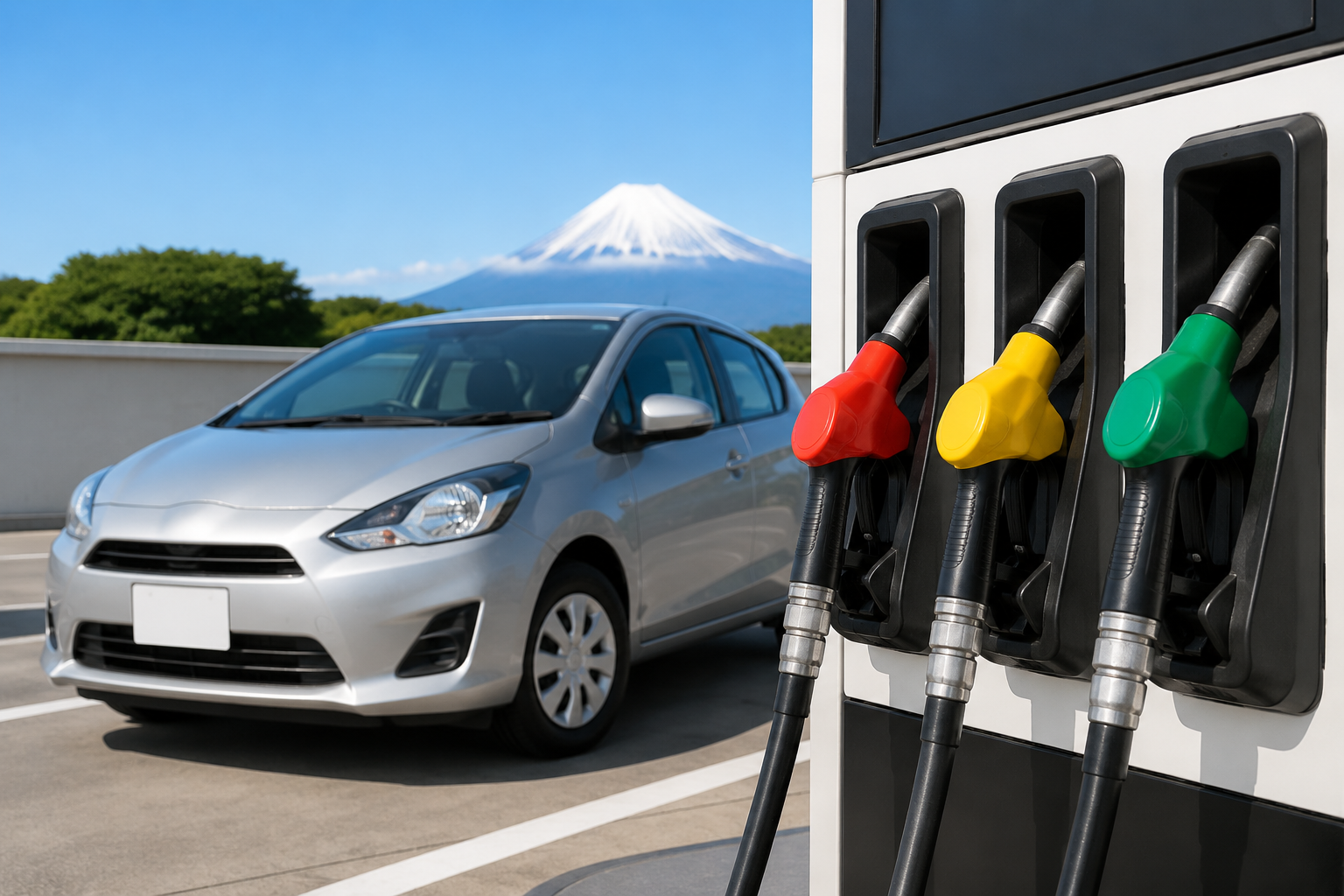
AI-generated illustration: a generic rental car beside an illustrative self-service pump with red, yellow and green nozzles; not a photograph of a specific station.
The Three Fuel Types and Nozzle Colors in Japan
Official Japanese guidance uses this color convention:
| Fuel | Japanese pump label | Usual nozzle color | Use it when |
|---|---|---|---|
| Regular gasoline | レギュラー | Red | The rental branch confirms regular gasoline for this vehicle |
| High-octane gasoline | ハイオク | Yellow | The rental branch or vehicle instruction confirms high-octane gasoline |
| Diesel | 軽油 | Green | The rental branch confirms that the vehicle has a diesel engine |
The color is a cross-check, not permission to guess. Read the live fuel label and use the fuel confirmed for your exact vehicle. JAF specifically warns that the correct fuel has nothing to do with the size or apparent type of the vehicle—an important point when you are driving an unfamiliar rental car.
At pickup, save three facts together:
- The exact fuel type.
- The return branch's full-tank and receipt rule.
- One suitable station near the return point.
That small record is the article's decision anchor: it prevents the most expensive guess at the pump and the most common proof problem at return.
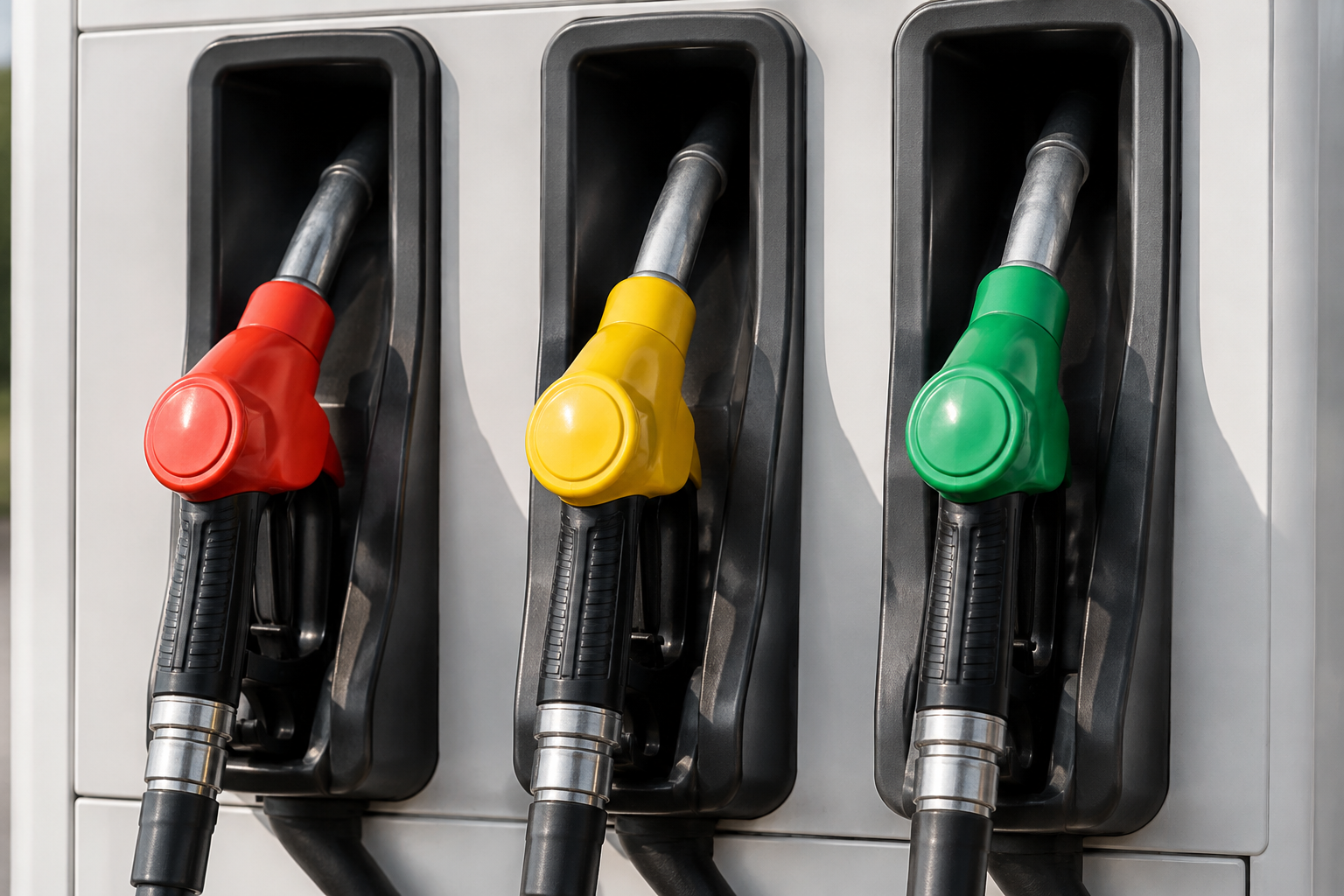
AI-generated illustration: three unbranded fuel nozzles in the standard red, yellow and green colors; confirm the live label and rental instruction.
Self-Service and Full-Service Gas Stations
Japan has both self-service and full-service gas stations. JAF says self-service entrances commonly show セルフ or セルフサービス. At a self-service station, you operate the pump. At a full-service station, an attendant fills the vehicle after you state the fuel and amount.
Choose full service when you are unsure about a Japanese-only screen, the fuel-door release, or the payment flow. Choose self-service only when you can positively match the vehicle's confirmed fuel to the live pump label.
| Situation | Better first choice | Why |
|---|---|---|
| Fuel confirmed and pump process clear | Self-service | You can follow the safety sequence without delegating the fuel decision |
| Screen or pump labels unclear | Ask the attendant or use full service | Guessing the button or nozzle risks the wrong fuel |
| Returning soon and receipt is required | Either, after confirming receipt availability | The contract proof matters more than service type |
| Card acceptance uncertain | Ask before fueling and carry yen | Toyota's guide notes that some stations may be cash-only |
How to Use a Self-Service Pump Safely
The controls vary by station, but the official safety sequence is consistent:
- Look for the self-service sign and use only a pump intended for customer use.
- Pull up with the vehicle's fuel-filler side next to the pump.
- Put the vehicle in park, switch off the ignition, and close the windows and doors.
- Select the payment method, confirmed fuel type, and fill amount on the live screen.
- Touch the anti-static pad before opening the fuel cap.
- Match the pump label and nozzle color to the fuel you recorded at pickup.
- Insert the nozzle securely and squeeze the trigger.
- Let the pump stop automatically; do not force more fuel into the tank.
- Return the nozzle, close the fuel cap, and collect the receipt and any change.
Smoking and lighter use are prohibited near the pump. Keep children away from the filler area, and do not fill a separate container yourself. If the automatic stop activates almost immediately or the pump will not start, ask the attendant instead of repeatedly forcing the trigger.
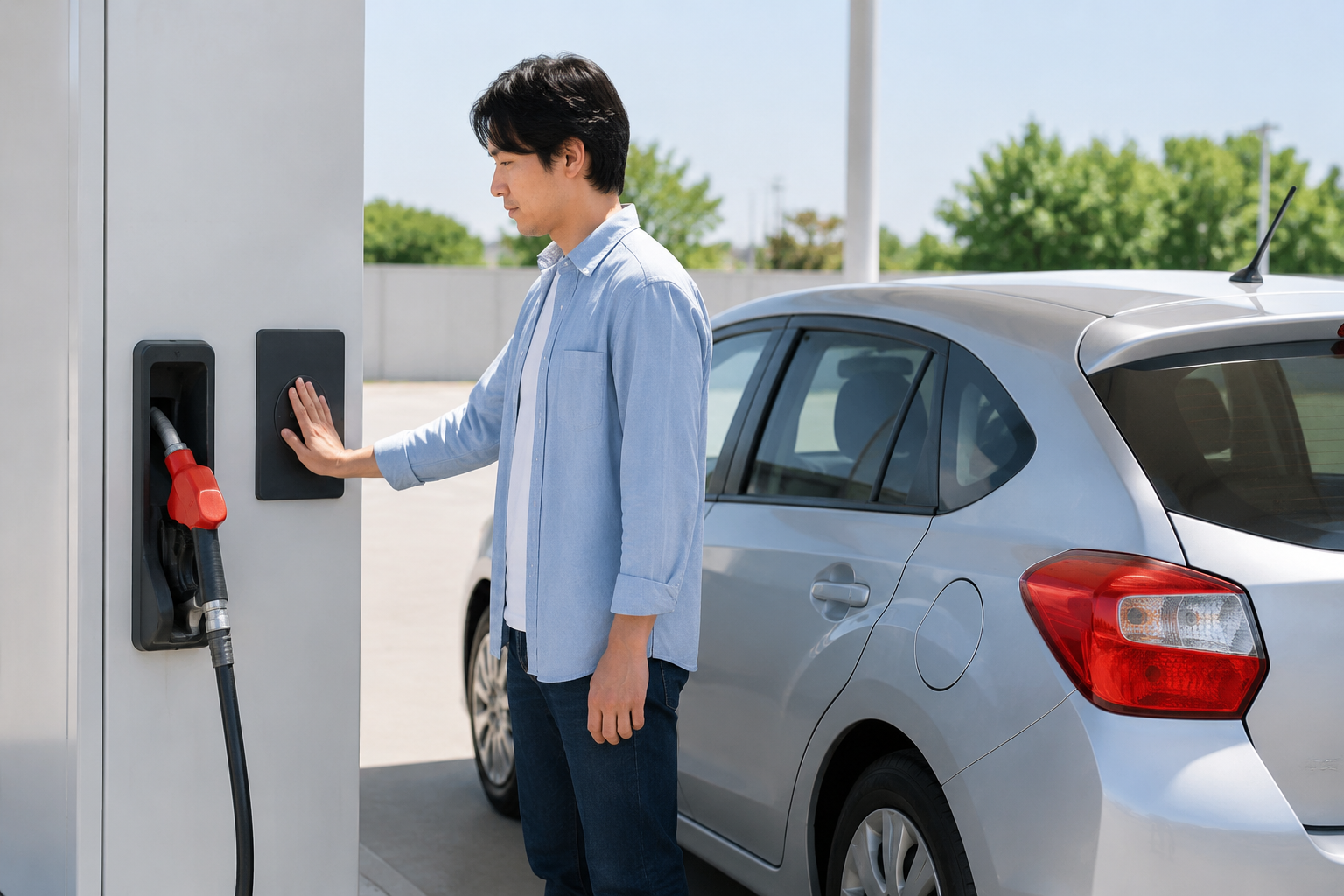
AI-generated illustration: a stationary rental car at a generic self-service pump with the driver touching a blank anti-static pad.
How to Ask for a Full Tank at a Staffed Station
At a full-service station, stop with the fuel door next to the pump and turn off the engine. State the fuel confirmed by the rental branch, then say mantan for a full tank.
Toyota Rent a Car gives this example for a regular-gasoline vehicle:
Regular, mantan.
Use that phrase only after confirming regular gasoline for your vehicle. If the vehicle requires high-octane or diesel, say that fuel instead. Show the recorded fuel type on the rental document if pronunciation is difficult.
Before fueling, also confirm how you can pay. Some stations may accept cash but not a credit card, and card acceptance should not be assumed from the fact that the rental counter accepted your card.
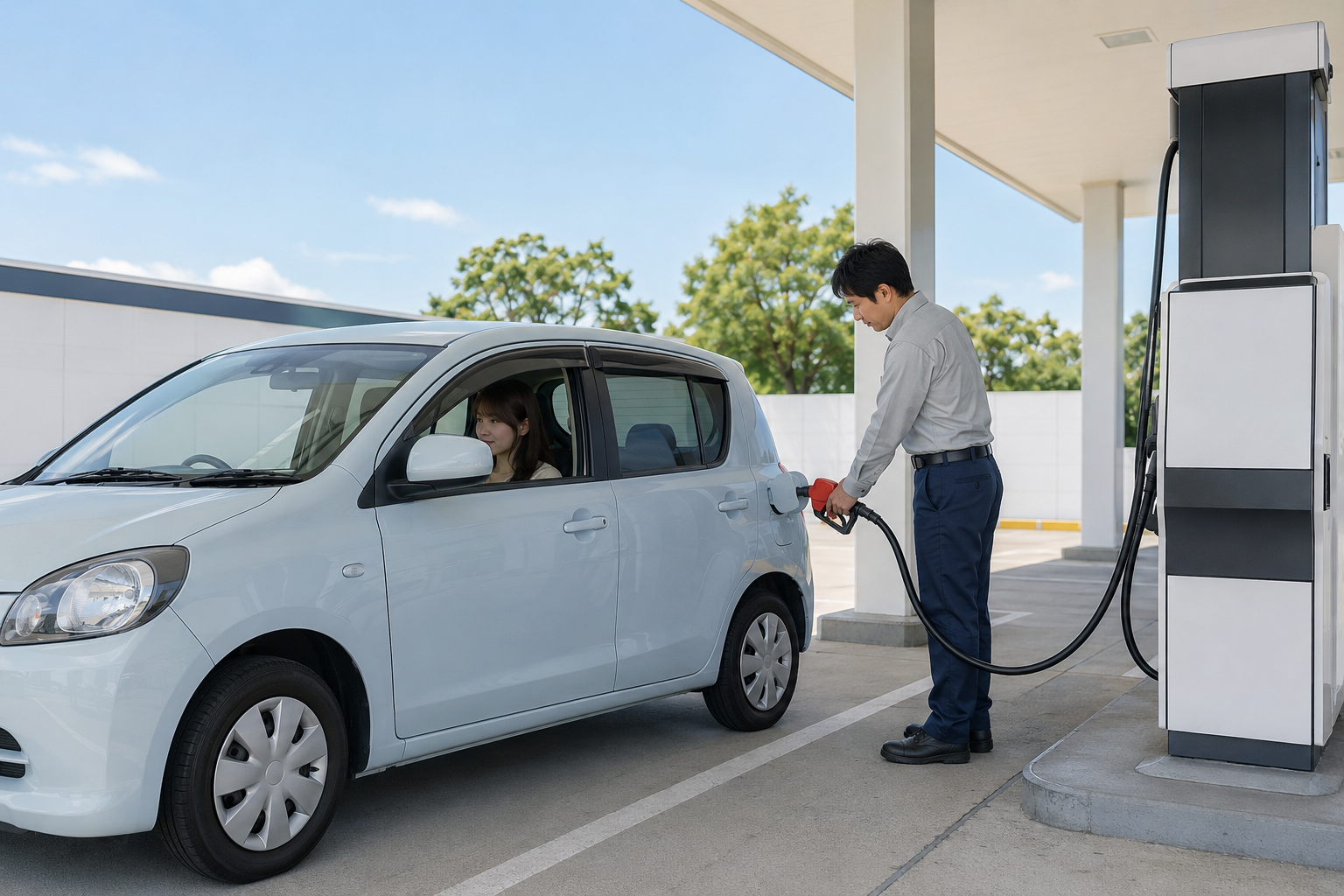
AI-generated illustration: a generic staffed gas station with an attendant refueling a parked, unbranded rental car.
Payment and Receipt Checks
At self-service stations, the screen may ask for the payment method before the fuel type and amount. Toyota's official guide shows cash and credit-card flows, but also warns that some stations may restrict payment to cash. Carry enough Japanese yen for the planned fill and do not rely on one foreign card or a phone wallet as your sole option.
Keep the receipt even if the rental company has not clearly requested it. It can record where and when the final fill happened, but a receipt does not override the rental contract. If the receipt requirement is unclear, call the exact return branch before the final fuel stop.
Do not freeze an old fuel price into your return budget. Fuel prices and payment acceptance can change, and the amount needed depends on the vehicle and route.
Rental-Car Return Rules Are Not Universal
JNTO describes refueling before return as a basic rental practice, but the detailed proof and charging method come from the rental agreement and provider.
Nippon Rent-A-Car's current English guidance says its customers should:
- refuel at the nearest gas station to the return location;
- return with a full tank using the vehicle's specified fuel;
- present the refueling receipt;
- expect a provider-calculated charge based on distance or the fuel gauge if the car is not returned full, which may cost more than ordinary refueling.
Those are Nippon Rent-A-Car conditions, not a promise about every rental company. At pickup, ask your own provider these four questions:
- Must this booking be returned full?
- How near the return branch must the final station be?
- Is a paper or digital receipt required?
- What happens if the branch is closed or a nearby station cannot be used?
Refuel with time to spare. A station listing in a map app does not prove that it is open, that the required fuel is available, or that your payment method will work.
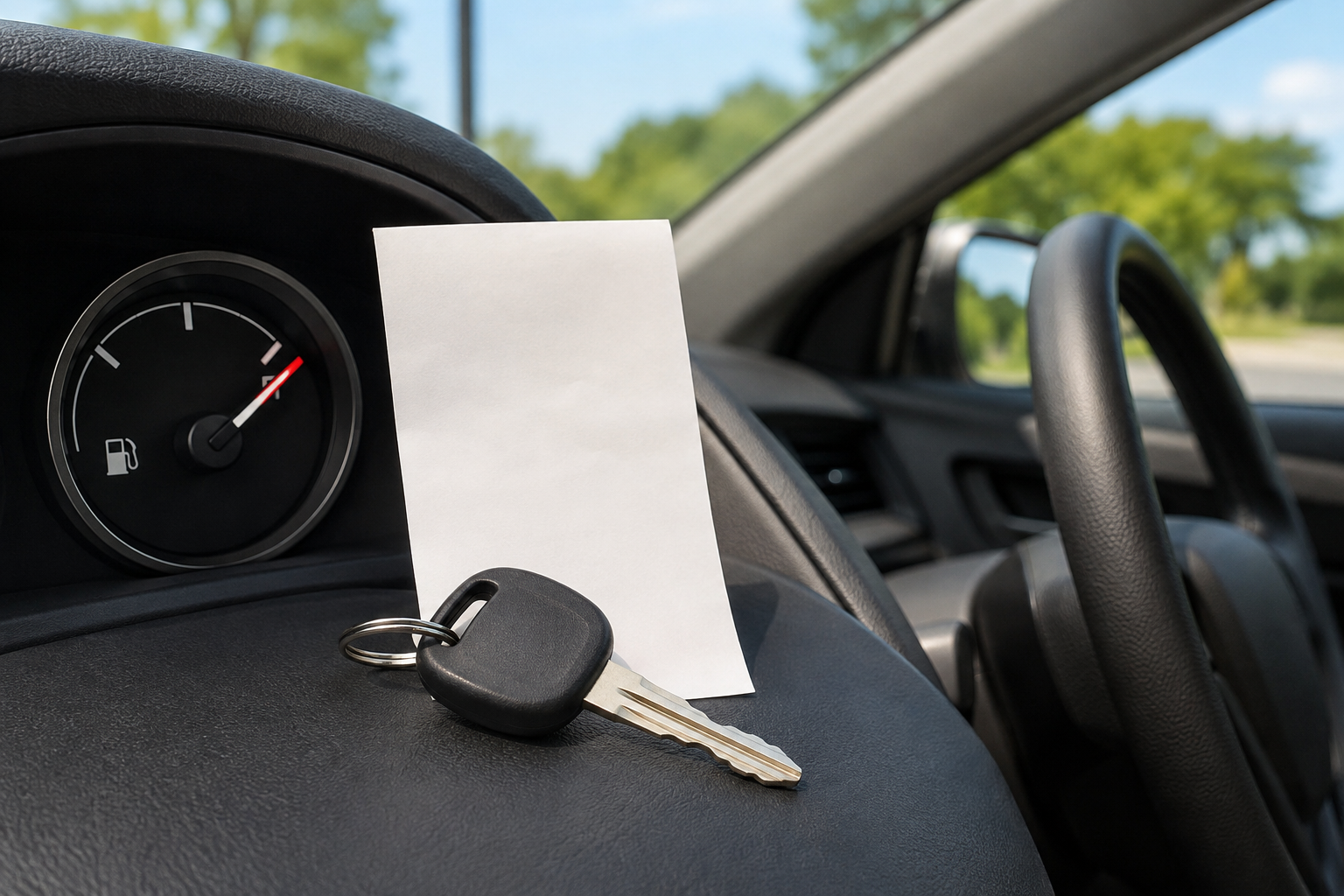
AI-generated illustration: a generic fuel receipt, rental key and full fuel gauge inside a parked car; no provider or transaction is represented.
If You Choose the Wrong Fuel
Do not start the engine. Keep the vehicle stationary and contact the rental branch immediately.
Nippon Rent-A-Car gives that instruction to its customers and warns that starting the engine after a wrong fill can cause serious vehicle problems. Follow the exact provider's recovery instructions and assistance number printed on your rental agreement. Do not improvise by driving to the branch or trying to drain the fuel yourself.
If you notice the mistake after starting the engine, stop safely without continuing the trip and contact the rental provider. The provider, not the article, must decide the recovery and repair process for that vehicle.
Pickup-to-Return Checklist
| When | Check | Evidence to keep |
|---|---|---|
| Pickup | Exact fuel type for this vehicle | Photo or written note from the rental counter |
| Pickup | Full-tank, nearby-station and receipt rule | Rental agreement or branch confirmation |
| Before driving | Fuel-door side and release control | Quick visual check while parked |
| Before return | Suitable station and current operating status | Live station check plus a backup station |
| At the pump | Live label matches confirmed fuel | Fuel name and nozzle-color cross-check |
| After fueling | Cap closed, nozzle returned, receipt collected | Receipt retained until return is accepted |
If you have not yet confirmed your driving documents, start with Driving in Japan: IDP, License Translation & Rental Rules. For toll planning, continue to Japan Expressway Tolls: ETC Cards, Cash & Rental Cars.
Plan B When the Pump or Fuel Type Is Unclear
Stop before selecting fuel. Use this order:
- Recheck the fuel note from the pickup counter.
- Compare the Japanese pump label, not only the nozzle color.
- Ask the station attendant to confirm the pump process.
- Call the rental branch if the vehicle's required fuel is still unclear.
- Leave and use another staffed station if no one can confirm the choice.
For the return trip, save a second suitable station before the final hour. Use Does Google Maps Work in Japan? to plan the stop, but check the station's current status directly.
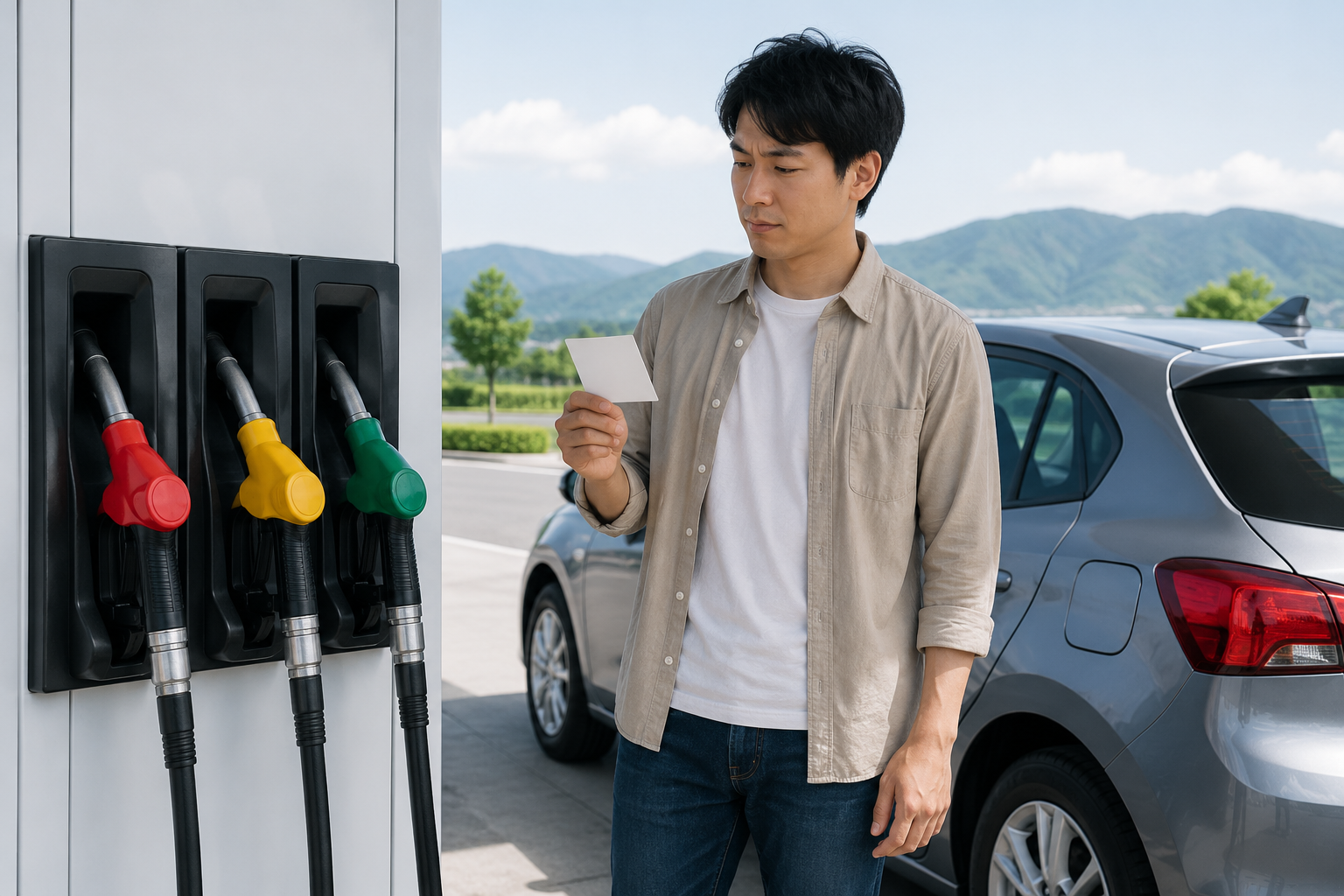
AI-generated illustration: a traveler checking a generic fuel note beside a parked rental car before choosing a nozzle.
Frequently Asked Questions
Which fuel should I put in a rental car in Japan?
Use the fuel confirmed for that exact vehicle by the rental branch or vehicle instruction. Do not infer it from the car's size or from what most rentals use.
What do the red, yellow and green nozzles mean in Japan?
Official guidance uses red for regular gasoline, yellow for high-octane gasoline, and green for diesel. Read the live label and match it to the fuel confirmed at pickup.
Are all gas stations in Japan self-service?
No. Japan has self-service and full-service stations. Self-service entrances commonly display セルフ or セルフサービス.
How do I ask for a full tank at a staffed gas station?
State the confirmed fuel, then say mantan for full. Toyota gives Regular, mantan as an example for a vehicle that uses regular gasoline.
Do Japanese gas stations accept foreign credit cards?
Do not assume they do. Toyota's guide warns that some stations may accept only cash, so carry Japanese yen and confirm payment before fueling.
Must every rental car be returned with a full tank?
Check your exact rental contract and return branch. Full-tank return is common, but detailed conditions and non-full charges are provider- and plan-specific.
Should I keep the fuel receipt when returning a rental car?
Yes, keep it until the return is accepted. Nippon Rent-A-Car currently requires its customers to present the receipt, but other providers may use different proof rules.
What should I do if I put in the wrong fuel?
Do not start the engine. Contact the rental branch immediately and follow its recovery instructions. Do not drive the car to the branch or attempt a do-it-yourself drain.
Official Sources Checked
- JNTO: Things to know when renting a car
- JAF: Driving a Motor Vehicle in Japan
- Toyota Rent a Car: Filling Up the Tank
- Nippon Rent-A-Car: For beginners
- Nippon Rent-A-Car: Refueling vehicles
- MLIT Chubu District Transport Bureau: Central Japan Rent-a-car Drive Guide
Last checked: August 26, 2026. Fuel prices, payment acceptance, station operation and rental return conditions can change. Recheck the exact vehicle, station and rental agreement before fueling and return.

Comments