Japan changed its flight rules for power banks on April 24, 2026. The basic answer is simple: keep them out of checked baggage, bring no more than two, and do not use them in the cabin. The difficult part is deciding whether the capacity label, your other spare batteries and the airline operating your flight create an extra restriction.
Quick answer: On flights covered by Japan’s 2026 rules, each passenger may carry up to two power banks, each rated 160Wh or less, in carry-on baggage rather than checked baggage. Do not recharge a power bank from the seat outlet or use it to charge a phone or another device during the flight. Protect it against short circuits and check the operating airline before departure. A codeshare partner or another country may apply stricter rules.
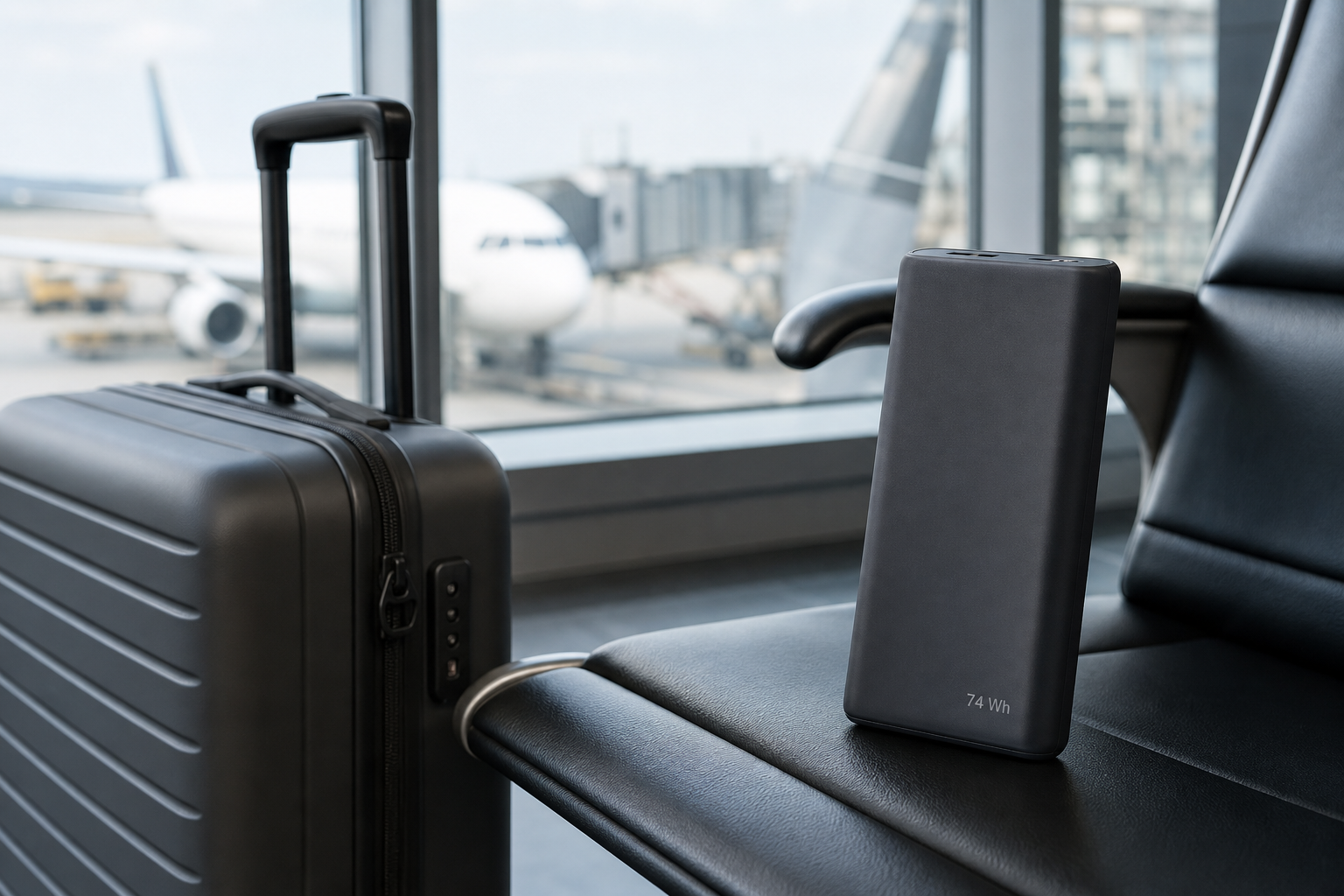
Editorial reconstruction. The image explains the topic but does not prove that a particular battery will be accepted.
- What changed on April 24, 2026?
- Use this 30-second packing decision
- How do you find the Wh rating?
- Carry-on placement still needs short-circuit protection
- Move it before your checked bag leaves your hands
- You cannot use the power bank during the flight
- ANA and JAL share the core rule, but details still matter
- Plan B: what if your battery fails the check?
- Final checklist before a Japan flight
- Frequently asked questions
- Can I put a power bank in checked baggage in Japan?
- How many power banks can I bring on a Japan flight in 2026?
- Can I use a power bank to charge my phone during the flight?
- Can I recharge the power bank from the seat USB port?
- How do I convert mAh to Wh?
- What happens if the Wh rating is missing?
- Do the same rules apply to a foreign airline flying to Japan?
- What should I do with a third power bank?
- Next useful guides
What changed on April 24, 2026?
Japan’s Ministry of Land, Infrastructure, Transport and Tourism introduced three additions to the existing battery rules:
- No more than two power banks per passenger.
- Each power bank must be 160Wh or less.
- During the flight, passengers must not recharge the power bank or use it to charge another electronic device.
The rule against putting a power bank in checked baggage already existed. Power banks must travel in the cabin because a battery incident needs to be noticed and handled quickly.
ANA and JAL published matching English notices. JAL also asks passengers not to place power banks in overhead compartments. Treat the operating airline’s page as the final check for your specific flight.
Use this 30-second packing decision
| Check | Your situation | Action before leaving for the airport |
|---|---|---|
| Baggage | Power bank is in a checked suitcase | Move it to carry-on baggage |
| Quantity | One or two power banks | Continue to the capacity check |
| Quantity | Three or more | Leave the extras behind unless the operating airline gives different written instructions |
| Capacity | Every unit is 160Wh or less | Continue to the condition and airline checks |
| Capacity | Any unit is over 160Wh | Do not pack it in either checked or carry-on baggage |
| Label | Wh is printed and readable | Use the printed rating |
| Label | Wh is missing but mAh and voltage are readable | Calculate Wh, then confirm with the airline if there is any doubt |
| Label | Capacity cannot be confirmed | Expect possible refusal; use the Plan B below |
| Other batteries | You also have 100–160Wh spare lithium-ion batteries | Check the carrier’s combined quantity rule |
| Onboard plan | You planned to use the power bank in flight | Charge the phone before boarding and keep the power bank disconnected onboard |
This table is a pre-trip filter, not an acceptance guarantee. Security staff and the operating airline can refuse a damaged, recalled, unidentifiable or otherwise unsafe battery.
How do you find the Wh rating?
Look for Wh on the battery label first. It may appear next to capacity, input and output specifications.
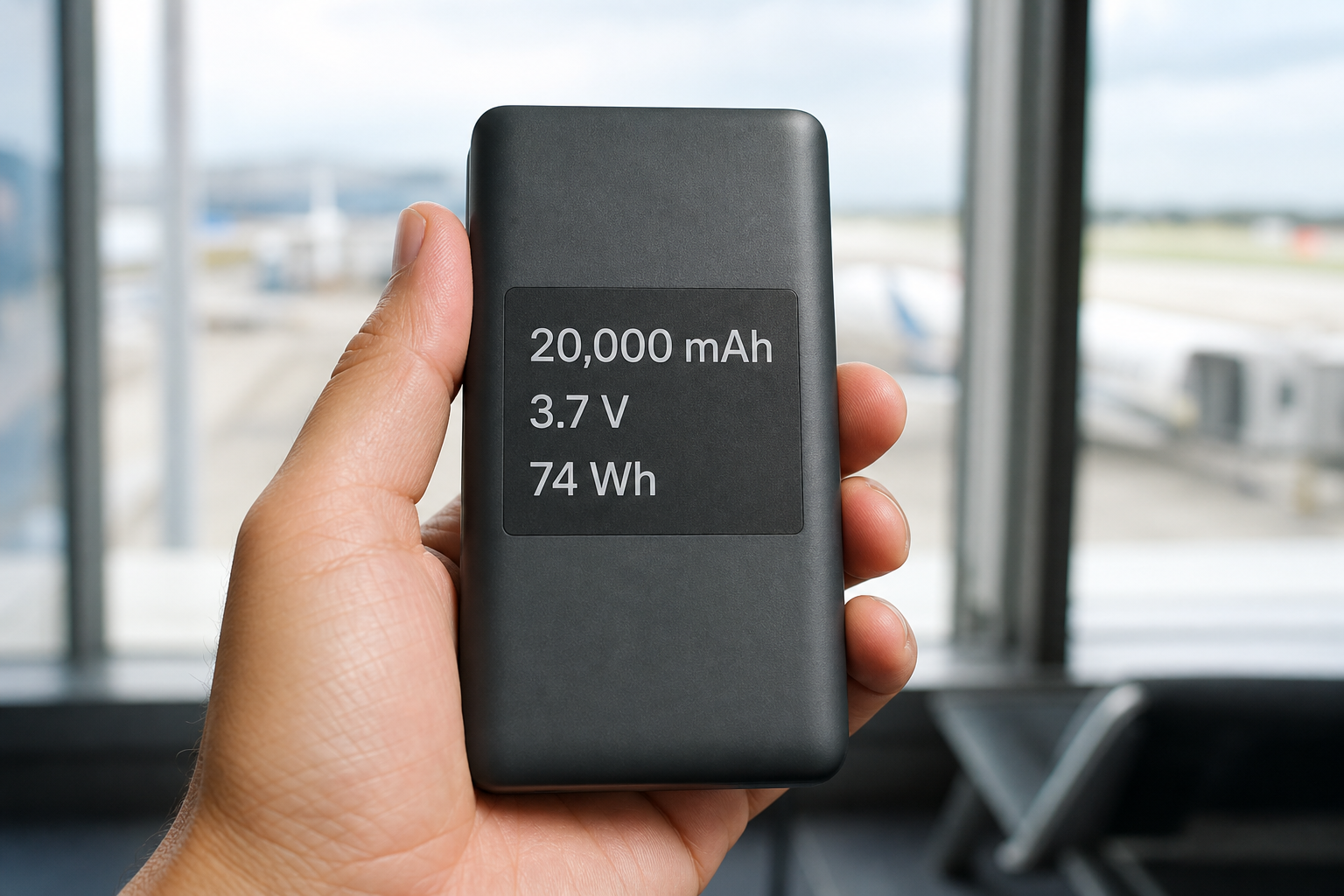
If the label shows milliamp-hours and voltage but no watt-hours, Haneda Airport and JAL provide this formula:
Wh = mAh × V ÷ 1,000
Examples using a rated voltage of 3.7V:
| Printed capacity | Calculation | Result |
|---|---|---|
| 5,000mAh | 5,000 × 3.7 ÷ 1,000 | 18.5Wh |
| 10,000mAh | 10,000 × 3.7 ÷ 1,000 | 37Wh |
| 20,000mAh | 20,000 × 3.7 ÷ 1,000 | 74Wh |
Use the voltage printed on your own device because power-bank voltage can differ. If the specifications are missing, worn away or contradictory, contact the operating airline before travel. JAL warns that transport may be refused when the Wh rating cannot be confirmed.
Carry-on placement still needs short-circuit protection
ANA, JAL and Haneda Airport tell passengers to prevent short circuits. Use the original retail packaging, cover exposed terminals with tape, or place each unit in a separate plastic bag or protective pouch.
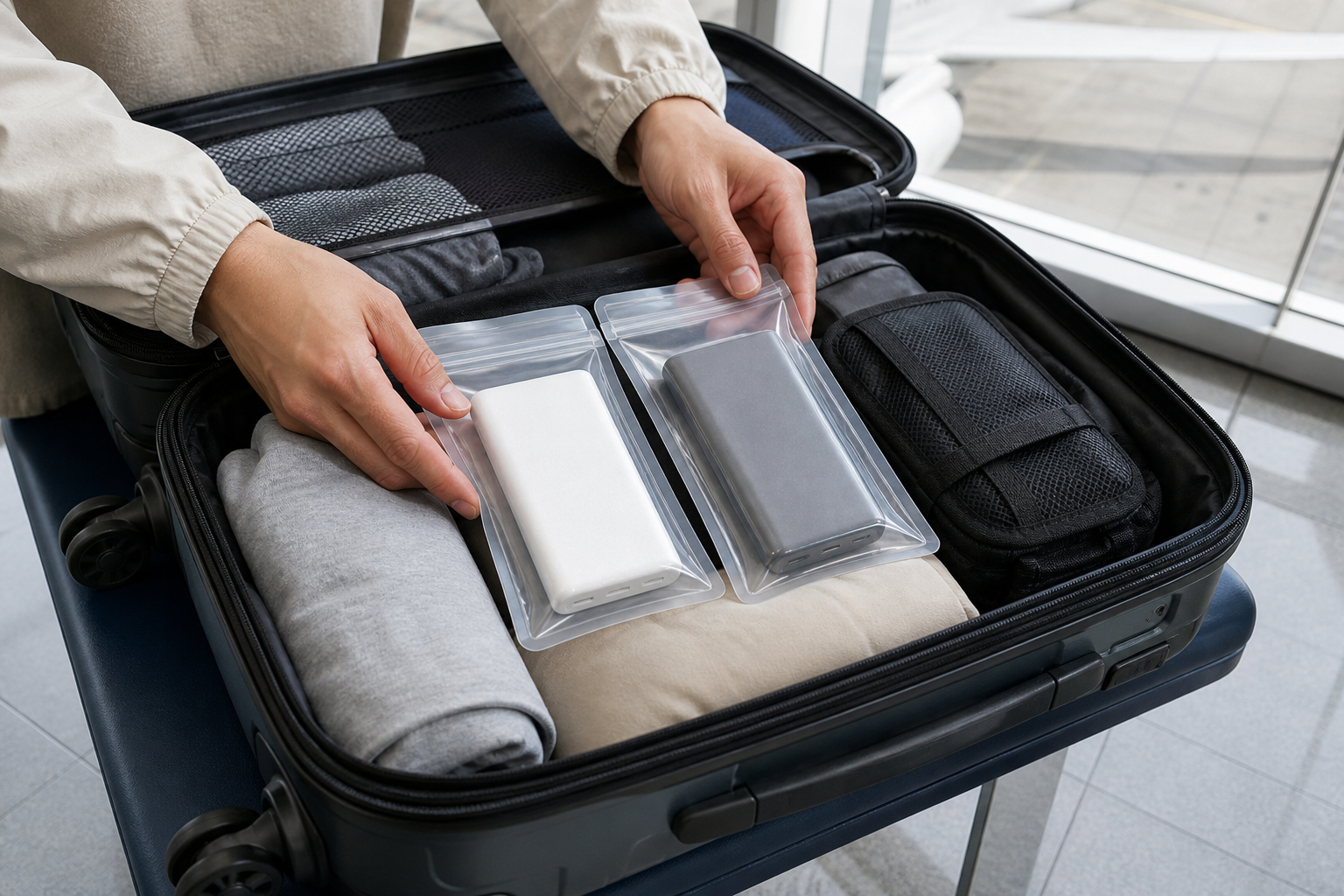
Before packing, check that the battery is not swollen, cracked, leaking, unusually hot or subject to a recall. Do not travel with a visibly damaged battery merely because its printed capacity is below 160Wh.
Keep the unit somewhere you can reach without opening an overhead compartment. JAL explicitly asks passengers to refrain from overhead storage. If the battery becomes hot, emits an odor, changes shape, smokes or behaves abnormally, stop touching it and alert cabin crew immediately.
Move it before your checked bag leaves your hands
The easiest failure to prevent is leaving a power bank inside a suitcase at bag drop.
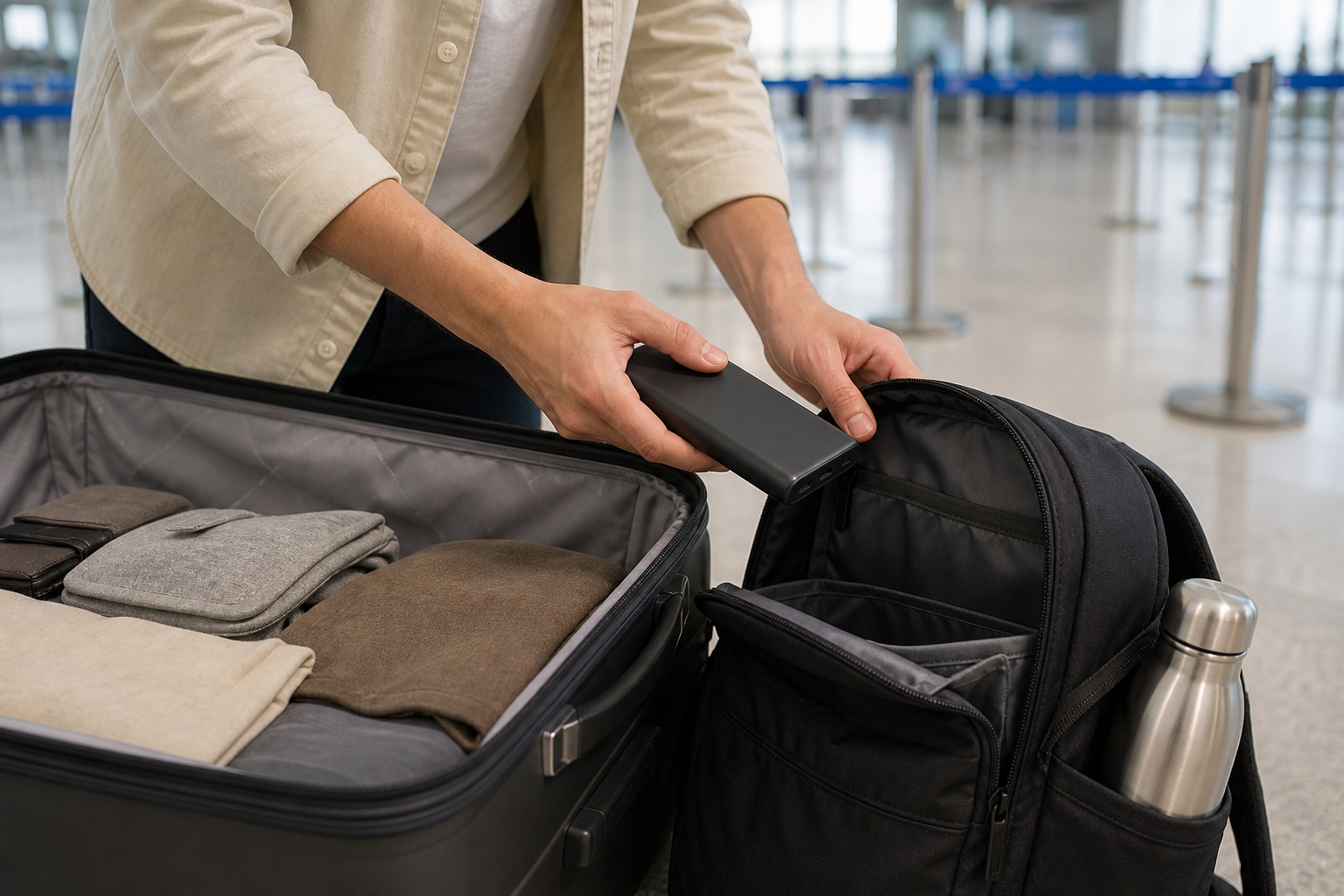
Do a final battery check before closing the checked suitcase:
- Power banks are in your carry-on or personal item.
- Each unit is individually protected.
- The capacity label is readable.
- You have counted power banks and large spare batteries separately.
- You know which airline actually operates each flight.
For a codeshare ticket, the airline name printed most prominently may not be the airline operating the aircraft. ANA says another operating airline’s baggage rules may apply. Check the words operated by on your booking.
You cannot use the power bank during the flight
The 2026 restriction works in both directions:
- Do not plug the power bank into an aircraft outlet or USB port to recharge it.
- Do not connect the power bank to your phone, tablet, camera or another device.
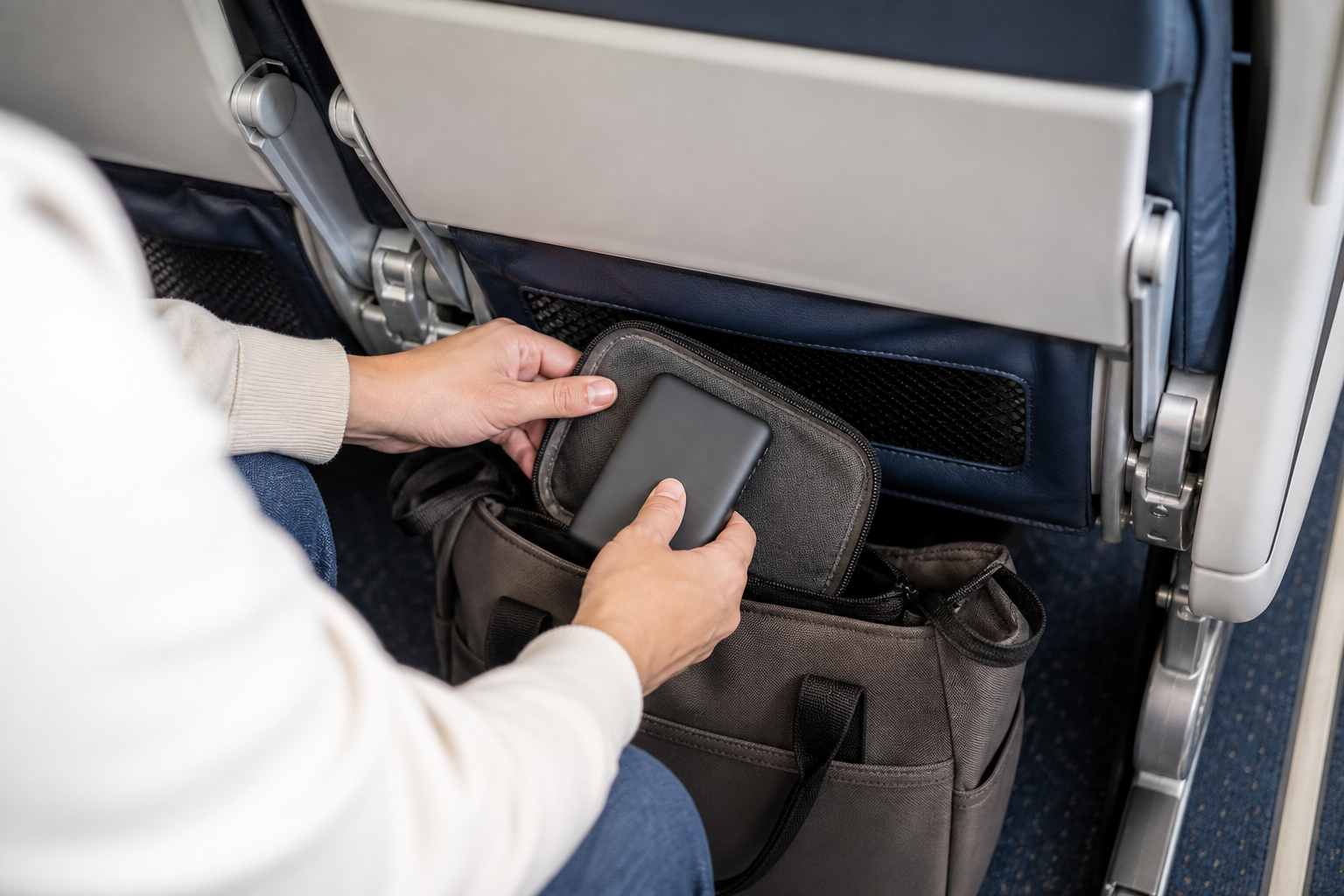
The new rule does not, by itself, say that an aircraft outlet can be used to charge a phone directly. Equipment and airline policies vary. Follow the operating airline’s instructions and any directions from the crew.
Power the phone down or use battery-saving mode if necessary. Save your hotel address, boarding details and important contact information offline before takeoff.
ANA and JAL share the core rule, but details still matter
Both airlines state the same headline limits: two power banks, each 160Wh or less, carry-on rather than checked baggage, and no onboard use.
There are still details worth checking:
- ANA: the permitted number can be affected by how power banks are combined with other lithium-ion spare batteries rated over 100Wh and up to 160Wh.
- JAL: the international baggage page asks passengers not to use overhead storage and says a battery may be refused if its Wh rating cannot be confirmed.
- Codeshares and connections: the operating airline or another country may apply a different or stricter rule.
- 2027 travel: JAL says the limit may be reduced to 100Wh from January 2027 because of anticipated IATA changes. Recheck this article and your airline before a 2027 flight.
Do not use an ANA or JAL page as proof for a flight operated by a different carrier.
Plan B: what if your battery fails the check?
If the power bank is over 160Wh, lacks a usable rating, is damaged, or puts you above the permitted quantity, do not move it into checked baggage.
Use this Plan B:
- Contact the operating airline before leaving your accommodation.
- Leave non-compliant or unnecessary units behind in a safe place.
- Follow local retailer, manufacturer or airport instructions for returns or disposal. Do not place a lithium battery in an ordinary trash bin.
- Charge your phone directly at an airport charging point before boarding.
- Carry offline copies of the address, route and booking information you need after landing.
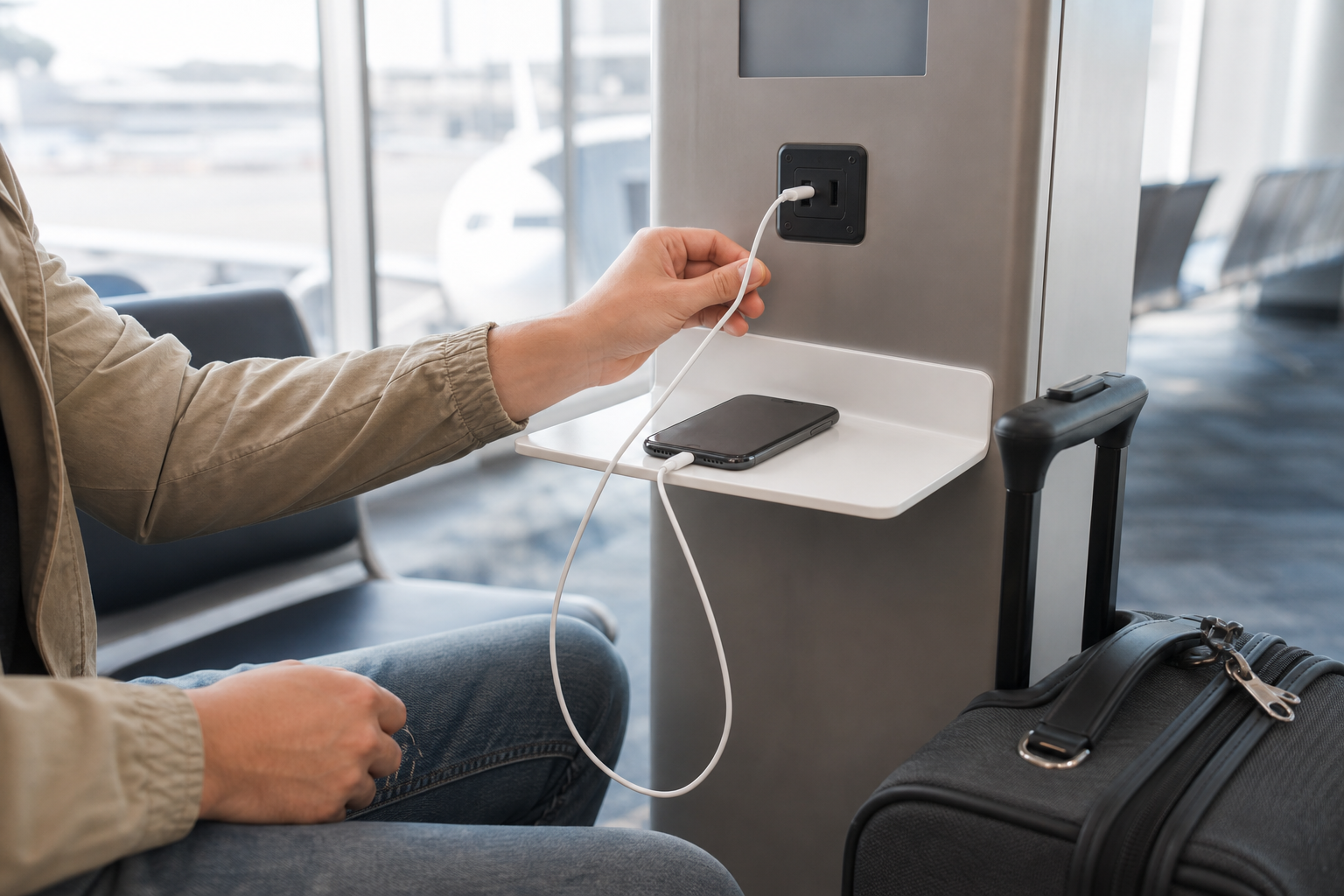
Airport storage, mailing and disposal services vary and may be unavailable.
Final checklist before a Japan flight
- [ ] No power bank is inside checked baggage.
- [ ] I have no more than two power banks.
- [ ] Each unit is 160Wh or less.
- [ ] Each capacity label is readable.
- [ ] Terminals are protected or units are packed separately.
- [ ] I checked other 100–160Wh spare batteries.
- [ ] I checked the airline operating the flight.
- [ ] I will not recharge or use the power bank onboard.
- [ ] I charged my phone and saved essential information offline.
Last checked: August 10, 2026. Battery rules can change quickly. Confirm the operating airline’s current restricted-baggage page before departure.
Frequently asked questions
Can I put a power bank in checked baggage in Japan?
No. Power banks must not be placed in checked baggage. Carry an eligible unit in cabin baggage and protect it against short circuits.
How many power banks can I bring on a Japan flight in 2026?
The new Japanese rule allows no more than two per passenger, each rated 160Wh or less. Other large spare batteries or an operating airline’s stricter rule can reduce what is accepted.
Can I use a power bank to charge my phone during the flight?
No on flights covered by the new rule. Do not use a power bank to charge a phone or another electronic device onboard.
Can I recharge the power bank from the seat USB port?
No. Charging a power bank from an in-seat outlet or USB port is prohibited under the 2026 rule.
How do I convert mAh to Wh?
Use Wh = mAh × V ÷ 1,000, with the voltage printed on your battery. Prefer the manufacturer’s printed Wh rating when available.
What happens if the Wh rating is missing?
The airline may refuse the battery if its rating cannot be confirmed. Contact the operating airline before travel or leave the unit behind.
Do the same rules apply to a foreign airline flying to Japan?
Do not assume so. International standards influenced the change, but the operating airline, departure country and transit points may impose different or stricter requirements.
What should I do with a third power bank?
Do not put it in checked baggage. Leave unnecessary units behind and follow the operating airline’s instructions if you believe an exception applies.


Comments