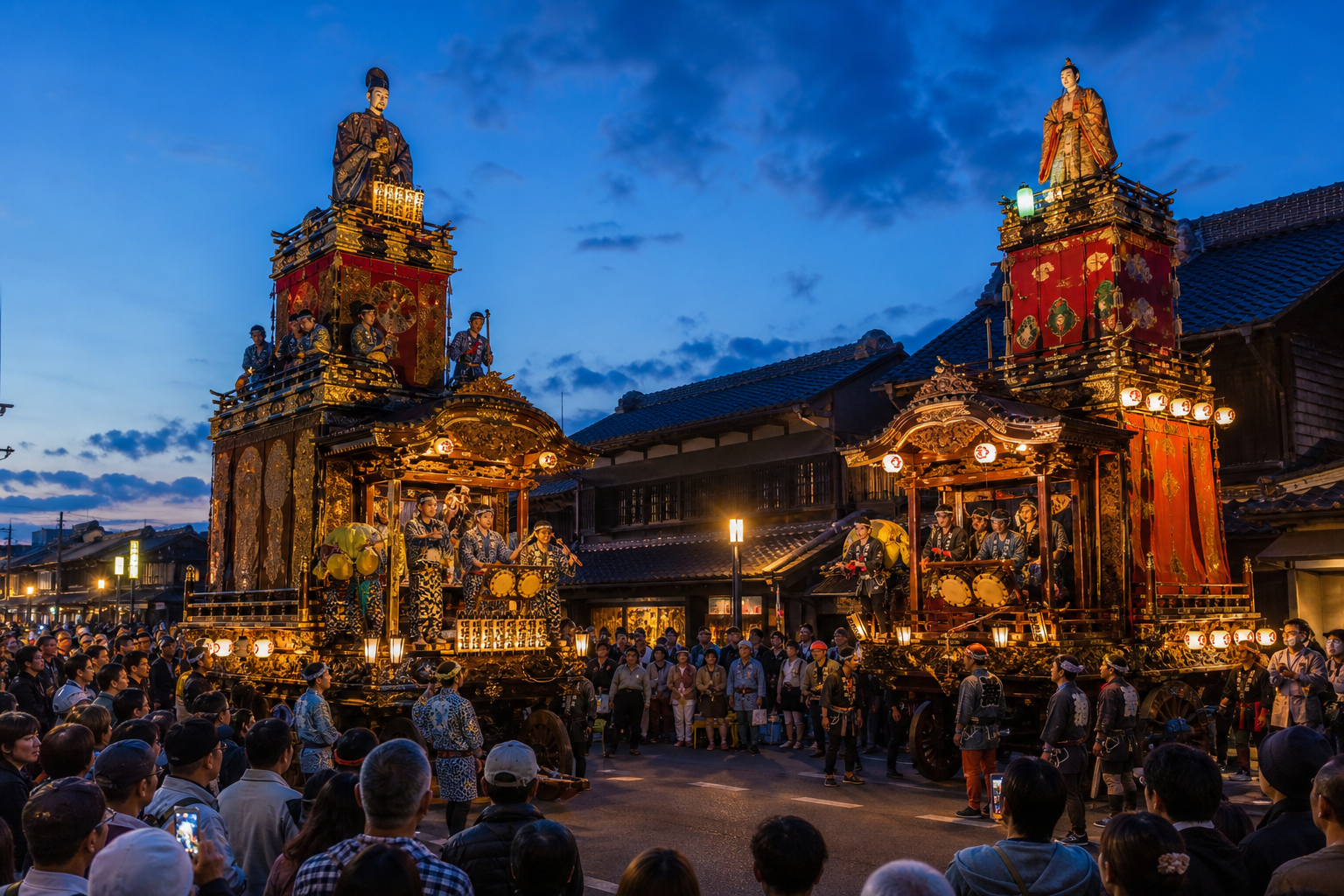
Kawagoe Festival is easy to reach from Tokyo and hard to navigate if you arrive without an exit plan. The festival spreads through streets rather than one gated venue. Huge traditional floats move through the old town, the most popular intersections become crowded, and the best railway station depends on where you start in Tokyo.
The 2026 Kawagoe Festival is confirmed for Saturday, October 17, and Sunday, October 18. As of August 6, the organizer has announced the dates, Saturday evening’s Yoi-yama period and a Sunday float procession, but the complete 2026 timetable and traffic-control map have not yet been published. This guide separates confirmed information from historical planning guidance so you can book the day without treating each route and time as final.
- Quick answer: decide the return station before you arrive
- What is confirmed for Kawagoe Festival 2026?
- Saturday evening or Sunday daytime: which should you choose?
- Do you need a ticket?
- Tokyo to Kawagoe: choose the railway by origin and exit
- Build a crowd plan, not a rigid float checklist
- Your realistic exit plan
- Plan B for crowds, rain or missing 2026 details
- Rules that prevent common failures
- Kawagoe Festival 2026 FAQ
- Is Kawagoe Festival 2026 confirmed?
- Do I need a ticket for Kawagoe Festival?
- Which station is best for Kawagoe Festival?
- What is the easiest route from Shinjuku?
- Should I visit on Saturday or Sunday?
- When is Kawagoe Festival most crowded?
- Can I drive to Kawagoe Festival?
- What should I do if it rains or the schedule changes?
Quick answer: decide the return station before you arrive
- Use Kawagoe Station if you are coming from Ikebukuro, Shibuya, Omiya or a JR route.
- Use Hon-Kawagoe Station if the Seibu Shinjuku Line is convenient from Seibu-Shinjuku or Takadanobaba. It also gives you a shorter approach to the old-town side of the festival.
- Save both stations in your phone. You do not have to return from the same station you used on arrival.
- If this is your first visit, choose daylight or early evening over a plan focused on late night. You will have more time to find the floats and understand the street layout.
- Treat the currently announced Saturday Yoi-yama, around 18:00–19:00, and Sunday’s City Hall float procession as anchors—not as the complete 2026 schedule.
- Do not copy the previous year’s traffic hours, bus diversions or float timetable. Recheck the official Kawagoe Festival site after the 2026 map is published.
- Before the first float you want to see, set a firm departure time and choose your return line. A fast train on paper does not remove the walk through a dense festival crowd.
| Your Tokyo base | Practical first choice | Arrival station | Main trade-off |
|---|---|---|---|
| Ikebukuro | Tobu Tojo Line | Kawagoe | Fast normal reference time, but a longer final walk toward the old-town core |
| Shibuya | Fukutoshin Line through service | Kawagoe | Simple through route when operating as planned; check the live train before departure |
| Shinjuku | JR Saikyo/Kawagoe Line or Seibu Shinjuku Line | Kawagoe or Hon-Kawagoe | JR can be simpler from JR Shinjuku; Seibu places you nearer the old-town side |
| Takadanobaba | Seibu Shinjuku Line | Hon-Kawagoe | Useful if you want to approach from the south side of the festival area |
| Omiya | JR Kawagoe Line | Kawagoe | Direct regional approach; still allow time for the walk from the station |
Information checked August 6, 2026. The complete 2026 program, traffic restrictions, bus changes and weather decision process remain subject to later official announcements.
What is confirmed for Kawagoe Festival 2026?
The official English festival site and Koedo Kawagoe Tourism Association event page currently confirm:
| Item | Confirmed as of August 6 |
|---|---|
| Dates | Saturday, October 17, and Sunday, October 18, 2026 |
| Main setting | Central Kawagoe streets, including the old-town and City Hall areas |
| Saturday anchor | Yoi-yama, approximately 18:00–19:00 |
| Sunday anchor | Float procession in front of Kawagoe City Hall; time not yet listed |
| Complete timetable | Not yet published |
| 2026 traffic-control map | Not yet published on the current event page |
| Ordinary street access | No general admission ticket has been announced |
| Optional paid product | A reserved dining/spectator-seat product is on sale at Resona Coedo Terrace |
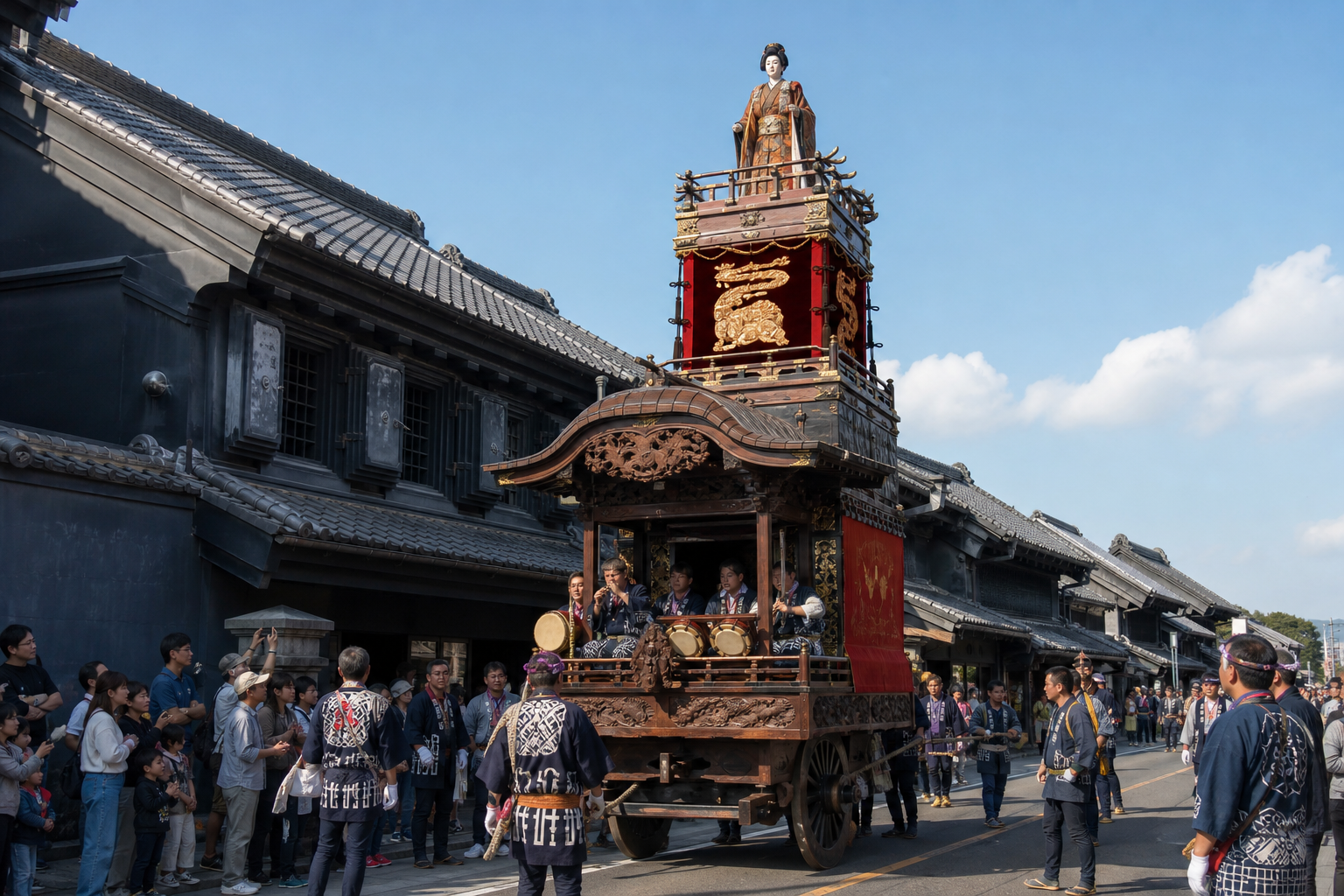
The festival combines Hikawa Shrine ceremonies with the dashi float event. Kawagoe’s floats use a two-story Edo-style structure with a doll above the upper level. When floats meet, their musicians and dancers can face one another in a performance called hikkawase.
Those cultural details are stable. Exact 2026 float routes and encounter times are not. A dashi is moving festival equipment, not a stage that stays at one pin throughout the day.
Saturday evening or Sunday daytime: which should you choose?
The two days do not offer one identical experience.
Choose Saturday if you want an evening introduction
Saturday currently has the clearest announced time: Yoi-yama is listed for approximately 18:00–19:00. This is a useful anchor for travelers who want lantern-lit floats but do not want to stay until the latest, busiest part of the night.
Do not interpret 19:00 as an announced festival closing time. The complete schedule is still pending. Build your return around the part you most want to see, not an assumed final event time.
Choose Sunday if you want a daytime float plan
The tourism association has announced a City Hall float procession for Sunday but has not yet listed the time. Sunday is the better planning shape for families, travelers who need daylight, and anyone who wants to return to Tokyo before late-evening crowd pressure.
The official English feature, based on a previous edition, describes the morning as relaxed and the streets becoming more crowded after sunset. That is useful historical guidance, not a 2026 crowd forecast or guarantee.
Do you need a ticket?
The official 2026 calendar lists the street festival and the paid spectator-seat product as separate entries. It does not announce a general admission ticket for ordinary street viewing.
The paid option is a reserved food-and-viewing package at Resona Coedo Terrace, along Kawagoe Ichibangai. The tourism association says it operates on both October 17 and 18, requires advance booking, includes food, and is about a 12-minute walk from Hon-Kawagoe Station. It is provided and sold by a private company with tourism-association cooperation.
Choose the paid option when you want that defined seat-and-meal product. Do not buy it because you think it is required to see a float. Before paying, read the current application form and flyer for the session time, price, cancellation terms, food details and accessibility.
For ordinary viewing, your real constraint is not a ticket gate. It is finding a workable street, keeping out of the float’s operating space and leaving before your return plan becomes stressful.
Tokyo to Kawagoe: choose the railway by origin and exit
The Kawagoe Tourism Association access page gives normal reference times, not festival-day door-to-float times:
| Origin | Official normal reference | Station |
|---|---|---|
| Ikebukuro | As little as 26 minutes on the Tobu Tojo Line | Kawagoe |
| Shibuya | About 45 minutes via the Fukutoshin Line | Kawagoe |
| Shinjuku | About 50 minutes on the JR Saikyo/Kawagoe route | Kawagoe |
| Seibu-Shinjuku | As little as 44 minutes by Seibu limited express | Hon-Kawagoe |
| Omiya | About 20 minutes on the JR Kawagoe Line | Kawagoe |
These times stop at the railway platform. They do not include the walk to the old town, waiting at signals, a temporary pedestrian route, finding a float or moving through a crowd.
Kawagoe Station
Kawagoe Station serves the Tobu Tojo Line and JR Kawagoe Line. It is the natural choice from Ikebukuro, Shibuya and Omiya. It also has a tourist information office near the ticket gates.
Its weakness is the final approach: the old-town festival streets extend north of the station. Do not schedule the first float five minutes after your train arrives.
Hon-Kawagoe Station
Hon-Kawagoe is the Seibu Shinjuku Line terminal. It is useful from Seibu-Shinjuku and Takadanobaba and places you closer to the old-town side than Kawagoe Station.
Its weakness is route fit. If your hotel is best served by JR or Tobu, a shorter final walk does not automatically make Seibu the better whole journey.
The RJG exit-first method
Open your map before leaving Tokyo and save:
- Kawagoe Station;
- Hon-Kawagoe Station;
- the official festival site and, once published, the current 2026 map;
- your Tokyo hotel station;
- one meeting point away from the float route.
Then choose a return line and a departure time. If you arrive at Kawagoe Station, you may finish nearer Hon-Kawagoe—or vice versa. Using different arrival and return stations can be sensible, provided both routes work for your hotel and any pass you bought.

Build a crowd plan, not a rigid float checklist
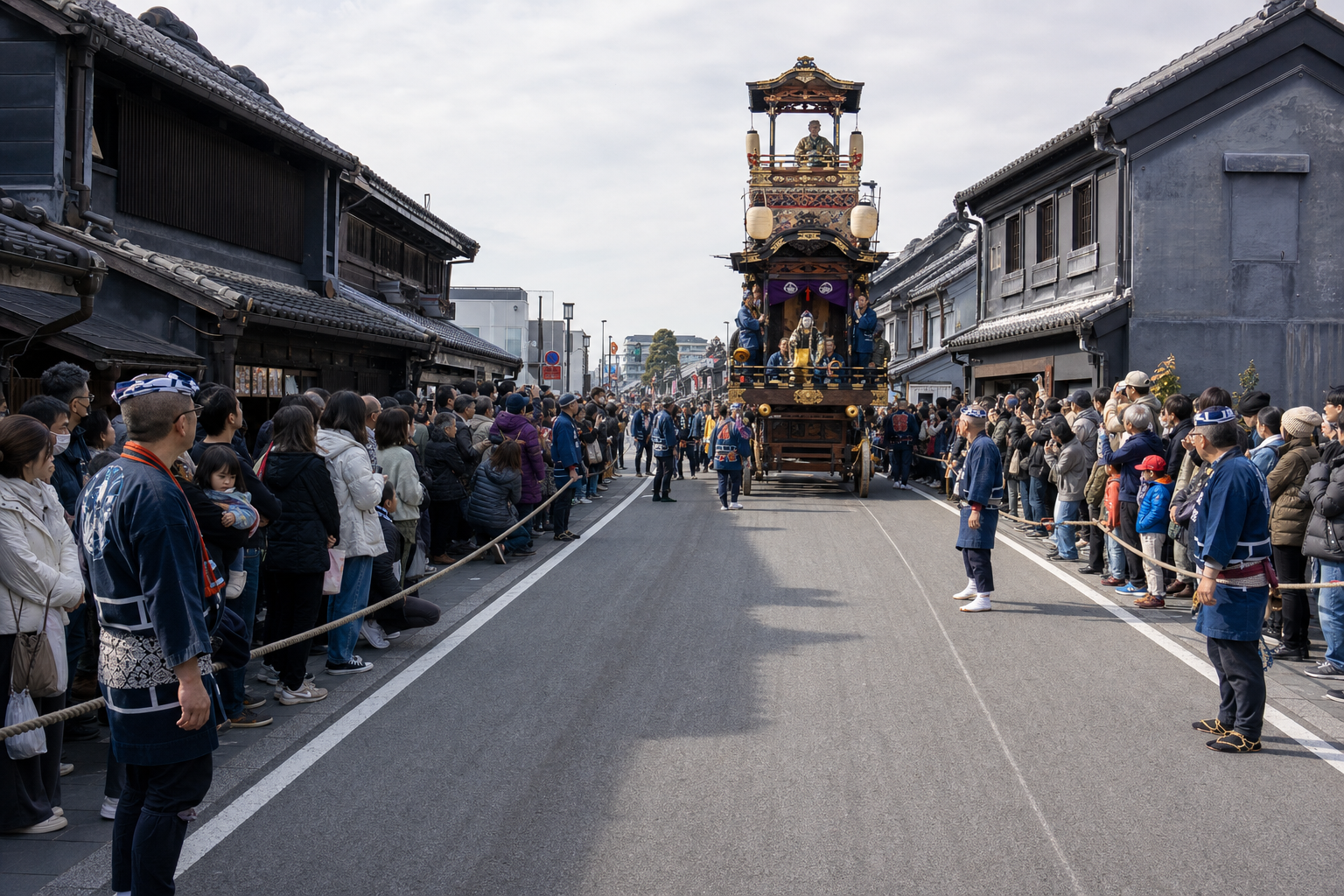
The official festival feature warns that large intersections become the most crowded and recommends moving between areas while following the sound of the hayashi music. Kawagoe City also notes that the historic sightseeing streets are narrow and asks visitors to use public transport.
Use this practical sequence:
- If the 2026 map has been released, download it from the official festival site or collect it from a currently listed official information point. An older official feature lists counters at Kawagoe Station and Hon-Kawagoe Station, but confirm current festival-day availability.
- Choose one confirmed anchor event rather than trying to see the full float list.
- Watch from an established public viewing area and keep the route clear for ropes, handlers and emergency movement.
- If a crossing stops moving, step away from the core instead of pushing toward the same float.
- Put the phone away while walking. Stop at the side before checking the map.
- Do not enter private land or use a shop entrance as your viewing space.
- Eat beside the seller or in a designated space rather than walking through the crowd with food.
- Carry your rubbish until you find the seller’s collection point or an official bin.
These are not cosmetic manners. They reduce the exact problems Kawagoe City identifies: people stepping into roads, walking while using phones, eating while walking, littering and entering private property.
Your realistic exit plan
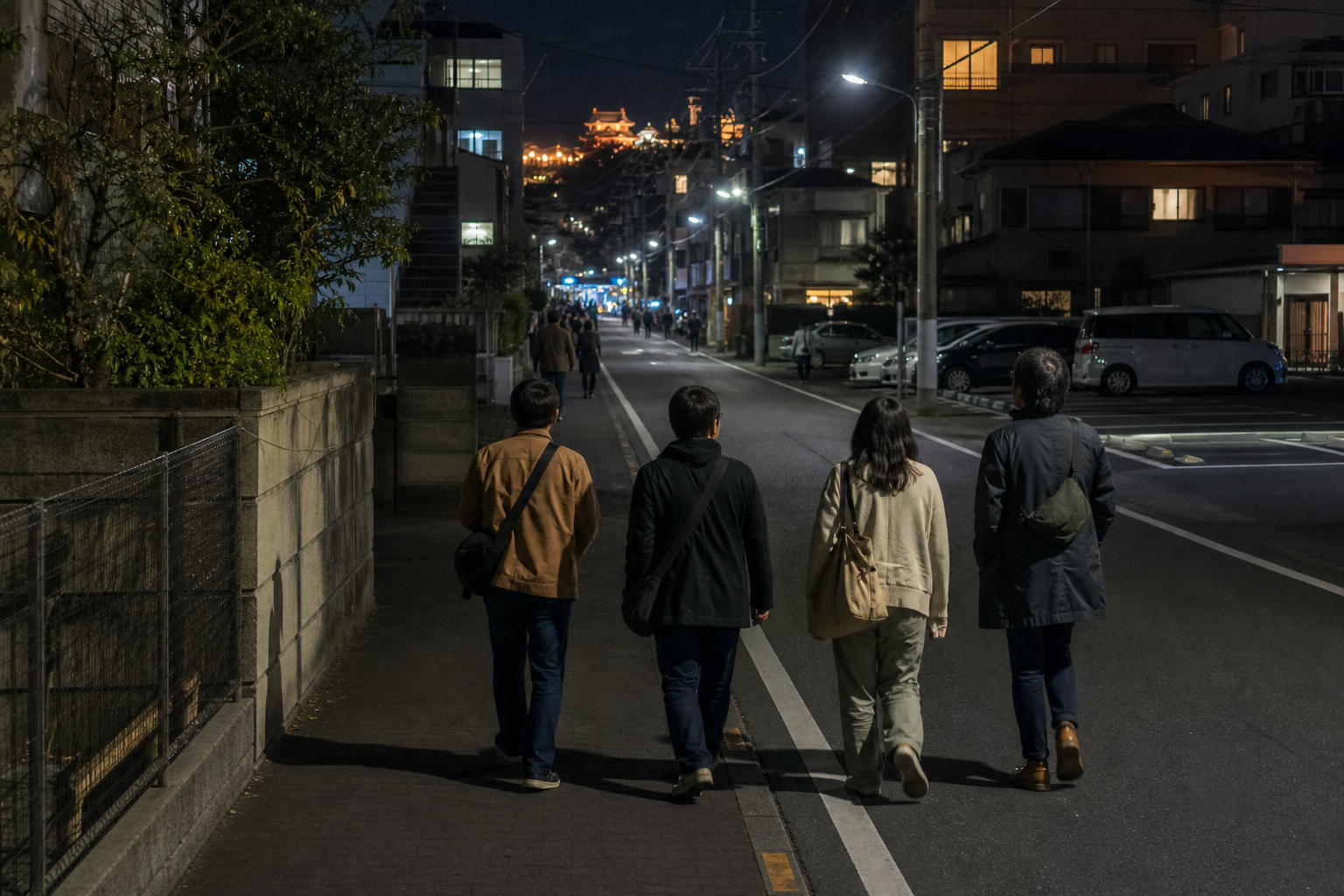
Do not wait until you are tired, cold and deep inside the old town to decide how to leave.
Before entering the busiest streets:
- Choose Kawagoe Station or Hon-Kawagoe Station for the return.
- Save the route offline and take a screenshot of the final train options.
- Set a departure alarm at least 15 minutes before you want to start walking.
- Give everyone in your group the same meeting point and return station.
- Remove any tight dinner, airport or long-distance connection after the festival.
When leaving:
- follow current staff signs and pedestrian controls;
- use the station that fits your route, not automatically the station where you arrived;
- expect the walking pace to slow near the central festival streets and station approaches;
- do not cross through a float rope or reverse against controlled pedestrian movement;
- if the night atmosphere matters less than certainty, leave after your chosen highlight rather than after an assumed finale.
The departure time is your measurable decision. “We will leave when it feels finished” is not an exit plan.
Plan B for crowds, rain or missing 2026 details
| Problem | Safer next action |
|---|---|
| The 2026 timetable is still incomplete | Choose one announced anchor and recheck the official site 24 hours before travel |
| The central crossing is barely moving | Step away from the core and watch another float route rather than pushing forward |
| Your group includes a child or someone who cannot stand in dense crowds | Choose daylight, stay near the edge of the festival area and leave before evening congestion |
| Bus diversions are unclear | Use rail plus the current official pedestrian route; do not rely on a normal bus timetable |
| Rain is forecast | Check the organizer’s live decision; bring a compact raincoat and do not assume an umbrella is practical in a dense viewing area |
| You miss the float you wanted | Follow another dashi or hayashi performance instead of crossing the town against the crowd |
| The event plan no longer works | Visit Kawagoe on a separate day and use the Kawagoe Festival Museum after confirming its current opening status |
| Your return connection becomes tight | Leave immediately for the preselected station; do not wait for an unannounced finale |
The Kawagoe Festival Museum displays two real floats and festival videos. It is an another-day substitute, not a promised same-day indoor refuge during the festival. Its standard October hours are 09:30–17:30 with last admission at 17:00, but temporary closures can occur.
For broader crowd, food and rubbish preparation, read RJG’s Japan Festival Survival Guide. To compare the railway journey with other Tokyo day trips, use Japan Travel Times from Tokyo. If Tokyo’s rail network is unfamiliar, start with Tokyo Trains 2026.
Rules that prevent common failures
- Use public transport: the city specifically asks visitors to avoid adding cars to narrow, congested sightseeing streets.
- Do not rely on ordinary bus routes: 2026 festival diversions have not yet been published.
- Do not walk while looking at your phone: stop at the edge before checking the map.
- Do not eat while walking: use the seller’s side space or another permitted place.
- Do not leave rubbish: carry it until you find an official collection point.
- Do not enter private property: old-town homes, alleys and shop thresholds are not overflow viewing areas.
- Do not treat old schedules as current: 2025 traffic restrictions and float times are not 2026 facts.
- Do not expect the full float list: moving dashi, weather, crowd control and program changes can alter what you see.
Kawagoe Festival 2026 FAQ
Is Kawagoe Festival 2026 confirmed?
Yes. The official festival site and Kawagoe Tourism Association list Saturday, October 17, and Sunday, October 18, 2026. The complete timetable and 2026 traffic map were not yet published when checked on August 6.
Do I need a ticket for Kawagoe Festival?
No general admission ticket has been announced for ordinary street viewing. A separate paid dining-and-spectator-seat product is available at Resona Coedo Terrace and requires advance booking.
Which station is best for Kawagoe Festival?
Use Kawagoe Station for Tobu Tojo or JR routes from Ikebukuro, Shibuya or Omiya. Use Hon-Kawagoe Station when the Seibu Shinjuku Line is more convenient or you want a shorter approach to the old-town side.
What is the easiest route from Shinjuku?
Compare the JR Saikyo/Kawagoe route to Kawagoe Station with the Seibu Shinjuku Line from Seibu-Shinjuku to Hon-Kawagoe. JR may be simpler from JR Shinjuku; Seibu normally places you closer to the festival’s old-town side.
Should I visit on Saturday or Sunday?
Saturday has an announced Yoi-yama period around 18:00–19:00 and suits an evening introduction. Sunday has a City Hall float procession, but its 2026 time is still pending. Choose Sunday daylight if crowd tolerance or an earlier return matters more than lantern-lit atmosphere.
When is Kawagoe Festival most crowded?
The organizer has not published a 2026 hour-by-hour forecast. Official historical guidance says major intersections are crowded and the streets become busier after sunset. Arrive early and treat that as planning guidance, not a guarantee.
Can I drive to Kawagoe Festival?
Driving is a poor default. Kawagoe City says the historic sightseeing area has narrow streets and traffic congestion and asks visitors to use public transport. The 2026 traffic-control and parking plan still needs to be checked when published.
What should I do if it rains or the schedule changes?
Check the official festival site before leaving Tokyo. The 2026 weather decision process has not yet been published, so do not assume the event will run, move indoors or follow the previous year’s rule. If your selected highlight disappears, switch to another float area or visit Kawagoe on a separate day.
Comments