Itabashi Fireworks 2026 is scheduled for Saturday, August 1, from 7:00 p.m. to 8:30 p.m. on the Itabashi side of the Arakawa River. The display runs at the same time as the Toda Bridge Fireworks Festival across the river, with about 15,000 fireworks planned in total. The most important 2026 change is not the program: it is the viewing layout. Itabashi’s free area has moved upstream, and visitors without tickets must use Takashimadaira Station.
Last checked: July 15, 2026. Ticket availability, access controls, and weather decisions can change. Recheck the official Itabashi Fireworks website on the day you travel.
- Quick Answer: The 30-Second Plan
- Date, Time, Venue, and What Changed in 2026
- Itabashi Side or Toda Side? Choose Before You Travel
- Free, Paid Unreserved, or Reserved? A Practical Decision Table
- How to Reach the Correct Itabashi Entrance
- A Crowd-Aware Arrival Timeline
- Heat, Food, Toilets, Cash, and What to Carry
- Rain, Wind, and a Real Cancellation Plan B
- How to Leave Without Creating a Second Problem
- Common Mistakes to Avoid
- Your Final Three-Step Plan
- Frequently Asked Questions
- When is Itabashi Fireworks 2026?
- Is Itabashi Fireworks free?
- Which station should I use for the free area?
- Which station should I use with a paid ticket?
- Can I enter with a ticket on my phone?
- What changed at Itabashi Fireworks in 2026?
- Can I watch from the Toda side for free?
- Are food and drinks available?
- Are there toilets?
- What happens if it rains?
- How should I get home after the fireworks?
- Official Sources
Quick Answer: The 30-Second Plan
- No ticket: use the new upstream free viewing area and take the Toei Mita Line to Takashimadaira Station. Do not approach from Nishidai, Hasune, or JR Ukima-Funado.
- Paid ticket: check the station printed or mapped for your exact seating zone. Paid areas use Nishidai or Hasune, depending on the zone.
- Print or collect your paper ticket before the event day. A phone screen alone is not accepted for paid-area entry.
- Arrive with water, food, some cash, a charged IC card, and a screenshot of the official map.
- Decide your return plan before the fireworks begin. The official site specifically warns against using JR Ukima-Funado because of dangerous crowding.
- If weather is uncertain, check the organizer’s 10:00 a.m. announcement and check again later because a subsequent cancellation is still possible.
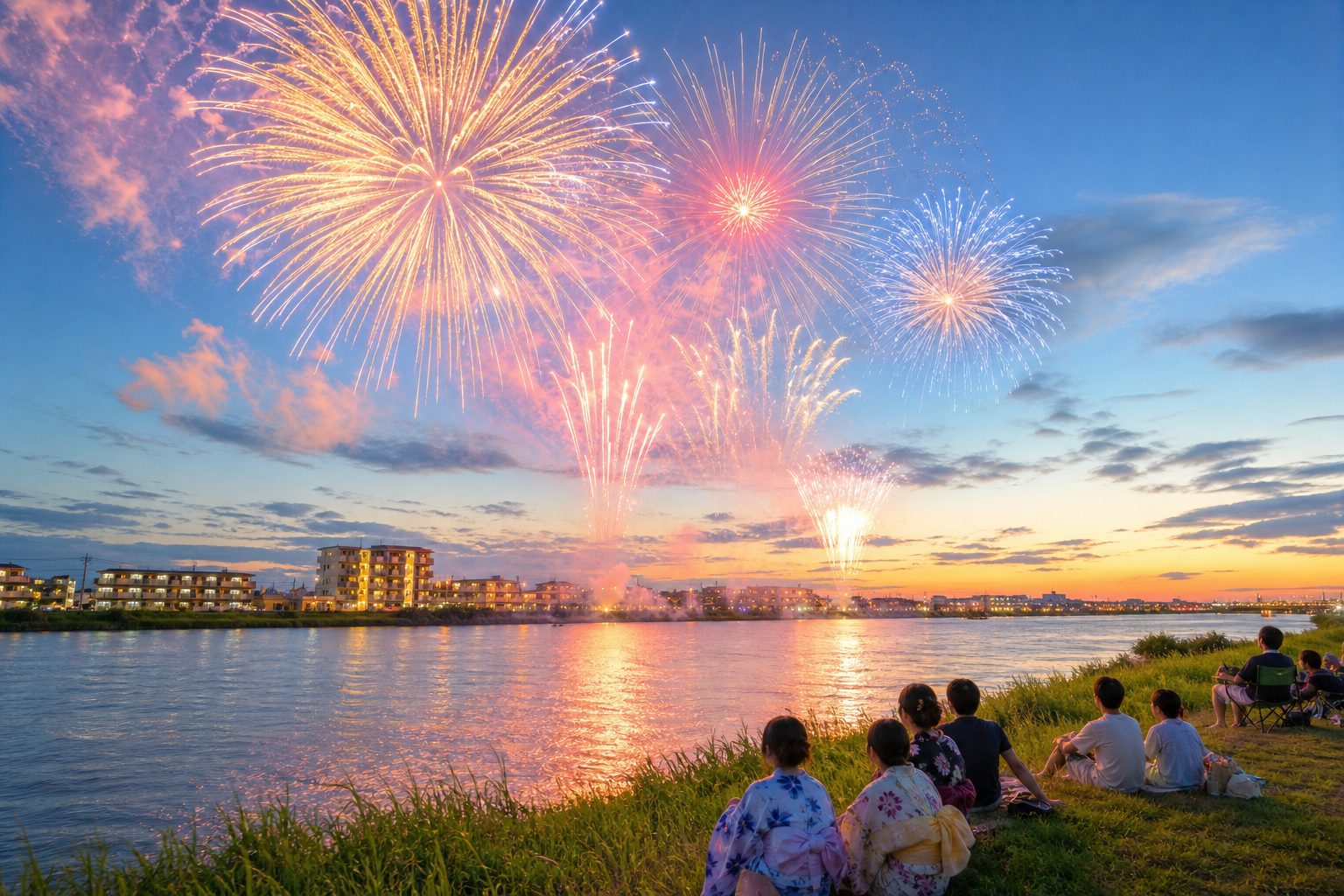
Date, Time, Venue, and What Changed in 2026
| Item | Official 2026 information |
|---|---|
| Date | Saturday, August 1, 2026 |
| Fireworks | 7:00 p.m.–8:30 p.m. |
| Itabashi venue | Arakawa riverbank on the south/Itabashi side |
| Combined display | About 15,000 fireworks with the simultaneous Toda Bridge event |
| Severe weather | Cancellation; no postponement |
| Day-of announcement | Organizer posts a status update at 10:00 a.m.; conditions can still cause a later cancellation |
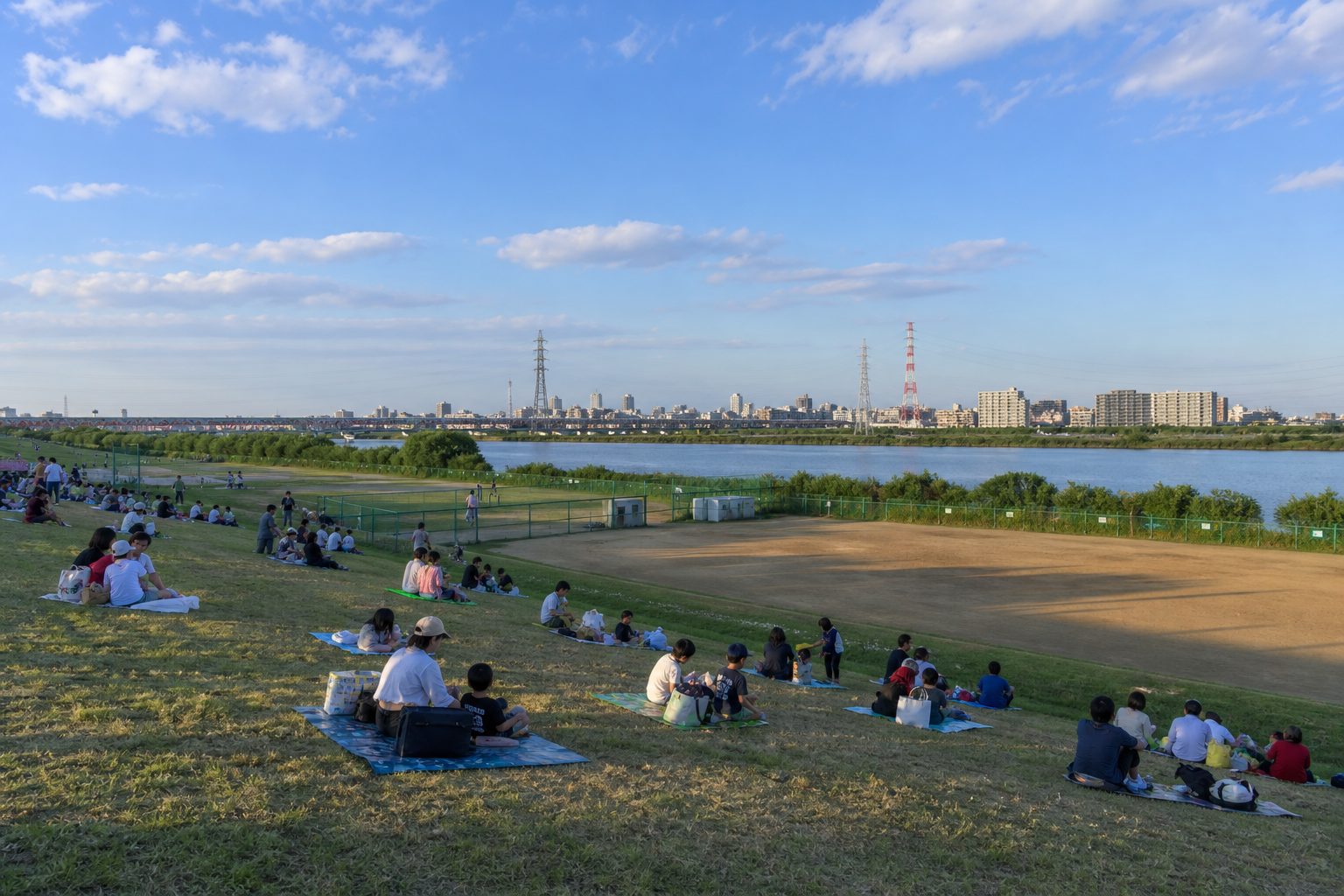
The free viewing area that used to sit on the downstream side has moved to the upstream baseball grounds. The former free baseball grounds and areas 14–17 are now a ¥2,000 paid unreserved area. This is why an old blog post, saved map, or last year’s station advice can send you to the wrong entrance.
The official rule is simple: free-area visitors use Takashimadaira Station and walk about 20 minutes toward the upstream grass field. Visitors with paid tickets should use the station assigned to their zone, generally Nishidai or Hasune. The free area can stop admitting people when it reaches capacity.
Before leaving your accommodation, open the official 2026 overview and layout change rather than relying on a generic map search.
Itabashi Side or Toda Side? Choose Before You Travel
The fireworks are presented together across the Arakawa, but Itabashi and Toda are separate operations.
| Your priority | Better starting choice | Why |
|---|---|---|
| You need a free official viewing area | Itabashi | Itabashi has an upstream free area; admission can close at capacity |
| You already hold an Itabashi ticket | Itabashi | Your ticket corresponds to an Itabashi-side zone and station |
| You already hold a Toda ticket | Toda | Toda’s venue is all paid seating in 2026 |
| Your hotel route strongly favors the Toei Mita Line | Itabashi | Itabashi access is organized around Takashimadaira, Nishidai, and Hasune |
| You want to decide after arriving | Neither | Late cross-river improvisation adds walking and can conflict with controlled routes |
Toda City states that its 2026 venue is all paid seating. If you have no Toda ticket, do not travel to the Toda side expecting to find an official free section. If you have an Itabashi ticket, it does not grant access to Toda seating, and vice versa.
Choose by ticket and train line, not by which bank looks closer in a map app.
Free, Paid Unreserved, or Reserved? A Practical Decision Table
| Plan | Cost | What you get | Main trade-off | Station rule |
|---|---|---|---|---|
| Upstream free area | Free | Official general viewing area | No reserved position; entry can close when full | Takashimadaira |
| Paid unreserved area | ¥2,000 per person | Entry to a defined former free-viewing zone; choose a spot inside | Bring a sheet; space is limited to 90 × 90 cm per person | Hasune according to the access guide |
| A seat | ¥4,500 per person | Assigned stepped seating with a cushion | Niagara feature appears smaller from this area | Nishidai or Hasune, depending on zone |
| S seat | ¥5,000 per person | Assigned seating closer to the launch area | Niagara is viewed at an angle | Nishidai or Hasune, depending on zone |
| Stadium chair | ¥5,500 per person | Chair seating in the athletics stadium | Official page says the Niagara feature is not visible | Nishidai |
| Prime seat | ¥6,000 per person | Front-facing premium stepped seating | Higher price and availability may be limited | Nishidai or Hasune |
Prices above are the official listed prices checked on July 15, but remaining inventory can change. Group and table products also exist. Use the official paid-seat and ticket page to check availability and the exact position before purchasing.
The paper-ticket rule can ruin a good plan
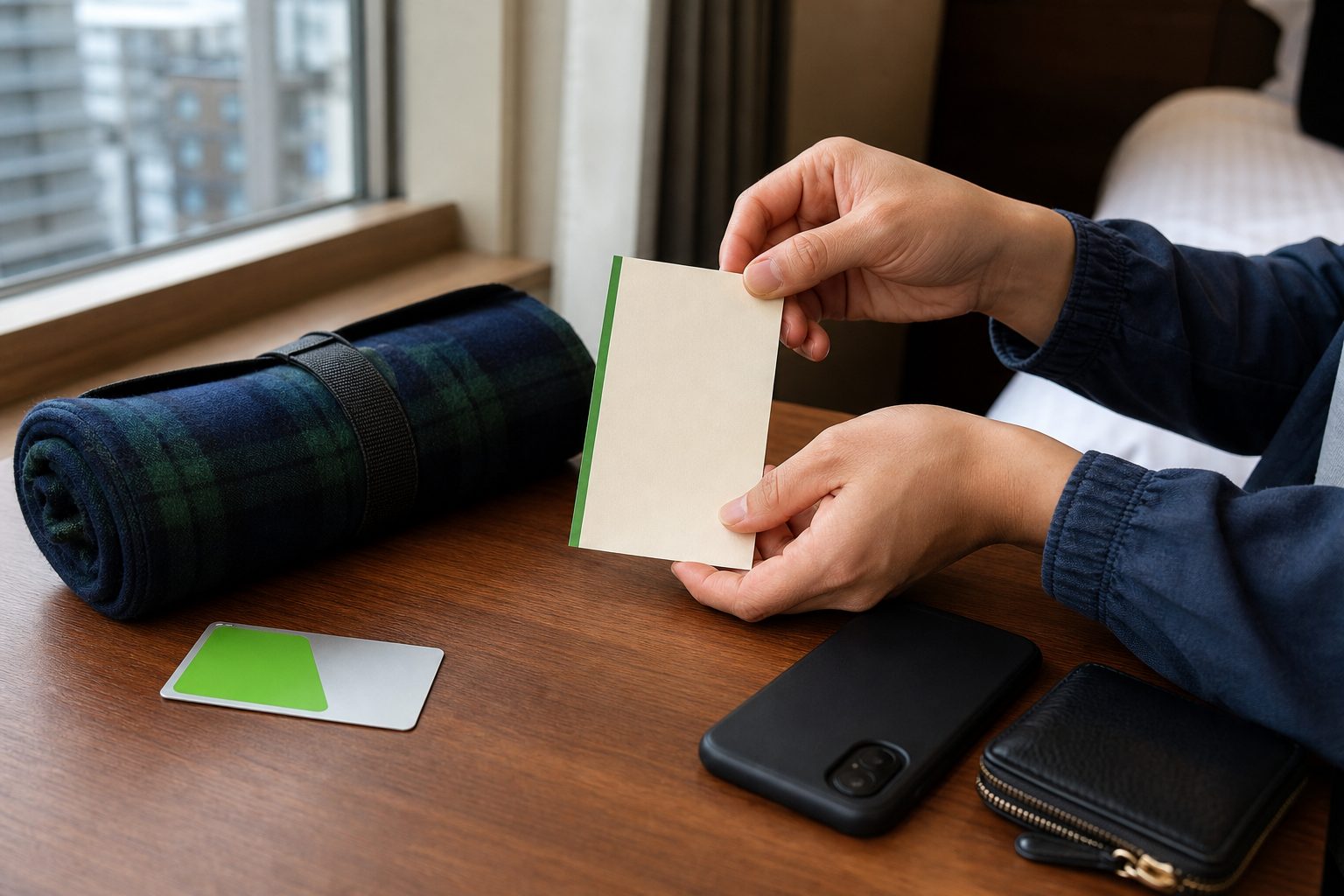
Paid-seat entry requires one paper ticket per person. A purchase email or phone screen is not sufficient. Collect the ticket before the event day; convenience-store machines near the venue may be overloaded.
Paid areas open at 5:00 p.m. Keep the ticket stub with you if you leave the seating area for a toilet or shop; the stub is required for re-entry. Except when the event itself is canceled, purchased tickets generally cannot be changed or refunded.
How to Reach the Correct Itabashi Entrance
No ticket: Use Takashimadaira Station
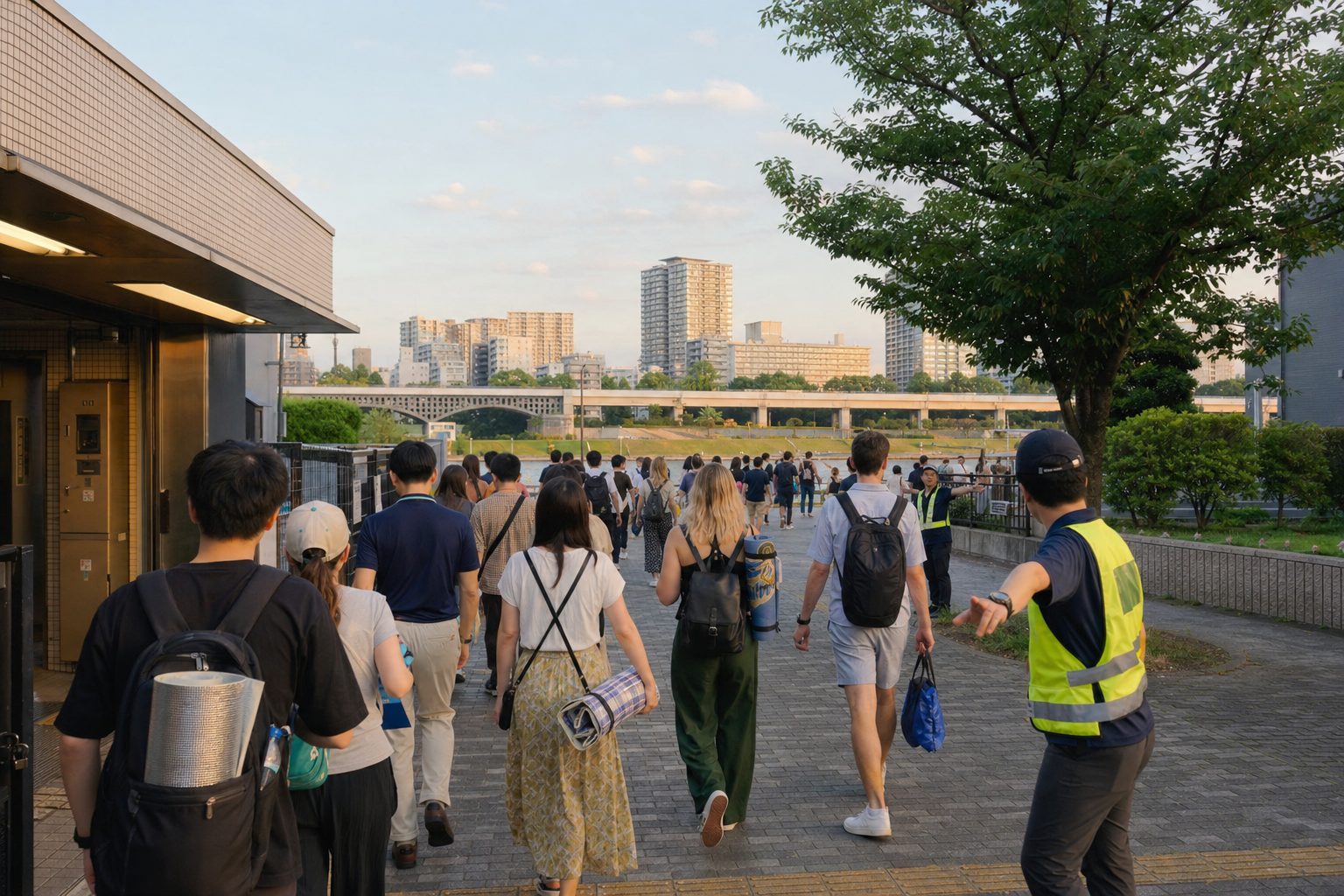
Take the Toei Mita Line to Takashimadaira Station. The official walking estimate to the upstream free area is about 20 minutes. Follow event signs.
Do not use Nishidai or Hasune for the free area. After 5:00 p.m., people without a paid ticket cannot use the riverside road through the paid zone to walk upstream. A route that looks possible on a normal map may therefore be blocked on event day.
Paid unreserved ticket: Hasune Station
The official access page directs holders of paid unreserved tickets to Hasune Station, about 20 minutes on foot. Although the seat page lists JR Ukima-Funado as geographically close, the event’s main access warning asks visitors to avoid it because the station and platforms can become dangerously crowded. Use the Toei Mita Line.
Reserved ticket: Nishidai or Hasune
Use the station shown for your exact area. The athletics stadium uses Nishidai; prime, S, and A zones vary between Nishidai and Hasune. Do not choose a station from the ticket class name alone—check the seat map because the same class can exist in more than one part of the venue.
Do not plan to arrive by car or bicycle
Vehicle restrictions run approximately 5:00–10:00 p.m., with no nearby parking or venue bicycle parking. Buses may be delayed, and several nearby stops suspend service after 5:00 p.m. Rail plus walking is the robust plan.
A Crowd-Aware Arrival Timeline
The times below are an RJG planning model, not official admission guarantees. Heat, ticket type, and free-area capacity should determine how early you go.
Before 3:00 p.m.: prepare for prolonged heat
The official FAQ allows free-area place-holding from the event morning but does not protect an unattended sheet. Long exposure adds heat risk, so plan shade breaks, water, salt, and an exit if you feel unwell.
Around 3:00–4:00 p.m.: practical for a free-area attempt
This gives you time to walk from Takashimadaira and check the new layout. It does not guarantee admission or a preferred position; access closes at capacity.
Around 4:00–5:00 p.m.: prepare before paid areas open
Shops and food trucks are expected to open around 4:00 p.m.; hours and payment methods vary. Paid areas open at 5:00 p.m. Have your paper ticket ready.
After 5:00 p.m.: route flexibility decreases
Vehicle controls begin, nearby bus stops change, and non-ticket holders cannot use the paid-area riverside road as a shortcut to the free section. If you are going to the free area, stay committed to Takashimadaira rather than trying to approach from downstream.
7:00–8:30 p.m.: the display
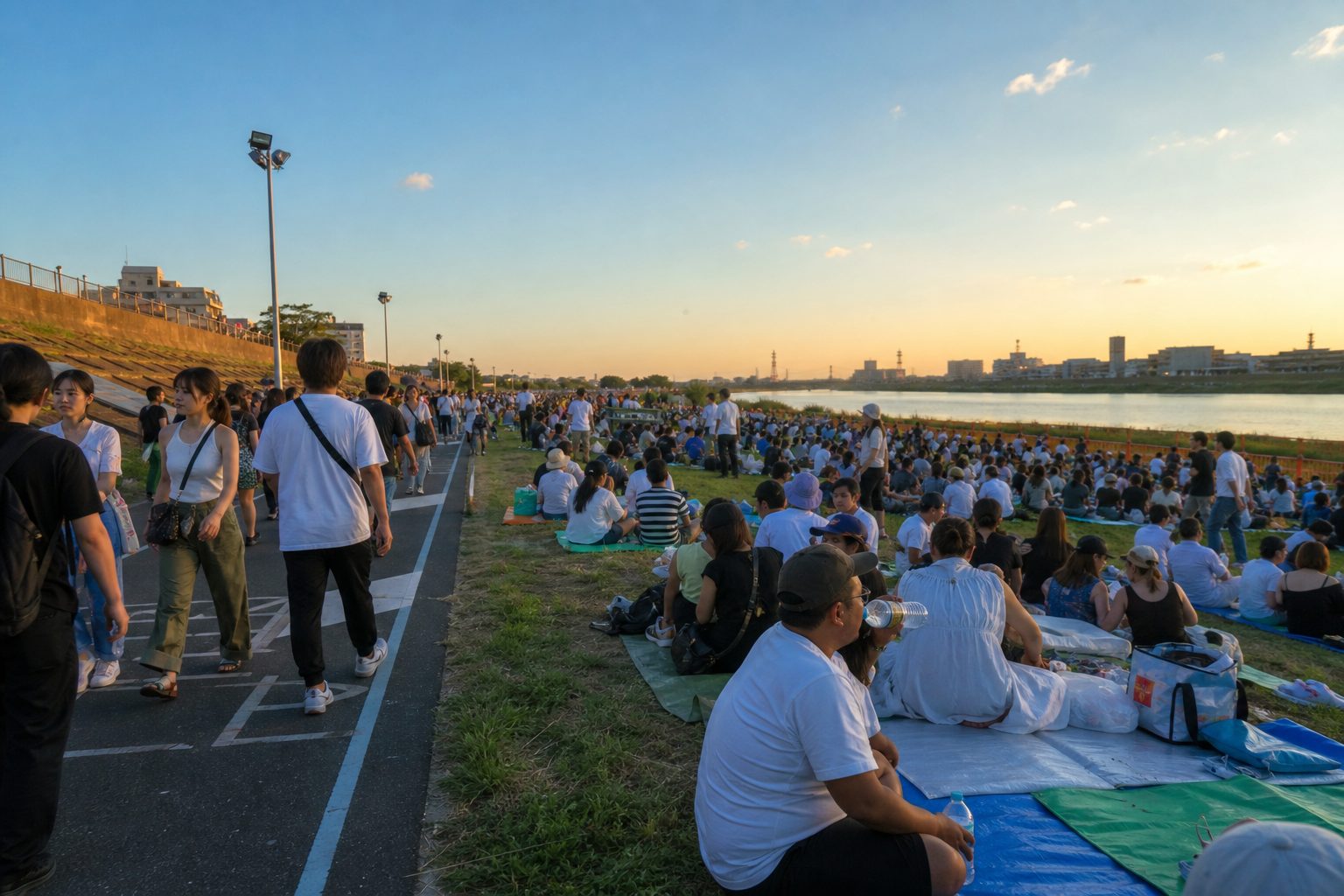
Use the toilet before the program begins. Mobile service can become difficult, so agree on a physical meeting point before your group separates.
Heat, Food, Toilets, Cash, and What to Carry
Food and drink
The official FAQ lists shops and food trucks, and outside food and drink are permitted. Buy a dependable meal and water before entering because queues grow near showtime.
Electronic payment may fail when networks are congested, so the organizer recommends carrying cash.
Toilets and phone service
Temporary toilets are installed, but long lines form later. Phone connections also deteriorate, so screenshot the map, hotel address, route, and meeting point.
Packing list
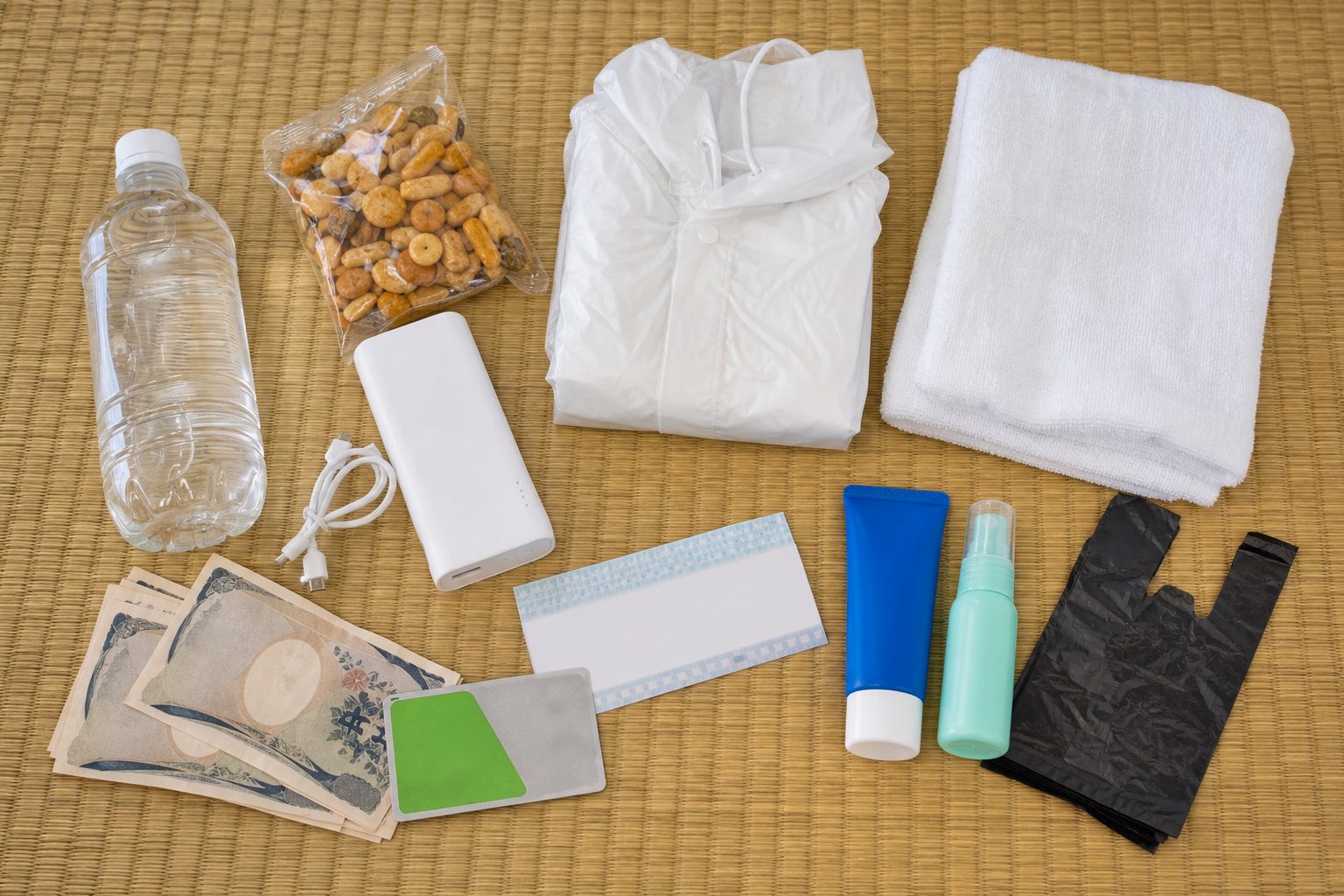
- Water, salt tablets or a salty snack, and a meal
- A compact sheet for the free or paid unreserved area
- A paper ticket for each paid-area visitor
- Cash plus a pre-charged Suica, PASMO, or other compatible IC card
- Phone power bank and offline screenshots
- Light rainwear or a poncho; avoid opening an umbrella in the viewing crowd
- Small towel, hand wipes, sunscreen, and insect repellent
- A rubbish bag for what you carry in
For a broader hot-weather plan, read the Japan Heat Survival Guide. For IC-card basics, see the Suica, PASMO, and ICOCA Guide.
Rain, Wind, and a Real Cancellation Plan B
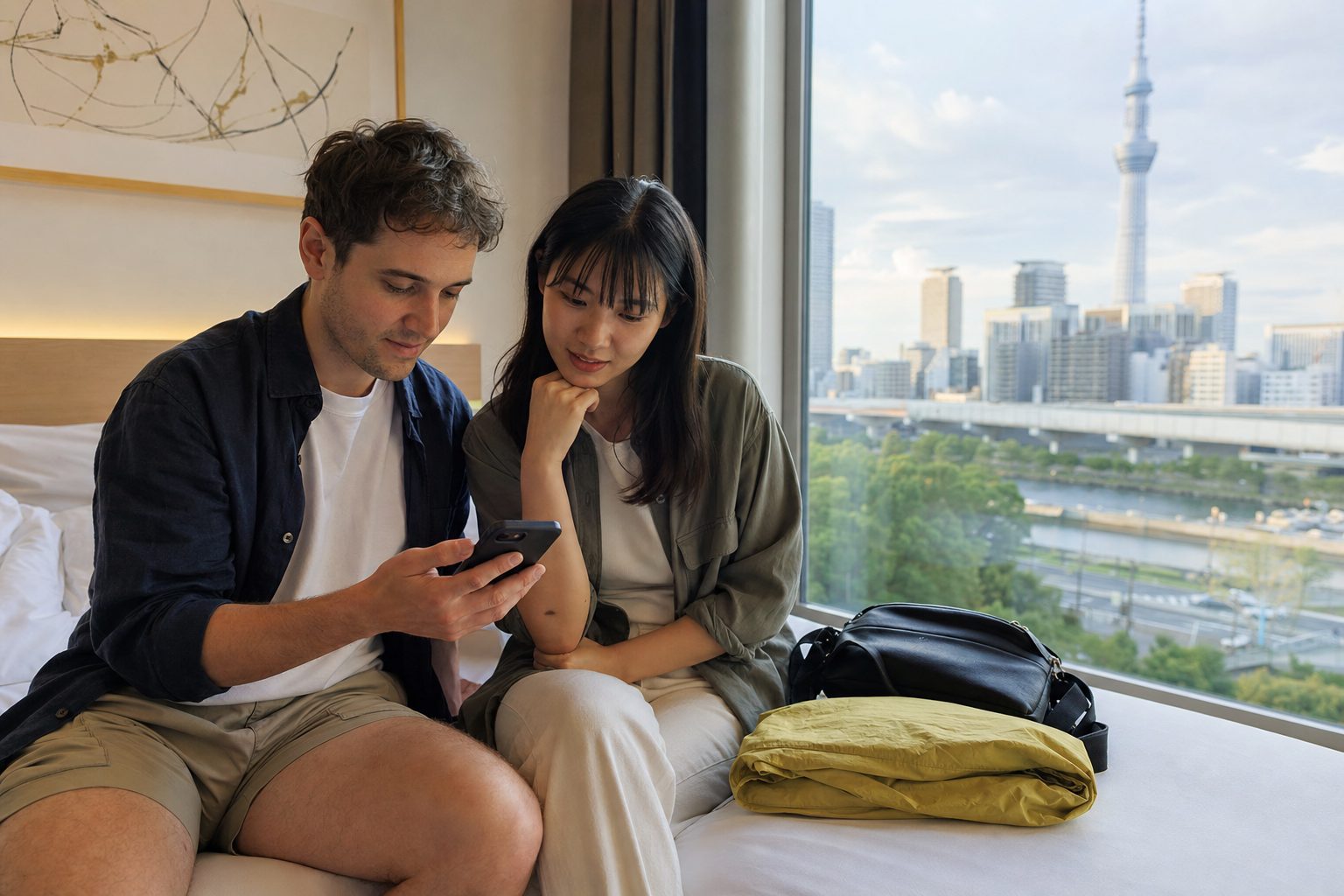
The festival is canceled for severe weather and is not postponed to another day. The organizer says it will publish a status update at 10:00 a.m. on August 1 on the official website and social accounts. A later cancellation remains possible if conditions worsen.
Do not decide from a weather-app icon alone. Use this sequence:
- Check the official event site at 10:00 a.m.
- Check again before leaving your accommodation.
- Check once more before entering the long walk from the station if conditions are unstable.
- If rain is possible but the event continues, bring a poncho. The official FAQ asks people not to use umbrellas in the viewing area because they obstruct others.
If canceled, do not travel to Takashimadaira to inspect the venue. Switch to an indoor activity near a major station on your side of Tokyo. Ticket holders should retain the paper ticket and follow official refund instructions.
How to Leave Without Creating a Second Problem
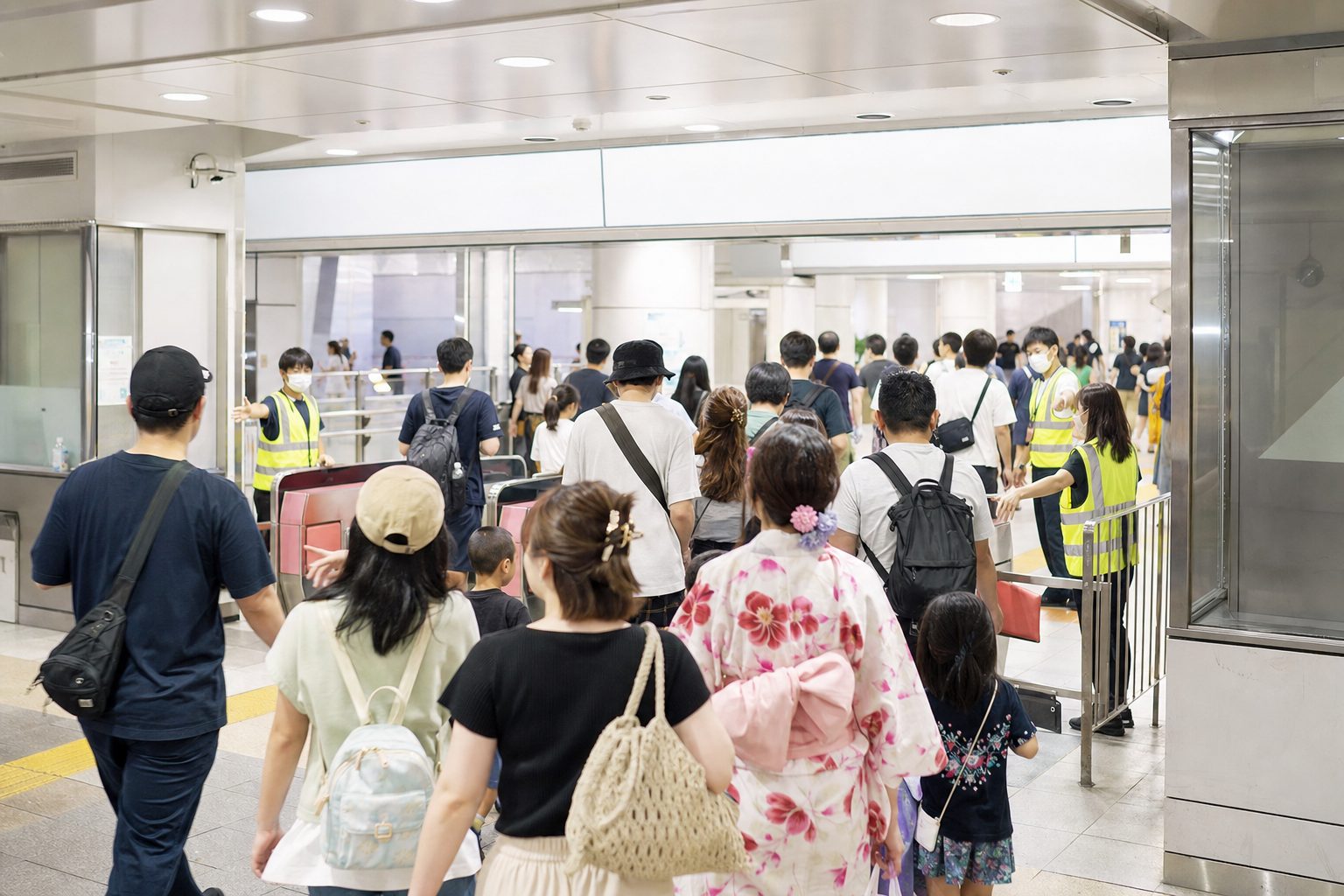
Free-area visitors should not improvise a downstream station switch through controlled venue roads. Reduce tasks before the finale and manage your timing at Takashimadaira.
Before 7:00 p.m.
- Charge your IC card. The official site warns that ticket machines and station windows become heavily congested after the event.
- Screenshot the train route and last practical connection to your accommodation.
- Put your group meeting point in writing.
- Decide whether seeing the final seconds is more important than a fixed connection.
Option 1: Leave shortly before the finale
For a reserved train or hard last-train connection, leaving several minutes early may let you start before more spectators begin moving. You will miss part of the display, and routes remain busy.
Option 2: Stay for the finale, then do not sprint
If flexible, let the immediate surge begin while you collect belongings and follow release instructions. Move when staff ask your section to leave.
Option 3: Build slack into the night
Avoid a tightly timed restaurant reservation or intercity connection after 8:30 p.m. A realistic plan assumes slow walking, station admission controls, and at least one train departure you may not board.
Do not use JR Ukima-Funado as an escape shortcut. The organizer warns of dangerous station and platform crowding and asks visitors to use the Toei Mita Line. Do not rely on a taxi near the controlled zone.
For a backup beyond the event area, use the Tokyo Last Train and Taxi Plan.
Common Mistakes to Avoid
- Using a 2025 map. The free area moved upstream for 2026.
- Going to Nishidai or Hasune without a ticket. Free-area visitors are directed to Takashimadaira.
- Choosing JR Ukima-Funado because it looks close. The official access warning asks visitors to avoid it.
- Showing a phone ticket instead of paper. Paid entry requires a paper ticket.
- Printing the ticket near the venue. Local convenience stores and ticket machines can be overwhelmed.
- Assuming Toda has free viewing. Toda City says its 2026 venue is all paid seating.
- Depending on mobile payment. Network congestion can interrupt electronic transactions; carry cash.
- Waiting until showtime to use the toilet. Later lines are expected to be long.
- Opening an umbrella in the viewing crowd. Use a poncho or raincoat.
- Following a normal map through the paid zone after 5:00 p.m. Event controls override the everyday walking route.
For general crowd etiquette and preparation, read the Japan Festival Survival Guide.
Your Final Three-Step Plan
- Choose the river side and ticket type now. No Itabashi ticket means the upstream free area and Takashimadaira. A Toda plan requires a Toda ticket.
- Save the live official instructions. Open the official Itabashi access and traffic-control guide and the official 2026 overview before traveling.
- Protect the trip home. Pre-charge your IC card, avoid JR Ukima-Funado, and leave enough time for controlled walking and station entry.
If you are comparing other displays on the same date or later in the season, use the Japan Summer Fireworks 2026 Guide.
Frequently Asked Questions
When is Itabashi Fireworks 2026?
It is scheduled for Saturday, August 1, 2026, from 7:00 p.m. to 8:30 p.m. Severe weather can cancel the event, and there is no postponement date.
Is Itabashi Fireworks free?
Itabashi has a free viewing area in 2026, but it has moved to the upstream baseball grounds. Admission can be restricted when the area reaches capacity. Other parts of the venue require paid tickets.
Which station should I use for the free area?
Use Takashimadaira Station on the Toei Mita Line. The official estimate is about 20 minutes on foot. Do not approach the free area from Nishidai, Hasune, or JR Ukima-Funado.
Which station should I use with a paid ticket?
It depends on the exact seating zone. The paid unreserved area uses Hasune; reserved areas use Nishidai or Hasune depending on their position. Check the official map linked to your ticket.
Can I enter with a ticket on my phone?
No. The organizer requires one paper ticket per person for paid-area entry. Collect it from the designated convenience-store system before the event day.
What changed at Itabashi Fireworks in 2026?
The free area moved upstream. The former free baseball grounds and areas 14–17 became ¥2,000 paid unreserved viewing. This also changed which station visitors should use.
Can I watch from the Toda side for free?
Toda City says the official Toda venue is all paid seating in 2026. A ticket for one side does not provide access to the other side’s seating operation.
Are food and drinks available?
Yes. The official FAQ lists shops and food trucks, and it permits outside food and drinks. Vendors get busier near showtime, payment methods vary, and the organizer recommends carrying cash because mobile service can fail.
Are there toilets?
Temporary toilets are installed throughout the venue. Long queues are expected later, so use them early.
What happens if it rains?
Check the official 10:00 a.m. announcement and later updates. Severe weather cancels the event with no postponement. If the event continues in rain, use a poncho rather than an umbrella in the viewing area.
How should I get home after the fireworks?
Pre-charge your IC card, save your route offline, and allow time for controlled exits and station queues. Free-area visitors should return via Takashimadaira rather than trying to cross the paid zone. The organizer asks everyone to avoid JR Ukima-Funado.
Comments