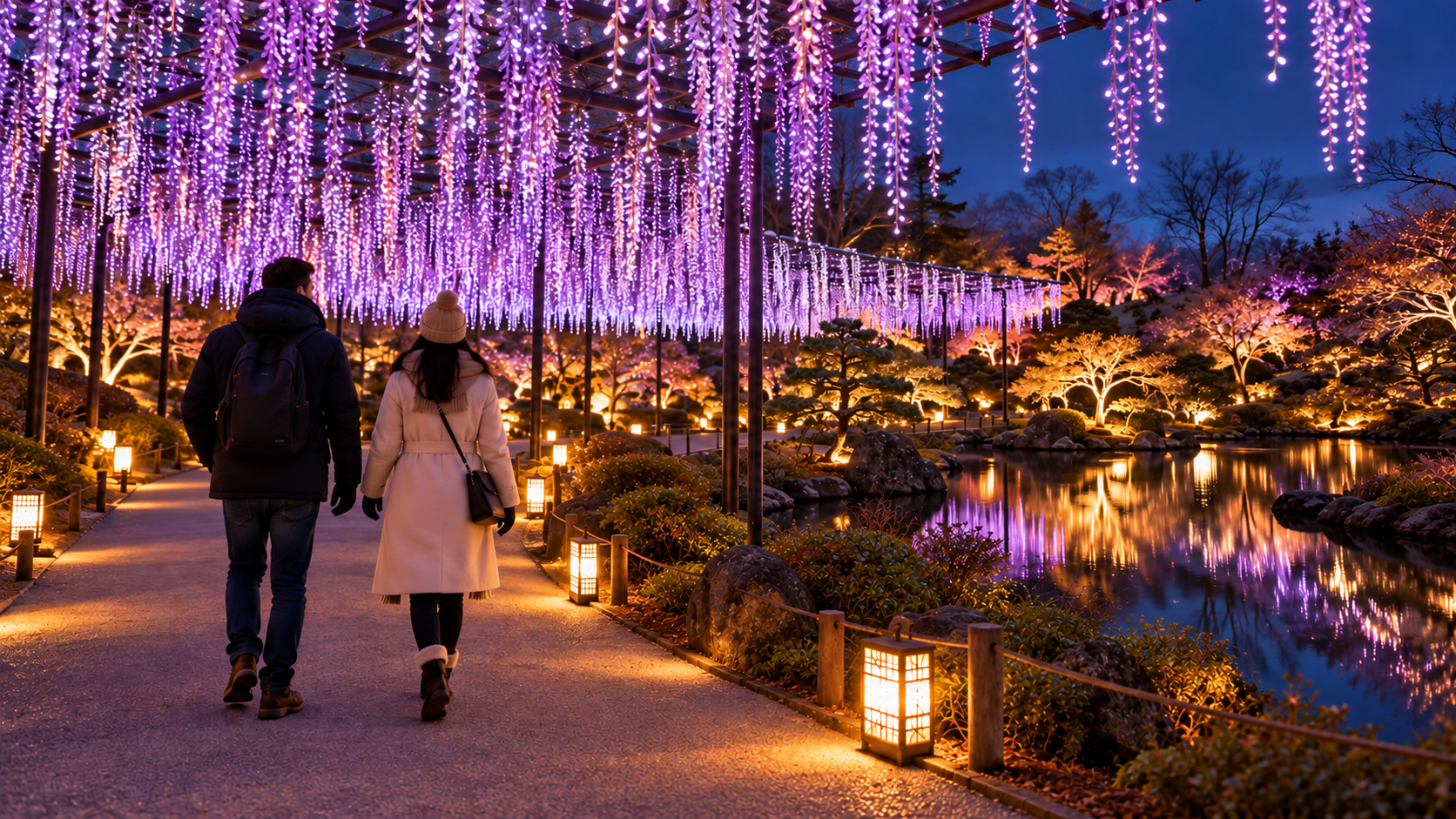
Featured image: AI-generated conceptual night garden; not a photograph of Ashikaga Flower Park or its current displays.
Quick answer: Ashikaga Flower Park’s Flower Fantasy runs October 17, 2026–February 14, 2027, with December 31 closed. Evening admission starts at 3:30 p.m.; the lights start later. Use JR Ashikaga Flower Park Station, choose a night-session ticket, and plan the return connection before leaving Tokyo. Standard adult night admission is ¥1,500; the operator also lists ¥1,450 convenience-store advance admission.
This is a trip to Tochigi, outside Tokyo, rather than a light display you can casually add after dinner in Shinjuku. Give the garden its own afternoon and evening. The most useful preparation is a dated train plan, enough time after dark and a clear point at which to head home.
Checked October 17, 2026. This is a researched guide; no firsthand visit is claimed. All six images are AI-generated illustrations, not evidence of actual entrances, railway platforms, installations or weather. Follow current venue and railway notices.
- Match your date to the evening hours
- Choose night admission before comparing ticket prices
- Use the full JR station name
- Plan a short garden walk, then leave room to linger
- Prepare for an outdoor evening and a food stop
- Choose the return connection before the final photograph
- Frequently asked questions
- Is Flower Fantasy the spring wisteria festival?
- Do the lights start when evening admission opens?
- Can I visit on New Year’s Eve?
- Can I stay for the lights with a daytime ticket?
- Which station should I type into my route planner?
- Is a pair set simply two discounted admissions?
- Which published child price should I rely on?
- Is there one safe last-train time for every Tokyo hotel?
- Can I bring a picnic or leave and re-enter for dinner?
- Official sources
Match your date to the evening hours
The current Japanese event page gives the following schedule. Dates in January and February are in 2027. Admission opening, switch-on and closing are different times.
| Visit date | Closing: weekdays / weekends and holidays | Approximate switch-on |
|---|---|---|
| October 17–November 6 | 8:30 / 9:00 p.m. | 5:00 p.m. |
| November 7–January 3, except December 31 | 9:00 / 9:30 p.m. | 4:30 p.m. |
| January 4–February 14 | 8:30 / 9:00 p.m. | 5:00 p.m. |
Evening entry opens at 3:30 p.m. throughout these announced windows. December 31 is closed. Recheck the dated notice before travel; a season-wide date range does not guarantee unchanged operations.
Arriving at opening gives you time to orient yourself, but it does not give you a fully dark garden immediately. If photographs are the priority, keep some visiting time after switch-on. If you dislike waiting outdoors, choose a later arrival that still leaves a comfortable gap before your return train.
The daily admission page says ticket sales finish 30 minutes before closing and re-entry is unavailable. Treat that sales deadline as a cutoff, not a recommended arrival time or proof of a separate last-entry rule for every ticket type.
Choose night admission before comparing ticket prices

Daytime and nighttime admission are separate sessions. A spring flower ticket, a daytime price or a photograph of blooming wisteria does not establish what your winter evening ticket covers. Check the session printed on the product before paying.
| Adult option | Published amount | What to compare |
|---|---|---|
| Standard night admission | ¥1,500 per person | Admission only |
| Convenience-store advance night admission | ¥1,450 per person | Validity and ticket issuance |
| Seven Ticket pair set | ¥3,300 | Two adult admissions plus a ¥500 merchandise voucher |
The operator’s October 1 advance-ticket notice lists these advance products. It distinguishes date-specific electronic tickets from convenience-store tickets; do not assume identical delivery or change conditions.
Two ordinary advance adult tickets total ¥2,900. The pair set costs ¥400 more and adds a ¥500 voucher. It saves ¥100 compared with buying those advance admissions and spending another ¥500, only if you use the voucher as allowed. Its published expiry is February 14. A voucher you will not use is not a reason to buy the larger bundle.
Traveling with children? The daily fee page, ticket notice and operator’s October 14 announcement list standard night admission at ¥800 for ages four through elementary school. The Japanese event page instead shows ¥900. Confirm the current child price on the actual ticket or at the counter before paying; the official pages disagree.
Use the operator’s ticket notice as your starting point. Check the event year, night session, visit date or validity period, adult/child category, delivery method and cancellation conditions. Save the issued ticket and instructions before leaving your accommodation. Buying admission does not reserve a seat on a train.
Use the full JR station name
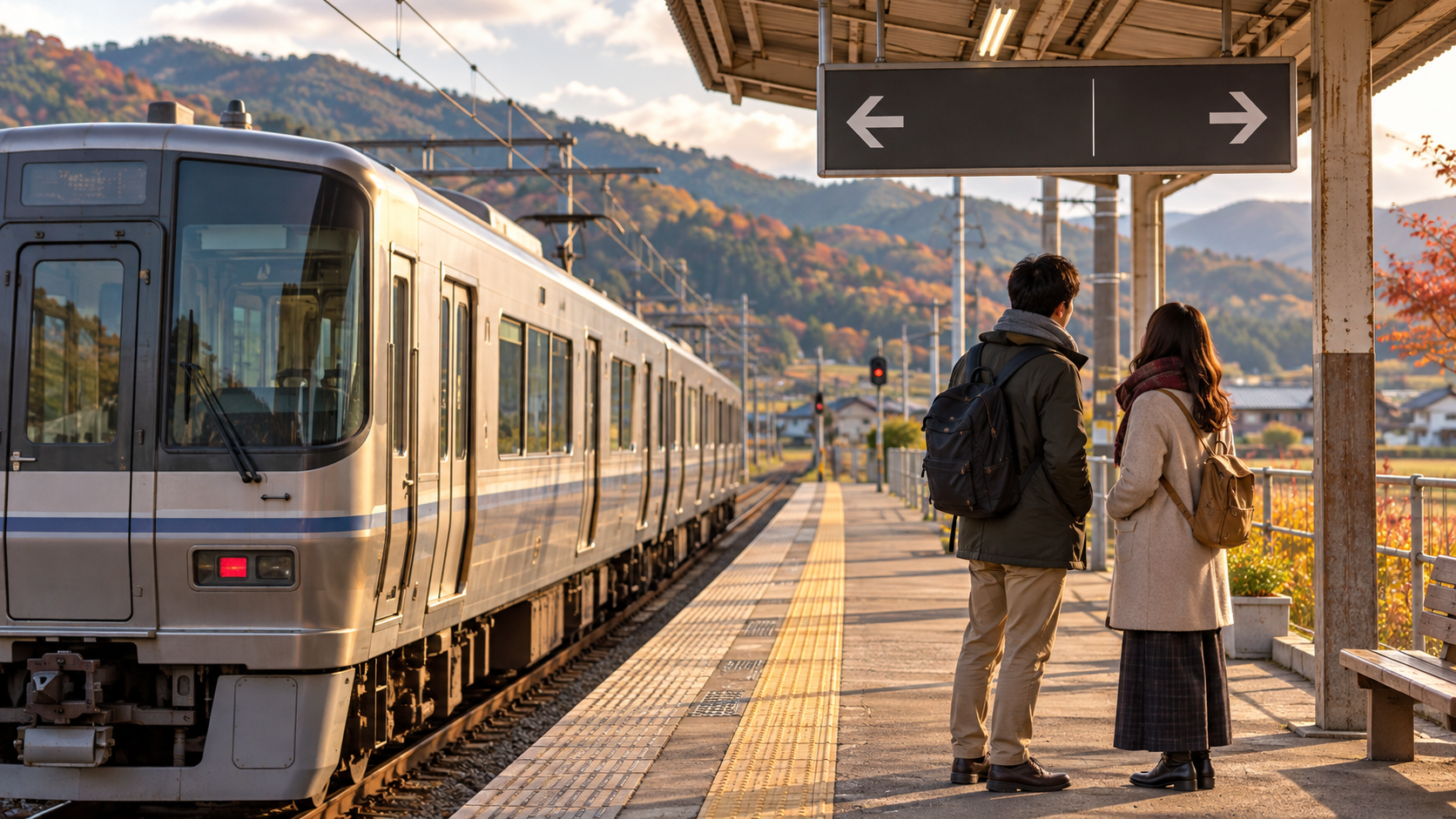
Enter Ashikaga Flower Park Station / あしかがフラワーパーク駅 as the rail destination. The park’s access page recommends this JR Ryomo Line station. JR Ashikaga and Tobu Ashikagashi are different destinations; selecting a shorter-looking name can leave you with a different final journey.
For a straightforward JR approach from the Ueno side of Tokyo, the operator describes traveling to Oyama and changing to the Ryomo Line. Search from your real starting station for your actual date. Some itineraries use a Shinkansen segment, while others use ordinary trains; compare the full journey and its fare rather than assuming “JR” means one ticket price.
JNTO’s park introduction puts the walk from the dedicated station at about three minutes. That is a walking estimate, not a promise that you can step off a crowded train and immediately enter the garden. Leave time for the station exit, ticket checks and finding your way.
If your planner offers a Tobu route, inspect every transfer and the last station. The park says there is no shuttle from Tobu Ashikagashi Station. Do not build the evening around an assumed shuttle or follow a spring-only transport arrangement without checking that it operates on your winter date.
Save the station name in Japanese, your accommodation address and the return route. For help reading transfer choices, see our Japan Google Maps guide. A route screenshot is a backup for navigation; it does not replace checking live disruption information.
Plan a short garden walk, then leave room to linger
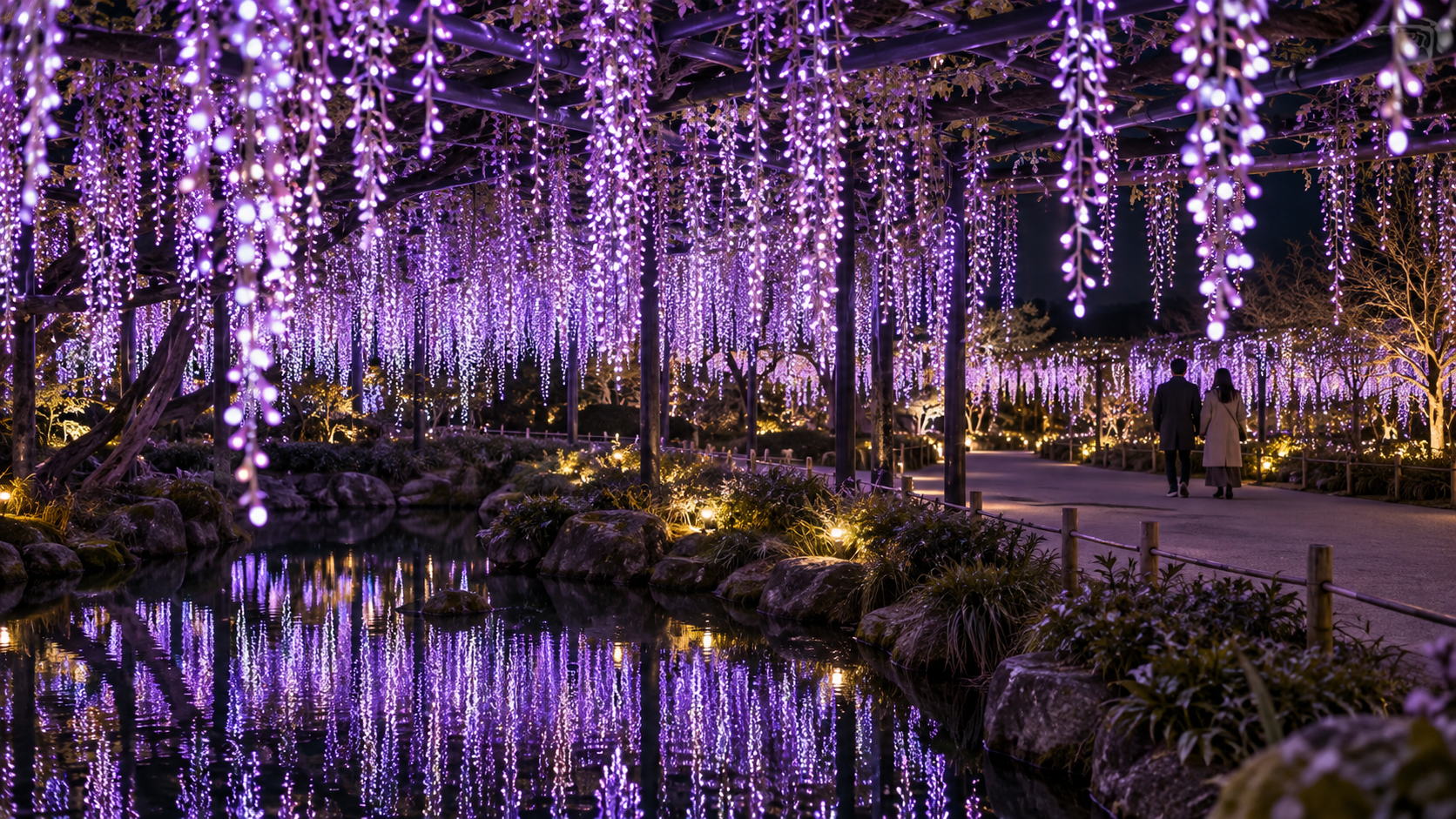
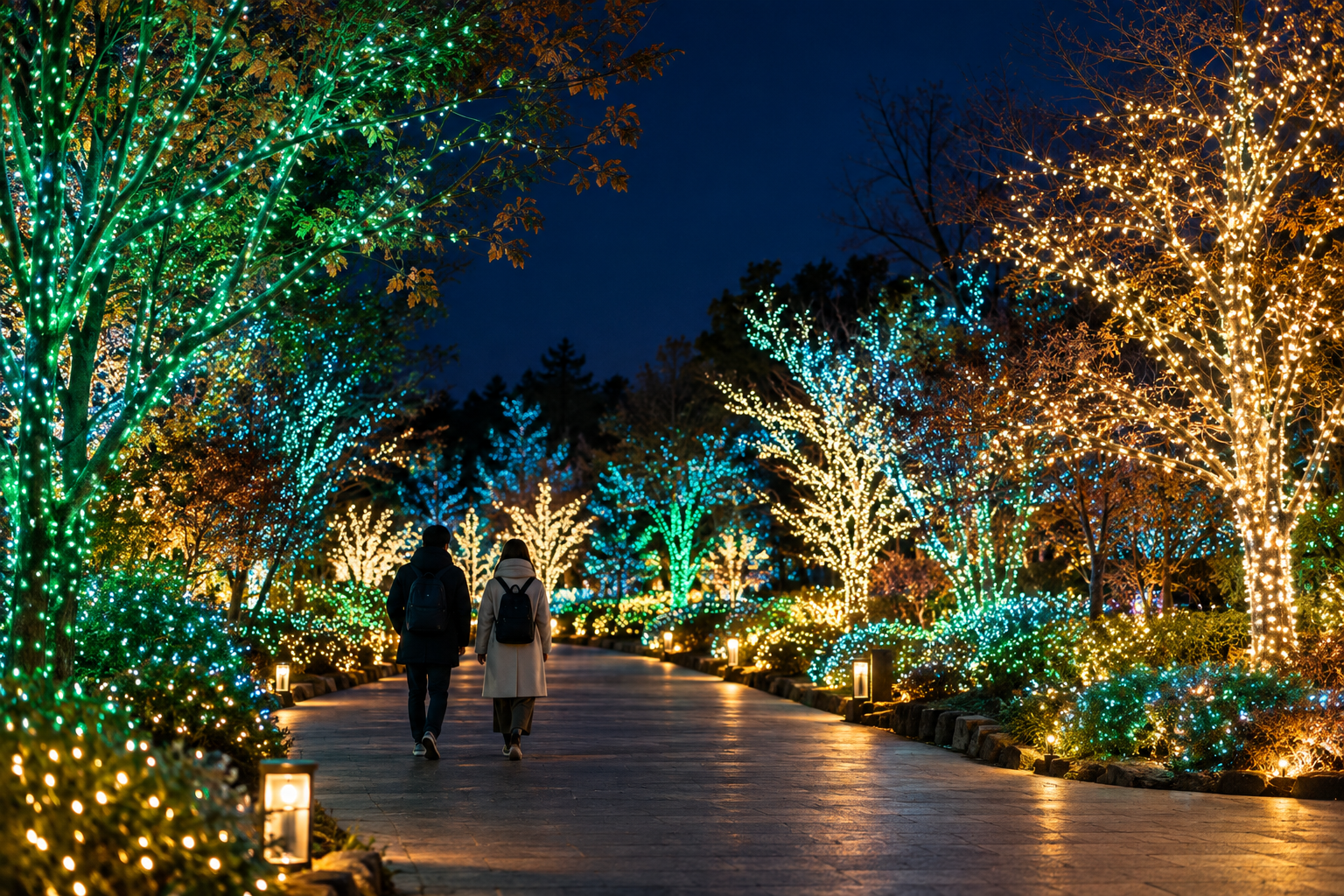
The 2026 operator announcement describes more than five million lights and a renewed anniversary presentation. The appeal is the contrast between hanging light forms, illuminated garden scenes and reflections. These are winter light installations; do not expect spring’s living wisteria flowers.
A manageable visit does not need an exact photographic checklist. Pick two or three displays that interest you from the current park map, allow a warm break and keep the exit direction in mind. Use signs and staff instructions on the day rather than treating an illustration or an old social-media route as a map.
As an editorial planning allowance, reserve about two hours inside after dusk if your rail connections permit. This is not an official tour duration or a guarantee that every installation will be covered. Add time if you want a meal or careful photographs; shorten the visit if someone is cold, tired or uncomfortable in the crowd.
With companions, agree on a meeting point before separating for photographs. Pause at a wide space rather than stopping everyone in a narrow passage. One person can check the next step while the others move out of the walking line. The useful goal is an enjoyable evening, not completing every possible angle.
Prepare for an outdoor evening and a food stop
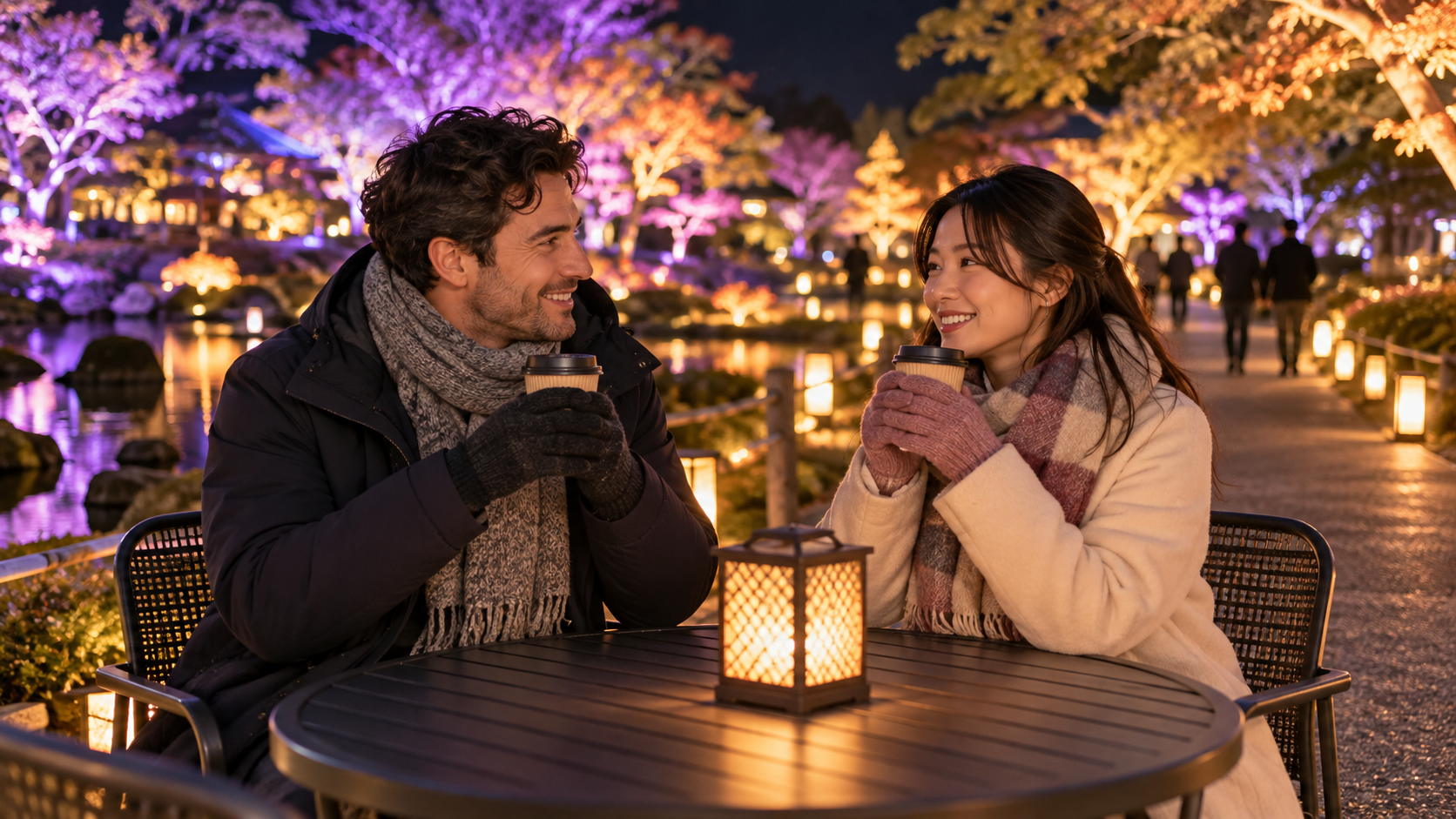
Bring layers, a wind-resistant outer garment, comfortable shoes and a charged phone. Gloves are useful when you stop moving to take pictures. Check the local forecast for Ashikaga rather than assuming central Tokyo conditions will suit an evening outdoors. Our pictures do not show a weather forecast.
The park’s Japanese FAQ prohibits bringing in food and drinks, and directs eating to food areas. Plan your meal around that rule instead of packing a picnic for the grounds. Its restaurant guide describes dining and snack options, but check opening times and availability on your visit date.
If a timely dinner matters, eat before entering or allow a dedicated stop inside. Do not use a restaurant queue as your only warm-up plan when a return connection is approaching. Keep enough flexibility to choose a simpler meal and leave on time.
Personal photography is allowed. The FAQ permits tripods when they do not obstruct paths, with restrictions possible in crowded areas; fold the legs when carrying one. It prohibits live broadcasting and bringing lighting equipment, reflectors or stepladders. A small setup is easier to manage around other visitors.
For access needs, the park lists a limited first-come supply of free wheelchairs for use inside, and no stroller rentals. That does not establish a fully step-free hotel-to-garden route. Check the station accessibility information and ask the park about the specific paths or assistance your group needs before making the journey.
Choose the return connection before the final photograph
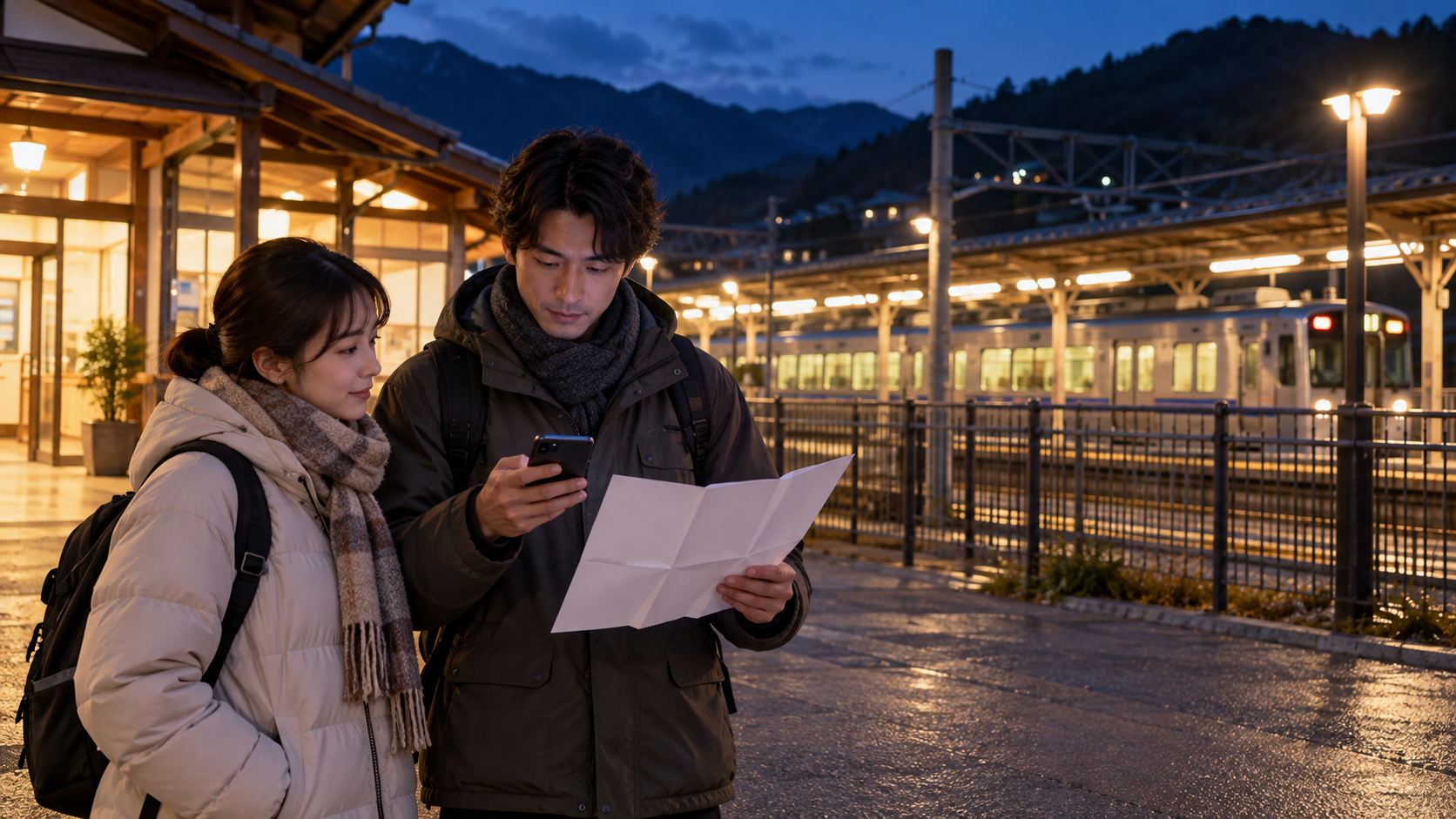
Check the JR station timetable for the correct direction and weekday or weekend/holiday schedule. It separates trains toward Oyama from trains toward Kiryu and Takasaki. For an Oyama connection back toward Tokyo, check that whole connection, not just whether a train leaves the park station.
Save a preferred return and an earlier or later workable alternative. Work backward from the platform departure: allow for reaching the exit, walking to the station and handling a crowd. Choose a personal “leave the garden” time that comes before your chosen departure, then set a reminder on your own phone.
The park specifically warns of crowding at the station when visitors leave and asks travelers to charge their transportation IC cards in advance. Sorting out your balance before the outing removes one avoidable task at the busiest point. A charged IC card still does not guarantee a reserved seat or a particular connection.
If weather, fatigue or disruption changes the evening, leave earlier and simplify the route. If the train plan cannot get you back comfortably, choose a nearer Tokyo outing on another date, such as Tokyo Mega Illumination, checking its separate operating calendar. Do not use the park’s closing time as a last-train time.
Frequently asked questions
Is Flower Fantasy the spring wisteria festival?
No. This guide covers the autumn-to-winter illumination season. The hanging wisteria-like light effects are not a promise of live wisteria flowers.
Do the lights start when evening admission opens?
No. Entry begins at 3:30 p.m.; the announced switch-on is later. Use the date-specific table above and check current notices.
Can I visit on New Year’s Eve?
No. December 31 is the announced closure within this season.
Can I stay for the lights with a daytime ticket?
Do not assume so. The park runs separate day and night sessions. Choose the night product and check its conditions.
Which station should I type into my route planner?
JR Ashikaga Flower Park Station, あしかがフラワーパーク駅. Avoid substituting JR Ashikaga or Tobu Ashikagashi.
Is a pair set simply two discounted admissions?
It also includes a merchandise voucher. Compare it with the plain advance tickets and buy it only if its spending conditions suit you.
Which published child price should I rely on?
Confirm the amount on the current ticket or at the counter. The operator’s own pages have conflicting standard child amounts; do not use an older translated page as a guarantee.
Is there one safe last-train time for every Tokyo hotel?
No. Your date, destination and transfers change the answer. Check the complete return journey and leave a crowd buffer.
Can I bring a picnic or leave and re-enter for dinner?
The park prohibits bringing food and drinks and says re-entry is unavailable. Arrange food before entry or use the designated dining areas.
Official sources
- Ashikaga Flower Park — 光の花の庭2026–2027 特設ページ · checked October 17, 2026
- Ashikaga Flower Park — 当日の料金・営業時間 · checked October 17, 2026
- Ashikaga Flower Park — 2026/10/01 前売入園券案内 · checked October 17, 2026
- Ashikaga Flower Resort (operator) — 2026/10/14 イルミネーション25周年発表 · checked October 17, 2026
- Ashikaga Flower Park — 交通・アクセス · checked October 17, 2026
- JNTO — Ashikaga Flower Park visitor introduction · checked October 17, 2026
- Ashikaga Flower Park — 園内マップ · checked October 17, 2026
- Ashikaga Flower Park — 日本語FAQと園内ルール · checked October 17, 2026
- Ashikaga Flower Park — Restaurant information · checked October 17, 2026
- JR East — Station layout/accessibility information · checked October 17, 2026
- JR East — Ashikaga Flower Park Station timetables · checked October 17, 2026
Comments