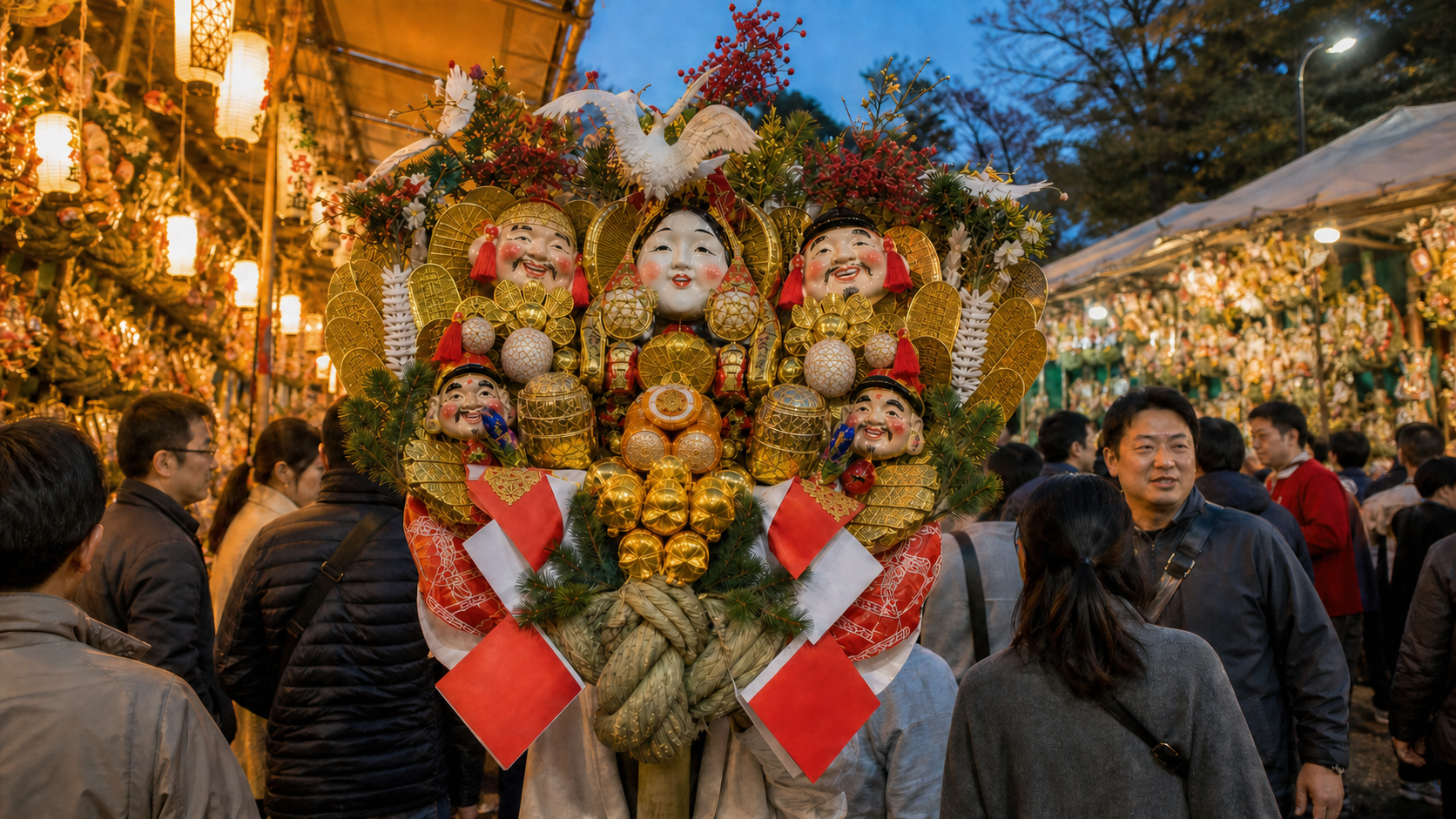
Asakusa Tori no Ichi is a 24-hour November fair of lanterns, food stalls and elaborately decorated kumade rakes associated with good fortune and business prosperity. It is one of Tokyo’s most distinctive late-autumn events—but the word “Asakusa” can send first-time visitors to the wrong place.
The fair is not held in the Sensoji precinct. Chokokuji and Otori Shrine official pages place it in Senzoku, north of central Asakusa. Your choice of station can change the final walk from about seven minutes to more than 20 minutes.
- Quick answer: save Senzoku, not Sensoji
- What is confirmed for Asakusa Tori no Ichi 2026?
- The venue mistake: “Asakusa” does not mean Sensoji
- November 7 or November 19: which date should you choose?
- What time should a first-time visitor go?
- What do you do at Tori no Ichi?
- Crowd and exit plan
- Rain and other Plan B choices
- Useful preparation before you go
- Asakusa Tori no Ichi 2026 FAQ
- When is Asakusa Tori no Ichi in 2026?
- Is Tori no Ichi held at Sensoji?
- Which station is best for Asakusa Tori no Ichi?
- Do I need a ticket or reservation?
- What time should a first-time visitor go?
- Can tourists buy a kumade?
- Does Tori no Ichi happen in the rain?
- What should I do if the fair is too crowded or the date does not work?
Quick answer: save Senzoku, not Sensoji
- 2026 dates: Saturday, November 7, and Thursday, November 19.
- Hours: 00:00–24:00 on each festival date.
- Main venue: Chokokuji temple and Otori Shrine, Senzoku, Taito City.
- Best simple rail approach: Iriya Station Exit 3 on the Tokyo Metro Hibiya Line, about a seven-minute walk according to the organizer.
- Also practical: Tsukuba Express Asakusa Station, about eight minutes on foot.
- Longer “Asakusa” approach: Tokyo Metro Ginza Line or Tobu Asakusa Station is about 20 minutes away; Toei Asakusa Line Asakusa Station is about 22 minutes away.
- Reservation: The official 2026 pages do not announce a general entrance reservation. Specific shrine rites have separate reservation rules.
- Rain: The organizer says the fair normally continues in rain or snow unless conditions create a serious safety or disaster risk. Check the latest notice before leaving.
Before travel, save the address 3-19-6 Senzoku, Taito City, Tokyo 111-0031 and the official access guide. Searching without the Senzoku address or walking from Sensoji can add time and place you on the wrong side of the crowd.
| Your priority | Practical choice | Why |
|---|---|---|
| Shortest official walking reference | Iriya Station Exit 3 | About seven minutes on foot |
| Combining the fair with eastern Asakusa | Tsukuba Express Asakusa Station | About eight minutes on foot |
| Staying near Sensoji or the Ginza Line | Ginza Line/Tobu Asakusa Station | Direct from central Asakusa, but about a 20-minute walk |
| Avoiding Saturday travel | Thursday, November 19 | A weekday option; crowd levels remain unconfirmed |
| Weekend convenience | Saturday, November 7 | Easier for many itineraries; allow more schedule slack |
Theme image: photorealistic editorial reconstruction of an Asakusa Tori no Ichi scene, with a large decorated kumade rake as the unmistakable foreground subject, warm lanterns and an orderly late-autumn crowd; not documentary evidence of the 2026 event.
Information checked August 13, 2026. Recheck the organizer’s current notice for weather, queueing, traffic and stall operations before travel.
What is confirmed for Asakusa Tori no Ichi 2026?
The official Chokokuji and Otori Shrine sites currently agree on the two dates and 24-hour schedule.
| Item | Confirmed as of August 13, 2026 |
|---|---|
| Ichi no Tori | Saturday, November 7, 00:00–24:00 |
| Ni no Tori | Thursday, November 19, 00:00–24:00 |
| Number of fair days in 2026 | Two |
| Main area | Chokokuji temple and Otori Shrine in Senzoku, Taito City |
| General visit | No general entrance booking is stated on the official 2026 pages |
| Special shrine rites | Advance reservation applies to the listed rites; arrive by the organizer’s stated check-in time |
| Prayer service | Offered separately; current shrine terms and fees must be checked before applying |
| 2026 queue layout | Not yet treated as fixed in this guide; follow current signs and staff |
Tori no Ichi is held on the days of the rooster in November. These dates occur at 12-day intervals, so a year can have two or three fairs. In 2026, the first is November 7 and the second is November 19.
The market is known for colorful kumade—decorated bamboo rakes that symbolize gathering good fortune—and for the rhythmic hand-clapping that can follow a sale. Food stalls also fill the streets around the temple and shrine.
The venue mistake: “Asakusa” does not mean Sensoji
This is the most important planning point in the article.
Sensoji, Kaminarimon and the riverside form Asakusa’s central sightseeing area. Tori no Ichi takes place farther north in Senzoku, around Chokokuji and Otori Shrine. The official access guide lists several stations with different walking times.
Use Iriya when the fair is your main destination
The organizer lists Iriya Station Exit 3 on the Hibiya Line as about seven minutes on foot. This is the shortest official rail-walking reference and the cleanest default when you are traveling specifically for the fair.
Use Tsukuba Express Asakusa when it fits your route
The Tsukuba Express Asakusa Station is listed at about eight minutes on foot. This station is not the same as the Ginza Line, Toei Asakusa Line or Tobu Asakusa stations near the better-known tourist center.
Walk from central Asakusa when it helps your itinerary
The organizer lists the Ginza Line/Tobu Asakusa Station at about 20 minutes and Toei Asakusa Line Asakusa Station at about 22 minutes. That can still work if you want to visit Sensoji first, but the festival is not directly beside the temple.
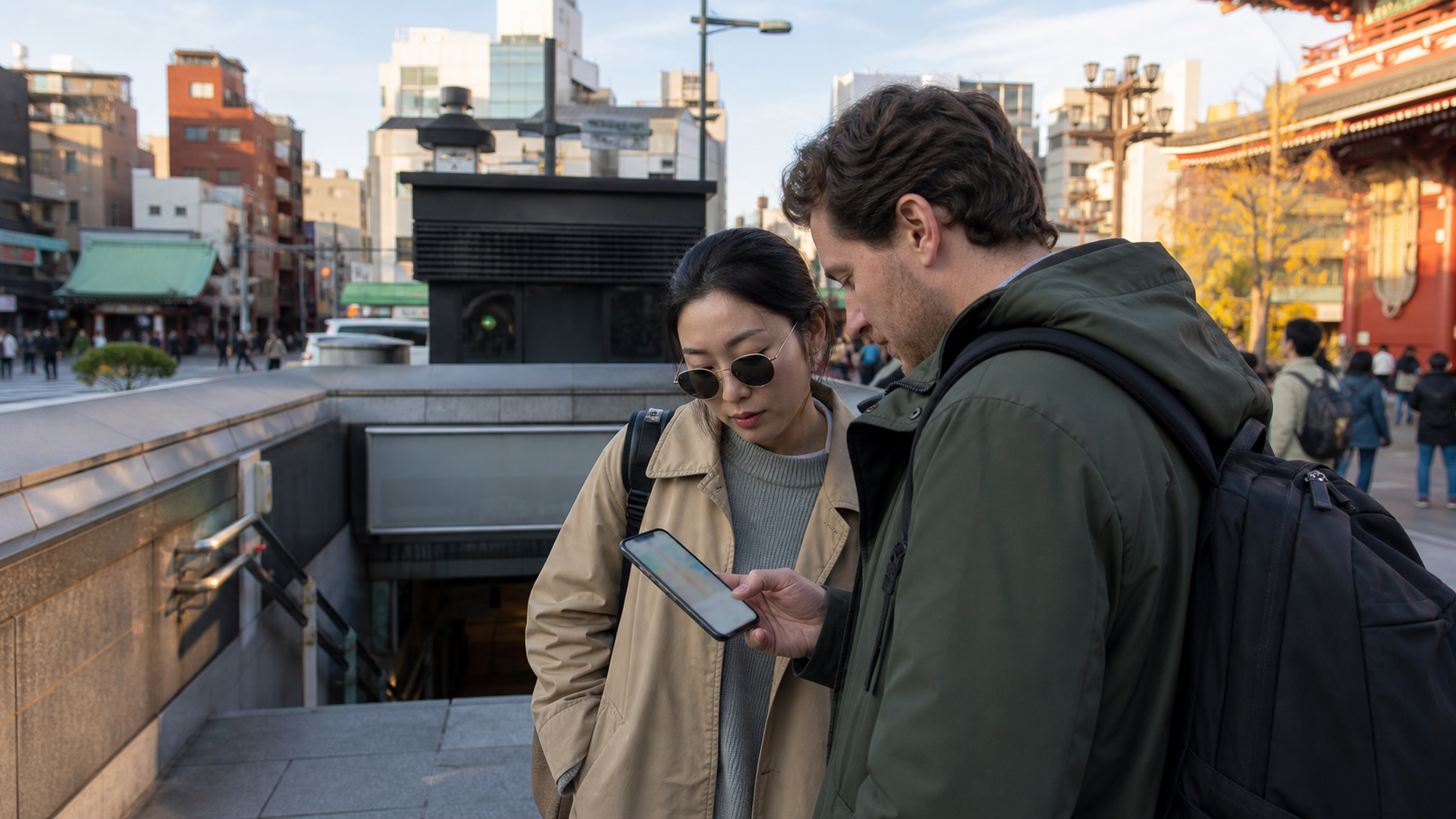
Access image: photorealistic travel scene of two visitors checking a saved walking route near a Tokyo Metro entrance, with autumn clothing and no readable interface text, logos or invented station signs.
Do not drive as the default
The organizer says there is no dedicated festival parking and warns that traffic restrictions and heavy attendance can create congestion. Public transport is the safer planning baseline.
November 7 or November 19: which date should you choose?
There is no official promise that one date will be quiet. Choose by itinerary reliability instead of inventing a crowd forecast.
Choose Saturday, November 7 for weekend convenience
Saturday fits more ordinary itineraries and lets many travelers avoid using leave or rearranging weekday plans. The trade-off is uncertainty: weekend convenience can attract demand, but the organizer has not published a 2026 comparison of crowd levels.
Build extra time around the walk, entrance queue and return journey. Do not schedule a fixed dinner, airport transfer or long-distance train immediately afterward.
Choose Thursday, November 19 for a weekday itinerary
Thursday can fit travelers with a flexible Tokyo stay. It may be easier to place around other attractions, but the weekday date is not evidence of low crowd levels. The fair still lasts 24 hours and attracts people coming specifically for the event.
If either date fits, choose the one with the cleaner next day
The measurable decision is simple: pick the date that lets you arrive without rushing and leave without sacrificing a fixed connection. If you plan to visit late at night, also check how you will return after ordinary trains stop.
What time should a first-time visitor go?
The fair operates from midnight to midnight, while stall and service availability varies by time.
The organizer says:
- some stalls near Chokokuji begin opening around 19:00 on the evening before the rooster day;
- the fair itself runs from 00:00 to 24:00;
- many stalls may continue until around 02:00 after the festival date;
- stall operations vary with weather and day of the week;
- some kumade merchants may not serve customers between roughly 03:00 and 09:00.
For a first visit, use one of these planning shapes:
| Visit shape | What it offers | Main caution |
|---|---|---|
| Morning after 09:00 | Daylight, operating rail service and a simpler return | Crowd levels remain unconfirmed |
| Afternoon | Easy to combine with another Tokyo stop | Allow time for queue changes |
| Evening | Lantern atmosphere and more visible market energy | Denser pedestrian movement is possible; no official hourly forecast is available |
| Midnight opening | The ceremonial start of the fair | Ordinary late-night transport and fatigue become part of the plan |
| 03:00–09:00 | The fair remains open | Some kumade merchants may not be operating |
Do not publish or rely on a “best empty hour.” The organizer provides operating information, not a 2026 hour-by-hour crowd forecast.
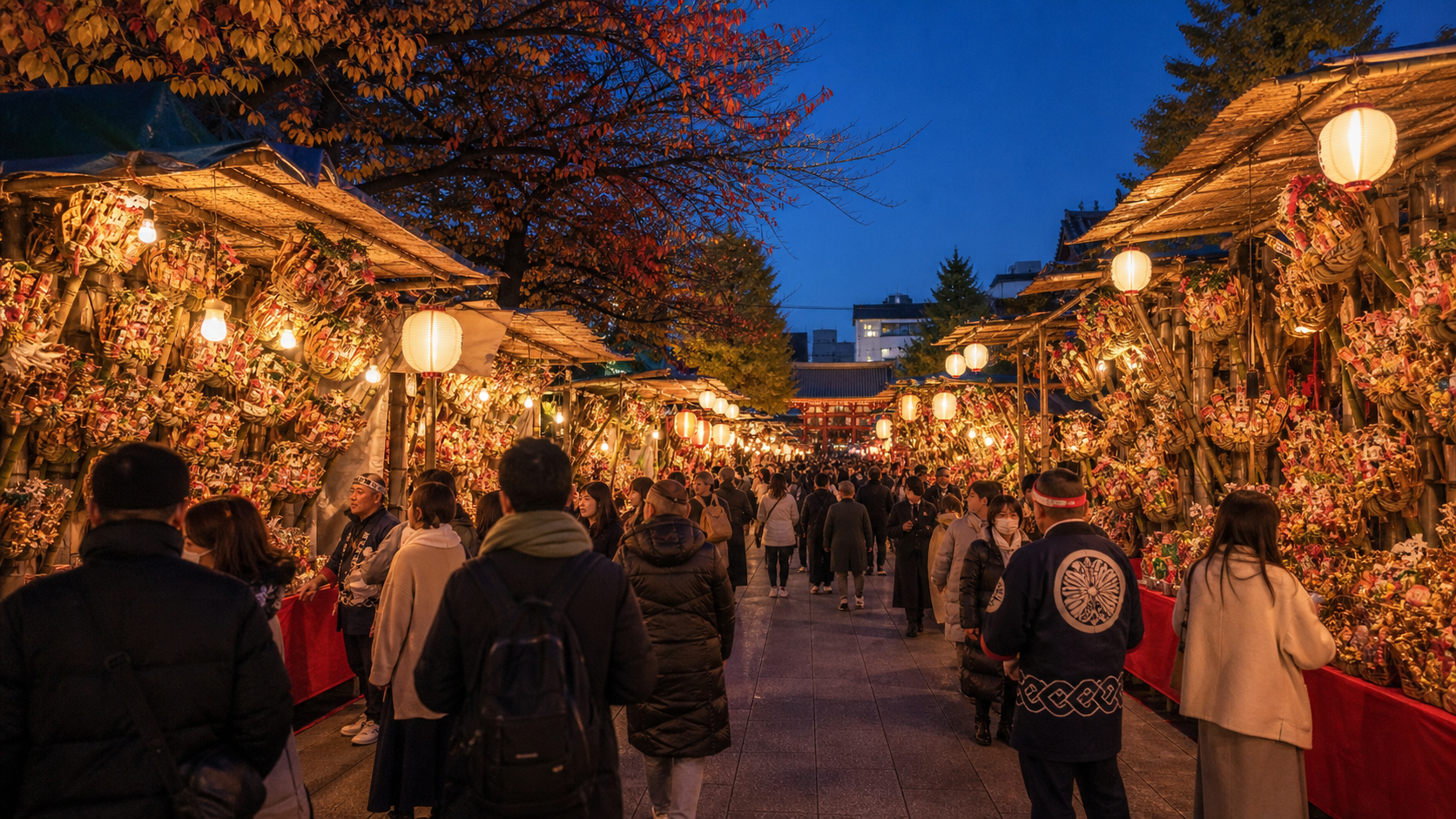
Crowd image: realistic lantern-lit Tori no Ichi walkway with decorated kumade stalls, visitors moving in one direction and sufficient visible space for safe circulation; no readable signs or documentary claim.
What do you do at Tori no Ichi?
You can visit without buying a kumade. Visitors can see the decorated rakes, listen to the sales calls and hand-clapping, view the shrine and temple activity, and try food from the surrounding stalls.
Understanding kumade without pretending to be an expert
Kumade literally resemble rakes. At Tori no Ichi, they are decorated as auspicious objects associated with gathering fortune and prosperity. Sizes and decorations vary widely.
If you want one, ask the seller about the price before committing. The official Q&A describes bargaining and gratuity as traditions that can vary by merchant; it does not describe them as compulsory buyer rules.
Payment methods also vary by stall. The official event pages do not promise universal card or contactless acceptance, so carrying a modest amount of yen is a useful backup. Merchant payment support is not standardized.
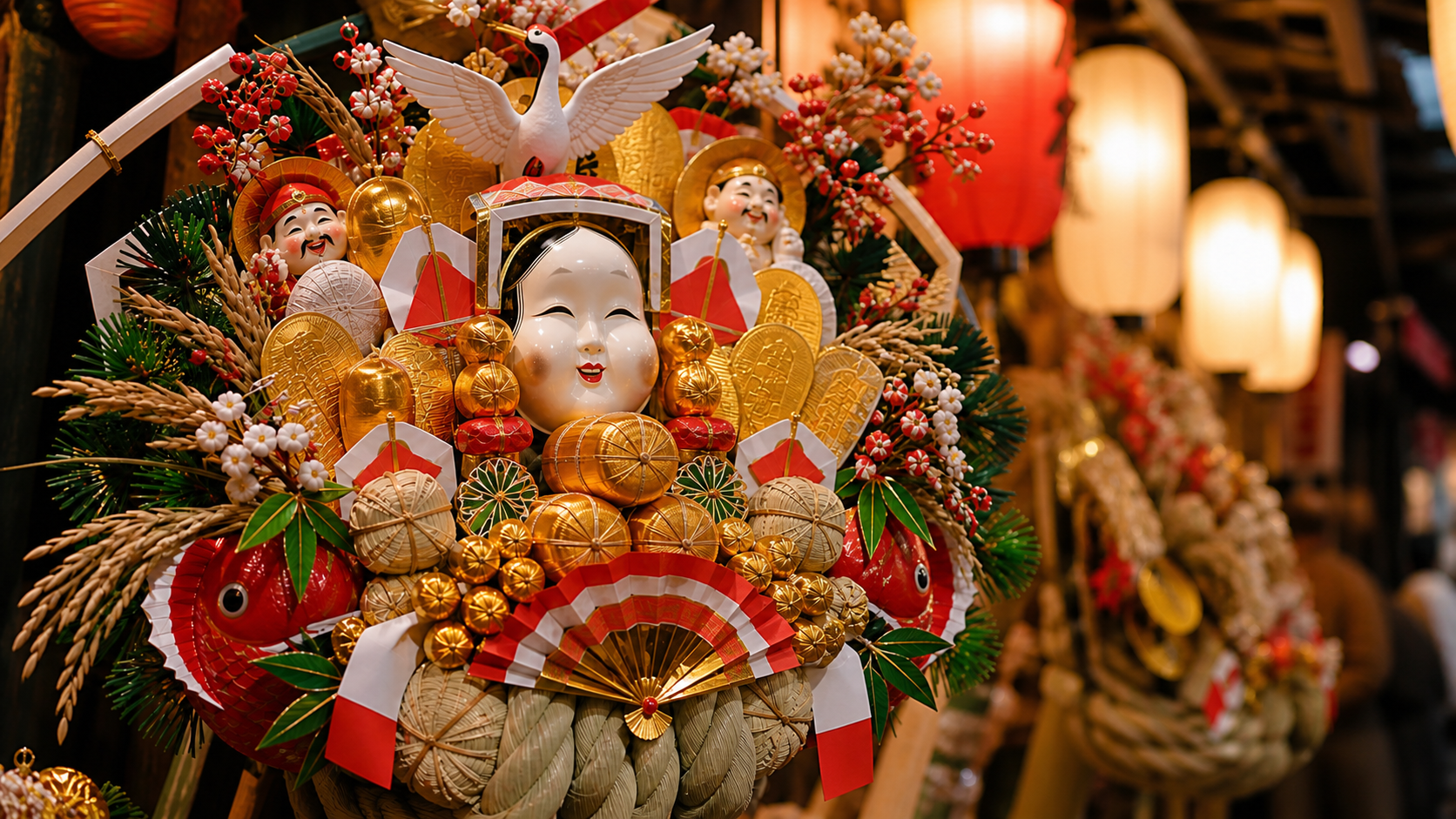
Kumade image: detailed photorealistic close-up of ornate bamboo lucky rakes with traditional masks, gold-colored ornaments and red-and-white accents, with no readable pseudo-text.
Ask before joining a sales custom
Watch first, keep shop entrances and queues clear, and follow the seller’s lead if you make a purchase. A visitor is not required to bargain, give a gratuity or imitate a hand-clapping sequence.
Crowd and exit plan
The organizer changed its entrance-queue arrangement in 2025 for safety and asked visitors to follow staff instructions. That previous-year notice proves the layout can change; it does not establish the final 2026 queue route.
Use this sequence:
- Check the official event homepage on the day of travel.
- Save Chokokuji/Otori Shrine and your chosen station before arrival.
- Follow current barriers and staff rather than an old screenshot.
- Stop at the side before checking your phone.
- Do not block a stall, shrine entrance, driveway or crossing.
- Give everyone in your group the same exit station and meeting point.
- Leave when your preselected time arrives; do not wait for an unannounced finale.
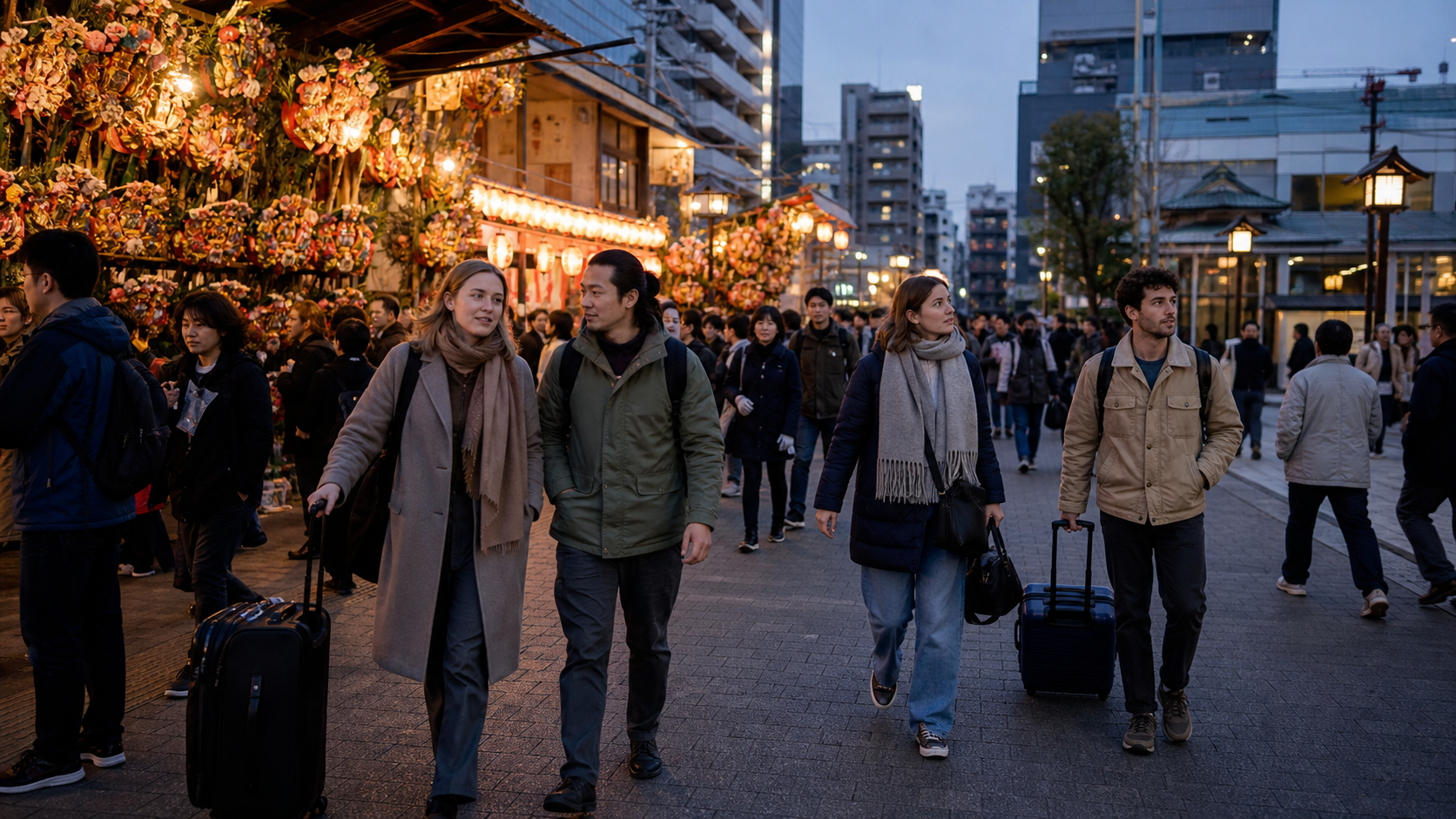
Exit-plan image: photorealistic late-evening scene of travelers calmly leaving a festival street toward public transport while lanterns and kumade remain visible behind them; no readable station signage.
If you entered from Iriya, returning the same way is the simplest default. If you continue to Sensoji or central Asakusa afterward, save the longer walking route before the crowd becomes tiring.
Rain and other Plan B choices
The organizer’s Q&A says Asakusa Tori no Ichi normally continues in rain or snow unless dangerous weather or a major disaster creates a safety risk. It also says the event has historically not been postponed for ordinary weather. Treat that as organizer guidance, not permission to ignore a live warning.
| Problem | Practical response |
|---|---|
| Ordinary rain is forecast | Recheck the organizer, wear a compact waterproof layer and avoid opening a large umbrella in a dense queue |
| A dangerous-weather or disaster warning is issued | Do not travel based only on the normal rain policy; follow current public and organizer instructions |
| The queue is beyond your tolerance | Leave the core area and use the broader autumn guide to choose another event or day |
| You arrive at Sensoji by mistake | Do not assume the fair was cancelled; navigate to Senzoku or switch to an Asakusa day plan |
| Late-night transport no longer works | Leave for the preselected station or switch to a daytime visit on the other fair date |
| A stall or ritual is not operating | Enjoy the public market area and avoid treating one vendor schedule as the festival schedule |
For another verified September–November event, open RJG’s Japan Autumn Events 2026 guide. For a daytime alternative around the better-known tourist center, use the Asakusa Quick Guide.
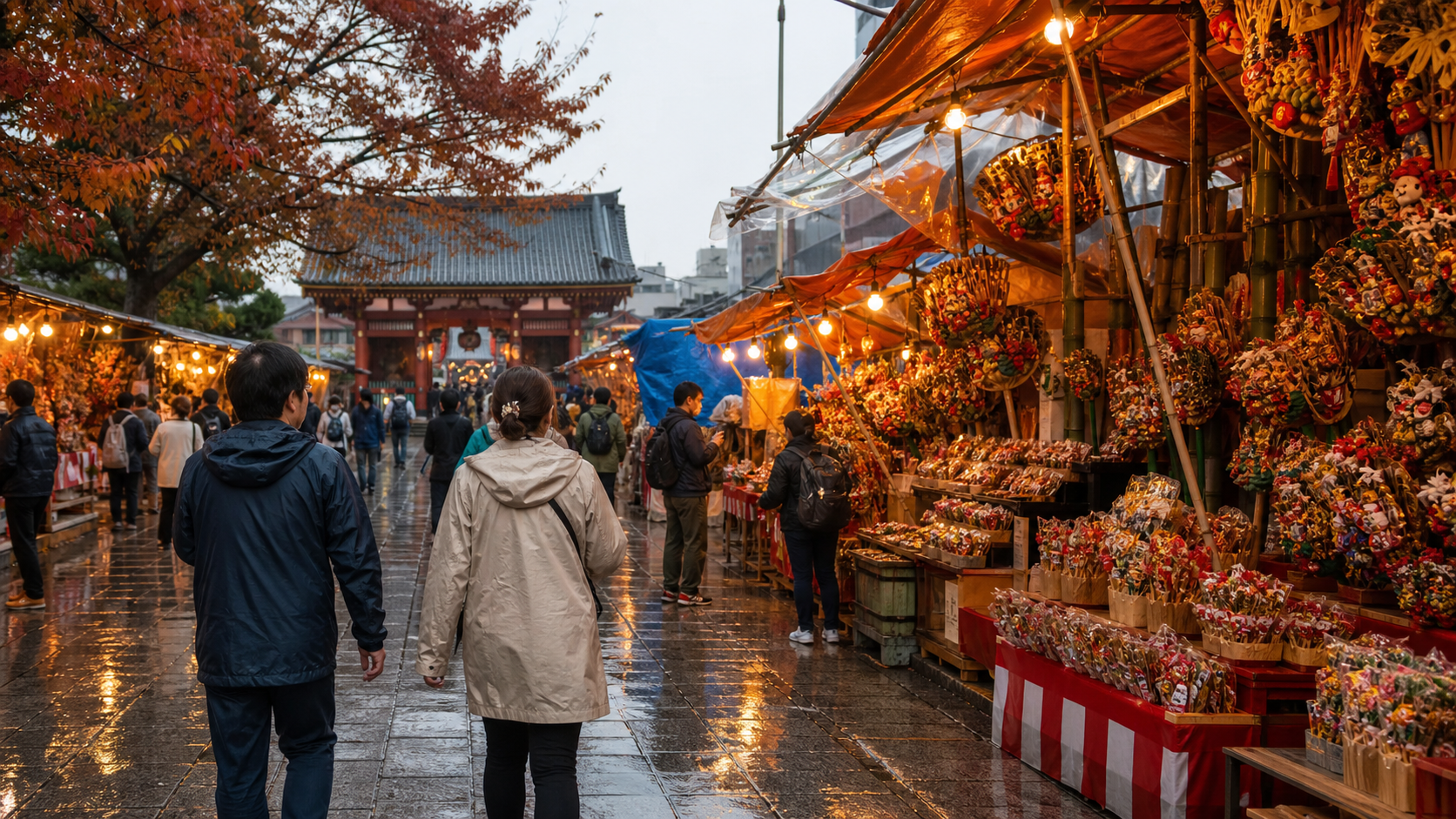
Rain Plan B image: realistic late-autumn Tokyo festival approach in light rain, with visitors wearing compact rain jackets and following an orderly route; decorated kumade remain visible so the article theme is clear.
Useful preparation before you go
- Save the correct Senzoku address and the official access page.
- Choose Iriya, Tsukuba Express Asakusa or central Asakusa deliberately.
- Carry a charged phone and enough yen for a payment fallback.
- Wear shoes suitable for a longer walk and standing.
- Bring a compact waterproof layer if rain is possible.
- Use current staff directions; do not rely on a 2025 queue diagram.
- Keep a fixed return time, especially for the midnight-to-morning period.
For general crowd, food-stall and rubbish preparation, read RJG’s Japan Festival Survival Guide. To compare other Tokyo festivals, use the Tokyo Matsuri Guide 2026. If Tokyo transport is unfamiliar, review Suica or PASMO in 2026.
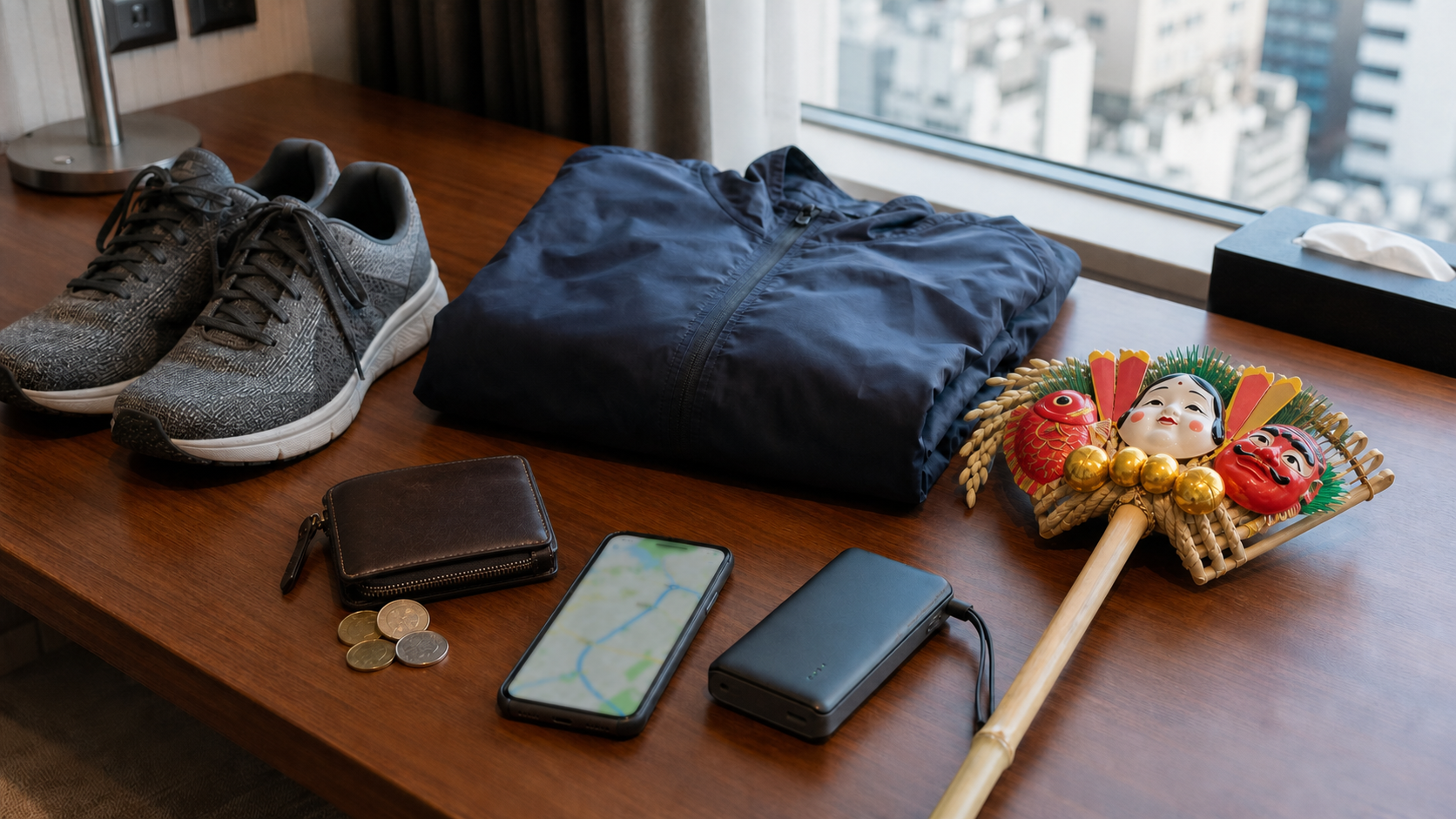
Preparation image: photorealistic hotel-desk scene with walking shoes, a compact rain jacket, a small yen wallet and a phone with a blurred saved route beside a small decorative kumade; no brands or readable text.
Asakusa Tori no Ichi 2026 FAQ
When is Asakusa Tori no Ichi in 2026?
It is scheduled for Saturday, November 7, and Thursday, November 19, 2026. Each fair runs from 00:00 to 24:00.
Is Tori no Ichi held at Sensoji?
No. Chokokuji and Otori Shrine official pages place the Asakusa fair in Senzoku, north of the Sensoji tourist area.
Which station is best for Asakusa Tori no Ichi?
Iriya Station Exit 3 is the simplest default and is listed by the organizer at about seven minutes on foot. Tsukuba Express Asakusa Station is listed at about eight minutes. Other Asakusa stations can require a 20-minute or longer walk.
Do I need a ticket or reservation?
The official 2026 pages do not announce a general entrance ticket or reservation for visiting the fair. Specific shrine rites and prayer services have separate arrangements, so check those terms if you want to participate.
What time should a first-time visitor go?
Morning after 09:00 is a practical starting shape because ordinary trains are running and the organizer notes that some kumade merchants may not operate between roughly 03:00 and 09:00. This is not an official promise of lighter crowds.
Can tourists buy a kumade?
Yes. Visitors can buy decorated kumade, but prices, bargaining customs and payment methods vary by merchant. Ask before buying and carry yen as a fallback rather than assuming universal card acceptance.
Does Tori no Ichi happen in the rain?
The organizer says it normally continues in rain or snow unless weather or a disaster creates a serious safety risk. Check the current notice before travel and follow live safety instructions.
What should I do if the fair is too crowded or the date does not work?
Leave the central queue instead of forcing your way through. Use RJG’s Japan Autumn Events 2026 guide to choose another verified event, or switch to an Asakusa daytime plan.
Comments