
Tabelog can help you find a restaurant that is easy to miss in an English travel list. It can also confuse you: a restaurant may have a score in the mid-threes on Tabelog and a much higher-looking score on Google Maps. The numbers are not interchangeable, and neither platform should be your sole check.
This guide gives you a repeatable way to use Tabelog without treating one score as a verdict. You will use Tabelog to compare restaurants in a similar context, Google Maps to check location and recent place information, and the restaurant's own current page or direct contact to confirm any detail that could ruin the visit.
- Quick answer: use three sources for three different jobs
- What a Tabelog score actually means
- The RJG four-check method
- Tabelog vs Google Maps: do not convert the scores
- How to search Tabelog in English
- Before you reserve through Tabelog
- Common mistakes that lead to a bad choice
- Mistake 1: automatically rejecting restaurants below 3.5
- Mistake 2: treating the default order as a pure quality ranking
- Mistake 3: trusting old hours because three pages agree
- Mistake 4: choosing a famous restaurant that does not fit the trip
- Mistake 5: assuming online booking confirms special requests
- Plan B when Tabelog is incomplete or the restaurant is unavailable
- A 90-second restaurant decision
- Frequently asked questions
- Is Tabelog available in English?
- Is a Tabelog score of 3.5 good?
- Does a score below 3.5 mean the restaurant is bad?
- Can I convert a Tabelog score to a Google Maps score?
- Which Tabelog sort should I choose?
- Can foreign visitors reserve through Tabelog?
- Should I trust the hours shown on Tabelog or Google Maps?
- What should I do if the restaurant is full or closed?
- Sources and last check
Quick answer: use three sources for three different jobs
Use this sequence:
- Tabelog: build a shortlist by area, cuisine, budget, availability, photos, reviews, and rating context.
- Google Maps: check the exact location, route, recent place information, and whether recent visitor reports reveal a practical problem.
- Restaurant source: confirm today's hours, closed days, menu or course, payment methods, reservation conditions, and any dietary request that matters.
- Plan B: save one nearby alternative before you leave your hotel or current station.
| Your question | Best first source | What to verify next |
|---|---|---|
| Which restaurants should I compare? | Tabelog | Compare the same area, cuisine, meal period, and budget |
| Where is the entrance and how do I get there? | Google Maps | Check the restaurant's address and access note |
| Is it open today? | Restaurant's official page or direct contact | Cross-check Maps and Tabelog, especially around holidays |
| Can I reserve in English? | Tabelog or the restaurant's linked booking page | Read the confirmation, fee, and cancellation terms before paying |
| What if the first choice is full or closed? | Your saved Plan B | Recheck current hours and availability before walking there |
Information checked August 1, 2026. Platform features, restaurant scores, hours, prices, availability, fees, and cancellation policies can change. Recheck the restaurant's current information before traveling or booking.
What a Tabelog score actually means
Tabelog says its restaurant rating is not a simple average of submitted user ratings. Its calculation gives users different levels of influence, including influence by food category. A reviewer who has substantial experience in one category may not have the same influence in another.
Tabelog also says that limited review volume can keep a restaurant's rating low, that ratings may move even without a new review, and that the complete calculation method is not disclosed. That means a score is useful context, but it is not a permanent certificate of quality.
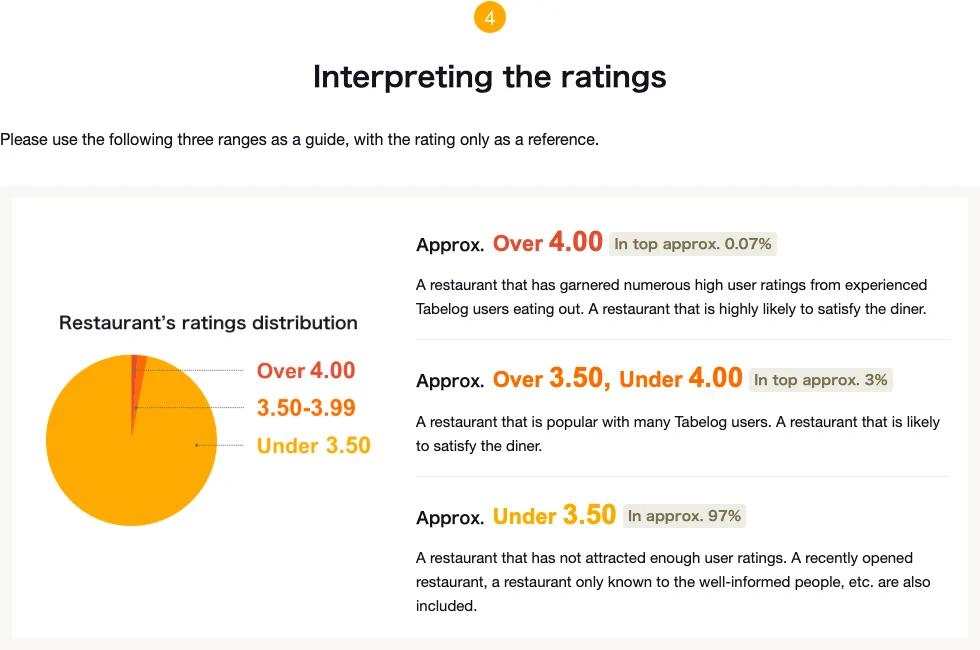
The current official reference ranges are:
| Tabelog's approximate range | Tabelog's current explanation | Safe traveler interpretation |
|---|---|---|
| Over 4.00 | Approximately the top 0.07% | Exceptionally rare on the platform; still check whether the restaurant fits your budget and needs |
| 3.50 to under 4.00 | Approximately the top 3% | Strong platform signal; not a promise that every traveler will prefer it |
| Under 3.50 | Approximately 97% of listings | A very broad group that can include ordinary, new, small, secluded, or lightly reviewed restaurants—not “bad restaurants” |
The practical mistake is turning the table into a universal cutoff. A newly opened counter with a small customer base and a long-established destination restaurant can have very different review histories. Compare a score with its context rather than automatically rejecting results below one number.
The RJG four-check method
RJG's method comes from practical Tabelog reviewing and restaurant research, including experience maintaining a reviewer account followed by about 12,000 people. That experience helps with reading patterns, but it does not reveal Tabelog's private algorithm and does not create a universal score conversion.
Check 1: compare like with like
Start with restaurants that solve the same problem:
- the same station or walkable area;
- the same cuisine or meal type;
- a similar lunch or dinner budget;
- the same day and approximate time; and
- any non-negotiable need, such as a private room, online reservation, or late opening.
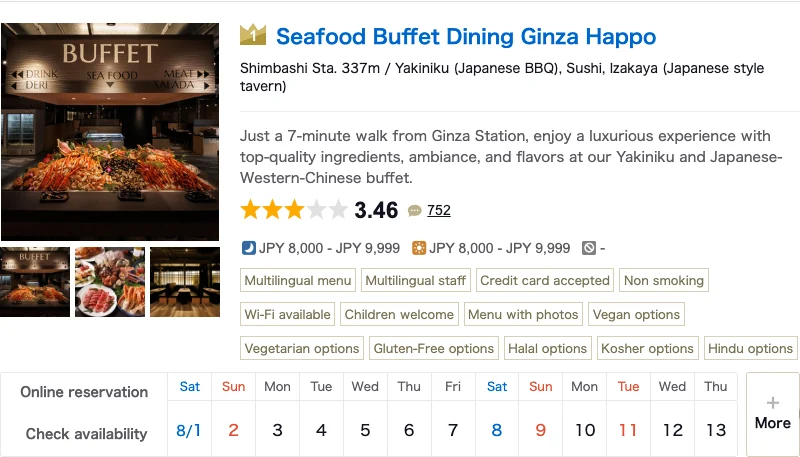
A 3.6 sushi restaurant and a 3.6 casual curry shop are not interchangeable choices. The score does not tell you which meal fits your plan.
Check 2: read beyond the headline score
Open the restaurant page and inspect:
- how many reviews and photos are available;
- whether useful reviews are recent;
- whether the dishes in recent photos match what you want;
- whether the stated budget matches the menu or course you intend to order; and
- whether repeated comments reveal a practical constraint, such as a long queue, difficult entrance, cash payment requirement, short meal time, or reservation requirement.
Do not treat one angry review or one five-star review as the whole restaurant. Look for repeated, specific observations and check their dates.
Check 3: verify the visit-critical facts
Before leaving, recheck:
- today's opening hours and last order;
- temporary closure or irregular holiday;
- exact branch and entrance;
- reservation status and confirmation email;
- course, system fee, cancellation rule, and payment timing;
- accepted payment methods; and
- any allergy, religious, vegetarian, accessibility, or child-related request.
Tabelog, Google Maps, and the restaurant's own page can disagree. For any fact that could cost you money or leave you without a meal, use the restaurant's latest official information or contact the restaurant.
Check 4: save a backup
Save one alternative near the same station or on the same route. The backup should be easier, not merely more famous. A useful Plan B might have:
- walk-in seating;
- later hours;
- a simpler menu;
- clear payment information;
- a multilingual booking path; or
- a nearby branch.
This turns restaurant research into a decision you can use on the street.
Tabelog vs Google Maps: do not convert the scores
There is no reliable rule such as “subtract one star from Google Maps.” The platforms calculate, order, and personalize information differently.
| Decision task | Tabelog | Google Maps | Final check |
|---|---|---|---|
| Compare restaurants in one cuisine or area | Useful when you select the intended sort and read the listing context | Useful for nearby discovery, but results may be personalized | Compare the actual menu and visit conditions |
| Understand Tabelog's rating context | Official rating ranges and methodology explanation | Not applicable to Tabelog's calculation | Do not invent a cross-platform conversion |
| Find the entrance and route | Listing address and access notes may help | Strong map, directions, Street View, and saved-place workflow | Confirm the exact branch and building |
| Check open-now information | Can display hours and availability | Can filter by open status and display hours | Verify with the restaurant when the trip depends on it |
| Judge current fit | Read recent reviews, photos, budget, and booking conditions | Read recent practical reports and inspect the location | Use your own needs, not only the average score |
Google explains that Maps restaurant results can use relevance, distance, prominence, history, and personalized recommendations. Tabelog explains that its multilingual search orders can use ratings, reservation activity, views, multilingual availability, information completeness, and in some tie or default cases paid customer-attraction services. Those are different systems answering different questions.
The safest conclusion is simple: use scores to create questions, not to end the decision.

How to search Tabelog in English
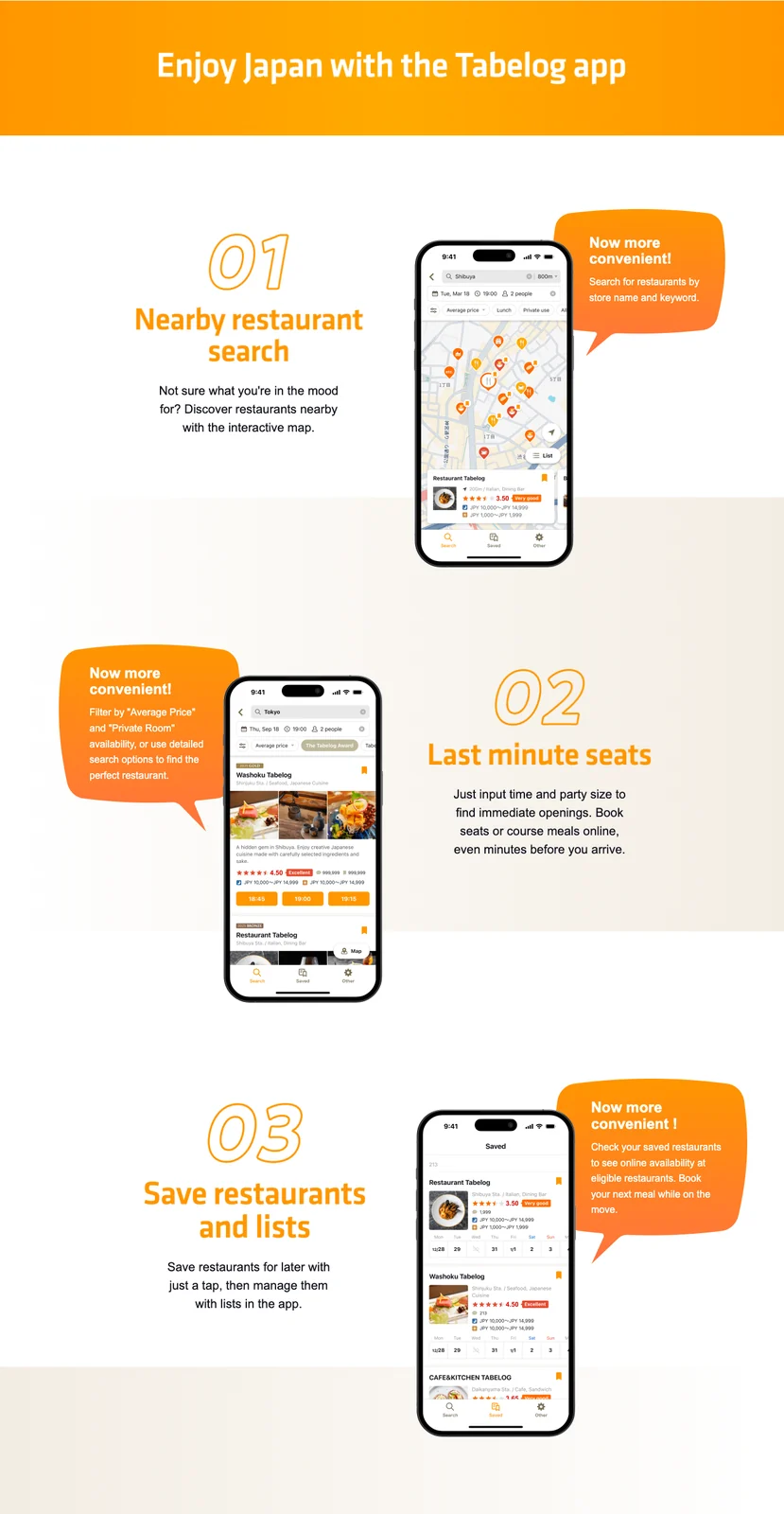
You can use the English website or the multilingual Tabelog app. The current app supports nearby map search, restaurant-name and keyword search, price and private-room filters, availability checks for eligible restaurants, and saved lists.
Step 1: choose the real dining area
Search by the station or neighborhood where you will actually be at mealtime. A restaurant across Tokyo is not a practical alternative if you have a timed ticket, tired children, luggage, or a last train to catch.
Step 2: add cuisine and budget
Use the dish or restaurant type you want, then set a realistic meal budget. Confirm whether the displayed budget refers to lunch, dinner, a course, or an average. The same restaurant can have a very different lunch and dinner cost.
Step 3: add practical filters
Use the filters that change the decision. Depending on the current interface and listing, these may include:
- date, time, and party size;
- online reservation availability;
- average price;
- private room; and
- nearby map results.
Do not create a filter stack so narrow that it hides reasonable backups.
Step 4: choose the intended result order
If you want to compare Tabelog ratings, select Highest rated. Tabelog's FAQ says this sorts restaurants from the highest Tabelog rating downward.
Other result orders answer different questions. “Most reserved by travelers,” “Most reserved by locals,” and “Most viewed” use reservation or viewing data and additional ordering rules. The default or a promoted result is not the same thing as the highest-rated result.
Step 5: open several restaurant pages
Do not choose from the result card alone. Open at least three candidates and compare:
- score and review context;
- recent photos and comments;
- lunch or dinner budget;
- course and seating details;
- reservation conditions; and
- access from your actual route.

Before you reserve through Tabelog
An online-reservation button does not mean the full meal is prepaid or the booking is flexible.
Tabelog's current international reservation terms say that the reservation contract is between the user and the restaurant. The restaurant's displayed cancellation policy applies. A service fee can be separate from food and drink charges, and the restaurant may charge a cancellation fee under the accepted policy.
Before confirming, check:
- restaurant name and branch;
- date, time, and number of guests;
- reservation for a seat without a course, or a course reservation;
- price per person and what is included;
- service or system fee;
- cancellation deadline and fee;
- payment timing; and
- confirmation email and reservation number.
Save the confirmation. If the reservation page, card check, cancellation wording, or payment flow is unclear, do not submit while guessing. Use the Tokyo restaurant reservation guide before committing.
Common mistakes that lead to a bad choice
Mistake 1: automatically rejecting restaurants below 3.5
Tabelog itself says the under-3.5 range includes recently opened, secluded, small, short-hours, and lightly reviewed restaurants. Use the score as a reason to inspect the context, not as an automatic rejection.
Mistake 2: treating the default order as a pure quality ranking
Confirm which result order you selected. If you want score order, choose Highest rated. Other orders can reflect reservations, views, multilingual booking support, listing completeness, and paid customer-attraction services.
Mistake 3: trusting old hours because three pages agree
Three websites can repeat the same stale information. Check the date of the restaurant's latest notice and look for temporary closures or irregular holidays.
Mistake 4: choosing a famous restaurant that does not fit the trip
A high score cannot solve a long detour, sold-out seats, a strict cancellation policy, a menu your group cannot eat, or a last-train problem.
Mistake 5: assuming online booking confirms special requests
A booking form may not confirm an allergy accommodation, birthday plate, child seat, wheelchair access, or specific seat. Ask the restaurant when the request is essential.
Plan B when Tabelog is incomplete or the restaurant is unavailable
Use this fallback ladder:
- No useful English result: search the restaurant name or address in Google Maps, then open the restaurant's own website or social account.
- No online reservation: check the restaurant's official booking link, ask hotel staff, call after confirming the language and terms, or choose a walk-in backup.
- Conflicting hours: use the most recent official notice or contact the restaurant. Do not travel across the city based on an undated listing.
- Restaurant is full: open your saved nearby backup or use the Tokyo restaurant Plan B guide.
- The meal format is unfamiliar: for an izakaya, check the otoshi, ordering, and bill guide.
- You are unsure about the route: use the Google Maps guide for Japan, then confirm the exact branch.
The goal is not to prove which platform is “right.” The goal is to reach one suitable restaurant with one realistic fallback.
A 90-second restaurant decision
Before leaving, complete this final check:
- I compared restaurants in the same area, cuisine, meal period, and budget.
- I opened the restaurant pages instead of choosing from one result card.
- I checked recent reviews, photos, and practical constraints.
- I verified today's hours and the exact branch.
- I understand any reservation fee and cancellation rule.
- I saved the confirmation or screenshot.
- I saved one nearby backup.
Once the seven boxes are checked, stop researching and go eat.
Frequently asked questions
Is Tabelog available in English?
Yes. Tabelog has an English website and a multilingual app. The current app supports nearby map search, keyword search, filters, eligible online reservations, and saved restaurant lists. Features and interface details can change, so use the current official page.
Is a Tabelog score of 3.5 good?
Tabelog's current official guide places scores from 3.50 to under 4.00 in approximately the top 3% of its listings. Treat that as a strong platform signal, not a guarantee that the restaurant fits your taste, budget, language, access, or dietary needs.
Does a score below 3.5 mean the restaurant is bad?
No. Tabelog says the broad under-3.5 group can include new, secluded, small, short-hours, lightly reviewed, and ordinary restaurants. Inspect the restaurant's context before deciding.
Can I convert a Tabelog score to a Google Maps score?
No reliable conversion exists. The services calculate and order information differently. Use Tabelog for its own rating and review context, Google Maps for map-based checks, and current restaurant information for the final decision.
Which Tabelog sort should I choose?
Choose Highest rated when you specifically want restaurants ordered by Tabelog rating. Other orders can reflect reservations, views, multilingual booking support, information completeness, and paid customer-attraction services.
Can foreign visitors reserve through Tabelog?
Eligible restaurants can be reserved through Tabelog's multilingual service. Read the restaurant, course, service fee, payment, and cancellation terms before confirming, then keep the confirmation email and reservation number.
Should I trust the hours shown on Tabelog or Google Maps?
Use both as cross-checks, but verify the restaurant's latest official notice or contact the restaurant when the visit depends on the hours. Platform listings can be edited, delayed, incomplete, or repeated from older information.
What should I do if the restaurant is full or closed?
Use a saved backup near the same station or route. Prefer a simpler option with current hours, clear payment information, and walk-in or immediate availability rather than starting the search again from zero.
Sources and last check
Major platform claims were checked on August 1, 2026 against:
- Tabelog: Ratings and Rankings
- Tabelog: FAQ and search-order definitions
- Tabelog: Multilingual App
- Tabelog: International Reservation Terms
- Google Maps Help: Search locations
- Google Maps Help: Check facts about places
Restaurant and platform information can change without notice. Recheck current hours, prices, payment methods, availability, fees, and cancellation conditions before visiting or booking.


Comments