- The short answer: choose the format before you choose the restaurant
- Quick comparison: individual tempura, tendon, or teishoku?
- What the three choices mean in practice
- A reliable ordering sequence for first-time visitors
- A chain example: Tempura Tendon Tenya
- Allergy and cross-contact: the question most guides skip
- Queue, payment, and branch checks before you join the line
- Plan B: decide your fallback before you are hungry
- Useful phrases for a calm order
- Three quick decision examples
- Related Real Japan Guide articles
- Final checklist
- FAQ
- What is the difference between tempura and tendon?
- Is a tempura teishoku the same as tendon?
- Can I order individual tempura pieces in Tokyo?
- Is tempura safe for someone with a food allergy?
- Does every Tokyo tempura restaurant accept cards?
- Is Tempura Tendon Tenya representative of all Tokyo tempura restaurants?
- Do I need a reservation for tempura in Tokyo?
- What should I do if the menu is only in Japanese?
- Official sources checked
- FAQ JSON-LD
The short answer: choose the format before you choose the restaurant
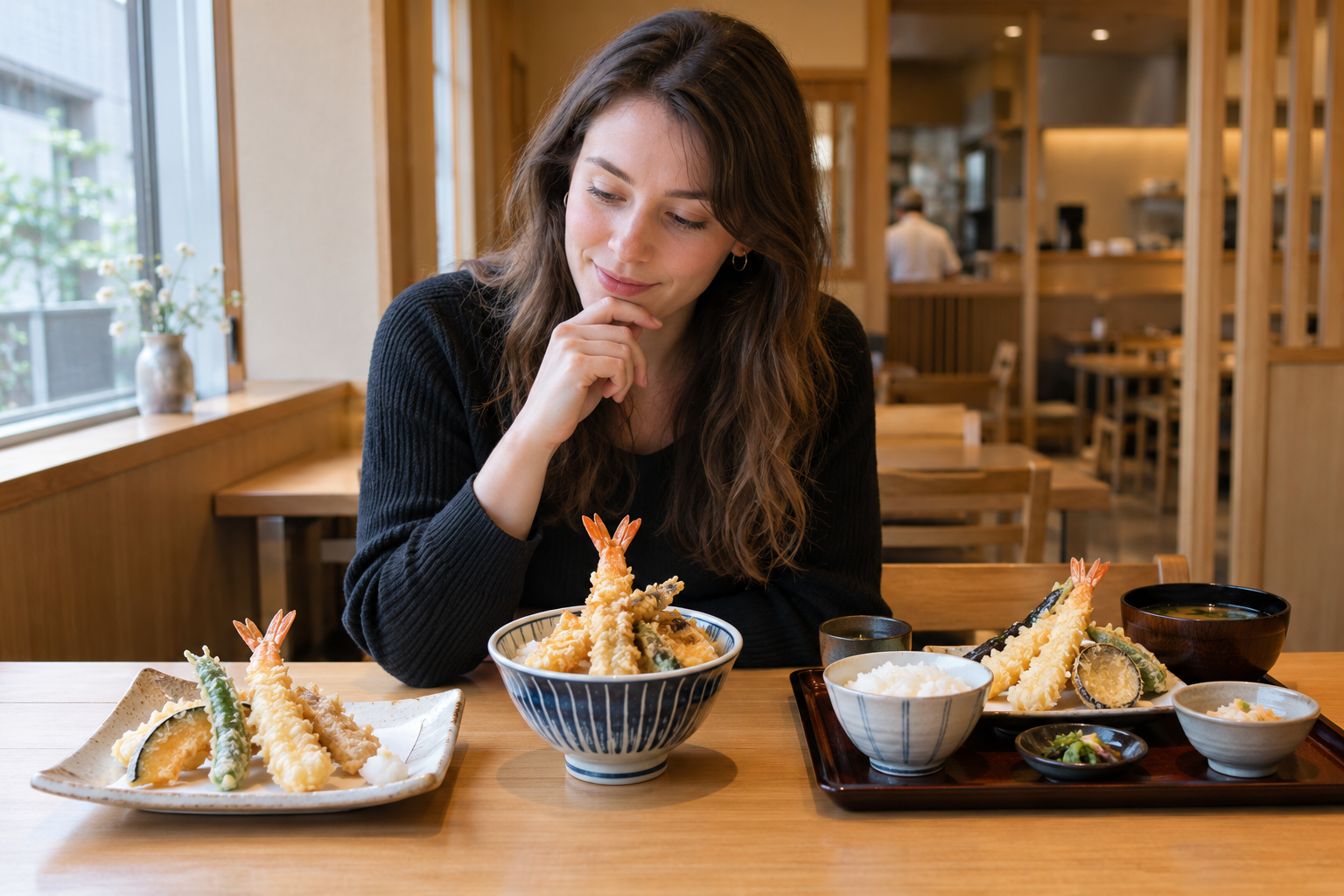
For a first tempura meal in Tokyo, make one decision first: do you want individual tempura, tendon, or a tempura teishoku?
- Choose individual tempura when you want to focus on each fried ingredient and control what you order piece by piece.
- Choose tendon when you want tempura served over rice in one compact bowl, usually with sauce already part of the dish.
- Choose a tempura teishoku when you want the tempura and rice served separately, normally as part of a set with other small items.
Then check the restaurant’s current official menu and location information before you go. Menus, prices, ingredients, business hours, payment methods, and branch operations can change. Never assume that one Tokyo restaurant works like another.
If you have a food allergy, the key question is not only “Does this dish contain my allergen?” Tempura is fried, so you must also ask about batter, sauce, toppings, preparation surfaces, utensils, and shared frying oil. If the staff cannot confidently confirm what you need, do not negotiate with uncertainty. Use your Plan B.
The Japan National Tourism Organization places tempura within the broad category of washoku, or traditional Japanese cuisine. That is useful cultural context, but it is not a menu, allergen guide, or promise about any restaurant. See the JNTO food and drink overview.
Quick comparison: individual tempura, tendon, or teishoku?
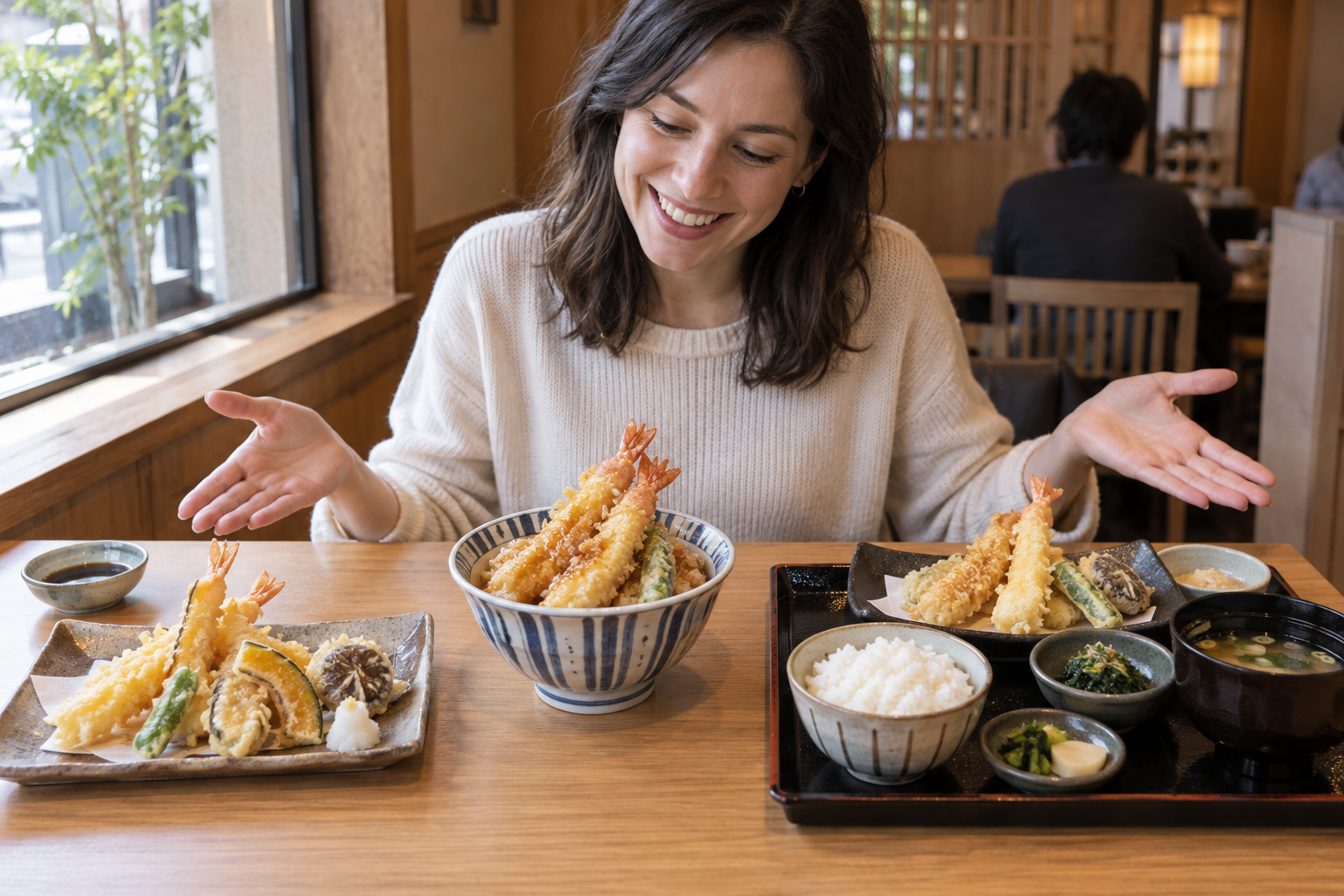
| Format | What arrives | Best for | What to confirm |
|---|---|---|---|
| Individual tempura | Separate pieces or an assortment, usually on a plate or served in sequence | Travelers who want to focus on ingredients or choose pieces | Which pieces are included, how many, sauce or salt, and whether rice is separate |
| Tendon | Tempura arranged over a bowl of rice | A simple one-bowl meal and travelers who like sauce with rice | Included tempura, sauce, rice size, toppings, and whether substitutions are possible |
| Tempura teishoku | Tempura served separately from rice, generally with soup and small sides | Travelers who want to keep the crisp tempura separate from rice and sauce | Exact set contents, side dishes, soup ingredients, and whether refills or changes are offered |
These are practical descriptions, not universal rules. A restaurant may use different English labels, offer only one format, serve an assortment under another name, or change the set contents. Read the current menu in front of you.
What the three choices mean in practice
1. Individual tempura
Individual tempura puts the attention on the fried item itself. Depending on the restaurant, you may order separate pieces, choose an assortment, or receive pieces one at a time. Rice, soup, and other sides may be separate orders.
This format is useful when your priority is selection. You can ask which vegetables, seafood, or other ingredients are included before ordering. However, ordering individual items does not automatically solve an allergy or dietary restriction. The same batter, utensils, preparation area, or frying oil may be used for multiple foods.
Before ordering, point to each item and confirm the quantity. A photo can help, but a photo is not a complete ingredient list.
2. Tendon
“Tendon” means a tempura rice bowl: tempura is placed over rice and served as one dish. The sauce is an important part of the format, so the rice and batter may be less dry or crisp than tempura served separately. That is not a quality problem; it is the intended eating style.
Tendon is convenient when you want one clear main dish. The trade-off is that the bowl may combine several ingredients and a sauce. If you need to avoid something, ask about the complete bowl rather than only the most visible piece of tempura.
Do not assume that every tendon contains shrimp, that every bowl uses the same sauce, or that the pictured ingredients are available at every location. Check the current menu and ask staff if the exact contents matter to you.
3. Tempura teishoku
A teishoku is a set-meal format. A tempura teishoku generally keeps the tempura on a separate plate or rack, with rice and other components served alongside it. This can be easier if you prefer to add sauce yourself or keep the rice separate.
The extra dishes also create extra questions. Soup, pickles, dressings, dipping sauce, grated condiments, and small sides can contain ingredients that are not obvious from appearance. Ask what is included today, especially if the menu uses a sample photo.
The word “set” does not guarantee the same components, portion, refill policy, or price from one restaurant to another.
A reliable ordering sequence for first-time visitors
Use this sequence instead of trying to translate the whole restaurant at once.
Step 1: check the exact location
Open the restaurant’s current official location page. Confirm the branch, address, date, and service you plan to use. If you are looking at a chain, branch information matters: operating details can differ.
Take a screenshot for navigation only after confirming it is the correct branch. Do not rely on an old blog post, an old menu photo, or a map listing alone for current restaurant operations.
Step 2: check the current menu
Look for the menu currently linked by the restaurant. Compare the web page, PDF, and in-store menu if more than one version exists. Check whether the item is dine-in, takeaway, seasonal, limited, or branch-specific.
If a page says that availability or price can differ by store or period, treat that as a real limitation. The final check is the menu at the branch on the day you visit.
Step 3: choose one format
Decide whether you want individual tempura, tendon, or teishoku. This reduces confusion at the counter.
You can say:
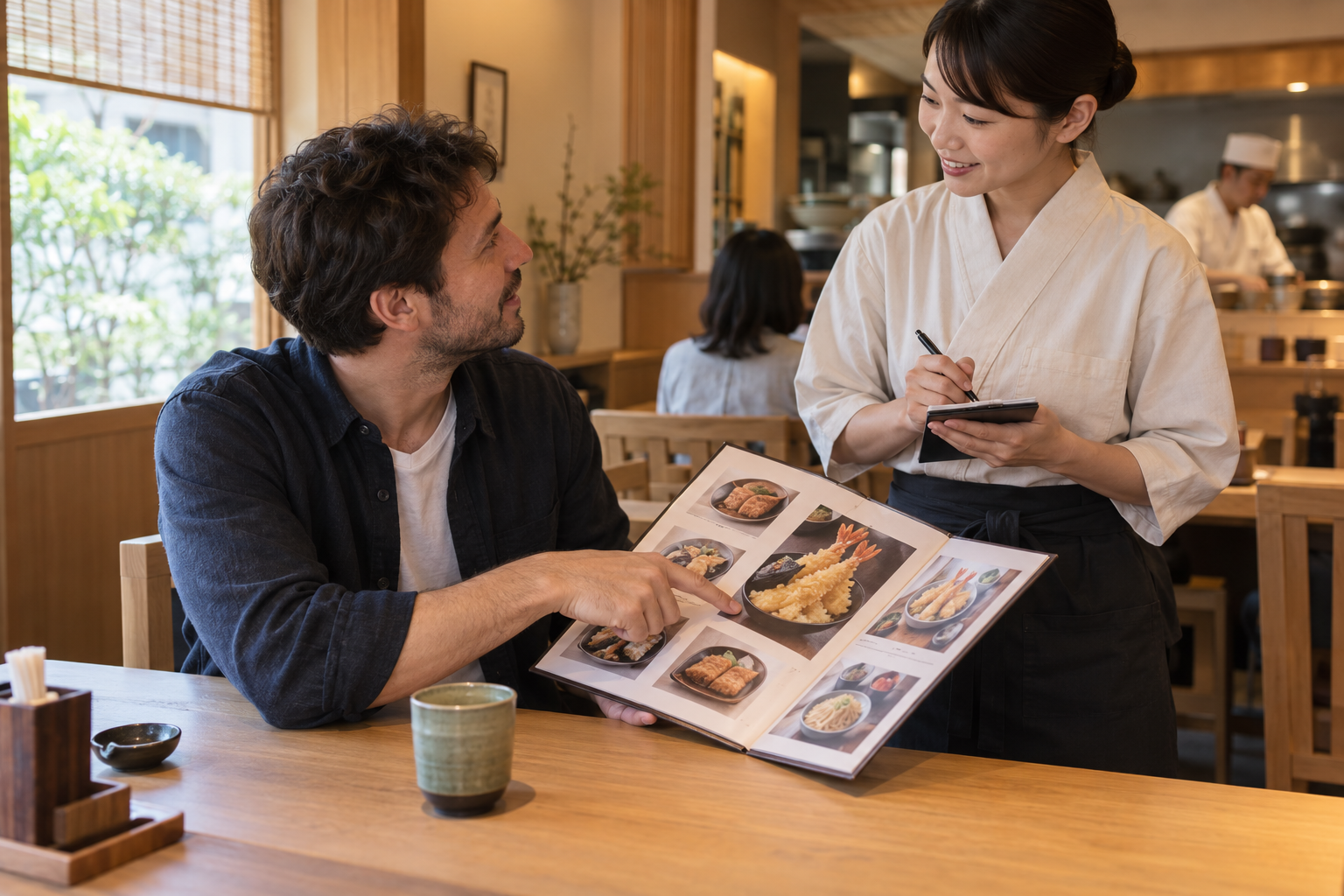
- “I would like this tendon, please.”
- “I would like this tempura set meal, please.”
- “Can I order these tempura pieces separately?”
Point to the current menu item while speaking. Keep the screen brightness high and avoid showing staff an unrelated search result.
Step 4: confirm what is included
Ask one short question at a time:
- “What tempura is included?”
- “Does this come with rice and soup?”
- “Is the sauce already on the rice?”
- “Is this available at this branch today?”
If a substitution matters, ask before paying or before the order is sent to the kitchen. A request is not a promise that the restaurant can make the change.
Step 5: handle allergy questions separately
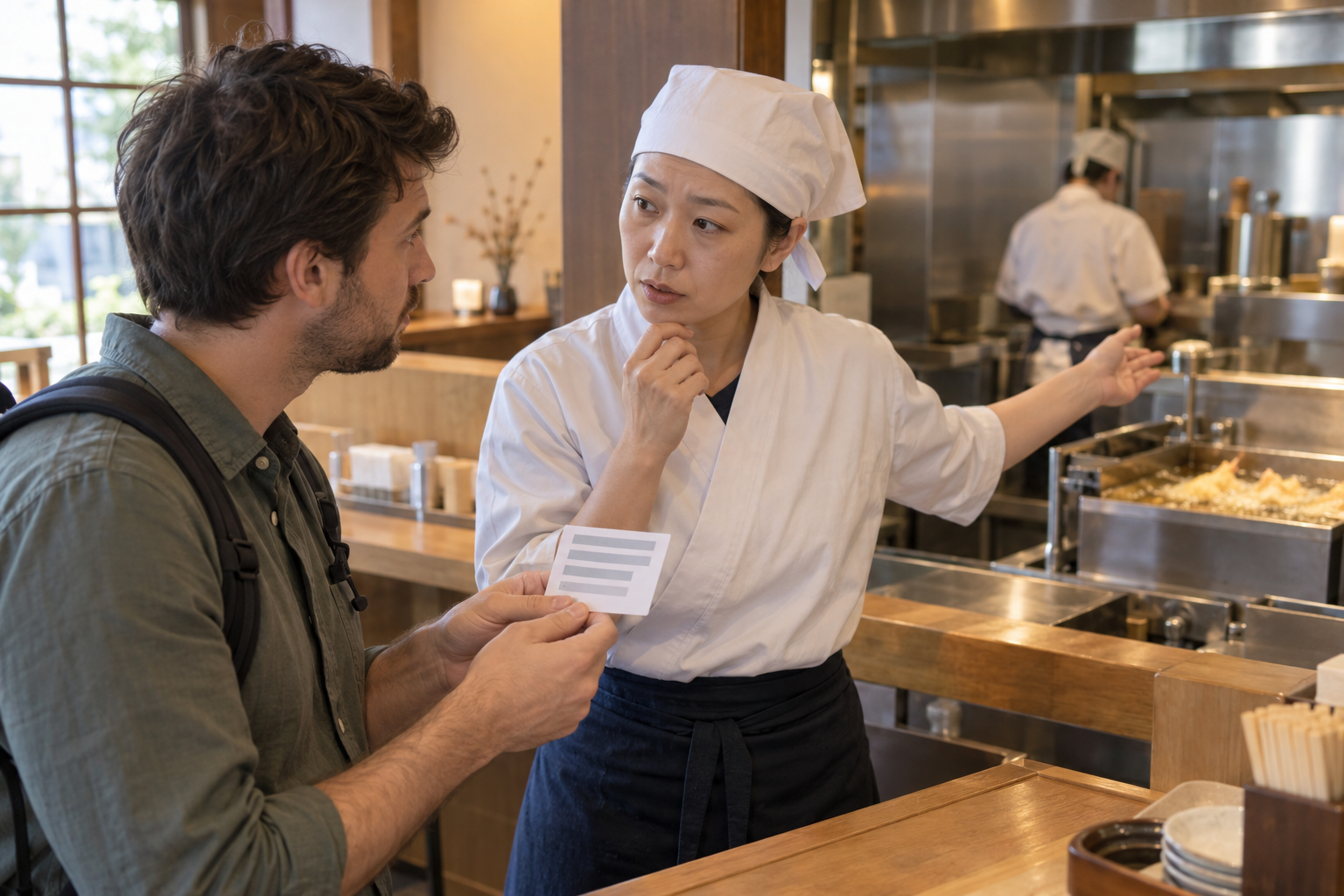
Do not bury an allergy question inside a long order. State the allergy first, show a clearly prepared allergy card, and ask about the dish and cross-contact. If communication is incomplete, pause the order.
Step 6: confirm payment and keep the receipt
Check the payment methods shown by the specific restaurant or ask staff before ordering. Do not assume that cash, cards, transit cards, mobile wallets, or foreign cards are accepted merely because another restaurant accepts them.
Keep the receipt until you have confirmed the order, especially at a counter-service venue.
A chain example: Tempura Tendon Tenya
Tempura Tendon Tenya is one clearly labeled chain example, not a model for every tempura restaurant in Tokyo.
Tenya’s official pages are useful because they illustrate that a single chain may publish an English entry page, a menu page, a Japanese current-menu page, a Tokyo location list, and a menu PDF. Its current Japanese menu page includes categories such as tendon, a tempura set meal, and tempura assortments, while also warning that some limited items, sales periods, contents, availability, or prices may differ by location or period. Recheck the official English page, English menu page, current Japanese menu page, Tokyo locations page, and official menu PDF immediately before visiting.
Do not carry Tenya-specific information into another restaurant. Tenya’s prices, ingredients, allergen information, frying oil, payment methods, queues, and branch operations say nothing about an independent tempura counter or another chain. Even within Tenya, check the current official menu and the page for the exact location.
This example is included for orientation only. It is not an affiliate recommendation, paid placement, or claim that Tenya will suit every traveler.
Allergy and cross-contact: the question most guides skip
Tempura creates several possible points of exposure. The visible ingredient is only one of them.
| Check | Why it matters | A clear question |
|---|---|---|
| Main ingredient | The piece may be seafood, meat, egg, or a vegetable you need to avoid | “What exactly is this piece?” |
| Batter | Recipes differ, and the ingredient list may not be visible | “What is in the batter?” |
| Sauce and toppings | A sauce or garnish may add ingredients not obvious in the photo | “What is in the sauce and toppings?” |
| Shared frying oil | Different foods may be fried in the same oil | “Is the same fryer or oil used for other foods?” |
| Utensils and surfaces | Tongs, trays, counters, and preparation areas may be shared | “Are the utensils and preparation area shared?” |
| Soup and side dishes | A teishoku contains more than the tempura plate | “Can you check every item in the set?” |
An allergen list can help, but it does not automatically answer every cross-contact question. A menu can also change. Use the restaurant’s current official allergen information where available, then confirm your needs with the specific branch.
If your allergy is severe, do not treat a translation app, a picture, or a staff member’s uncertain nod as a safety guarantee. Staff may be trying to help while still lacking enough information about suppliers, preparation, or shared equipment. If the answer is unclear, choose a meal or venue with a process you can verify—or do not eat there.
A practical allergy card should state:
- the exact ingredient or ingredients you must avoid;
- that even a small amount can be a problem, if applicable;
- whether shared frying oil or shared utensils are unacceptable;
- that you need staff to say clearly if they cannot confirm safety.
Do not use vague labels such as “seafood allergy” if only certain species are relevant. Conversely, do not narrow the wording if your restriction is broad.
Queue, payment, and branch checks before you join the line
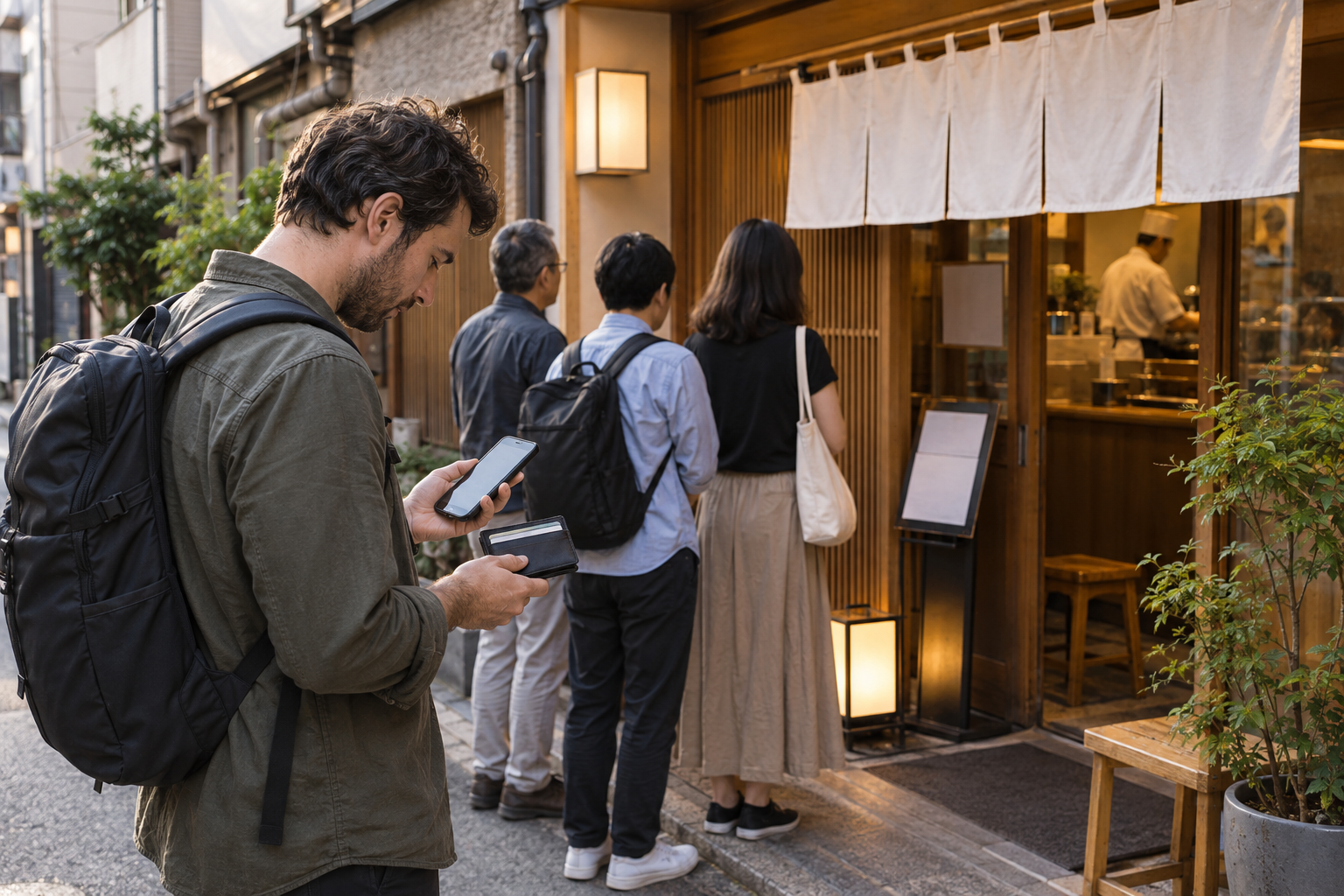
A queue tells you that people are waiting. It does not tell you the waiting time, last-order time, stock status, payment method, accessibility, or whether every menu item is available.
Before joining, check five things:
- Is this the correct branch?
- Is the service dine-in, takeaway, or both?
- Is your intended item on the current menu here?
- Can the restaurant handle your allergy or dietary question?
- Can you use an accepted payment method?
If the answer to an essential question is unknown, ask before spending a long time in line. Keep the question short and show the relevant menu item.
Tokyo restaurants vary widely. Some use table ordering, some use a counter, some may use a ticket machine, and others may take the order after seating. Treat the system you see at the actual entrance as the source of truth. Do not force a memorized “Japan restaurant rule” onto the venue.
Plan B: decide your fallback before you are hungry
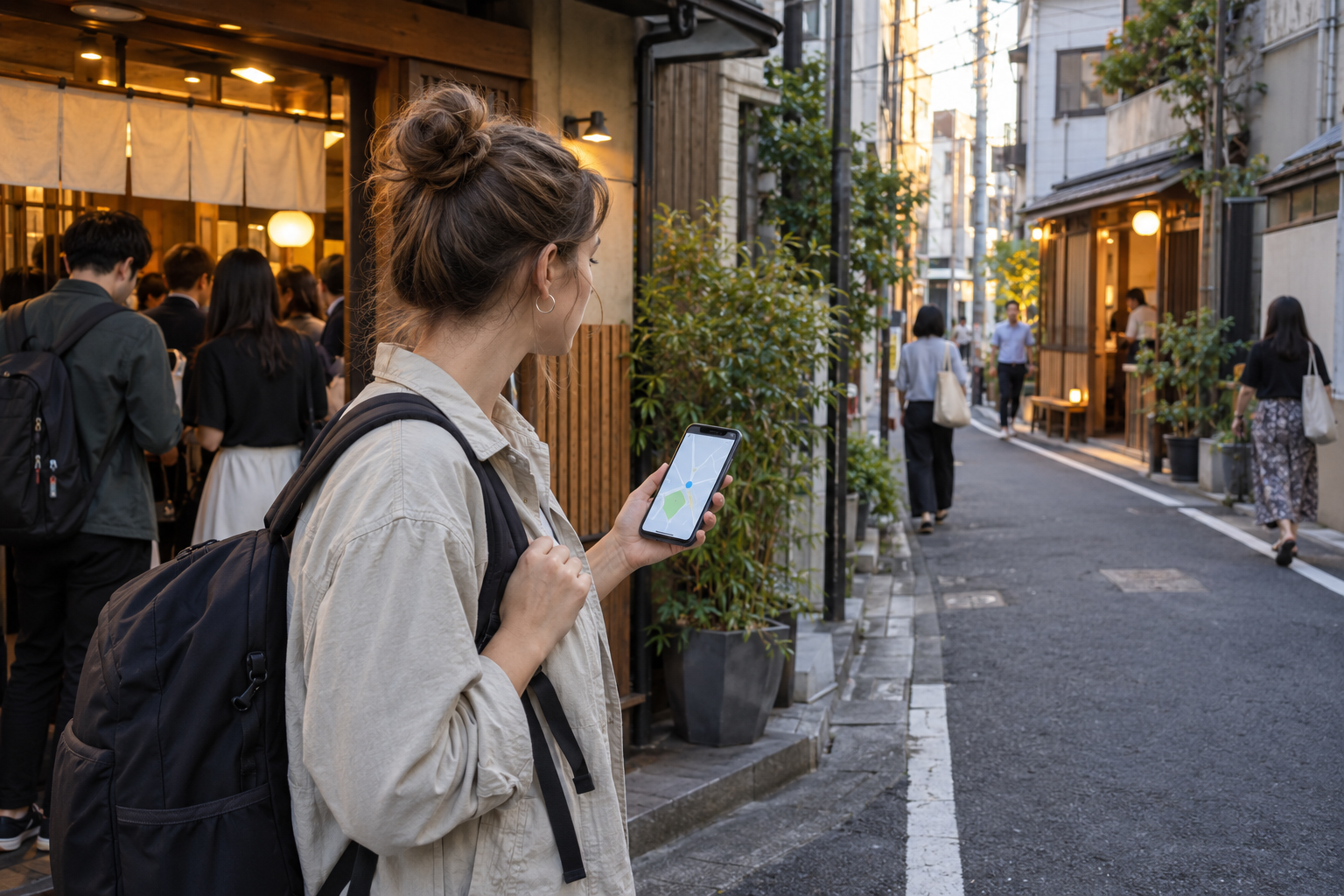
A useful Plan B is not simply “find another tempura restaurant.” It is a verified alternative that solves the reason Plan A failed.
Use this fallback ladder:
- Same restaurant, different format: If tendon ingredients are unclear, ask whether a simpler individual order or set is easier to confirm. Do not assume it is safer; verify it.
- Same area, another verified venue: Check the second venue’s current official menu, location, and operating information before walking there.
- Different cuisine with clearer information: If the allergy or cross-contact question remains unresolved, choose a restaurant that can explain its ingredients and preparation more clearly.
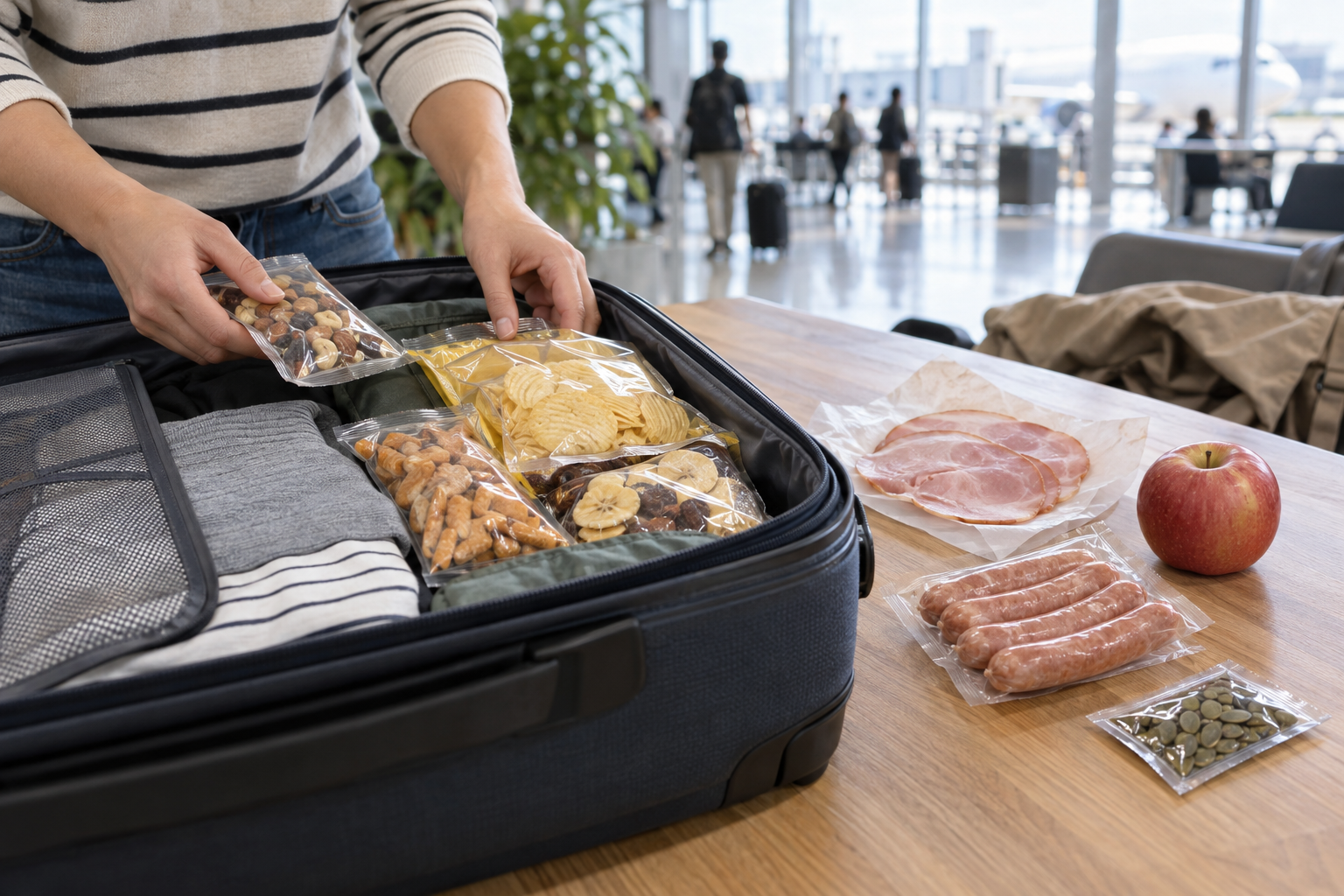
- Packaged-food fallback: For a serious restriction, a sealed product with an ingredient label you can reliably understand may be more practical than improvising at a busy fryer. Labeling still requires careful checking.
Save two possible venues near your planned sightseeing area. Recheck both on the day. A backup that closed, changed its menu, or cannot answer your allergy question is not a backup.
When a line is too long, payment does not work, a menu item has sold out, or communication is uncertain, leaving is a successful travel decision—not a failed food mission. Tempura will still exist tomorrow.
Useful phrases for a calm order
Keep each sentence short. Point to the current menu, and give staff time to answer.
| English | Simple Japanese reading aid | Purpose |
|---|---|---|
| “This one, please.” | Kore o onegaishimasu. | Select the item you are pointing to |
| “Is this tendon?” | Kore wa tendon desu ka? | Confirm the rice-bowl format |
| “Is this a set meal?” | Kore wa teishoku desu ka? | Confirm the set format |
| “What tempura is included?” | Nani no tempura ga haitte imasu ka? | Ask about the pieces |
| “Is the sauce already on it?” | Tare wa kakete arimasu ka? | Check the sauce format |
| “I have an allergy.” | Arerugii ga arimasu. | Start an allergy conversation |
| “Is the same frying oil used?” | Onaji abura de agete imasu ka? | Ask about shared oil |
| “If you cannot confirm, please tell me.” | Kakunin dekinai baai wa oshiete kudasai. | Make uncertainty acceptable |
These phrases are communication aids, not safety certificates. For a serious allergy, use a professionally checked translation that names your exact allergen and cross-contact limits.
Three quick decision examples
You want the simplest complete meal: Start with tendon, check the included pieces and sauce, and confirm the current price and availability at that restaurant.
You want crisp tempura separate from rice: Look for a tempura teishoku or a separate assortment plus rice. Confirm the set components rather than relying on the photo.
You have a serious allergy: Choose based on verifiable ingredient and preparation information, not on which format looks simplest. Shared oil can make individual tempura unsuitable even when the visible ingredient appears safe.
Related Real Japan Guide articles
- Japan Food Allergy Guide 2026 — prepare exact ingredient and cross-contact questions.
- Tokyo Restaurant Plan B 2026 — build a practical fallback before committing to a queue.
- Tokyo Restaurant Reservation Guide 2026 — check whether the exact venue uses reservations or walk-ins.
- Japan Restaurant Ticket Machine Guide 2026 — understand ticket-machine ordering where it is actually used.
- How to Use Tabelog in Japan — use restaurant listings as discovery support, then recheck current official information.
Final checklist
Before leaving for tempura in Tokyo:
- choose individual tempura, tendon, or teishoku;
- open the current official menu;
- verify the exact branch and service;
- confirm included items and sauce;
- ask separately about allergens and shared oil;
- check payment before committing to a queue;
- keep one verified Plan B nearby.
The best first tempura meal is not necessarily the most famous or expensive. It is the one you can identify, order, and eat with clear expectations.
FAQ
What is the difference between tempura and tendon?
Tempura refers to the fried items. Tendon is a rice bowl topped with tempura, usually served with sauce as part of the dish. Exact ingredients and presentation vary, so check the current menu.
Is a tempura teishoku the same as tendon?
No. In a tempura teishoku, the tempura is generally served separately from the rice with other set components. In tendon, the tempura sits on the rice. Restaurant definitions and set contents can vary.
Can I order individual tempura pieces in Tokyo?
Some restaurants offer individual pieces or assortments, while others focus on bowls, sets, or fixed courses. Check the current menu at the exact restaurant.
Is tempura safe for someone with a food allergy?
There is no universal answer. You must check the ingredient, batter, sauce, toppings, sides, utensils, preparation surfaces, and shared frying oil. If the restaurant cannot confirm what you need, use another verified option.
Does every Tokyo tempura restaurant accept cards?
Do not assume so. Payment methods differ by restaurant and may change. Check the specific restaurant’s current official information or ask before ordering.
Is Tempura Tendon Tenya representative of all Tokyo tempura restaurants?
No. Tenya is included only as one clearly labeled chain example with official menu and location pages. Its prices, menu, allergens, oil, payment, queues, and branch operations must not be generalized to other restaurants. Recheck Tenya’s current official menu and exact location page before visiting.
Do I need a reservation for tempura in Tokyo?
It depends on the restaurant. Some venues accept reservations, while others use walk-in queues or another current system. Check the exact restaurant’s official information instead of assuming one rule for Tokyo.
What should I do if the menu is only in Japanese?
Use the restaurant’s current official menu where available, point to the exact item, and ask one short question at a time about the format and included items. A photo or translation app can assist communication but does not replace ingredient or allergy confirmation.
Official sources checked
- JNTO: Food & Drink in Japan
- Tempura Tendon Tenya: English
- Tempura Tendon Tenya: English menu
- Tempura Tendon Tenya: Current Japanese menu
- Tempura Tendon Tenya: Tokyo locations
- Tempura Tendon Tenya: Official menu PDF
FAQ JSON-LD
Production note: LOCAL_PREP source production only. READY=false. Published=false. Public changes=0.

Comments