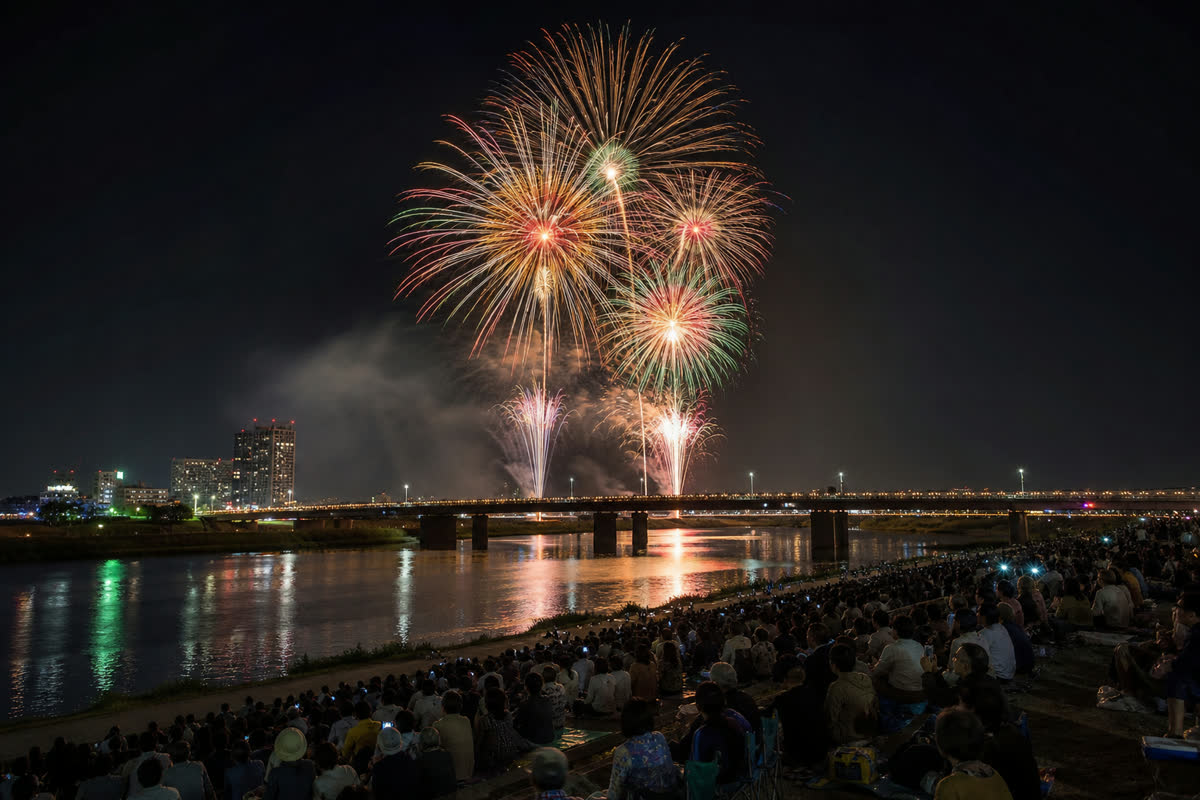
Tokyo's Tamagawa fireworks can create one very expensive mistake: you buy a seat on one side of the river, follow directions for the other side, and reach the wrong gate after the crowd has slowed the walk to a crawl.
The Setagaya Tamagawa Fireworks Festival and the Kawasaki City Tamagawa Fireworks Festival happen at the same time on opposite sides of the Tama River. They are coordinated events, but their venues, tickets, entrances and rules are not interchangeable.
This guide is for travelers planning the Setagaya side, especially the Kamata venue (鎌田会場). It gives you a practical train plan, explains which ticket you are buying, and builds a Plan B for rain, crowds and the trip home.
- Quick answer: what you need to know
- Setagaya or Kawasaki? Decide before you buy anything
- Are paid tickets worth it?
- Which train should you take?
- What time should you arrive?
- What to bring—and what to leave at the hotel
- General-viewing rules: no ticket does not mean no plan
- Rain, cancellation and refunds
- The exit is the second event
- Plan B if tickets sell out
- A screenshot-ready day plan
- Frequently asked questions
- Official sources and update note
Quick answer: what you need to know
- Date: Saturday, October 3, 2026.
- Fireworks: 6:00 p.m.–7:00 p.m.; approximately 6,000 fireworks on the Setagaya side.
- Setagaya venue: Setagaya Futako-Tamagawa Green Space Athletic Field (世田谷区立二子玉川緑地運動場).
- Paid-seat destination: Kamata venue, written 鎌田会場. This is not Kamata Station, written 蒲田駅, in southern Tokyo.
- Main rail station for the Setagaya side: Futako-tamagawa Station on the Tokyu Den-en-toshi and Oimachi lines. Do not rely on an ordinary map-app walking estimate on event day.
- Paid area opens: 3:00 p.m. The organizer warns that the journey from the station to the venue can take more than 90 minutes in severe crowding.
- General viewing: The Kamata general-viewing area operates from 2:00 p.m.; the Unane venue operates from 3:00 p.m. These areas are unreserved, and space or access may become unavailable.
- Weather: The event is canceled in severe weather, with no rain date announced. The organizer plans to post a cancellation decision by 7:00 a.m., but a later cancellation remains possible if conditions change.
- Rain gear: Use a raincoat, not an umbrella, in the viewing area.
- Transport: Do not arrive by car. Traffic restrictions are scheduled around Futako-tamagawa from the afternoon into the evening, and event-day bus changes are still being finalized as of July 16.
Do one thing now: save the official Setagaya venue map and, if you want a reserved seat, open the official paid-seat page before reading resale listings or social posts.
Setagaya or Kawasaki? Decide before you buy anything
The two displays are intentionally held together. On October 3, both are scheduled for 6:00 p.m.–7:00 p.m., and each side lists approximately 6,000 fireworks. From a distance, this can look like one giant event. Operationally, it is two.
| If your confirmation says… | Your event side | What to follow |
|---|---|---|
| 世田谷区たまがわ花火大会 / 鎌田会場 | Setagaya, Tokyo | Setagaya ticket page and Setagaya venue map |
| 川崎市制記念多摩川花火大会 | Kawasaki, Kanagawa | Kawasaki City / Kawasaki tourism instructions |
| 上野毛会場 | A Kawasaki paid-seat area located on the Tokyo side | The instructions attached to that Kawasaki ticket—not the Setagaya Kamata gate |
The last row is the trap. The Setagaya ticket page also lists Kawasaki's Kaminoge venue paid seats in Futako-tamagawa Park. Being physically on the Tokyo side does not turn that ticket into a Setagaya Kamata ticket.
Before payment, match these three items:
- the organizer named on the sales page;
- the exact venue written on the ticket; and
- the route published for that venue.
If one does not match, stop. Do not assume you can cross the river or enter another enclosure after reaching the area. The Setagaya organizer says wrong-venue arrivals recur each year, and crowd controls or bridge restrictions may be introduced for safety.
Are paid tickets worth it?
A paid seat does not remove the transport problem. It removes the need to compete for an unreserved patch of ground after you arrive.
That distinction matters for a one-night Tokyo plan. If seeing the full display is the priority, a reserved seat gives you a defined capacity and location. If your schedule is flexible and you are comfortable accepting a partial view, a crowded standing area or leaving early, the general-viewing areas cost less but shift more risk onto arrival time and space availability.
2026 Setagaya Kamata paid-seat prices
| Seat type | Capacity | Price | Approximate price per person at full capacity |
|---|---|---|---|
| Chair seat | 1 | ¥6,500 | ¥6,500 |
| Pair chair seats | 2 | ¥14,000 | ¥7,000 |
| Pair sheet | 2 | ¥15,000 | ¥7,500 |
| Sheet | 4 | ¥22,000 | ¥5,500 |
| Table with four chairs | 4 | ¥42,000 | ¥10,500 |
| Large sheet | 10 | ¥55,000 | ¥5,500 |
The table is a planning comparison, not a promise of availability. Sales are first-come, first-served. Setagaya resident priority sales run from July 12 at 2:00 p.m. to July 22 at 11:00 p.m. Applications from non-residents during that period are canceled later. General sales begin July 26 at 2:00 p.m. through Rakuten Ticket or the published phone service.
A single chair seat is the simplest product to compare when buying for one person. A four-person sheet can be better value for a group, but the space is fixed at 180 cm × 180 cm. The pair sheet is smaller. The large sheet becomes economical when you can coordinate a group of up to ten people and arrive together.
The ticket step travelers can easily miss
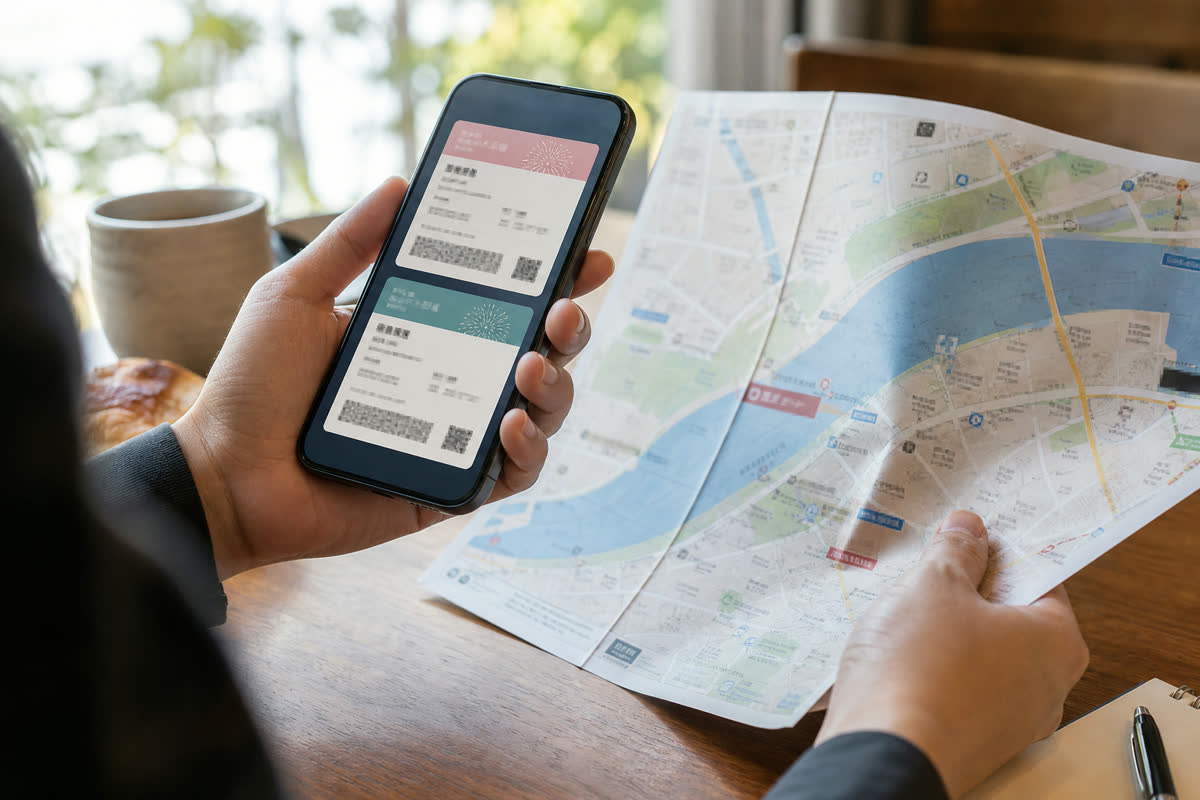
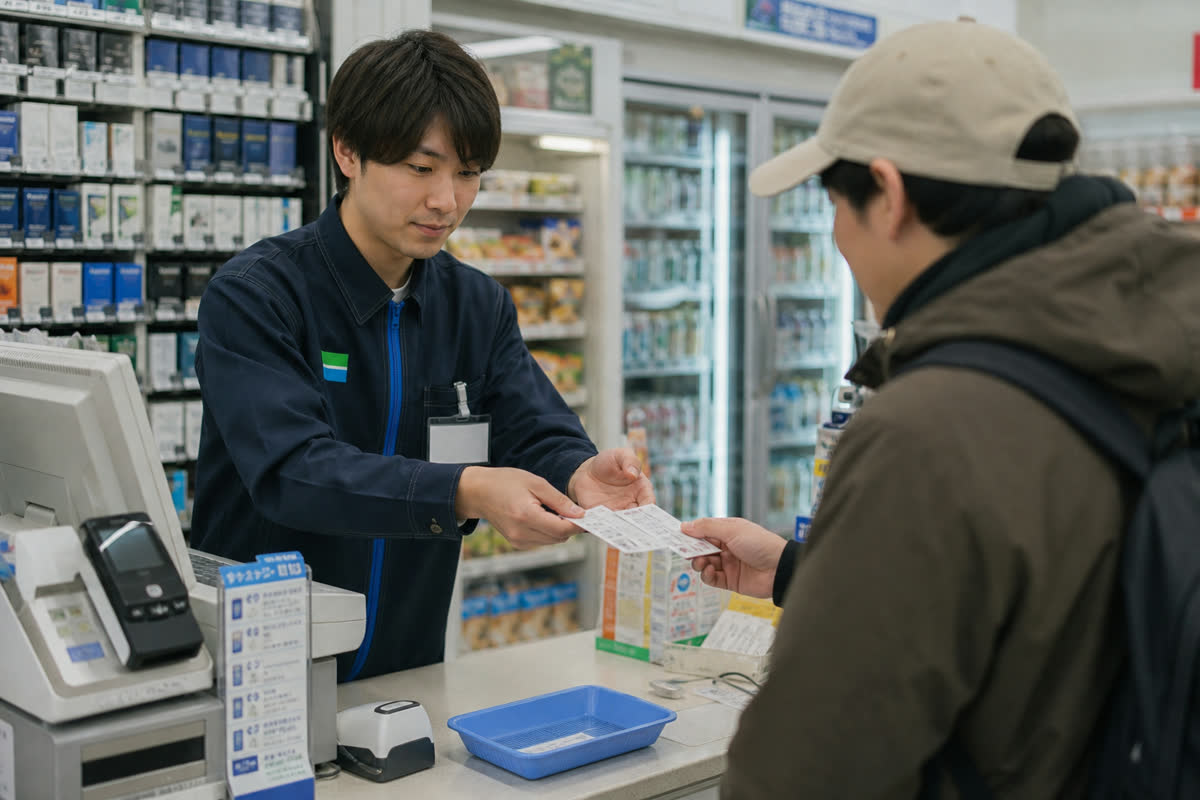
An online reservation is not the item you show at the gate. The organizer says tickets must be printed at a 7-Eleven register, with printing available from September 13 at 10:00 a.m. Each attendee needs a ticket. Tickets cannot be reserved over a convenience-store counter, and purchased tickets cannot be canceled, changed or reissued.
That means a traveler leaving Japan before September 13 cannot complete the printing step early. Make a printing plan before buying: check the sales instructions, confirm the pickup method attached to your order, and leave time to visit a Japanese 7-Eleven after printing opens.
Which train should you take?
For the Setagaya Kamata venue, build your route to Futako-tamagawa Station (二子玉川駅), served by the Tokyu Den-en-toshi Line and Tokyu Oimachi Line. Then follow the current official pedestrian route and event staff—not the shortest blue line suggested by a map app.
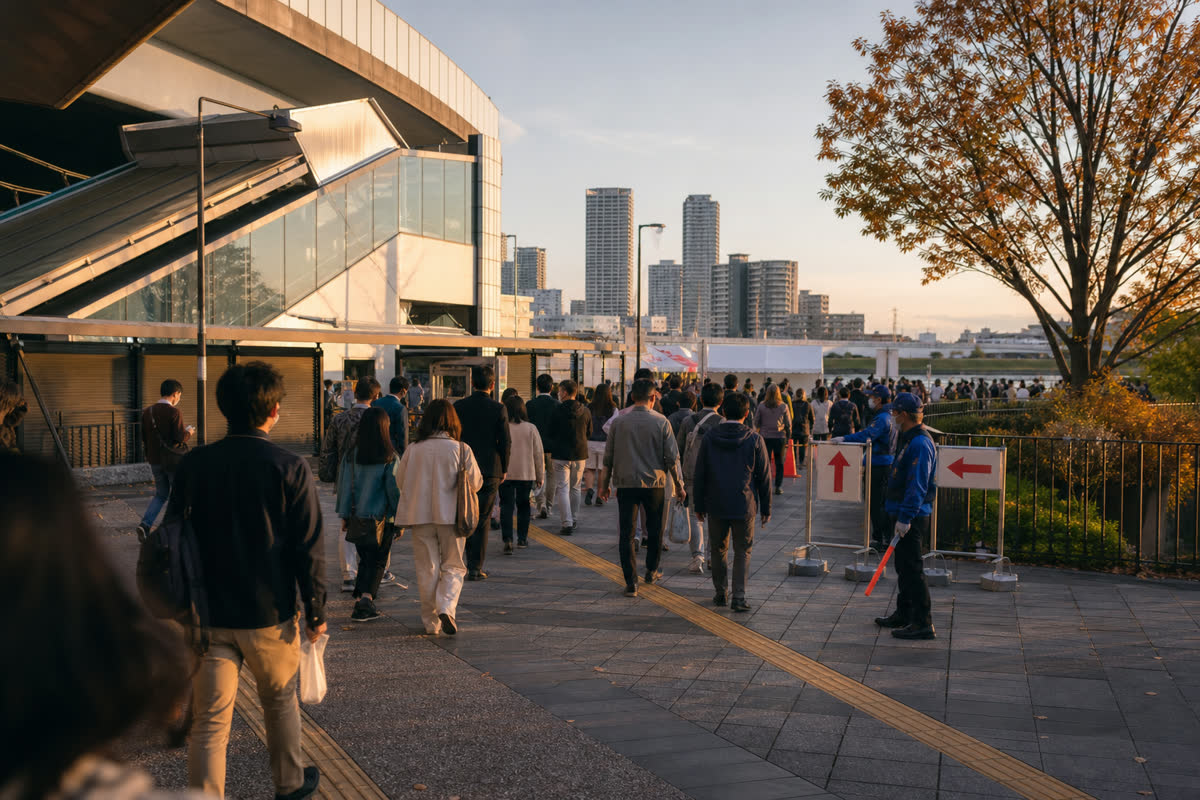
The station is the beginning of the event queue, not the end of your journey. The Setagaya organizer explicitly warns that severe crowds can make the station-to-venue trip exceed 90 minutes. The paid area opens at 3:00 p.m., and no refund is offered when crowd delay or late arrival prevents you from reaching the venue.
A route-planning rule that survives timetable changes
Do not plan backward from the 6:00 p.m. launch time alone. Plan three separate legs:
- Hotel to Futako-tamagawa: check your rail route on the morning of October 3.
- Station to venue: use the official map and budget for crowd-controlled walking.
- Venue to your second-choice station or waiting point: decide before your phone signal becomes unreliable.
If you are coming from central Tokyo, your exact transfer depends on your hotel. The Den-en-toshi Line connects through Shibuya; the Oimachi Line serves the Oimachi direction. Through-services, platform assignments and crowd controls can change, so this guide does not prescribe one train number months in advance.
Save the venue name in Japanese: 世田谷区立二子玉川緑地運動場・鎌田会場. Also save a screenshot of your ticket's venue line. Those two images are more useful to station staff than saying just “Tamagawa fireworks.”
Do not use Kamata Station
Japanese has two different place names that can both appear as “Kamata” in English:
- 鎌田 is the Setagaya neighborhood and event venue in this guide.
- 蒲田 is Kamata Station in Ota Ward, far to the southeast.
Typing “Kamata” by itself into a route app can send you to the wrong part of Tokyo. Search for Futako-tamagawa Station or paste the venue's Japanese name.
What time should you arrive?
There is no single magic arrival time. Choose based on what you bought and how much risk you accept.
| Your plan | Practical target at Futako-tamagawa | Why |
|---|---|---|
| Paid seat, low-stress priority | About 3:00–3:30 p.m. | The paid area opens at 3:00 p.m.; this leaves a large crowd buffer |
| Paid seat, willing to accept pressure | By about 4:00 p.m. | Still leaves two hours, but the official 90-minute crowd warning matters |
| General viewing, full-display priority | Before the general area opens at 2:00 p.m. | Space is unreserved and may be reduced or closed for safety |
| Only want atmosphere or a partial view | Later, with a preselected exit plan | Accept that access restrictions may prevent entry |
These are Real Japan Guide planning buffers, not organizer guarantees. Weather, rail disruption and police-directed crowd controls can change the outcome.
For a paid-seat holder, arriving at 5:00 p.m. is a poor bet even though the fireworks begin at 6:00 p.m. A normal walking-time estimate does not account for one-way pedestrian routing, station congestion, bag checks, toilet queues or a temporary stop in admissions.
For general viewing, “I placed a sheet, so I can return later” is not a secure plan. The organizer may shrink unattended or oversized space, and entry can be stopped even when your group has already marked a place inside.
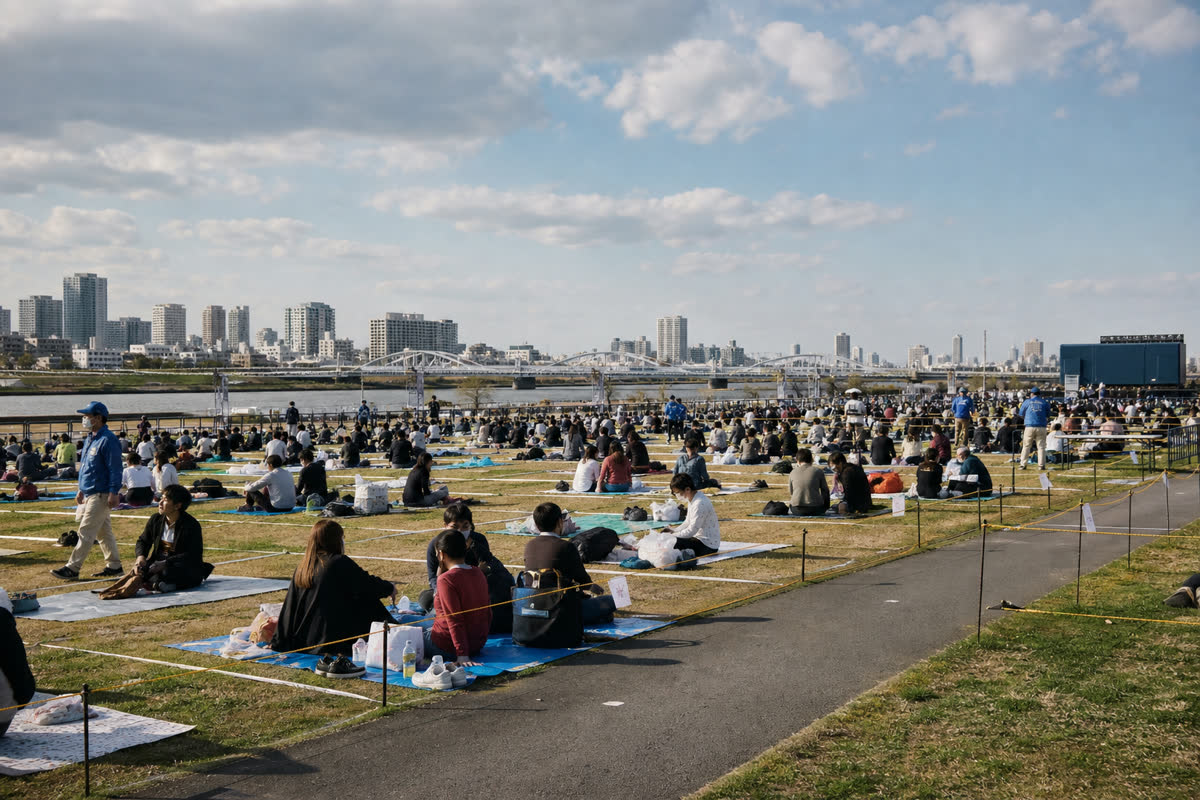
What to bring—and what to leave at the hotel
Pack for a one-hour autumn display plus several hours of slow movement.
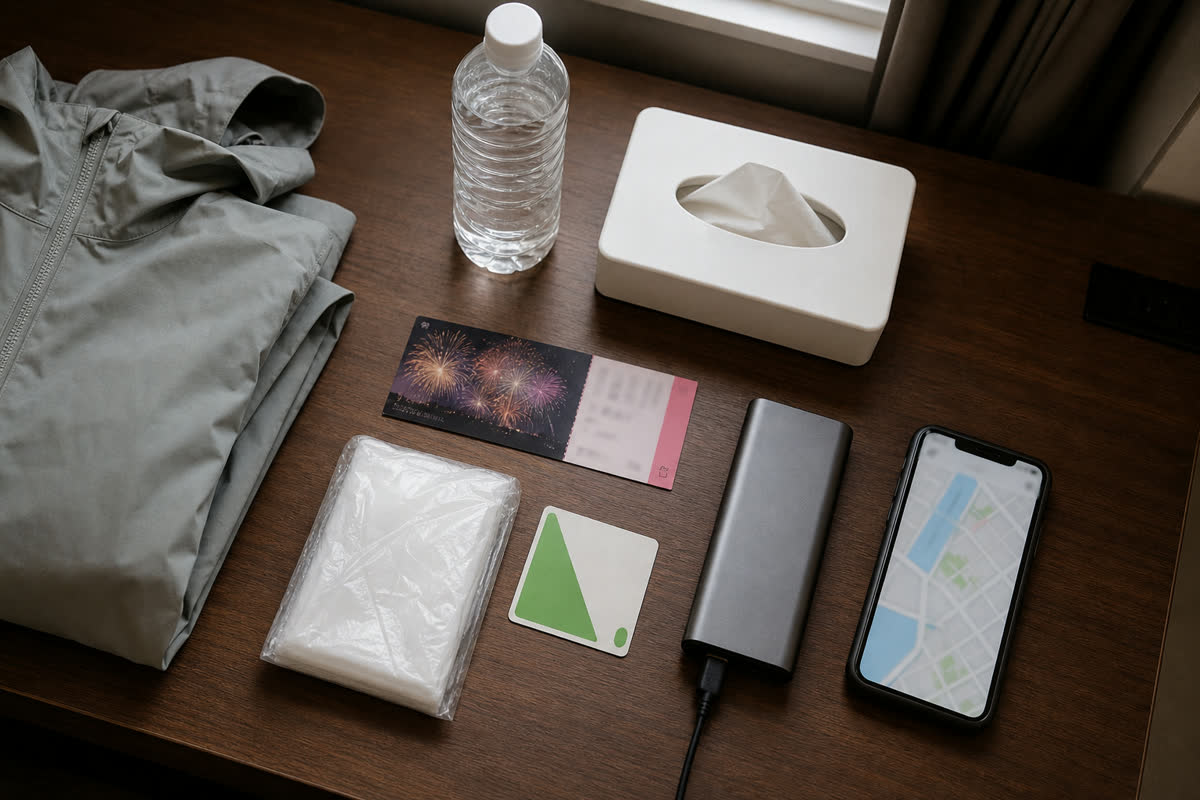
Bring
- one printed ticket per attendee in a waterproof sleeve;
- a charged phone and compact power bank;
- a screenshot of the official venue map and ticket venue name;
- an IC transit card with enough balance for the return trip;
- a light raincoat or poncho;
- water and any essential medication;
- a small towel, tissues and hand sanitizer;
- a warm layer for the riverbank after sunset;
- glasses or eye protection if you are concerned about ash or firework debris.
Phone service may be limited in the dense crowd. Agree on a meeting point before entry and enter together. Toilets also become heavily congested, so use one before the final approach when practical.
Leave behind
- umbrellas for use in the viewing area;
- pets, except assistance dogs;
- drones;
- tents, parasols, leisure tables and personal chairs for the general venue;
- pegs, stakes, stones, adhesive tape or spray used to claim ground;
- dangerous items or open flames.
The organizer may conduct a bag check. Keep the load compact: unnecessary items add weight during a slow exit.
General-viewing rules: no ticket does not mean no plan
The official schedule lists a general-viewing area at Kamata from 2:00 p.m. to 8:00 p.m. and the Unane venue from 3:00 p.m. to 8:00 p.m. These are the two official starting points for a no-paid-ticket plan; do not invent a viewing spot in a residential street or on private land.
At the Setagaya venue, the guideline is roughly 90 cm square per person. Rope-based place marking may begin at midnight on event day. Plastic sheets may be laid starting at 2:00 p.m. to protect the grass. Someone must remain with the space, and organizers may reduce unattended or excessive claims. Routes and aisles must stay open.
This creates a simple choice:
- If the full hour matters, arrive early enough to accept a long wait.
- If you do not want the wait, treat any view as a bonus and keep your evening flexible.
Do not plan to stand on a bridge. Safety controls can close bridges or restrict entry. Do not enter nearby homes, private land or restricted riverbank zones, even if a social-media post recommends a “secret spot.”
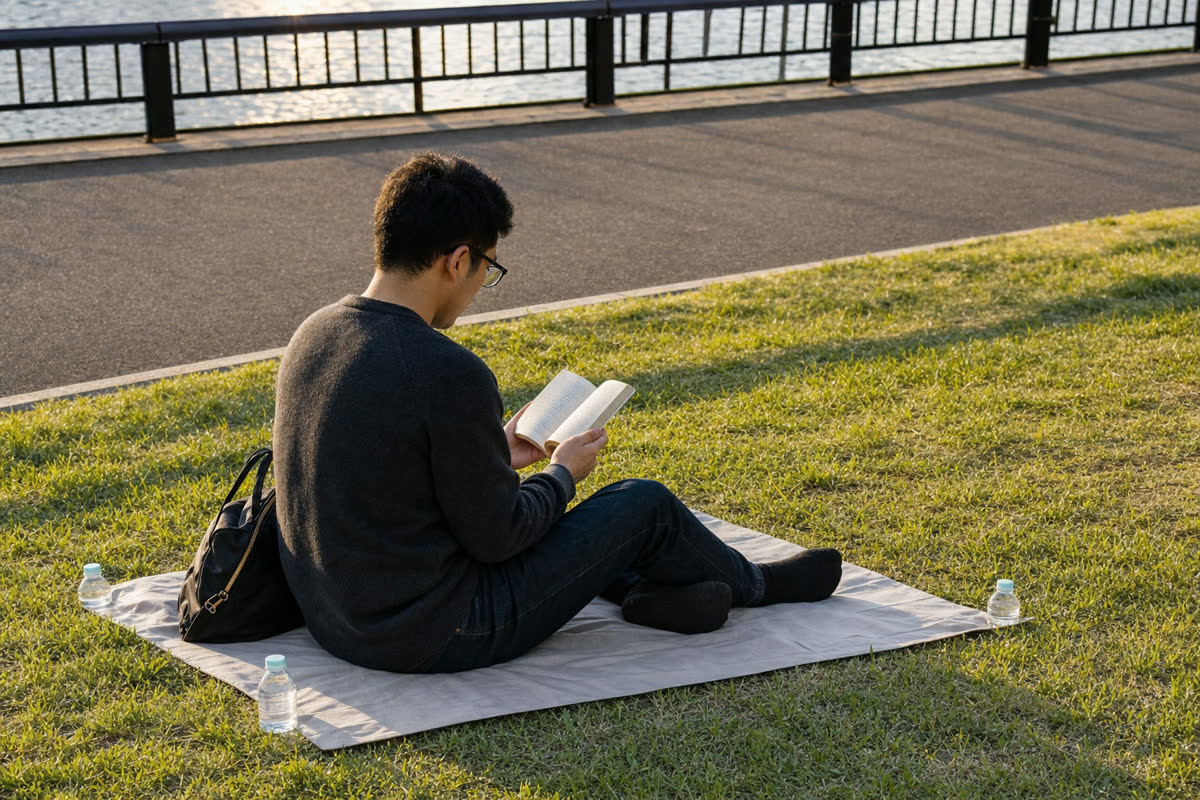
Rain, cancellation and refunds
The Setagaya event is scheduled to be canceled in severe weather. It is not listed with a postponement date. The organizer plans to decide by 7:00 a.m. on October 3 and post a cancellation notice on the official website. A decision to proceed can still be reversed if the weather changes.
Paid-seat refund rule
If the event is canceled before fireworks launch, the organizer says printed tickets will be refunded at the store that issued them, in exchange for the complete set of tickets. Convenience-store payment fees are excluded. Detailed instructions are to be posted after cancellation.
This is narrower than “bad weather equals refund.” Do not make a nonrefundable hotel or transport decision based on an assumed ticket payout. Keep the physical tickets until the organizer closes the refund process.
For Kawasaki cooperation seats, read the Kawasaki terms separately. Kawasaki describes the seats as a return for sponsorship and says refunds are generally not provided except when the event is canceled before launch. Do not transfer the Setagaya refund procedure to a Kawasaki ticket.
Your weather decision tree
- Check the Setagaya official site before leaving your hotel.
- Check the local hourly weather and rail status.
- If the event proceeds in rain, take a raincoat and waterproof your ticket.
- If conditions deteriorate, follow staff instructions rather than waiting for a complete social-media update.
- If canceled, keep the complete set of printed tickets and follow the official refund notice.
For a broader storm-day plan, use our Japan Rain and Typhoon Plan.
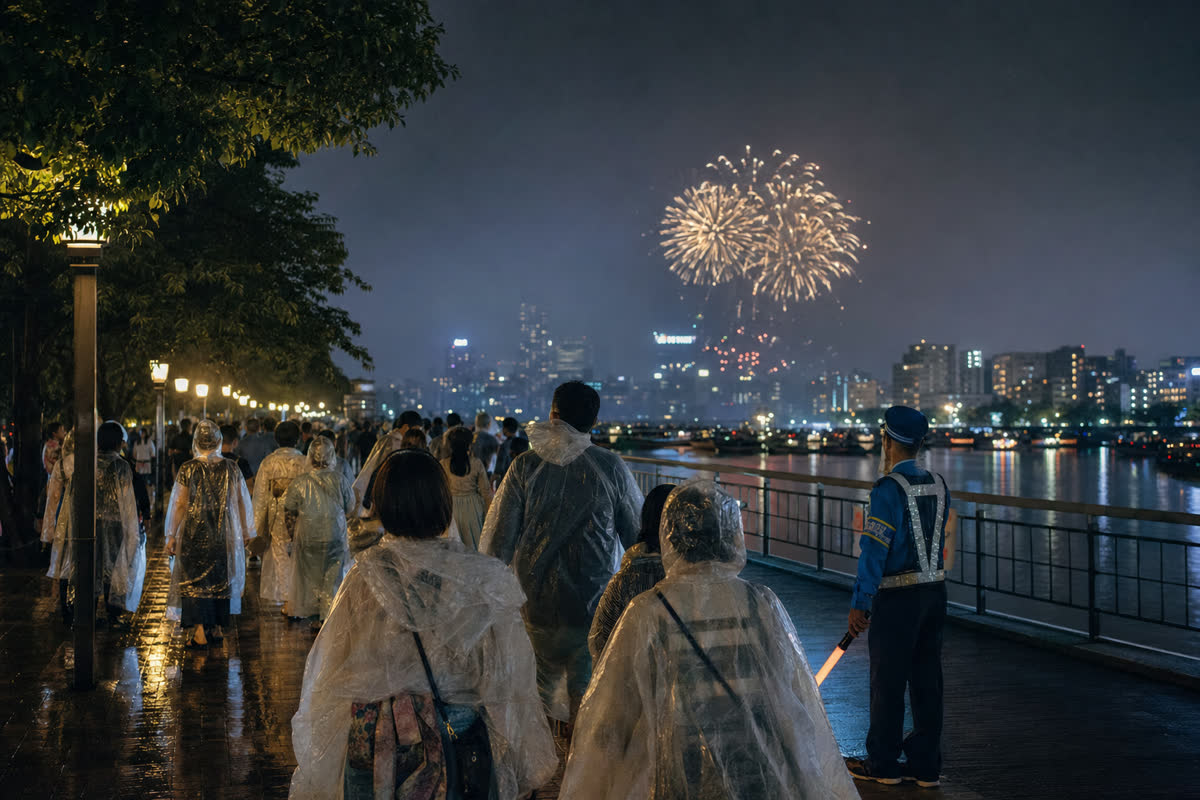
The exit is the second event
At 7:00 p.m., thousands of people begin moving toward limited routes. If everyone in your group opens a map and improvises at once, you have waited too long.
Before the first firework, choose one of three exit modes:
1. Leave before the finale
You sacrifice the closing sequence but leave before the post-finale surge. This can reduce schedule pressure when you have a fixed dinner reservation, young children, limited standing tolerance or a long connection.
2. Stay seated and let the first wave pass
This option depends on the venue remaining open and staff permitting it. Keep your group together, use the toilet before the end if feasible, and do not block cleanup or emergency routes.
3. Walk to an alternative transport point—after checking the official update
Event-day bus operations around Futako-tamagawa will change. As of July 16, the 2026 bus plan is still being adjusted, with details expected later. Do not copy last year's bus stop or departure time into your itinerary as if it were confirmed.
The practical move is to revisit the official bus-operation page in late August or September, then save the final leaflet offline. Also review the 2026 traffic restriction page: vehicle restrictions are planned on the west side of Futako-tamagawa Station from roughly 4:00 p.m. to 9:00 p.m. and on the east side from roughly 3:00 p.m. to 9:00 p.m.
Taxis are not an escape hatch inside a traffic-control zone. If you need one, choose a pickup area well outside the restrictions and expect high demand. Our Tokyo Last Train and Taxi Plan explains how to build the final leg before the night begins.
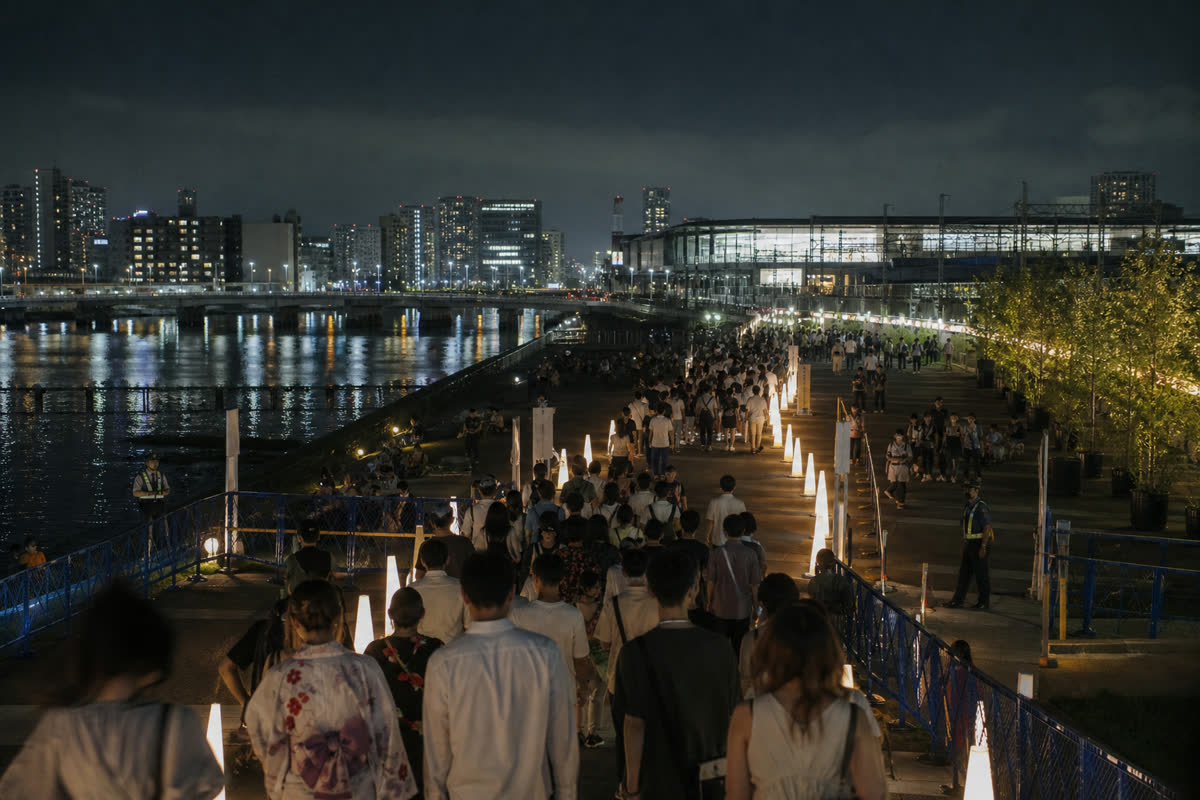
Plan B if tickets sell out
Sold out does not mean your Tokyo evening is ruined. It means you should stop optimizing for an ideal front-row view.
Plan B1: use an official general-viewing area
Choose Kamata general viewing or Unane, arrive early, obey the space rules and accept that admission can be restricted. Recheck the official map close to the event because venue details may change.
Plan B2: make the fireworks optional
Spend late afternoon around Futako-tamagawa, but set a personal cutoff. If the station or river approach becomes uncomfortable, leave before the 6:00 p.m. surge and turn the night into dinner or an indoor activity. A distant flash or a few minutes of atmosphere can still be a good travel memory.
Plan B3: choose a different fireworks experience
If you have not fixed your October dates, compare other confirmed events rather than buying an unclear resale ticket. Start with our Japan Summer Fireworks 2026 Guide and Japan Festival Survival Guide.
Avoid unofficial paid “viewing packages” unless the seller clearly identifies the property, legal access, cancellation terms and exact sightline. A photograph taken in another year is not proof that a route or view will remain open in 2026.
A screenshot-ready day plan
Morning
- Check the Setagaya official homepage for the 7:00 a.m. event decision.
- Check Tokyu service information and the hourly forecast.
- Confirm one printed ticket per person, if applicable.
Before leaving the hotel
- Put the venue name and map screenshots on each group member's phone.
- Agree on a meeting point and an exit mode.
- Add transit-card balance before entering the event crowd.
Around 3:00 p.m.
- Paid-seat holders prioritizing low stress should be at or near Futako-tamagawa.
- General-viewing visitors should already understand that space is unreserved.
By 4:00 p.m.
- Recheck the official crowd update.
- Use toilets before the final approach.
- Keep the group together.
6:00 p.m.–7:00 p.m.
- Enjoy the display and keep aisles clear.
- If wind carries ash, protect your eyes and follow staff guidance.
After 7:00 p.m.
- Use the exit mode you chose earlier.
- Do not stop in a bridge, road or station entrance to renegotiate the plan.
- If you miss the intended train, switch to the preselected backup—not a taxi pickup inside the restricted zone.
Frequently asked questions
When are the Setagaya Tamagawa Fireworks in 2026?
They are scheduled for Saturday, October 3, 2026, from 6:00 p.m. to 7:00 p.m. The Setagaya organizer lists approximately 6,000 fireworks and cancellation in severe weather.
Which station should I use for the Setagaya side?
Use Futako-tamagawa Station on the Tokyu Den-en-toshi and Oimachi lines, then follow the official event route. The organizer warns that the station-to-venue journey can exceed 90 minutes in severe crowding.
Is the Setagaya venue near Kamata Station?
No. The event's Kamata is 鎌田 in Setagaya. Kamata Station is 蒲田駅 in Ota Ward. Search for Futako-tamagawa Station or the full venue name instead of entering “Kamata” by itself.
Can tourists buy tickets?
Yes, through the general sale scheduled to begin July 26 at 2:00 p.m., subject to availability and the seller's purchase process. The earlier July 12–22 priority window is for Setagaya residents; non-resident applications in that window are canceled.
Is a phone ticket enough?
No. The Setagaya organizer says reserved tickets must be printed at a 7-Eleven register from September 13 at 10:00 a.m., with one ticket required per attendee.
What happens if it rains?
The event may proceed in rain, but severe weather leads to cancellation. Use a raincoat rather than an umbrella in the viewing area. Check the official site on the morning of the event and continue monitoring conditions.
Can I get a refund if the event is canceled?
For Setagaya paid seats, the organizer says a cancellation before fireworks launch triggers a refund at the issuing store in exchange for the complete set of printed tickets, excluding store payment fees. Follow the official post-cancellation notice for the exact procedure.
Can I go without a paid ticket?
The official schedule lists general-viewing areas at Kamata and Unane. They are unreserved, space or access may become unavailable, and entry can be restricted for safety. Arrive early or accept a flexible, partial-view plan.
Official sources and update note
This guide was last checked on July 16, 2026. Event operations can change. The 2026 Setagaya bus plan and some Kawasaki venue details were not final at the time of checking.
Comments