Japan's departure tax changed on July 1, 2026. The headline is simple: the International Tourist Tax rose from ¥1,000 to ¥3,000 per departure. The amount on an individual ticket can be less simple.
A ticket bought before July may still qualify for the old rate when the underlying contract of carriage meets the transition rules. An open ticket, a date change made after July 1, or a contract that collects the tax separately can produce a different result.
This guide gives you a practical way to check the amount before you reach the airport or cruise terminal.
- Quick Answer
- What Changed on July 1, 2026?
- Who Must Pay the ¥3,000 Departure Tax?
- Does the Purchase Date or Departure Date Decide the Rate?
- Where Does the Tax Appear on Your Ticket?
- Children, Transit Passengers and Other Exemptions
- Departure Tax vs Visa, Airport and Hotel Taxes
- Plan B: What to Do If the Amount Looks Wrong
- Official Sources and Last-Checked Date
- FAQ
- 1. Do I pay Japan's ¥3,000 departure tax at the airport?
- 2. Does the departure tax apply just to foreign tourists?
- 3. I bought my ticket before July 1, 2026. Do I pay ¥1,000 or ¥3,000?
- 4. Is the tax charged per departure or per airline seat?
- 5. Do children pay Japan's departure tax?
- 6. Are transit passengers exempt?
- 7. Does the tax apply to cruises and ferries?
- 8. Is this the same as a visa fee, airport charge or hotel tax?
Quick Answer
For departures from Japan on or after July 1, 2026, the International Tourist Tax is generally ¥3,000 per person, per departure. It applies to people leaving Japan by aircraft or ship regardless of nationality or travel purpose.
As a general rule, airlines and cruise lines collect it before boarding by adding it to the ticket price. The collection step is handled through the carrier rather than a separate tax counter for a standard commercial ticket.
The old ¥1,000 rate can still apply to an eligible contract of carriage concluded before July 1, 2026, when the departure date was already fixed and the contract did not provide for collecting the tax separately from the fare. Important exceptions are explained below.
Do this now: Find the confirmation for the trip leaving Japan. Check the original issue or contract date, the departure date and any tax or fee breakdown. If you cannot tell whether ¥1,000 or ¥3,000 applies, ask the operating carrier before departure.

*Caption: An international traveler heads toward departure with a passport and carry-on at a Japanese airport.*
Information checked: July 25, 2026. Carrier displays and refund procedures can differ. The National Tax Agency rules and your carrier's confirmed fare breakdown are the final authorities for your ticket.
What Changed on July 1, 2026?
Japan's national International Tourist Tax increased from ¥1,000 to ¥3,000 on July 1, 2026.
The new rate is based primarily on when you depart from Japan:
| Departure from Japan | Starting point |
|---|---|
| On or before June 30, 2026 | ¥1,000 |
| On or after July 1, 2026 | ¥3,000 in principle |
The tax is charged for each departure from Japan, not once per vacation. For example, if a cruise itinerary leaves Japan, visits a foreign port, returns to Japan and later leaves Japan again, the tax can apply to each departure.
It is based on the person departing, not the number of seats purchased. If one traveler buys a second airline seat for an instrument, the National Tax Agency says the tax is levied for one person.
The name can be misleading. This is not limited to leisure tourists. Japanese residents, foreign visitors and people traveling for business, study, work, medical care or other purposes can be liable when they depart by aircraft or ship.
Who Must Pay the ¥3,000 Departure Tax?
The general rule covers a person departing Japan on an international aircraft or ship on or after July 1, 2026.
That includes most passengers on:
- international flights leaving a Japanese airport;
- international ferries and cruise ships leaving a Japanese port; and
- domestic-to-international itineraries when the taxable departure is the leg that leaves Japan.
The airline or sea carrier normally collects the tax from the passenger and remits it to the Japanese government. If someone leaves using a private aircraft or vessel outside the normal carrier-collection system, the traveler may have to pay the government by the time of boarding.
Nationality does not decide the tax. A foreign visitor is not charged merely for being foreign, and a Japanese citizen is not automatically excluded.

*Caption: Travelers prepare for an international departure from a bright, modern Japanese airport.*
Does the Purchase Date or Departure Date Decide the Rate?
Start with the departure date, then check whether the pre-July contract exception applies.
The practical decision table
| Your situation | Likely rate under the official rule |
|---|---|
| You depart before July 1, 2026 | ¥1,000 |
| You depart on or after July 1 and the contract of carriage was concluded on or after July 1 | ¥3,000 |
| The contract was concluded before July 1, the departure date was fixed before July 1, and the contract did not provide for separate tax collection | ¥1,000 |
| You had an open or coupon ticket before July 1 but fixed the departure date on or after July 1 | ¥3,000 |
| You changed the departure date on or after July 1 | ¥3,000 |
| The pre-July contract says the International Tourist Tax is collected separately from the fare | ¥3,000 |
The legal date is the date the contract of carriage with the international passenger carrier was established. It is not necessarily the date you signed a package-tour agreement with a travel agency.
This is why “I booked my holiday in June” is not enough by itself. You need the ticket or carrier confirmation for the outbound trip from Japan.
A common example
Suppose a carrier issued a fixed-date ticket on June 28 for a July 3 departure. The old ¥1,000 rate generally applies if the contract does not say that the tax will be collected separately.
If the passenger changes that departure on July 2 to July 4, the official Q&A says the new ¥3,000 rate applies.
If your booking was reissued, split across tickets or arranged through an agent, do not guess from the first email date. Ask the operating carrier which contract date and rate it applied.

*Caption: A traveler checks the June 30 and July 1 boundary before departure.*
Where Does the Tax Appear on Your Ticket?
For a normal commercial flight or cruise, the carrier collects the tax before boarding, with the amount included in or added to the ticket total. It may appear as a named tax line or within a combined taxes-and-fees breakdown. The exact label and screen layout can vary by carrier and booking channel.
Check these places:
- the final payment page or fare breakdown;
- the e-ticket receipt or cruise invoice;
- any reissue confirmation after a date change; and
- the carrier's booking-management page.
Do not assume that a ¥3,000 line is this tax without checking its label. Airport passenger facility charges, security charges, carrier surcharges and other fees can appear beside it.
If the line is unclear, ask the carrier:
“What amount of Japan International Tourist Tax was collected for this passenger, and which ticket or contract date determined it?”
Save the answer with the receipt. That gives you a specific record if a later reissue or airport collection does not match.
For everyday payment preparation before your final travel day, see our Cash in Japan guide. The departure tax itself, however, is normally handled through the carrier rather than as a cash payment at a standard airport counter.
Children, Transit Passengers and Other Exemptions
The National Tax Agency lists these traveler-facing exclusions and exemptions:
- children under age two;
- ship and aircraft crew members;
- certain passengers subject to deportation;
- people leaving on qualifying official government aircraft or ships;
- certain transit passengers leaving Japan within 24 hours of arrival;
- certain passengers whose aircraft or ship stopped in Japan because of weather or another unavoidable emergency; and
- certain diplomats, state guests and eligible military or United Nations personnel traveling for qualifying official purposes.
Children
A child under two is not taxed. For a round trip issued on one ticket, the official rules contain a specific age-determination provision tied to when transportation under that ticket began. If a child turns two during the trip, ask the carrier to confirm how the rule applies to that ticket instead of using the return-flight date by itself.
Transit passengers
A layover under 24 hours does not by itself establish the exemption.
The air-transit rule is for qualifying travel from one foreign country to another via Japan, with the required itinerary shown on a single ticket. The official Q&A uses the scheduled arrival and departure times shown on that ticket to judge the 24-hour period. Separate tickets or an itinerary that does not meet those conditions may be treated differently.
If you enter Japan during a connection, keep the same ticket confirmation and ask the carrier whether the exemption is reflected in the fare. Sea-transit rules are not identical to the air-transit rule, so cruise and ferry passengers should confirm their itinerary with the operator.
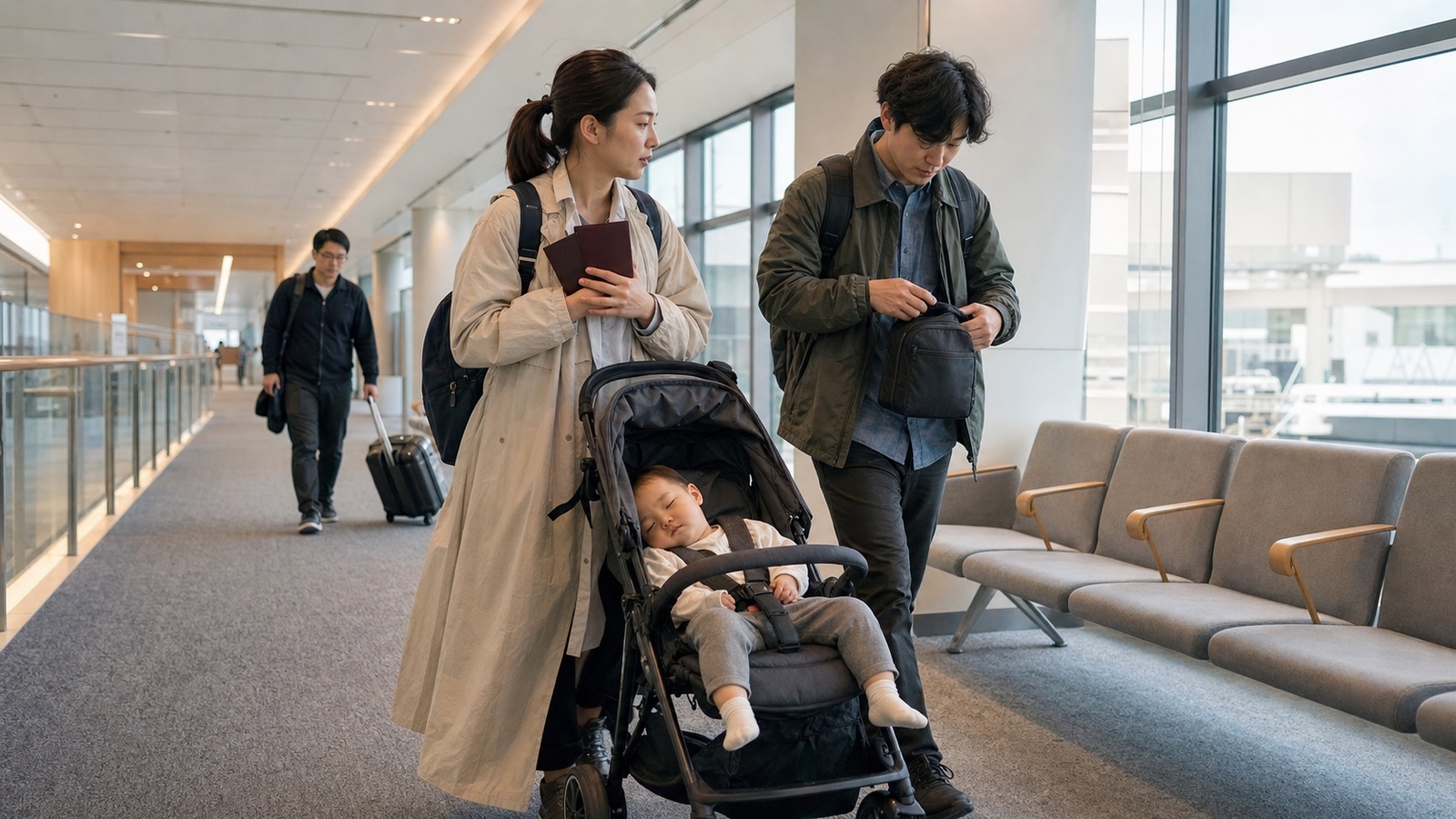
*Caption: A family with a young child moves through an international transfer corridor.*
Departure Tax vs Visa, Airport and Hotel Taxes
The ¥3,000 International Tourist Tax is a national departure tax. It is separate from other travel costs that may appear before or during a Japan trip.
| Charge | What triggers it |
|---|---|
| International Tourist Tax | A taxable departure from Japan by aircraft or ship |
| Visa fee | A visa application or issuance process, when required |
| Airport or port facility charge | Use of a particular passenger facility under that facility's rules |
| Accommodation tax | A qualifying hotel or lodging stay under the relevant local rules |
| Consumption tax | Taxable purchases of goods or services in Japan |
One charge does not replace another. A ticket can contain both the International Tourist Tax and airport-related charges without being a duplicate collection.
Likewise, Japan's tax-free shopping system concerns consumption tax on eligible purchases. It is not a refund of the departure tax. Read our Japan Tax-Free Shopping 2026 guide before relying on an airport refund process.
Keep your passport accessible for departure and any official travel procedures. Our passport and lost-passport Plan B explains what to do if the document goes missing before your flight.

*Caption: A traveler separates air-ticket, hotel, visa and shopping costs before departure.*
Plan B: What to Do If the Amount Looks Wrong
If you expected ¥1,000 but see ¥3,000—or cannot locate the tax—use this sequence.
1. Preserve the original records
Save the original e-ticket receipt, payment confirmation, itinerary and any later reissue notice. Record when the departure date was first fixed and whether it changed after July 1.
2. Ask the carrier for an itemized explanation
Contact the airline, cruise line or ferry operator that issued or operates the international departure. Ask which International Tourist Tax rate was collected and why. If a travel agent made the booking, the carrier contract date may differ from the agency booking date.
3. Do not rely on a third-party “tax refund” offer
Use the carrier's official website, app, counter or customer-service channel. The normal passenger tax is collected by the carrier, so an unsolicited service promising to recover it is not the first place to resolve a mismatch.
4. Leave time at the departure point
If the carrier says a balance must be collected, arrive early enough to obtain a written or itemized receipt. Do not wait until boarding closes to dispute the fare breakdown.
5. Keep the receipt after travel
If the carrier later confirms an overcollection or reissue error, follow its documented correction or refund process. The National Tax Agency explains the tax rules; the carrier has the transaction record for an ordinary commercial ticket.
If you are still planning how to reach the airport with enough buffer, use our Tokyo Airport Transfer guide.

*Caption: A traveler calmly asks an airline service agent to explain an itemized fare breakdown.*
Official Sources and Last-Checked Date
This article was checked on July 25, 2026 against:
- the National Tax Agency overview;
- the National Tax Agency Q&A revised in April 2026;
- the National Tax Agency directive on the 2026 transition; and
- the Japan Tourism Agency traveler leaflet.
Check the carrier's current fare breakdown for the final treatment of your specific ticket.
FAQ
1. Do I pay Japan's ¥3,000 departure tax at the airport?
Answer: For a standard commercial ticket, no separate counter payment is needed. Airlines and cruise lines collect the tax before boarding by adding it to the ticket price. Private aircraft or vessel departures outside that collection system can follow a different payment process.
2. Does the departure tax apply just to foreign tourists?
Answer: No. It generally applies regardless of nationality or travel purpose. Japanese citizens and people traveling for business, study or other reasons can also be liable.
3. I bought my ticket before July 1, 2026. Do I pay ¥1,000 or ¥3,000?
Answer: An eligible pre-July contract of carriage can retain the ¥1,000 rate, but the departure date must have been fixed before July 1 and the contract must not provide for separate tax collection. Open tickets, later date changes and some separately collected contracts use the ¥3,000 rate.
4. Is the tax charged per departure or per airline seat?
Answer: It is charged per taxable person, per departure from Japan. Buying a second seat for one person does not create a second passenger tax, but leaving Japan twice can create two taxable departures.
5. Do children pay Japan's departure tax?
Answer: Children under age two are not taxed. A special age rule can apply to a round trip issued on one ticket, so ask the carrier if the child turns two during the itinerary.
6. Are transit passengers exempt?
Answer: Certain air passengers traveling from one foreign country to another via Japan and departing within 24 hours are not taxed when the itinerary meets the official single-ticket conditions. A short layover alone does not prove eligibility.
7. Does the tax apply to cruises and ferries?
Answer: Yes, taxable departures by international ship are covered. A cruise that leaves Japan more than once can be taxed for each departure. Ask the operator how the tax and any transit treatment appear on the invoice.
8. Is this the same as a visa fee, airport charge or hotel tax?
Answer: No. The International Tourist Tax is a national tax on taxable departures from Japan. Visa fees, passenger facility charges, local accommodation taxes and consumption tax are separate charges with different triggers.


Comments