- How do you send a postcard from Japan overseas?
- Choose a card that qualifies for postcard postage
- Prepare the address before looking for stamps
- Buy the right postage at a counter or a shop
- Write the address and place the stamp
- Mail it at a counter or use the labeled postbox slot
- Can you send a postcard at Narita or Haneda Airport?
- Delivery expectations and a practical Plan B
- Frequently asked questions
- How much is an international postcard from Japan?
- Can I use a stamp bought for domestic mail?
- Do I need to write the address in Japanese?
- Can I buy stamps at a convenience store?
- Which side of the postbox should I use?
- Can I mail it after security at Narita?
- Will it arrive before I return home?
- Can I track an ordinary postcard?
How do you send a postcard from Japan overseas?
For an eligible postcard, international airmail postage is ¥100; surface mail is ¥90. Write the overseas address clearly, put the destination country in capitals, mark an airmail card “AIR MAIL,” and use the correct postage. For a first attempt, take the finished card to a Japan Post counter and ask staff to check it before mailing.
The flat price does not mean every souvenir card qualifies or every destination currently accepts mail. Check your card and destination before buying stamps. This guide covers ordinary postcards sent from Japan, with a departure-day backup for Narita and Haneda.
Last checked: October 9, 2026. Postal rates, international service availability and facility hours can change. Images are AI-generated illustrations, not photographs documenting actual facilities.
Choose a card that qualifies for postcard postage
A pretty souvenir is not automatically a postal postcard. Japan Post specifies a long side of 14–23.5 cm and a short side of 9–12 cm; the long side must be at least 1.4 times the short side. Check the actual card rather than judging it from its display rack. A 15 × 10 cm rectangle meets those dimensional conditions; a 10 × 10 cm square does not.
If the card is unusually shaped, oversized or has bulky attachments, show it to the counter before assuming the postcard price applies. An envelope changes what you are sending, so ask for the appropriate letter service and price rather than putting the card inside one and using the same postage.
| Service | Postage for an eligible card | What to check |
|---|---|---|
| Airmail | ¥100 | Destination availability; mark AIR MAIL |
| Surface mail | ¥90 | Availability and a slower delivery method |
| Unusual card or card in an envelope | Ask the counter | Classification and the applicable charge |
These postcard rates are the same across destination countries. Japan Post does not offer SAL, its economy air service, for postcards. For most travelers who want the card to arrive sooner, airmail is the sensible starting point; the saving for choosing surface mail is only ¥10. Neither service gives you a promised arrival date.
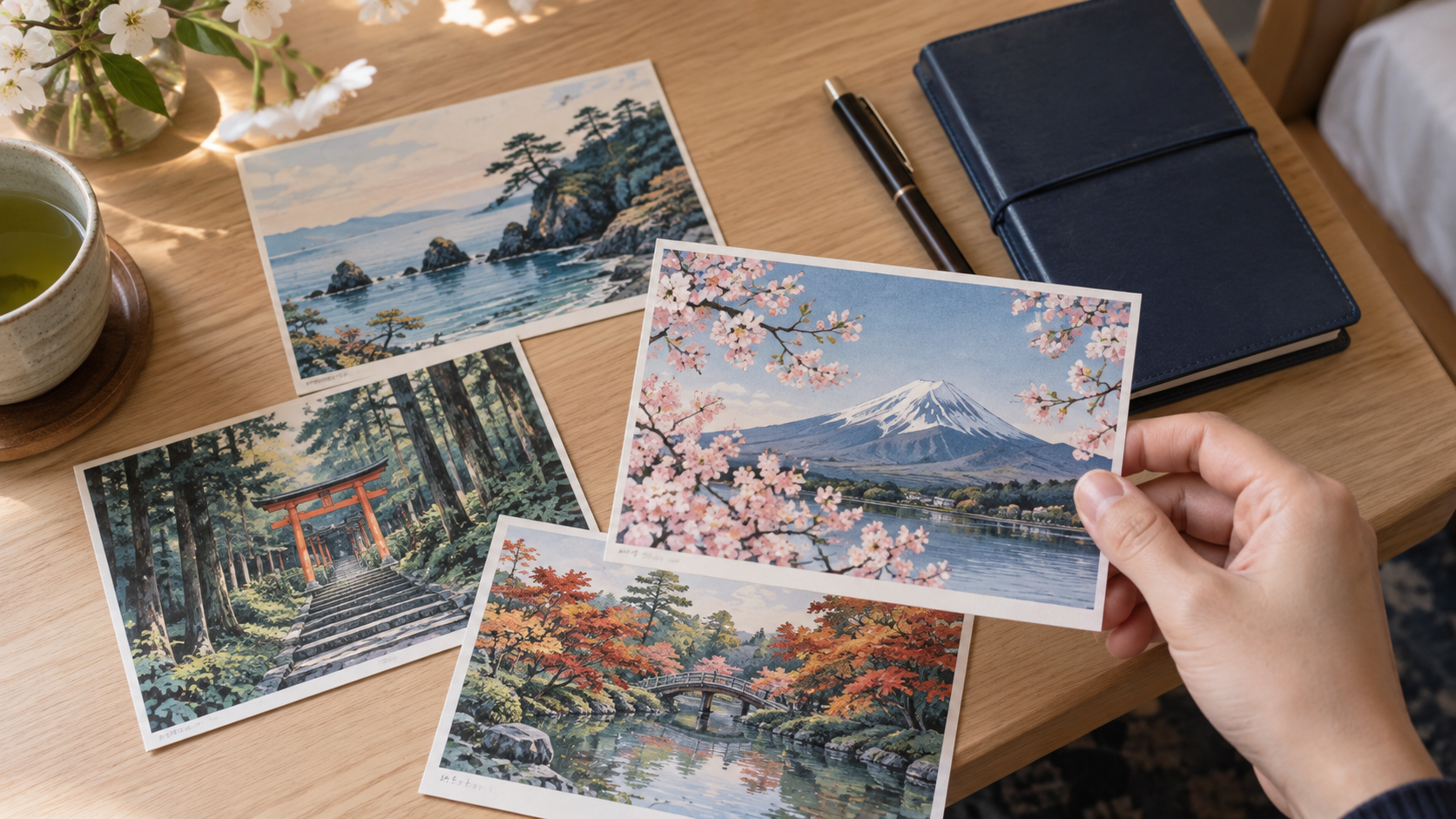
Source: Japan Post’s international postcard specifications and rates.
Prepare the address before looking for stamps
Ask the recipient for the full address in the format their own postal service uses. Save it somewhere you can read without relying on airport Wi-Fi. Include the apartment or building details where relevant, and copy the postal code carefully. Do not guess a missing part from a map.
Bring the card, a pen, the recipient’s address and a payment method. Keeping some yen cash available is a useful backup, but check the shop or counter’s payment options. If you have several cards, write them before joining the postal queue so you can concentrate on checking postage.
Use Japan Post’s country service availability chart to check letter-post service for your destination and the method you want. Read any notes attached to a restricted entry. A parcel or EMS listing is not a substitute for checking ordinary letter-post. The worldwide rate and current acceptance are separate questions.
Buy the right postage at a counter or a shop
The clearest option is a staffed postal counter: show the card, name the destination and say you want airmail. You can use this sentence:
“I’d like to send this postcard by airmail to [country]. Could you check the postage?”
Showing the written address can help when the place name is difficult to pronounce. Let staff check an unusual card before you pay. If the building also provides banking services, look for the postal counter and follow its queue instructions.
JNTO lists post offices, convenience stores and station kiosks as places to buy postcards and stamps. Stock varies, so a nearby convenience store may be worth trying when you already know the correct postage, but do not assume every branch has the denomination you need or can assess an unusual card.
Check the total postage on the card, not just the number of stamps. If you already have a card with prepaid domestic postage or a stamp bought for sending within Japan, show it to the counter and ask what extra postage is needed. Buying a postcard and paying for its journey are separate purchases unless the product says otherwise.
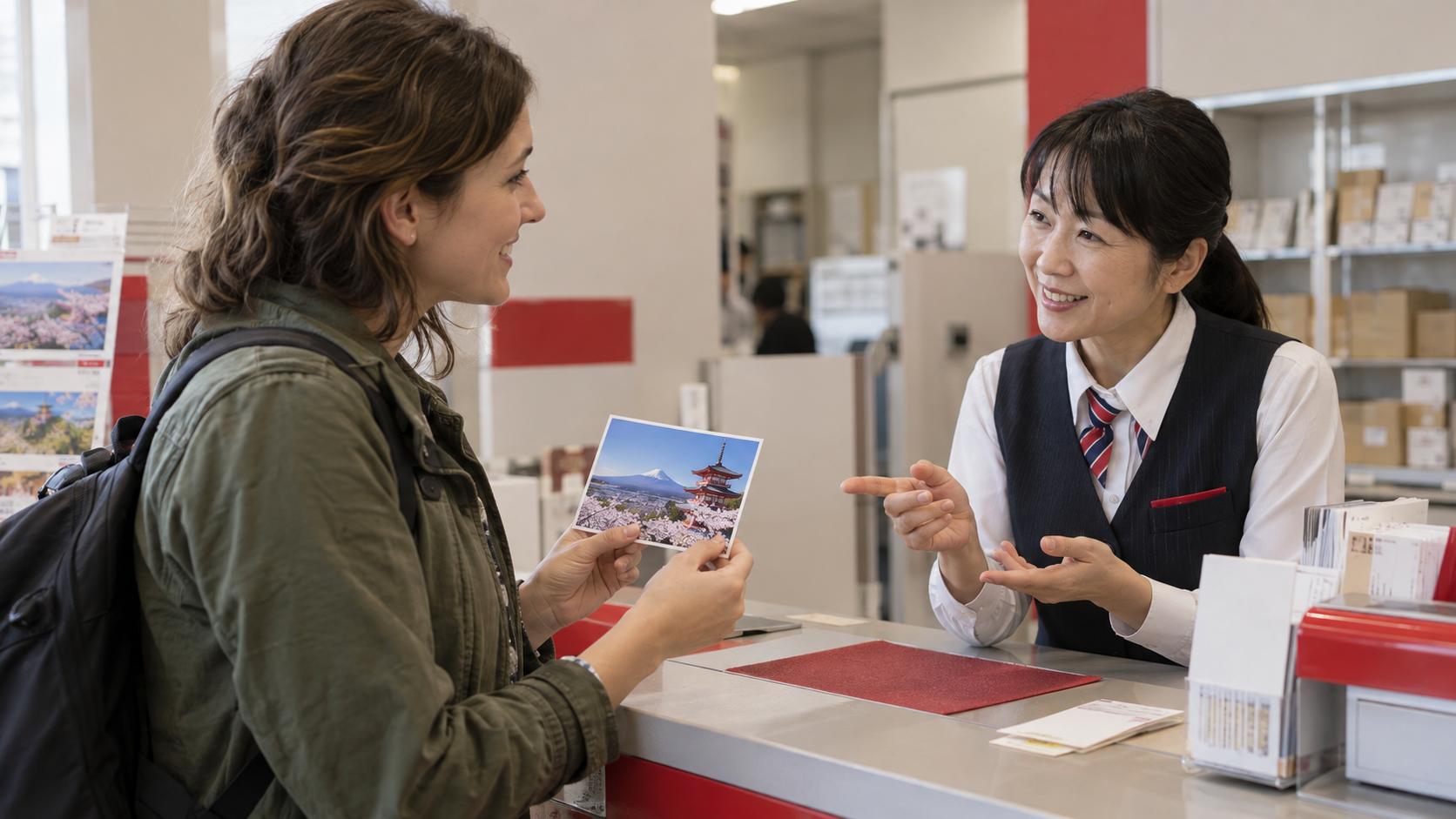
Sources: JNTO’s postal services guide and Japan Post’s letter and postcard sending steps. For other everyday shop services, see our Japan convenience-store guide.
Write the address and place the stamp
For a typical landscape postcard, keep your message on the left and the recipient’s address on the right. Japan Post advises distinguishing sender and recipient, writing the destination country in capitals, and indicating AIR MAIL for airmail. Use clear Roman lettering and Arabic numerals for the address; keep decorative handwriting for your message.
This is an address checklist, not a real delivery address. Replace each line with the recipient’s details and follow their country’s address order:
| Recipient | Full name |
|---|---|
| Delivery details | Apartment or building, street and number |
| Locality | Town or city, region where required, postal code |
| Destination | COUNTRY IN CAPITAL LETTERS |
Keep sender details separate and label them “From”; label the recipient “To” if the layout could be confusing. Use a return address that can actually receive mail. If you want to use your hotel’s address, ask the hotel first rather than assuming it will handle returned mail after you leave.
On a horizontally oriented postcard, Japan Post places stamps at the upper right. Its guidance for a vertically oriented item is upper left, so do not treat one corner as a rule for every layout. Keep stamps and postal markings clear of the message and address.
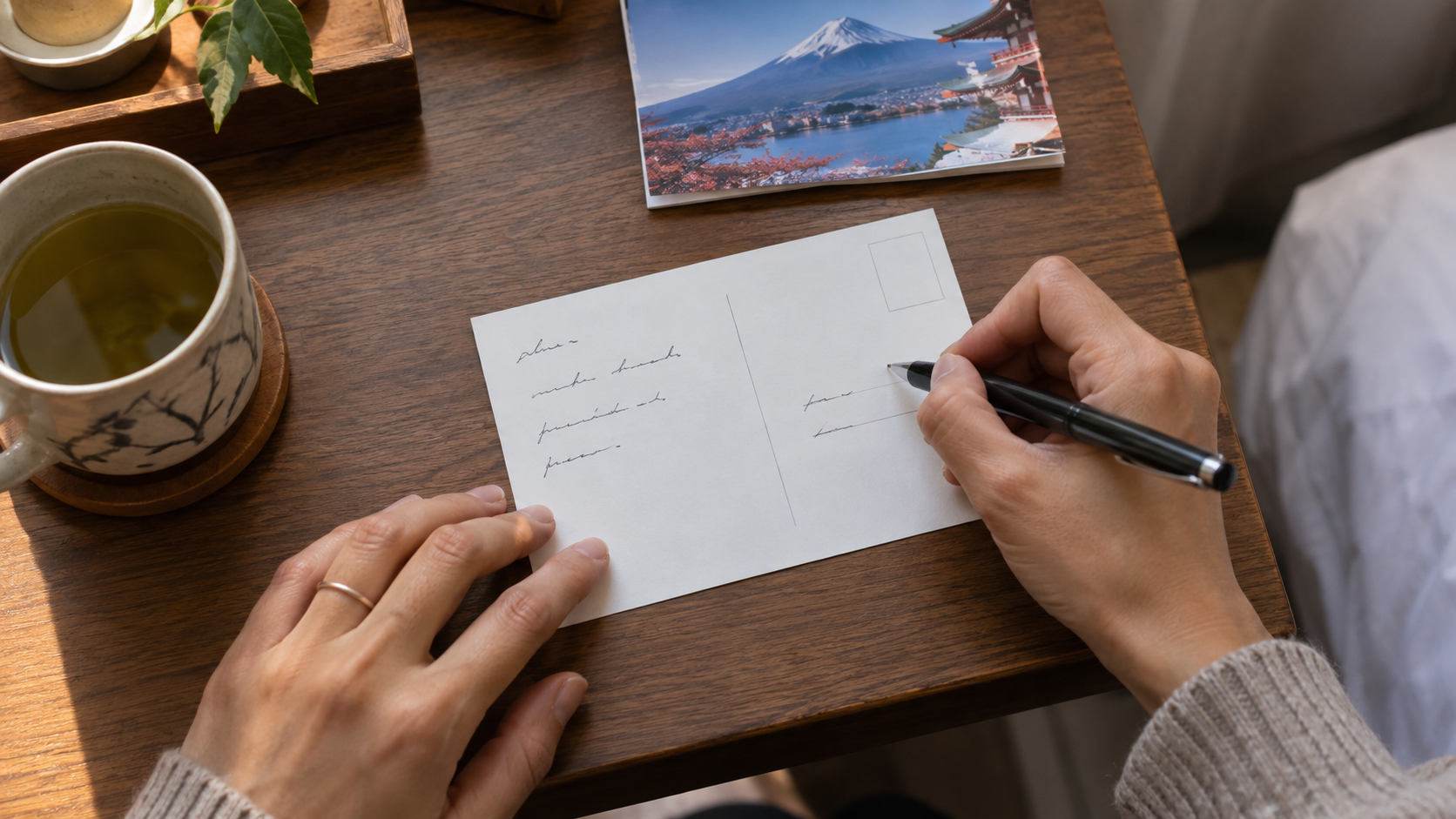
Sources: Japan Post’s overseas postcard layout, address-writing guidance and stamp-placement guidance.
Mail it at a counter or use the labeled postbox slot
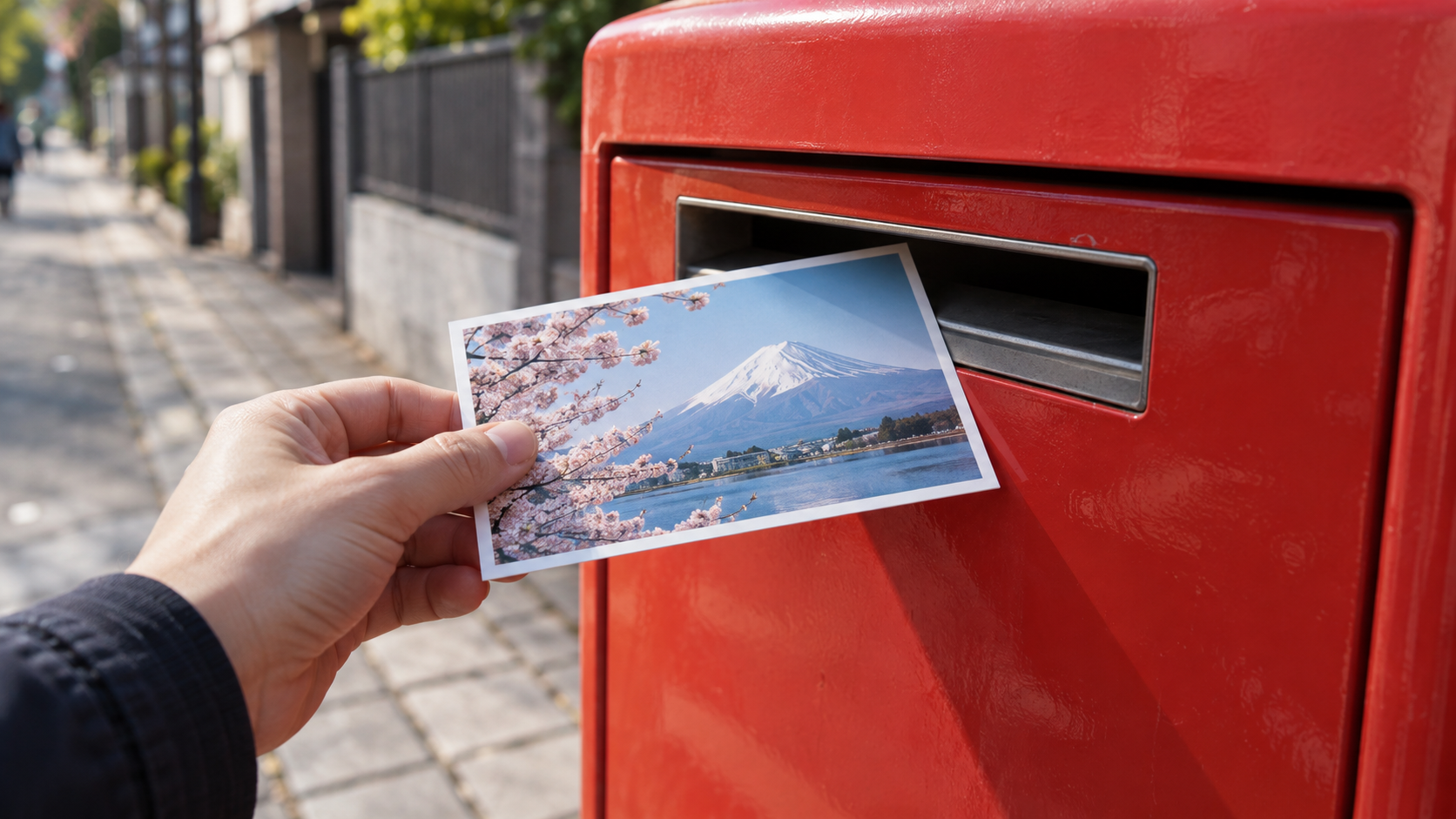
A counter is useful when you want the card and postage checked together. For a correctly addressed, stamped card, a postbox is another option. JNTO notes that Japanese postboxes generally have separate slots for different mail types. Read the labels on the actual box; do not choose a slot just because it is on the left or right.
If the categories are unclear, ask at a staffed counter rather than forcing the card into a guessed slot. Check for a collection schedule if you are mailing late in the day, and allow for the next collection. Putting a card in the box is not the same as having it collected or delivered.
Before mailing, make one final check: recipient, full address, country, AIR MAIL if applicable, and enough postage. A photograph of the finished card is a useful personal record of what you wrote. It is not a tracking receipt or proof of delivery.
Can you send a postcard at Narita or Haneda Airport?
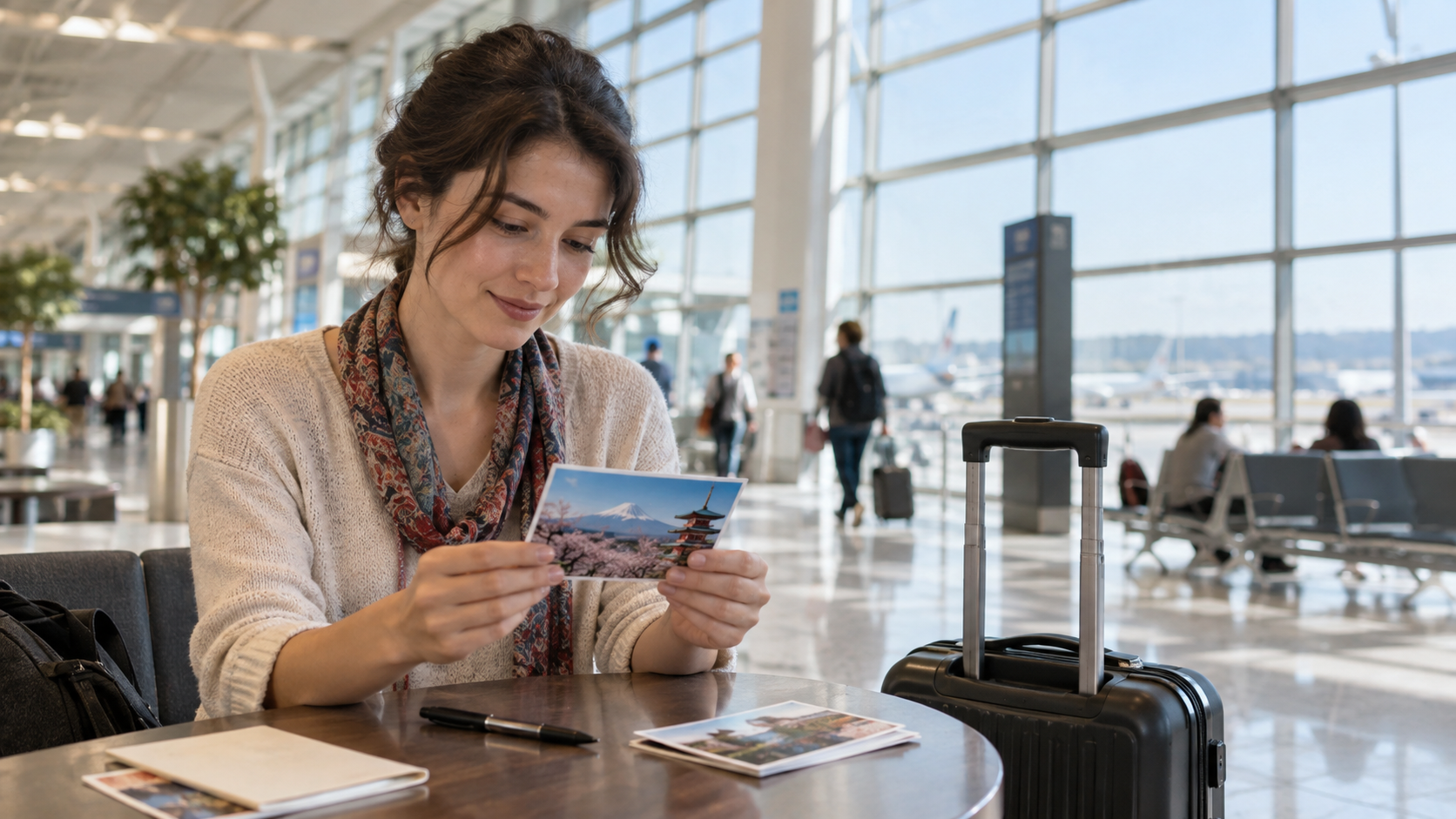
Check your terminal and mailing location before security. Airport postal counters and postboxes are different facilities: a box does not solve missing postage, and an information desk does not necessarily sell stamps. Plan airport mailing as a backup, with your card written and postage ready.
| Airport | Postal counter | Postbox or other option |
|---|---|---|
| Narita | T1 central building 4F and T2 main building 3F, before security; listed hours 08:30–20:00 | T3 has no postal counter, but has a postbox in its 2F departure lobby |
| Haneda | T1 1F arrivals lobby; Monday–Friday 09:00–17:00, closed weekends and holidays | T3 has boxes in the 1F Entrance Plaza and 3F departure lobby; none in the gate lounge |
Narita also lists postboxes in the T1 and T2 departure and arrival lobbies. After passport control, its T1 and T2 information counters offer a postcard handover service: staff take the card to a departure-lobby postbox. These counters do not sell postage stamps and do not accept sealed letters. The airport also notes customs inspection. This is a specific backup for a ready postcard, not a full postal counter.
Haneda’s postal counter is in T1, even if your flight uses another terminal. Do not build a last-minute terminal detour into a tight departure. Recheck the airport’s official page for current locations and hours, and protect your boarding time. Our Narita and Haneda transfer guide can help with the wider journey.
Sources: Narita postal facilities, Narita’s airside postcard service and Haneda postal facilities.
Delivery expectations and a practical Plan B
There is no single reliable delivery time for every destination. Use Japan Post’s rates and delivery-days tool and check service notices; treat an estimate as an estimate. Do not promise that a postcard will reach home before you do.
Ordinary postcards are not trackable through Japan Post’s tracking service. If a posting record or tracking matters, ask the counter about registered international mail, its extra charge and destination coverage before sending. Tracking availability differs by country. A decorative souvenir is usually a different need from a time-sensitive document.
If the counter is closed, use a postbox only when the address, postage and service choice are already clear. Otherwise, look for another open branch or ask your accommodation whether it can help; confirm what it can actually do and any fee. If departure is imminent, carry the card home instead of risking your flight. Mailing it later from another country will require that country’s postage.
Sources: Japan Post’s tracking scope and international registered-mail options.
Frequently asked questions
How much is an international postcard from Japan?
An eligible postcard costs ¥100 by airmail or ¥90 by surface mail. Check destination acceptance separately. The purchase price of the card is additional.
Can I use a stamp bought for domestic mail?
Have the counter check its value and the total required for the overseas service. A domestic-rate stamp alone should not be assumed sufficient.
Do I need to write the address in Japanese?
Use clear Roman lettering and Arabic numerals, with the destination country in capitals. Keep the recipient’s own national address order.
Can I buy stamps at a convenience store?
JNTO lists convenience stores as stamp sellers, but stock varies. A postal counter is better when the card’s classification or postage needs checking.
Which side of the postbox should I use?
Follow the actual labels, not a memorized left-or-right rule. Ask at a counter if the categories are unclear.
Can I mail it after security at Narita?
Narita lists a postcard handover service at T1 and T2 airside information counters. Bring postage already attached; those counters do not sell stamps or accept sealed letters.
Will it arrive before I return home?
That is not guaranteed. Check the destination’s estimated delivery time and current service notices; allow for collection and delivery delays.
Can I track an ordinary postcard?
No. Ask about registered mail before posting if a record or available destination tracking is important.
Comments