Tokyo Sushi Guide 2026: 4 Types from u00a51,000 Kaiten to u00a550,000 Omakase

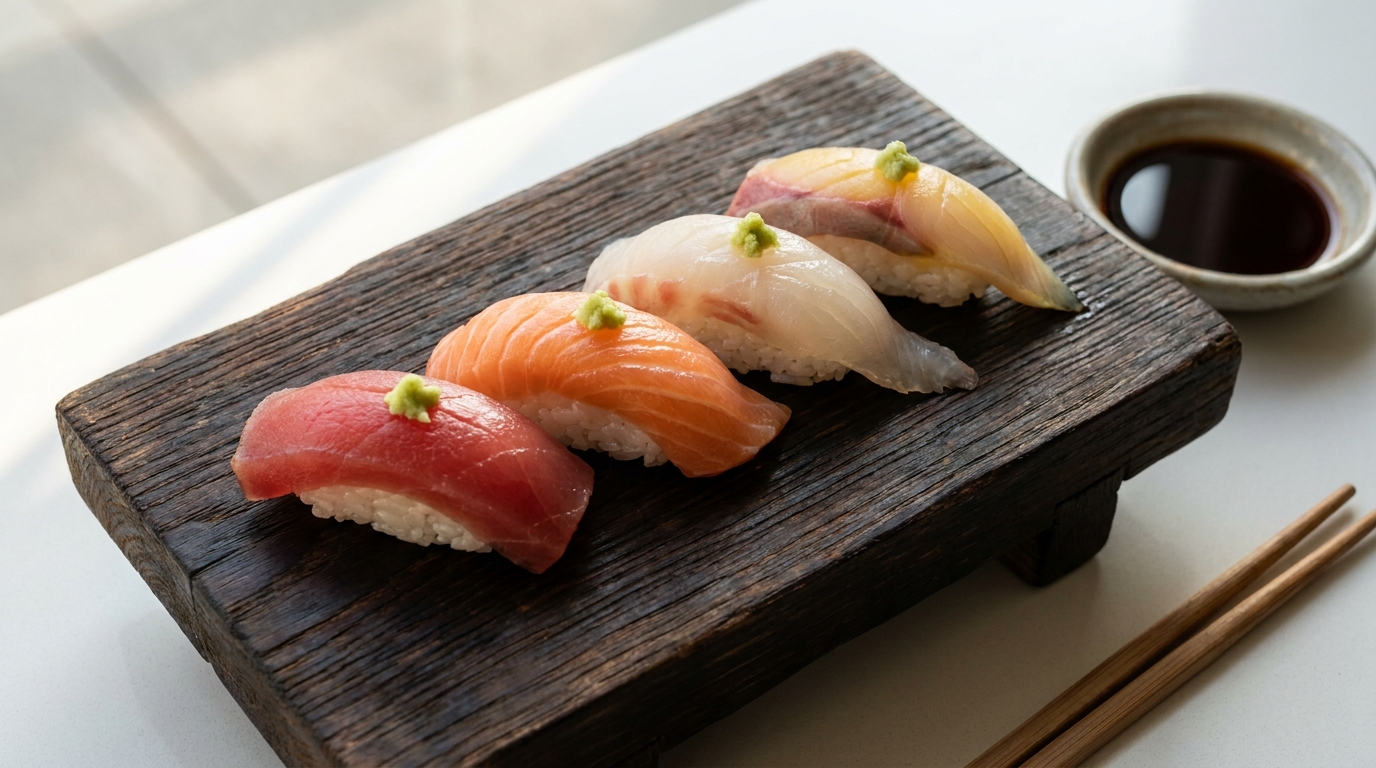
Tokyo sushi platter on wooden board Travel Tips
Tokyo sushi platter on wooden board
  1. Quick Answer
  2. A Quick Decision Guide: Which Type Fits Your Day?
  3. Type 1: Edomae & Omakase — Best for Travelers Who Want the Full Chef-Counter Experience
    1. What it is
    2. Price range
    3. Reservations and access
    4. Atmosphere and etiquette to know in advance
    5. What it’s good for
    6. What it’s not great for
  4. Type 2: Popular Counter & Standing Sushi — Best for Travelers Who Want the Chef-Counter Feel Without the Price or Formality
    1. What it is
    2. Price range
    3. Reservations and access
    4. Atmosphere and etiquette to know in advance
    5. What it’s good for
    6. What it’s not great for
  5. Type 3: Conveyor-Belt Sushi (Kaiten) — Best for Travelers Who Want Easy, Affordable, Family-Friendly Sushi with Almost No Language Barrier
    1. What it is
    2. Major chains
    3. Price range
    4. Reservations and access
    5. Ordering and payment
    6. Atmosphere and etiquette to know in advance
    7. What it’s good for
    8. What it’s not great for
  6. Type 4: Tourist-Friendly Sushi — Best for Travelers Near a Tourist Hub Who Want a Relaxed Sit-Down Meal Without Reservations
    1. What it is
    2. Where to find them
    3. Price range
    4. Reservations and access
    5. Atmosphere and etiquette to know in advance
    6. What it’s good for
    7. What it’s not great for
  7. The Four Types Compared
  8. Common Etiquette Across All Types
    1. Soy sauce: dip the fish, not the rice
    2. Wasabi: usually pre-applied at chef counters, separate at conveyor-belt shops
    3. Hands or chopsticks: both are fine
    4. Order, roughly: lighter to heavier
    5. Eat each piece in one or two bites
    6. Ginger (gari): palate cleanser, not topping
    7. Tea (agari): help yourself
    8. Tipping: don’t
    9. Photography: ask at the higher end, free at the lower end
    10. Saying thanks at the end
  9. Health, Allergies, and Dietary Notes
    1. Pregnancy and raw fish
    2. Common allergens
    3. Children
  10. Where to Find Each Type in Tokyo: An Area Overview
    1. Ginza
    2. Tsukiji Outer Market
    3. Toyosu Market & Toyosu Senkyaku Banrai
    4. Shinjuku
    5. Shibuya
    6. Asakusa
    7. Shibamata, Yanaka, and other “old-Tokyo” neighborhoods
    8. Around major train stations
  11. Other Forms of Sushi You’ll See in Tokyo
  12. Frequently Asked Questions
    1. How much should I budget for sushi in Tokyo?
    2. Can I walk into a sushi restaurant without a reservation?
    3. Do I need to know Japanese to eat sushi in Tokyo?
    4. What does omakase mean?
    5. Can I take photos at a sushi restaurant?
    6. Do you tip at sushi restaurants in Japan?
    7. What’s the difference between sushi and sashimi?
    8. Is conveyor-belt sushi as good as traditional sushi?
    9. Can pregnant women eat sushi in Japan?
  13. Closing Thoughts
    1. Related Reading

Quick Answer

Sushi in Tokyo isn’t one experience. It’s at least four different ones, ranging from a ¥1,000 conveyor-belt lunch to a ¥50,000 omakase counter dinner. Before you pick a restaurant, decide which type fits your budget, schedule, and Japanese ability — they are not interchangeable.

This guide breaks down the four common categories of sushi you’ll meet in Tokyo as a traveler, what each is good for, and the etiquette and practical notes that apply across all of them.

A Quick Decision Guide: Which Type Fits Your Day?

Use this rough decision flow before you start picking restaurants.

Four sushi types decision guide
  • You want the cheapest, easiest, family-friendly option, with English-language tablets and almost no language barrier.
    → Go to Type 3: Conveyor-belt sushi (kaiten).
  • You want a real chef-counter experience and you’re comfortable booking weeks in advance, dressing neatly, and following a quiet, focused vibe.
    → Go to Type 1: Edomae omakase.
  • You want the chef-counter feel without the price tag or formality, and you don’t mind queueing or eating standing up.
    → Go to Type 2: Popular counter / standing sushi.
  • You’re near a tourist hub (Tsukiji Outer Market, Asakusa, Ginza) and want a relaxed sit-down meal with English menus, no reservation, and reasonable prices.
    → Go to Type 4: Tourist-friendly sushi.

You can mix and match across a trip. Many travelers do conveyor-belt sushi for lunch on a busy sightseeing day, and a counter or omakase dinner once during the trip as a “splurge night.” There’s no rule that one type is more authentic than another — they coexist as part of how Tokyo eats.

Type 1: Edomae & Omakase — Best for Travelers Who Want the Full Chef-Counter Experience

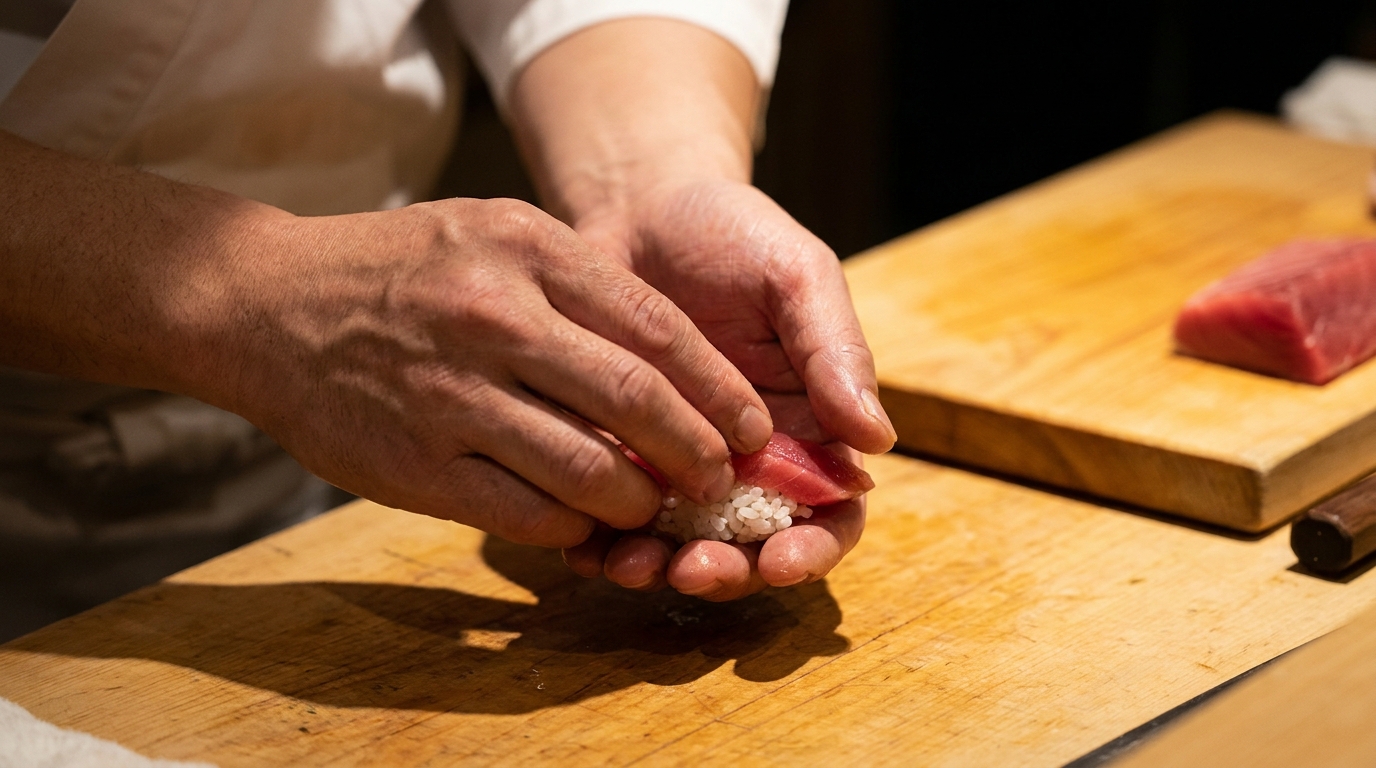
Sushi chef forming nigiri

What it is

Edomae sushi is the Tokyo style: nigiri made with a small ball of vinegared rice topped with a slice of fish, often subtly worked on by the chef (lightly cured, marinated, brushed with nikiri soy sauce, or aged for days). Omakase, which means roughly “I leave it up to you,” is the format where you sit at the counter, the chef serves you piece by piece, and the meal ends when the chef decides it ends.

Price range

  • Lunch courses: about ¥3,000 to ¥15,000 per person
  • Dinner courses: about ¥10,000 to ¥50,000+ per person, with well-known shops often starting around ¥30,000 and going up

Tipping is not expected (more on that in the etiquette section). Service charge is sometimes added at higher-end places — check before you sit down if it matters to you.

Reservations and access

Most omakase counters seat between six and twelve people, and many have a strict reservation policy. Common reservation paths for travelers without a Japanese phone or address:

  • Pocket Concierge (English booking platform run by American Express)
  • TableCheck (English-friendly, used by many mid- and high-tier counters)
  • OMAKASE (a dedicated omakase booking site, partial English)
  • Hotel concierge at upper-tier hotels — often the only realistic path into the most exclusive shops, which take introductions only

The most famous shops (for example Sukiyabashi Jiro Honten in Ginza) operate on a near-introduction-only basis and are not bookable as a casual visitor. If you’ve heard of the shop from a documentary, assume it’s harder to access than what you saw on screen.

Atmosphere and etiquette to know in advance

  • Counters are quiet. Loud conversation, speakerphone calls, and strong perfume or cologne are out of place.
  • Photography requires permission. Many shops post a “no photo” or “ask before photographing” rule. Watch for the sign, or ask the chef at the start of the meal.
  • Ask before placing your phone on the counter. At higher-end shops, many chefs prefer phones not to be set directly on the counter surface — a quick “Is it okay if I put my phone here?” before placing it down is appreciated.
  • Eat each piece soon after it’s placed in front of you. The chef has timed the temperature of the rice and the texture of the fish for that moment.
  • Use your hands or chopsticks — both are acceptable. Many regulars use their hands for nigiri.
  • Don’t dunk the rice into the soy sauce. The chef has often already brushed nikiri (a sweetened soy reduction) on the fish. If you’re given soy sauce, dip the fish side lightly.
  • The chef will tell you, indirectly, when the meal is winding down (often by serving tamago, the egg omelet, and then maki rolls). Don’t ask for a long list of additional pieces unless invited.

What it’s good for

  • A “once in this trip” sushi experience that you’ll remember
  • Solo or small-group dining (2 to 4 people typically works best at a counter)
  • Travelers who like fine dining and don’t mind a quiet, focused atmosphere

What it’s not great for

  • Large groups (6+ at the same counter is rarely possible)
  • Picky eaters or strong dietary restrictions (you eat what the chef serves)
  • Children, especially under elementary-school age — many shops decline child diners
  • Same-day spontaneity, especially in central Tokyo on weekends

Type 2: Popular Counter & Standing Sushi — Best for Travelers Who Want the Chef-Counter Feel Without the Price or Formality

Standing sushi bar interior

What it is

This is the broad middle of Tokyo’s sushi scene: counter shops where a chef makes nigiri in front of you, you order piece by piece (or take a fixed set), and you pay between ¥1,500 and ¥15,000 per person. Many shops in this category are casual chains or popular individual shops where you might queue, but the experience itself is closer to traditional sushi than to a conveyor belt.

Three sub-formats are worth knowing:

  • Sushizanmai (Tsukiji-headquartered chain) — large, sit-down counter shops, English menus, open late, accepts walk-ins. Founded in Tsukiji and now in many parts of central Tokyo. A safe, predictable choice when you want sit-down sushi without booking.
  • Standing sushi (tachigui-zushi) — you stand at a counter, the chef makes pieces in front of you, the meal usually finishes in 20 to 30 minutes. Lower price point (often ¥1,500 to ¥3,000), faster turnover. Popular near major stations.
  • Independent neighborhood sushi shops — smaller, often family-run, sometimes English-friendly and sometimes not. Quality and pricing vary widely. Worth asking your accommodation host or checking recent reviews before going.

Price range

  • Standing sushi: about ¥1,500 to ¥3,000 per person
  • Sushizanmai-style chains: about ¥2,500 to ¥6,000 per person
  • Popular independent counter shops: about ¥5,000 to ¥15,000 per person

Reservations and access

  • Standing sushi usually does not take reservations. Walk in, queue if needed, eat, leave.
  • Sushizanmai and similar chains typically take walk-ins and can sometimes be booked through TableCheck or their own websites.
  • Independent counter shops increasingly use TableCheck, OMAKASE, or in-person reservation. Some still take phone-only reservations in Japanese.

Atmosphere and etiquette to know in advance

  • More relaxed than Type 1, but still treat the chef with respect — don’t lean over the counter glass, don’t put bags on the chef’s side, don’t take detailed close-up photos without asking.
  • Speed matters at standing sushi. The shop wants turnover. Eat each piece reasonably quickly.
  • Soy sauce is provided in a small dish. Dip the fish side, not the rice side.

What it’s good for

  • A chef-made sushi experience without breaking your travel budget
  • Solo travelers — standing sushi is comfortable for one
  • Travelers who want a “real” sushi memory but don’t want the cost or commitment of an omakase counter

What it’s not great for

  • Diners who need to sit down (standing sushi is, well, standing)
  • Long, leisurely meals (especially at standing shops, where the implicit expectation is to finish in 30 minutes)
  • Travelers who want extensive English explanation of every piece — staff are friendly but often busy

Type 3: Conveyor-Belt Sushi (Kaiten) — Best for Travelers Who Want Easy, Affordable, Family-Friendly Sushi with Almost No Language Barrier

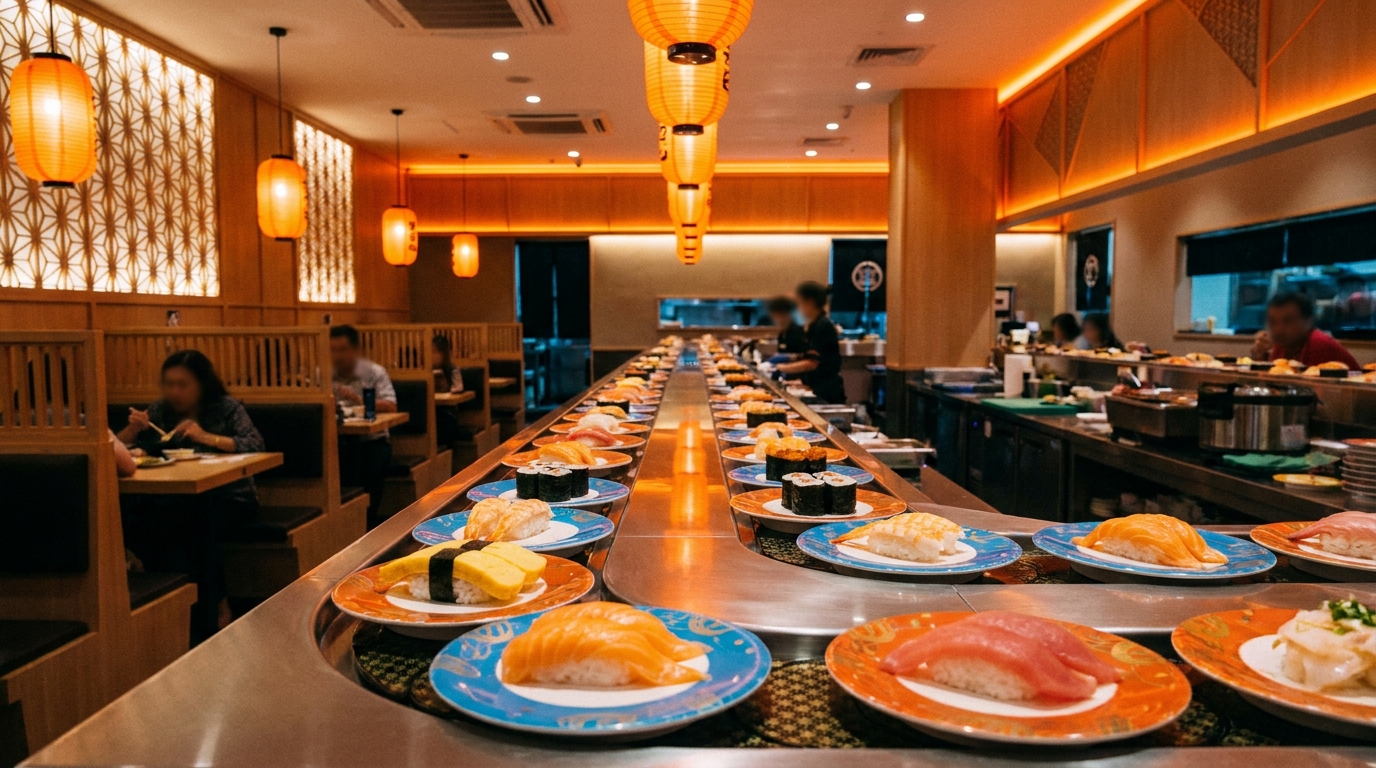
Conveyor belt sushi lane

What it is

Conveyor-belt sushi (called kaiten-zushi in Japanese) is the format that became globally famous through Japanese pop culture. Plates of nigiri, rolls, side dishes, and desserts circulate on a belt around the restaurant. You take what you want as it passes, or — increasingly common today — order from a tablet and the dish arrives at your seat on a separate fast-lane track or by direct delivery.

For travelers, conveyor-belt sushi is by far the easiest type to access in Tokyo. It’s the type most likely to have a fully English-language ordering tablet, the type most likely to take walk-ins, and the type most likely to welcome children and large groups.

Major chains

  • Sushiro (スシロー) — the largest conveyor-belt sushi chain in Japan. Standard plates start around ¥120 at suburban locations, but central-Tokyo “urban” stores typically start from ¥130 or ¥150 per plate. English tablet, photo-based menu. Reliable for a quick lunch on a sightseeing day.
  • Kura Sushi (くら寿司) — known for the “Bikkura-Pon” (a lottery game where every five empty plates trigger a chance at a small toy). A paid mode called “Bikkura-Pon Plus” adds about ¥10 per plate and guarantees a prize every three rounds, which is popular with families. No artificial additives marketing. English tablet.
  • Hama Sushi (はま寿司) — often the lowest-priced of the major chains. Standard plates start around ¥110 nationwide and around ¥121 at central-Tokyo “urban” stores. Some menu items were raised in late 2024 due to rice-price pressure, but the lowest tier was kept. Tablet ordering, large suburban locations, smaller central-Tokyo footprint.
  • Uobei (魚べい) — a chain in the Genki Sushi group. The Shibuya Dōgenzaka branch became known overseas for its high-speed delivery track where plates arrive directly at your seat with no rotating belt. Heavy tourist traffic, expect a queue at peak times.

Price range

About ¥1,000 to ¥3,000 per person, depending on how many plates you eat and which chain. Drinks (tea is free; beer, sake, soft drinks are extra) and side dishes can add to the bill.

Reservations and access

  • Most chains accept reservations through their own apps (Japanese-language) or third-party services like EPARK.
  • Walk-in is possible at most locations, but expect a wait of 20 to 60 minutes at peak meal times in central Tokyo (Shinjuku, Shibuya, Ikebukuro).
  • Off-peak weekday afternoons (around 2 to 5 p.m.) are typically the easiest time to walk in.

Ordering and payment

  • Ordering tablets at the table usually have an English mode. Look for a small flag or globe icon to switch language.
  • Some chains use a hand-held barcode scanner to count your empty plates at the end. Others count plates dropped into a slot.
  • Payment is usually at a self-service register near the exit, which accepts cash, IC cards (Suica, PASMO), credit cards, and major QR pay services. Specifics vary by chain and location.

Atmosphere and etiquette to know in advance

  • Conveyor-belt sushi restaurants are loud, casual, and family-friendly. Children’s voices and lively conversation are normal.
  • Photography is generally fine. The chains are not strict about it.
  • Don’t take a plate from the belt, look at it, then put it back. If you take it, eat it.
  • Don’t lean on the belt or block the path. The belt is a working track.
  • Wasabi is usually not pre-applied. There’s a small wasabi container at each seat.

What it’s good for

  • Travelers with kids — easy, casual, the children pick what they want
  • Travelers with limited Japanese — tablets do most of the work
  • Travelers who want a quick, affordable meal between activities

What it’s not great for

  • Travelers seeking the highest-quality sushi experience (conveyor-belt sushi quality is good for the price, but it’s not aiming for the same target as a chef counter)
  • Travelers who hate waiting in line at peak times in tourist hubs
  • Quiet, focused dining

Type 4: Tourist-Friendly Sushi — Best for Travelers Near a Tourist Hub Who Want a Relaxed Sit-Down Meal Without Reservations

Outdoor market sushi shop

What it is

This type isn’t a strict format — it’s more a positioning. Tourist-friendly sushi shops are concentrated in places where international visitors already go: the Tsukiji Outer Market, Toyosu Market (the wholesale market that replaced Tsukiji’s inner market in 2018), Ginza, Asakusa, and parts of Shinjuku and Shibuya. They tend to:

  • Have English (and often Chinese, Korean, sometimes Thai or Vietnamese) menus
  • Display photos for every dish
  • Accept walk-ins and group bookings
  • Open earlier than typical sushi shops, especially around Tsukiji Outer Market (some shops open by 6 a.m.)
  • Be priced for tourists — not the cheapest in the city, but transparent and predictable

Where to find them

  • Tsukiji Outer Market (Tsukiji-jōgai-ichiba) — the open-air market area near Tsukiji Station. Wholesale moved to Toyosu in 2018, but the outer market continues as a food-and-shopping street with many small sushi shops, often opening early morning. Good for a sushi breakfast or early lunch after a market walk.
  • Toyosu Market — the wholesale market on a man-made island that replaced Tsukiji’s inner market in 2018. Public access is allowed in viewing areas, and there are several sushi shops inside; some require reservations far in advance, others are walk-in. In February 2024, the adjacent food-and-shopping complex Toyosu Senkyaku Banrai (豊洲千客万来) opened next to the market, recreating an Edo-period streetscape with multiple sushi shops, seafood street food, and a public bath. It’s now the main visitor hub for the Toyosu area.
  • Asakusa — many casual sit-down sushi shops aimed at international visitors after a Senso-ji temple walk.
  • Ginza side streets and basement floors — alongside the very high-end shops, there are mid-tier counters with English menus that quietly serve travelers who don’t want to do an omakase.

Price range

About ¥3,000 to ¥8,000 per person for a sit-down meal with a few pieces and a small dish or two.

Reservations and access

  • Many shops accept walk-ins, and most are bookable through Klook, TableCheck, OpenTable, or KKday for travelers who want a guaranteed seat.
  • Group bookings (4 to 8 people) are usually possible — call or use a reservation site a day or two ahead.

Atmosphere and etiquette to know in advance

  • Casual, often busier than Type 1 or 2 because of foot traffic. Expect a wait at peak hours.
  • Photography is generally fine.
  • Tipping is still not expected, even though staff often interact in English. Don’t leave cash on the table; many shops will return it.
  • Allergen and dietary information is more often available in writing than at smaller neighborhood shops.

What it’s good for

  • First-time visitors to Tokyo who want a sushi meal as part of a sightseeing day
  • Groups of mixed ages and dietary preferences
  • Early-morning sushi (especially around Tsukiji Outer Market)
  • Travelers who don’t want to plan a reservation days in advance

What it’s not great for

  • Travelers seeking the most authentic chef-counter experience (this is intentional — these shops optimize for accessibility, not exclusivity)
  • Travelers on the tightest budget (conveyor-belt chains are still cheaper)

The Four Types Compared

Four sushi types comparison
Type Price (per person) Reservation Japanese needed Photos? Group size
Type 1: Omakase ¥3,000–¥50,000+ (lunch from ¥3,000) Required, often weeks ahead Helpful, often not required Often restricted 1–4
Type 2: Popular counter / standing ¥1,500–¥15,000 Sometimes; standing is walk-in Useful but not required Generally OK 1–4
Type 3: Conveyor-belt ¥1,000–¥3,000 Optional, app-based Almost not needed (English tablets) Fine Any size
Type 4: Tourist-friendly ¥3,000–¥8,000 Walk-in or online booking Almost not needed Fine Any size

If you only have time for one sushi meal, look at this table as a budget-and-style filter, not as a quality ranking. All four types can produce a good meal; they’re aiming at different traveler needs.

Common Etiquette Across All Types

A few etiquette points apply almost everywhere, not just at high-end counters. Knowing these will make any sushi meal — including conveyor-belt — go more smoothly.

Soy sauce: dip the fish, not the rice

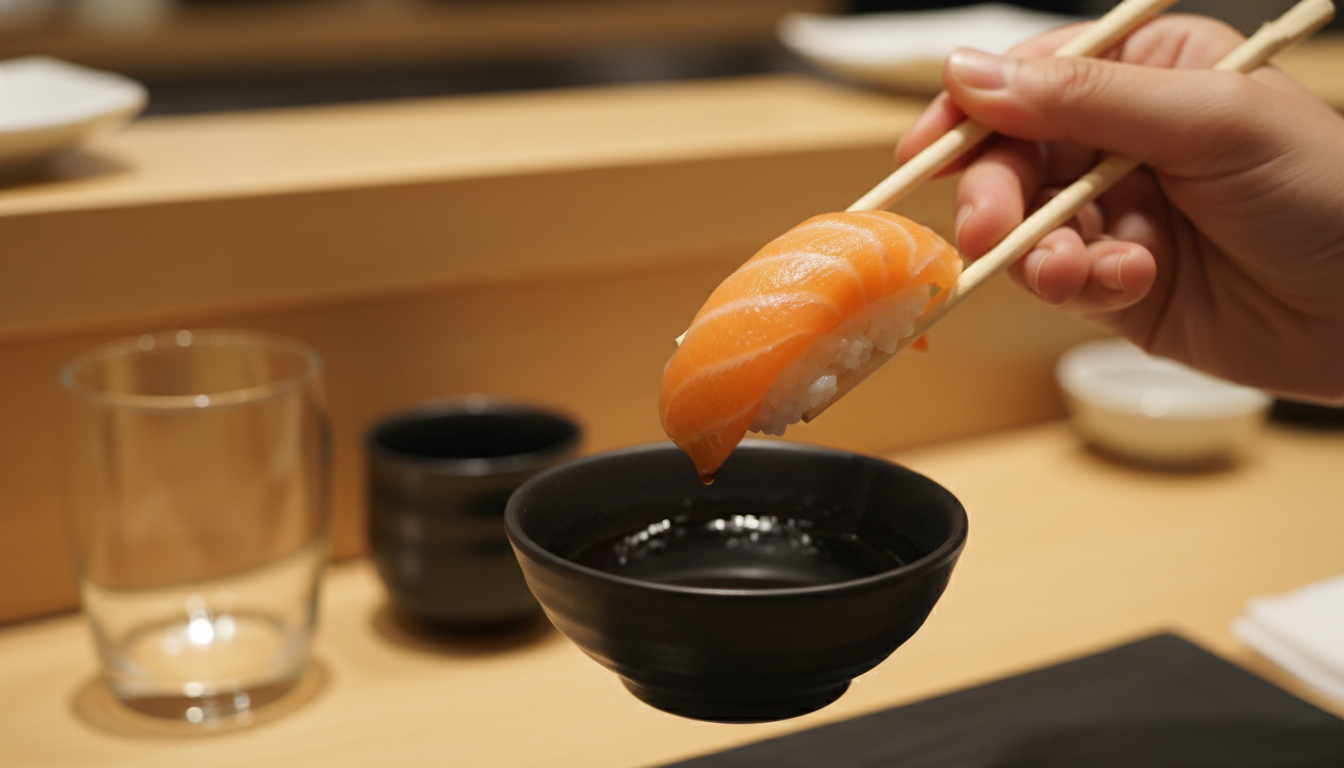
Place a small amount of soy sauce in the small dish at your seat. When you pick up a piece of nigiri, tilt it so that only the fish side touches the soy sauce. Dipping the rice side soaks it, the rice falls apart, and the meal becomes salty.

At higher-end counters, the chef has often already brushed sweetened soy sauce (nikiri) on each piece. In that case, no additional soy sauce is needed — just eat as served. If you’re not sure, watch what the chef does with the first piece.

Wasabi: usually pre-applied at chef counters, separate at conveyor-belt shops

At a chef counter, wasabi is usually placed between the rice and the fish in just the right amount. Don’t ask for “more wasabi” until you’ve tasted as served — it’s part of the chef’s balance.

At conveyor-belt chains, the plates often arrive with no wasabi. There’s a small container of wasabi paste at the table. Use what you like.

Hands or chopsticks: both are fine

Traditional Edomae sushi was eaten with the hands. Chopsticks are also fine. Use whichever feels comfortable. There’s no rule.

Order, roughly: lighter to heavier

If you’re ordering piece by piece (Types 1 and 2), the rough convention is to start with white-fleshed fish (sea bream, flounder), move to red-fleshed fish (tuna, bonito), then richer or fattier pieces (sea urchin, fatty tuna, eel), then maki rolls, and finish with tamago (egg). This is a rough convention, not a rule. If you want fatty tuna first, order it first.

Eat each piece in one or two bites

Sushi is built to be eaten in one bite. Two bites is acceptable. Cutting a piece in half with chopsticks tends to make the rice ball collapse.

Ginger (gari): palate cleanser, not topping

The pickled ginger at the side of the plate is meant to be eaten between pieces to reset the palate, not piled on top of the fish.

Tea (agari): help yourself

A pot of green tea or a tap for hot tea is usually available. There’s no need to wait to be offered.

Tipping: don’t

Tipping is not expected anywhere in Japan, including sushi shops at every price level. Cash left on the table will often be returned. Service charges may be added on the bill at high-end shops; that’s the formal “tip” structure for the country.

Photography: ask at the higher end, free at the lower end

At Type 1 omakase counters, photography is often restricted; some shops post signs, others don’t but expect customers to ask. At Type 2 to 4 (standing, conveyor-belt, tourist-friendly), photography is generally fine. When in doubt, ask the chef or staff at the start of the meal.

Saying thanks at the end

A simple “gochisō-sama deshita” (literally, “thank you for the meal”) at the end is a courteous way to close. The English equivalent (“thank you for the meal”) works at tourist-friendly shops if you’re not comfortable in Japanese.

Health, Allergies, and Dietary Notes

Dipping nigiri in soy sauce

This section gives general orientation, not medical guidance. If you have a serious allergy, a chronic condition, or are pregnant, the safest path is to confirm with the restaurant in writing and, if needed, consult a medical professional. Translation cards (for example, allergy-translation cards used by Japanese travel forums and some hotels) are worth carrying for severe allergies.

Pregnancy and raw fish

In Japan, eating sushi during pregnancy is more common than in some Western countries, but Japan’s Ministry of Health publishes guidance to limit certain fish during pregnancy because of mercury content. Many travelers who are pregnant choose to avoid raw fish during their trip and instead order cooked options (eel, shrimp, tamago, vegetable rolls) — that’s a personal call between the traveler and their doctor. The restaurant won’t refuse to serve raw fish to a pregnant guest; the responsibility for the choice is yours.

Common allergens

  • Shellfish (shrimp, crab) — common, including in maki rolls and in some sauces
  • Egg — tamago is egg, several side dishes include egg, and some sauces use egg
  • Soy — soy sauce is everywhere, and many seasoned dishes use soy
  • Wheat — most regular Japanese soy sauce contains wheat; if you have celiac disease or a wheat allergy, ask whether tamari (wheat-free soy sauce) is available, or carry your own

Children

Many conveyor-belt sushi shops are explicitly child-friendly. Tamago, corn-mayo gunkan (a kid favorite at chain conveyor-belt shops), and small desserts are easy starters. At higher-end Type 1 counters, however, very young children are often not welcomed; check the shop’s policy before booking.

Where to Find Each Type in Tokyo: An Area Overview

Tokyo sushi neighborhoods map

This is a rough orientation, not an exhaustive directory. Specific shops change over time, so use this as a way to plan a sushi day around what you’re already doing in the city.

Ginza

A historic part of Tokyo’s high-end sushi scene, with many well-known Type 1 omakase counters alongside mid-tier counter shops and a few tourist-friendly options on side streets. That said, Type 1 omakase shops can also be found in Roppongi, Akasaka, Shibuya, Aoyama, Nihonbashi, and many other central districts — Ginza is one cluster among several. Ginza is most useful if you have a reservation here, or want a Type 2 lunch combined with an upscale neighborhood walk afterward.

Tsukiji Outer Market

Best for Type 4 tourist-friendly sushi, especially in the morning. The wholesale market is now in Toyosu, but the outer-market street remains active with breakfast-friendly sushi shops, food stalls, and knife shops. Several sushi shops here open before 8 a.m., which is unusual in Tokyo.

Toyosu Market & Toyosu Senkyaku Banrai

The wholesale market itself is open to public visitors during set hours, and there are restaurants — including Type 1 sushi counters with reputations built on direct sourcing from the market — inside the market complex. Some require reservations far in advance. Access is from Shijō-mae station on the Yurikamome line.

Adjacent to the wholesale market, Toyosu Senkyaku Banrai (豊洲千客万来) opened in February 2024 — a large food-and-shopping complex designed as an Edo-period streetscape, with many sushi shops, seafood street food, and a rooftop hot spring with a Tokyo Bay view. For most travelers, this is now the easiest way to combine market sightseeing with a sushi meal in a single trip.

Shinjuku

Heavy concentration of Type 3 conveyor-belt chains (Sushiro, Kura, Hama, Uobei) and Type 4 tourist-friendly shops. Type 1 omakase counters are well-represented in Shinjuku as well, especially in side-street restaurant buildings. Useful if your accommodation is in or near Shinjuku and you want a short walk to dinner.

Shibuya

Uobei Shibuya Dōgenzaka (a chain in the Genki Sushi group) is one of the best-known conveyor-belt shops for visitors, partly because of its high-speed delivery track that captured travelers’ attention on social media. Other Type 3 chains are also present. Expect peak-time queues.

Asakusa

Tourist-friendly sit-down sushi (Type 4) is common on the streets near Senso-ji temple. Combine with the temple walk and Nakamise shopping street.

Shibamata, Yanaka, and other “old-Tokyo” neighborhoods

Smaller, older neighborhood sushi shops (Type 2 independent) are easier to find here, but English-language access varies widely. These are higher-effort, higher-discovery options that work better if you have someone who can help with reservation and translation.

Around major train stations

Nearly every major station — Tokyo, Shinagawa, Ikebukuro, Ueno, Akihabara — has at least one Type 3 conveyor-belt chain and several Type 2 standing or chain sushi shops in the station building. Useful for a quick meal between trains.

Other Forms of Sushi You’ll See in Tokyo

A short note for completeness, since travelers often see these and aren’t sure how to think about them:

  • Convenience store sushi (Lawson, FamilyMart, 7-Eleven). Inexpensive, mass-produced, kept refrigerated. Fine as a quick fix or a snack on a busy day, but not the same category as the four types above.
  • Supermarket and depachika (department-store basement) sushi. Higher quality than convenience-store sushi, often very good at major department stores, sold in sets at posted prices. Good for picnics or for an evening in your accommodation, particularly if you want sushi without committing to a sit-down meal.
  • Conveyor-belt-style sushi delivered to a hotel or rental kitchen. Some chains deliver via delivery apps in Tokyo. Useful for a low-key dinner with kids or a tired travel day, but the experience is different from eating in the shop.

Frequently Asked Questions

How much should I budget for sushi in Tokyo?

For a single sushi meal, plan around ¥1,000 to ¥3,000 at a conveyor-belt chain, ¥1,500 to ¥3,000 at a standing-sushi shop, ¥3,000 to ¥8,000 at a tourist-friendly sit-down shop, ¥5,000 to ¥15,000 at a popular independent counter, and ¥10,000 to ¥50,000+ at a high-end Type 1 omakase. Most travelers do one or two splurge meals and several casual ones across a trip.

Can I walk into a sushi restaurant without a reservation?

Yes for conveyor-belt and most tourist-friendly shops. Sometimes for popular counter shops; expect a wait. Generally no for high-end Type 1 omakase counters — those are usually fully booked and many require advance booking through Pocket Concierge, TableCheck, OMAKASE, or a hotel concierge.

Do I need to know Japanese to eat sushi in Tokyo?

Not for Type 3 (conveyor-belt) and Type 4 (tourist-friendly) — most of the major chains have English-language tablets, and tourist-area shops have English menus and staff. For Type 1 and high-end Type 2, knowing some Japanese helps but is not required; many counters have at least one English-speaking staff member or printed English explanations of each piece. If your Japanese ability is a concern, conveyor-belt and tourist-friendly are the safest choices.

What does omakase mean?

Omakase (お任せ) translates literally as “I leave it to you.” It’s a format where you don’t order specific pieces — the chef serves you a curated sequence of pieces based on what’s in season and what they think you’ll enjoy. It can be a lunch course (¥3,000 and up) or a long dinner course (¥10,000 to ¥50,000+). At top-tier shops, the experience is closer to a tasting menu at a fine-dining restaurant than to a casual sushi meal.

Can I take photos at a sushi restaurant?

At conveyor-belt chains and tourist-friendly shops, yes, generally without asking. At popular independent counter shops, yes for most dishes, but check for posted signs. At high-end Type 1 omakase counters, photography is often restricted — many shops post a “no photo” sign, others expect you to ask before shooting. When in doubt, ask the chef or staff at the start of the meal.

Do you tip at sushi restaurants in Japan?

No. Tipping is not expected at any sushi shop in Tokyo, regardless of price level. Many shops will return cash left on the table. At high-end shops, a service charge may be added to the bill — that’s the formal tip equivalent. Don’t add anything on top.

What’s the difference between sushi and sashimi?

Sushi is vinegared rice topped with (or rolled with) fish or vegetables. Sashimi is sliced raw fish on its own, without rice. Many sushi shops serve sashimi as a side dish or appetizer — that’s how the same shop offers both.

Is conveyor-belt sushi as good as traditional sushi?

It’s aiming at a different goal. Conveyor-belt chains optimize for price, accessibility, and speed. Traditional counter sushi optimizes for craft, freshness on the day, and a chef-customer interaction. Both are good at what they do. The chains’ top-tier products (especially at major brands’ Tokyo locations) are higher quality than many travelers expect from “conveyor belt.”

Can pregnant women eat sushi in Japan?

In Japan, pregnant women often continue to eat sushi, but Japan’s Ministry of Health publishes guidance limiting certain fish during pregnancy because of mercury content. Many travelers who are pregnant choose to avoid raw fish during the trip and order cooked options instead. This is a personal medical decision; the restaurant won’t refuse to serve raw fish to a pregnant guest.

Closing Thoughts

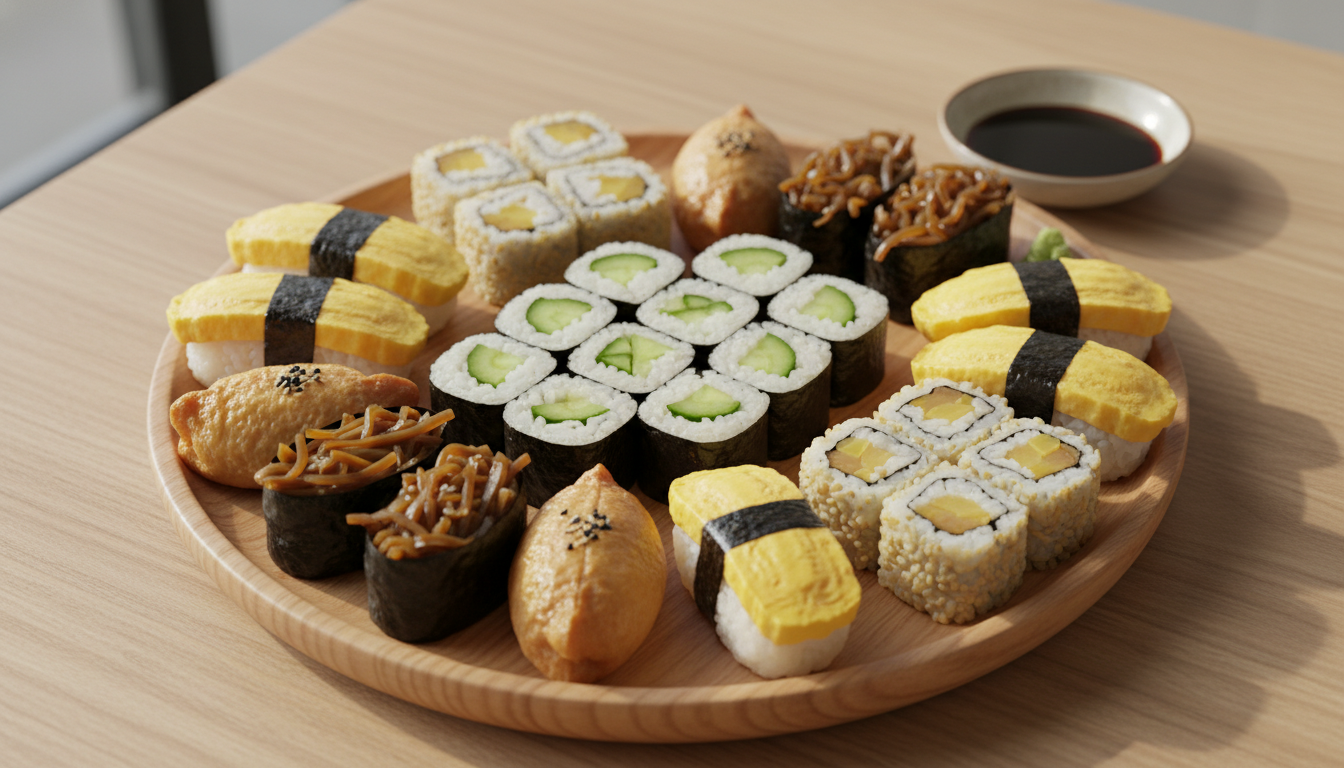
Various sushi options

Sushi in Tokyo is not a single experience. It’s at least four, and they coexist as legitimate parts of how the city eats. The travelers who come away most satisfied tend to be the ones who pick the right type for the day they’re having — a conveyor-belt lunch on a sightseeing day, a standing-sushi dinner after work, an omakase counter on the night they want to remember.

If you’re new to Tokyo and unsure where to start, conveyor-belt sushi is the lowest-friction entry point. If you have a reservation skill set and a budget for a memorable evening, an omakase counter is a different world. The two aren’t competing. They’re just answering different questions.

Related Reading

  • Tokyo Restaurant Reservation Guide — How to book sit-down restaurants in Tokyo as a foreign visitor, including the apps mentioned for Type 1 and Type 2 sushi.
  • Tokyo Airbnb Starter Guide — The hub guide for planning your stay around food, transit, and neighborhoods.
  • Japanese Konbini Guide — How convenience-store food (including their sushi) fits into a travel day.


Comments

Copied title and URL